
What was Paul’s “thorn in the flesh”?

Q.  What was Paul’s “thorn in the flesh“?  I’ve heard some people say it was a disease he couldn’t recover from.  But I’ve heard other people say this isn’t right because Paul had the gift of healing and could have healed any sickness he had, so we need to take him literally when he calls it “a messenger of Satan, to torment me.”  In other words, these people say it was a demon that was harassing him that he couldn’t make go away.  Which is right?

I think the first understanding, that Paul’s “thorn in the flesh” was a disease he couldn’t recover from, is more likely the correct one.

We know that Paul suffered from a disease at some point in his ministry because he wrote to the Galatians, “It was because of an illness that I first preached the gospel to you.”  (“Illness” here is astheneia in Greek, literally “weakness.”) This was most likely some disease of the eyes, because Paul goes on to say, recalling the Galatians’ love and concern for him at this time, “If you could have done so, you would have torn out your eyes and given them to me.”

There’s a further suggestion that Paul had eye trouble at the end of Galatians. Paul authenticates the letter, which he has been dictating to a scribe, by adding some things in his own handwriting, and he begins by saying, “See what large letters I use as I write to you with my own hand,” as if he had difficulty seeing.

Some have actually speculated that Paul suffered from chronic bacterial conjunctivitis, a recurring infection of the lining of the eye (a common ailment in the time when he lived) that would have made it difficult for him to see. It would also have affected his appearance, making his eyes red and causing them to discharge fluid or mucus.  Perhaps this is why Paul also told the Galatians, as he recalled their earlier care, “Even though my illness was a trial to you, you did not treat me with contempt or scorn.”  There was something embarrassing about Paul’s condition that the Galatians overlooked in love.

All of this background helps make sense of what Paul says about his “thorn in the flesh” as he defends his credentials to the Corinthians, at the demand of the self-styled “super-apostles” who had infiltrated the church there.  Paul describes some amazing visions he had, but then explains he was given a “thorn in the flesh” to “keep me from becoming conceited” because of these “surpassingly great revelations.”  An unsightly disease of the eyes would be an ironically appropriate means of keeping a person from boasting about visions they’d had.

After explaining that he’d asked the Lord to take this “thorn” away from him, but that God had told him in response, “My grace is sufficient for you, for my power is made perfect in weakness,” Paul says, “Therefore I will boast all the more gladly about my weaknesses, so that Christ’s power may rest upon me.”  “Weakness” here is astheneia, the same word Paul used to describe his “illness” to the Galatians.

Paul also notes, earlier in this section, that the super-apostles were saying about him, “In person he is unimpressive,” literally “the appearance of his body is weak” (asthenos).  Such language about “weakness” seems more appropriate for describing the effects of a disease like chronic conjunctivitis than the frustrations of persistent spiritual harassment.

Even though Paul had the gift of healing, this didn’t mean that God always chose to heal everyone through him.  For example, Paul tells Timothy at the end of his second letter, “I left Trophimus sick in Miletus.”  The fact that Paul had to leave this valuable co-worker behind shows that he couldn’t heal everybody, and that would include himself.

And so when Paul describes his illness as a “messenger of Satan,” he most likely uses this language not because his “thorn in the flesh” was a harassing demon, but to indicate that God is not the creator or source of sickness and disease. These things are instead the result of sin and evil in the world.

We’re promised that when God renews the heavens and the earth, there will be no more sickness or pain.  But in the meantime, Paul’s experience with his “thorn in the flesh” shows us that God can redeem even these features of our fallen world to make our character more Christ-like and to lead us to rely more on the sufficiency of his grace.

(When I discuss Paul’s “thorn in the flesh” in my study guide to Paul’s Journey Letters, I ask, “Do you have a physical ‘weakness’ that you wish God would take away? If so, given what Paul writes here, could this weakness actually be protecting you from something and permitting God’s power to be seen more clearly in you?”  What would you say in response to that question?)
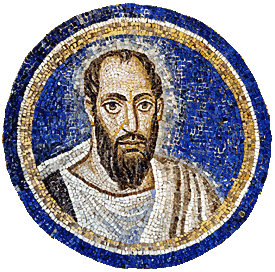
The apostle Paul, 5th-Century Ceiling mosaic, Archepiscopal Chapel of St. Andrew, Ravenna, Italy. (Do the large eyes reflect some ancient tradition about Paul’s appearance?)

Didn’t Jesus and the apostles quote verses to support their teachings?

People ask this question from time to time when they hear about The Books of the Bible, because it presents the biblical books as whole literary works, without any chapters and verses.  The questioners wonder how anyone would be able to quote verses if all Bibles were like this, and since quoting verses seems to be something Jesus and the apostles did, they think it should be possible for everyone to keep doing it.

A friend of mine blogged about this very question a while back and I’d like to share how I responded to his post at the time.  John Dunham, a member of the Bible Design Group that created The Books of the Bible, explained on his blog Quibbling how an article by W. Sibley Towner helped him become much more comfortable with the “versejacking” that the New Testament authors appear to engage in.

We can define versejacking as taking statements from the Scriptures and applying them to contexts that are different from (and, in the worst cases, contrary to) the contexts to which they originally applied.  In other words, it’s the practice of non-contextual or counter-contextual application of isolated biblical statements.

The fact that the New Testament writers appear to do this in many instances has long been troubling to interpreters.  Until recently the only recourse was to draw a contrast between so-called “inspired subjectivity” and “hermeneutical objectivity,” in the words of an essay by John Walton that’s cited in the Quibbling post.  In other words, the biblical writers can get away with this because they’re inspired, but don’t you try this at home.  You need to be objective and carefully contextual.

More recently, however, there’s been a realization that the New Testament writers are themselves being objective and contextual.  They’re actually making valid applications of statements originally spoken at one point in redemptive history to corresponding points later in that history as it unfolds.  For example, things that are originally spoken of Israel can be applied to Jesus as he embodies the people or work of God on earth.  What is spoken of Israel can also be applied validly to the community of Jesus’ followers as the new people of God.

This typological principle accounts for what happens in places like the ones at the beginning of Matthew where the gospel writer describes Scriptures such as “out of Egypt have I called my son” as having been “fulfilled” in the life of Jesus.  This statement was originally a historical description by Hosea of the exodus, not a prophecy about the future career of the Messiah.  So this does seem to be a case of versejacking.

“The Flight Into Egypt,” Bartolome Esteban Murillo. Is this what Hosea meant by “out of Egypt I called my son”?

However, “fulfilled” in cases like this doesn’t mean that a future foretold has come to pass.  Rather, it means that a statement spoken earlier in redemptive history has taken on a fuller and deeper meaning in the light of later redemptive-historical events.  Jesus embodies the new Israel and his flight to Egypt and return from there is like a second exodus.

This promising new understanding is articulated in Towner’s article and in other articles such as Greg Beale’s “Did Jesus and His Followers Preach the Right Doctrine From the Wrong Texts?” and Peter Enns’ book Inspiration and Incarnation: Evangelicals and the Problem of the Old Testament.  (Dr. Beale later updated his article to interact with Dr. Enns’ book.)

While appreciating, and carefully emulating, apostolic typological hermeneutics may feel like condoning “versejacking,” it’s actually very consistent with the overall vision that inspired The Books of the Bible.  We wanted to format the Bible in such a way that people could appreciate its grand sweep and see how the overall story unfolded.  With such an appreciation, which the apostolic writers had themselves, valid typological applications can be made.  In fact, one unexpected benefit of The Books of the Bible may be to equip people to make applications that are closer to the New Testament ones in their actual essence, even as it steers people away from non-contextual, non-typological applications that only appear coincidentally to be like the New Testament ones on the surface.

None of this supports or condones a very different kind of versejacking, which begins with the premise that there’s such a thing as a “Bible verse.”  This other kind of versejacking sees the Bible as a collection of some 11,000 discrete propositions that are jumbled together and need to be sorted and connected topically.

The very premise that there is such a thing as a Bible verse, and that our goal as readers is to get as much as possible out of a single verses at a time, is contrary to the true character of Scripture.  Hopefully taking the verses out of the Bible will enable people to recognize what the Bible really is, a collection of complete literary works, and help them begin to approach it on its own terms.

But I’m afraid that habits built on “Bible verses” are deeply ingrained and may need some time to change.  That being the case, I would suggest that we keep using the term “versejacking” to describe the approach that takes up “verses” in isolation. We should use some other term to describe what the apostles are doing when they understand Jesus and the community of his followers as the continuation of the story that begins with Israel and they use the language of the earlier part of the story to tell its later parts.

Enns calls this “christotelic interpretation,” in which Christ is understood as the goal (telos) of the story.  Other terms would be Christological or typological interpretation.  I’d go with any of those.  And, as I said, The Books of the Bible might just promote the wider use of this approach in our day.

Corrections to Daniel-Revelation guide


Though you are probably already aware of it, I just wanted to let you know that there seem to be two typos in the guide to Daniel and Revelation, on pages 36 and 47. On page 36 in the second paragraph the second sentence says “in some cases it can so destructive.” On page 47 in the chart on the ancient empires under “Little Horn” it says “Seleucid emperor… 175-64 BC.” Then on page 49 it says that he ruled from 175-164 BC. Just making you aware in case you weren’t, but otherwise this was an excellent guide.

Thanks very much for catching these typos.  P. 36 should read, “In come cases it can be so destructive . . .”  And the correct dates for the Seleucid emperor Antiochus IV Epiphanes are 175-164 BC.  I have contacted the publisher and these changes will be made in the next printing.

I’m glad you enjoyed the guide.  If you have any questions about its content, or about anything in any of the other guides, please feel free to post them to this blog and I’ll try to answer them.  Thank you.

How can I get a copy of your Matthew article affordably?

Q. I just started reading your blog and your books. I would like to get an article you wrote for New Testament Studies, “Literary Evidences of a Fivefold Structure in the Gospel of Matthew.” At their web site they wanted $30.00 to buy your article. That seems a bit steep for a single article. Is there any way I can get it for a more reasonable price?

Thank you very much for your interest.  Cambridge University Press, the publisher of New Testament Studies, holds the copyright to the article, so unfortunately I can’t post its content online myself.  I do need to honor their rights and help make sure they get their royalties so they can continue publishing the journal.  But even so, I think you could get the article more cheaply than by buying a single copy online.

For one thing, if you live near a university or especially a seminary, they might have an institutional subscription to the journal that would allow their patrons to read the article.  Many such schools offer courtesy borrowing privileges to those living in their area.  So this is one avenue you could pursue.

Another possibility would be to ask your local library to try to get you a copy by Inter-Library Loan.  Consortia of libraries pay fees to consortia of journals to make this kind of thing possible.  I’ve often gotten journal articles this way myself, usually free, although occasionally for a slight fee, which has always been significantly less than $30.

Finally, since ideas are not copyrighted, only specific expressions of them, let me summarize here the main ideas in the article:

The first page of Matthew in the Lindisfarne Gospels.

• The first literary evidence of a five-fold structure in the gospel of Matthew is the way the author has marked off five discourses with the formula “after Jesus had finished saying these things” at the end, and with references to Jesus gathering his disciples together for teaching at the beginning.  These discourses are the Sermon on the Mount, the commissioning of the disciples, the collection of parables, the teaching about community life, and the Olivet Discourse (about the “sign of his coming and the end of the age”).

• The next evidence is that each of these discourses expounds on a theme that the episodes in the preceding narrative have introduced. These themes are, sequentially, the foundations, mission, mystery, family, and destiny of the kingdom of God. So the gospel as a whole consists of five thematically coordinated narrative-discourse pairs. (These are preceded by the genealogy of Jesus and followed by the narrative of his death and resurrection.)

• The final evidence is the way transitional episodes between these five major sections reprise the theme of the preceding section and introduce the theme of the new one.  The account of the healing of the leper at the start of the second section, for example, reprises the theme of the first section that has just ended–that the foundations of the kingdom are in an inward “righteousness” that fulfill the deepest intentions of the law (Jesus tells the leper to show himself to the priest and offer the gift that Moses commanded).  But this episode also introduces the “mission” theme of the second section, since at the start of the discourse in this section, Jesus sends the disciples out to “heal the sick, raise the dead, cleanse those who have leprosy, drive out demons”–Jesus himself has just done most of these things in the narrative portion of the section.

I hope this information is helpful, and that you are able to find an affordable copy of the article.  Thanks again for your interest!

Why didn’t Jesus explain his parables to everyone?

Q. I have a question about something I read today in my quiet time in the gospel of Mark. Why didn’t Jesus explain all of his parables to everyone who was listening?  Instead, it says he explained them to his disciples later, but for the public, everything was in parables. Is it because he knew the crowds were just “fans” who thought the things he said were interesting but not important? Jesus even says,”otherwise they might turn and be forgiven.” That sounds strange to me. Doesn’t he want each and every person on earth to believe, even though he knows there are many who won’t believe?

Vincent van Gogh, “The Sower,” 1888

Jesus says the things you’re wondering about when he’s explaining the Parable of the Sower to his close followers.  As I observe in my Mark study guide, it may appear that he doesn’t want “those on the outside” to understand, since he says that when they listen, they will be “ever seeing but never perceiving” and “ever hearing but never understanding.”  However, Jesus is actually quoting these phrases from the book of Isaiah.  That was how God described what the response of the hard-hearted Israelites would be when he sent Isaiah to speak to them.  These words explain what happens to someone whose heart is hardened, as represented by the first kind of soil in the parable.

(I discuss the passage in Isaiah in this post, in response to a question about whether God actually hardens people’s hearts so they won’t believe.  As I say there, “God really wants people to respond positively to his warnings and invitations and so be rescued. But the language here reflects God’s knowledge of the people’s confidence in their own strategies and his realization that they will choose their own way even more stubbornly when they’re challenged. And so God tells Isaiah, ironically, to go and make the people even more insensible and resistant. Whatever their response, the reality of the situation needs to be proclaimed.”)

Back here in Mark, it’s clear from the Parable of the Sower that other kinds of responses are possible, since the parable eventually describes the seed finding good soil and bearing much fruit, representing those who not only believe, but help others to believe.

It’s even clearer from the next parable that Jesus wants everyone to understand.  He uses a lamp to illustrate that he’s not deliberately concealing the truth about himself; he wants this to be “brought out into the open,” and ultimately it will be.

And so he invites everyone in the crowd, right after telling the Parable of the Sower, “Whoever has ears to hear, let them hear.”  Jesus wants people to hear and understand–if they want to themselves.  In other words, as has often been observed, parables were the perfect vehicle for Jesus’ purposes because they either reveal or conceal the message, depending on the state of a person’s heart.  They reveal the truth to those who are open to it, but conceal it from those who aren’t ready for it yet.

That’s why, after telling the parable about the lamp, Jesus also warns his listeners–most likely the entire crowd once again–“Consider carefully what you hear.”  If people don’t understand, it’s not because God doesn’t want them to understand, it’s because of how they’re listening.  They might be just “fans,” as you put it, listening carelessly to what Jesus says as some kind of novelty or diversion.

I think you actually model the kind of response Jesus is looking for.  You’re not just reading his words in your daily quiet time as some kind of religious duty.  You’re thinking carefully about them, and if something bothers you, you don’t just gloss over it, you try to find out what it means.

Keep doing this!  That’s what it looks like to be someone who truly has “ears to hear.”

Are Jeremiah’s oracles rearranged in The Books of the Bible?

Michaelangelo’s Sistine Chapel portrait of Jeremiah

Q. For The Books of the Bible, did you just reorder the biblical books? You didn’t, say, put the oracles within Jeremiah in chronological order? I was just reading Jeremiah in my other Bible and it’s so dang confusing going back and forth between kings and what not. I was wishing the oracles were more orderly.

The creation of The Books of the Bible did not involve any internal rearrangement of biblical books.  That was something that our project team agreed early on with the NIV translation committee to leave off the table.

However, the question of internal order within Jeremiah specifically has come up on several occasions over the course of our work.  This is because, as the “Invitation to Jeremiah” in The Books of the Bible explains, it appears that a large section of that book has been dislocated.

Jeremiah has four major parts:
1. Mostly poetic oracles, undated, likely not in chronological order.
2. Mostly narratives, dated, but not in chronological order.
3. Mostly narratives, dated, in chronological order.
4. Poetic oracles against the surrounding nations.

The introduction to Part 4, however, is found right after Part 1, suggesting that the oracles against the nations were originally placed before Part 2.  This is where they are found in the Septuagint, an early Greek translation of the First Testament.

It would certainly make sense to put these oracles against the nations back in their original location, right after the introduction to them, or at least to read them after that introduction.  Accordingly, in the reading plan for the Prophets module of the Community Bible Experiences, Biblica explains how Part 4 of Jeremiah appears to be out of order, so that people can choose to read it after Part 1 if they wish.

As for the lack of chronological order within Parts 1 and 2 themselves, this is due to Hebrew scribes’ preference for “chiasms,” intricate arrangements in which passages that feature certain themes or key words are paired opposite one another.

For example, as the “Invitation to Jeremiah” also explains, at one point in the book a prayer of Jeremiah’s is surrounded by two episodes that feature potters.  The very next prayer is surrounded by episodes that feature two  men named Pashhur.  And these two clusters of episodes are then surrounded by matching episodes relating to the city gates.

Similar chiastic arrangements are found in other prophetic books.  As I explain in my Isaiah study guide, for example, many of the arrangements there are “a bit like the kind of trophy case you’d find in the front hallway of a school. The trophies, awards, and plaques in such cases usually aren’t arranged in historical order, from left to right. Instead, the tallest trophy will likely be in the middle, with shorter trophies on each side, and even shorter ones towards the edges of the case—regardless of when they were won. Photos and plaques will be hung on the back wall where there is space and visibility, but not necessarily right behind trophies from the same era. The overall goal is to create a pleasing and appealing visual arrangement. In the same way, the poems, stories, and songs in the book of Isaiah are arranged not historically but artistically, to blend together into an overall message prophetic responses to significant challenges that the people of God faced at different times.”

The same can be said about the arrangements in the non-chronological portions of Jeremiah.

I hope this helps you navigate through that book a bit more easily!