
Does the Bible clearly forbid a man to have more than one wife?

Q. I just want to know where it is categorically written in the Bible that men should not marry more than one wife because the way things are going with the Christian ladies is terrible for us.

I believe you’re saying that there aren’t enough godly Christian men out there to provide husbands for all of the Christian women who desire to be married, and so it would help if men (specifically, godly Christian men) could marry more than one woman. Before I offer any reflections about that from the Bible itself, let me say first that I am very sympathetic to your concern. In response, I’d like to challenge all the men who read this who might be hovering around the edges of the faith to step up and commit to following Christ and becoming godly so that they could be a suitable husband, if that turns out to be God’s will for them, to one of the many wonderful Christian women who have this desire. And I wish the comfort and companionship of God for those women as they wait for their longing to be fulfilled. I do appreciate how difficult that can be.

It is important, however, to seek to understand God’s ideals for human life as they are disclosed in the Bible, and not come to conclusions based on the needs and constraints of our present situations. And so, to pursue the biblical teaching on the subject you’re asking about, let me say that I believe it is actually not embodied in a categorical statement. That is, I’m not aware of any biblical commandment along the lines of, “Thou shalt not marry more than one wife.” Rather, the clearest teaching on the subject is found by analogy to an answer that Jesus gave to a different question about marriage.

According to the gospel of Matthew, some Pharisees came to Jesus and asked him whether men could divorce their wives for any reason they wished. Jesus answered, quoting from Genesis, “Haven’t you read that at the beginning the Creator ‘made them male and female’ and said, ‘For this reason a man will leave his father and mother and be united to his wife, and the two will become one flesh’? So they are no longer two, but one flesh. Therefore what God has joined together, let no one separate.”

The Pharisees responded, “Then why did Moses command that a man give his wife a certificate of divorce and send her away?” They were referring to a law in Deuteronomy that actually says that if a man divorces his wife and gives her a certificate of divorce, he can’t take her back again if she marries someone else and that second husband subsequently divorces her as well. So it isn’t actually the case that Moses commanded men to give their wives certificates so they could divorce them. Nevertheless, the Law of Moses does regulate the situation of divorce (the certificate would have proved that the woman was legally free to remarry, which was important for her protection and provision), and thus the Law tacitly recognizes that situation.

Jesus explained this distinction in his reply to the Pharisees. “Moses permitted you to divorce your wives”—he didn’t command this—”because your hearts were hard. But it was not that way from the beginning.” Jesus added that therefore if a man divorced his wife for a reason other than marital unfaithfulness and then married another woman, he would be committing adultery.

I think there is a clear analogy here to the issue you’re asking about. Suppose the Pharisees had instead asked Jesus whether a man could marry more than one wife. He would likely have answered the same way at first, by quoting from the Genesis creation account. And the Pharisees would likely have responded in the same way, by appealing to the law of Moses, which regulates various situations that might arise from a man having more than one wife and so tacitly recognizes that situation as well.

For example, a law in Exodus says that if a man marries one of his female slaves (so that she becomes his concubine, both his slave and his wife) and he then marries another woman, “He must not deprive the first one of her food, clothing, and marital rights. If he does not provide her with these three things, she is to go free, without any payment of money.” And another law in Deuteronomy says that if a man has two wives and the less-preferred wife bears his firstborn son, he can’t deny that son the double share of his inheritance that’s the “right of the firstborn” and give it instead to a son of the more-preferred wife.

But even though the Law of Moses regulates and thus recognizes the situation of a man having more than one wife, I believe that Jesus would have said the same thing about this situation that he did about divorce: “It was not that way from the beginning.” So while we must acknowledge that the practice of men marrying more than one wife has been followed in many different times and places (indeed, Old Testament figures such as Abraham, Jacob, and David followed it themselves), and that this practice in fact continues in some places today, if we are looking for God’s ideal for human life as disclosed in the Bible, we find it embodied in the answer that Jesus gave to the question he was asked about divorce: As it was at the beginning, “A man will leave his father and mother and be united to his wife, and the two will become one flesh.” Just the two of them.

Once again, let me say that I am very sympathetic to the concern that leads you to ask about this. But I would encourage you to resolve to pursue God’s ideal, and nothing else, in this area and in all others, so that no matter what happens, whether a desire to be married is ultimately fulfilled or not, you will be drawing closer and closer to God over the course of your whole life.
Were Jacob’s descendants not supposed to stay in Egypt?

Q. As a nation, did Israel sin against God by remaining in Egypt for 400 years and not returning to the promised land? I mean, 400 years is a long time! Maybe they got way too comfortable. I realize He spoke to Abraham about this and we all know about God’s deliverance etc., but perhaps God punished Israel with Egyptian slavery for her failure to return? Also, we know that Abraham sojourned in Egypt but he didn’t stay. What do you think?

As I read the biblical accounts of ancient Israel’s time in Egypt (found in the books of Genesis and Exodus), I see first that Joseph, who brought his father Jacob and his whole extended family down to Egypt, told his brothers when he was dying, “God will surely come to you and bring you up out of this land to the land that he swore to Abraham, to Isaac, and to Jacob.” In other words, the Israelites were supposed to wait for God to come and give them just as clear an indication that they were meant to leave as they had gotten to come in the first place. So it wasn’t a sin for them to stay.

I see next that at the start of the following generation, “A new king arose over Egypt, who did not know Joseph.” This king was so concerned that the Israelites, who were already becoming a large community, might side with their enemies that he persuaded his people and officials to enslave them. So the Israelites didn’t have an opportunity to return to the land of Canaan but  were too complacent to take advantage of it. Instead, they never got such an opportunity, because Joseph said when he was dying that they should wait, and the next thing that happened was that they were enslaved and trapped.

We should also note that in Exodus, God never says that He has punished the Israelites with slavery because they have complacently ignored their responsibility to return to the promised land. Instead, God says that He will punish the Egyptians for enslaving them and exploiting their labor. You mentioned that God had spoken to Abraham about the future enslavement of his descendants; God specifically told him, “For four hundred years your descendants will be strangers in a country not their own and they will be enslaved and mistreated there. But I will punish the nation they serve as slaves, and afterward they will come out with great possessions” (that is, as compensation for their unpaid labor).

It’s still an important biblical warning for us not to be complacent but instead to remain aware of what God expects of us and to seek eagerly to fulfill God’s purposes for our lives. Paul wrote to the Ephesians, for example, “Be very careful, then, how you live—not as unwise but as wise, making the most of every opportunity, because the days are evil. Therefore do not be foolish, but understand what the Lord’s will is.” However, the time that the ancient Israelites spent in Egypt doesn’t seem to be a case study of the kind of complacency we need to be careful to avoid.

Why God didn’t create Eve at the same time as Adam?

Q. Why God didn’t create Eve along with Adam?

In the ancient world, animals were the original “high-tech devices” that enhanced and expanded human capabilities. The Bible actually speaks about this in many places:

Where there are no oxen, the manger is empty, but from the strength of an ox come abundant harvests.” In other words, keeping an ox to plow the fields is well worth it because of the far greater harvests this makes possible.

If you have raced with men on foot and they have worn you out, how can you compete with horses?” Even though this is spoken to Jeremiah as a metaphor, it’s drawn from the ancient experience of relying on horses for much greater than human speed in communication and warfare.

Be sure you know the condition of your flocks, give careful attention to your herds … the lambs will provide you with clothing, and the goats with the price of a field. You will have plenty of goats’ milk to feed your family and to nourish your female servants.” Here again the benefits of relying on animals, in this case for food, clothing, and wealth, are highlighted.

Because animals expanded human capabilities so greatly, in the ancient world they were even worshiped as manifestations of divine power. The bull, for example, became a symbol of Baal, a fertility god.

But to speak to your question directly, and to address it from within the story of Adam and Eve in Genesis, I think God first brought all of the different animals to Adam “to see what he would name them“—which implies that he would recognize their various qualities—so that it would become apparent that despite all the advantages the animals could confer, nevertheless “no suitable helper was found” for him. Adam was supposed to say, “I still need something more.” And then, when Eve was presented to him, he would exclaim,

“This is now bone of my bones
    and flesh of my flesh;
she shall be called ‘woman (‘ishshah),’
    for she was taken out of man (‘ish).”

In other words, “At last, someone like me, who’s just right for me!” Significantly, Adam gives himself a new name, ‘ish, when he recognizes the woman as ‘ishshah. He understands himself in a new way by understanding what kind of creature is his complement.

So because animals were so highly valued in the ancient world for the way they could expand human capabilities, I think it was strategic for God to show Adam all they could contribute and still have him conclude, “I need something more.” This would enable Adam to recognize the cooperation and interdependence by which he and Eve would most effectively fulfill their responsibilities as God’s representatives within creation and build a joyful and fruitful life together.

Are our lives determined by God from the time we are born?

Q. Do you think our lives were determined by God the day we were born? Is it a fixed destiny regardless of the twists and turns? Or is changes from time to time?

I think the discussion in this earlier post will largely address your concern:

Does the “sovereignty of God” mean that God is responsible for everything that happens?

That post responds to a question asked from the perspective of God, rather than from the perspective of human experience, as your question is but the answer is really the same either way. As I say in that post, God is not the only free moral agent in existence, but God is able to work through the free choices, both good and bad, of human moral agents to accomplish His purposes.

So I would say that our lives are not determined the day we are born; God has built a beautiful but terrible freedom into the moral universe that allows us to make choices by which we might bring joy and blessing to ourselves and to others, or by which we might cause great suffering. But God hasn’t left us alone to make those choices and to deal with their consequences; rather, God is an active free moral agent right in the mix, and with His infinite wisdom and power, He is constantly at work to help us make our choices work out, if we will live in fellowship with Him and depend on Him. So we should pray for wisdom and strive to develop godly character, so that we can cooperate with God in his plans for the created universe.

As I say at the end of that post, I picture God out there saying, “Let’s see what happens next. I’m sure I can do something with it.” We should respond, “Please do, and let me know how I can help!”

Why haven’t I received a spiritual gift like tongues or prophecy?

Q. I have been a believer for some time, and to the best of my ability I love our Lord with all of my heart, soul, and mind. I have prayed for years that the Holy Spirit would manifest in me and I would receive the gift of speaking in tongues, prophecy, or some other sign, but to date nothing like that has happened. Should I interpret this to mean that for some reason God hasn’t found favor with me, or that the Holy Spirit isn’t living in me? Or even, heaven forbid, that I am not saved? I desire to know God to the fullest, and I desire the deepest relationship with him possible.

Actually, I’m certain that you already have received a spiritual gift that evidences God’s favor upon you, the Holy Spirit’s presence in your life, and your salvation. This gift probably just isn’t manifesting itself in a public, declaratory way like prophecy or tongues (which, as I explain in this post, is the gift of speaking a language one has not formally acquired).

The reason I’m certain about this is that Scripture tells us clearly that “to each one the manifestation of the Spirit is given for the common good.” Or, as another translation puts it, “A spiritual gift is given to each of us so we can help each other.” In other words, every single believer in Jesus is given a spiritual gift that they can use to build up the community of his followers. But because the needs are so great and varied, and because people have such diverse personalities, interests, concerns, and passions, the Holy Spirit distributes a wide range of gifts throughout the community, and these gifts don’t all look alike.

The statement I just quoted is from Paul’s first letter to the Corinthians. When he first says this, he illustrates it by listing several high-profile gifts such as you’re asking about—prophecy, tongues, miracles, healing, discernment of spirits, words of wisdom and knowledge, etc. These are most likely the kinds of gifts that the Corinthians valued and wanted to have. But Paul then proceeds to explain how the whole point of the gifts is to build up the body, and that a wide range of gifts is needed for this, so everyone shouldn’t want just this one kind of gift; they should seek to discover and welcome whatever gift God actually has given them.

In fact, as Paul concludes this discussion, he offers another list of gifts, and while it includes some of the ones he named earlier, such as prophecy, miracles, and healing, he now also mentions things like teaching, helping, and administration. In Romans, after explaining similarly that “we have different gifts, according to the grace given to each of us,” Paul mentions further gifts such as serving, encouraging, giving, and showing mercy. These are quiet, background gifts, but they are just as essential to bringing blessing throughout the community of Jesus’ followers and to people who are not yet part of that community.

Indeed, I once heard someone say, perfectly seriously, that the person with the gift of prophecy stands up and says, “Thus says the Lord, I have set before you an open door that will lead to a great expansion of this ministry,” and the person with the gift of administration responds, “In that case, we’d better buy another filing cabinet”—and both are just as spiritual.

So I would encourage you to consider in what ways God has already been using you to bless and help others, and to recognize what gifts God must have given you to make this possible. As you consider this, one gift may stand out, or you may discern a cluster of related gifts. In any event, I hope you will recognize that this indeed means that you are saved, the Holy Spirit is living in you, and God has shown you his favor. These are all good things, and I commend you for desiring to be reassured about them, in the context of knowing God to the fullest and having the deepest possible relationship with him, by identifying a spiritual gift you have received.

But beyond this, please recognize that the essential purpose of God giving us spiritual gifts is “for the common good” or “so we can help each other.” So with your new assurance of God’s love and favor, and your new recognition of the gifts God has given you, put those gifts to use to build up the body of Christ and spread the good news about Jesus. As another version translates Paul’s words in Romans, “Having gifts that differ according to the grace given to us, let us use them.”

Do Christians who die await the return of Christ before going to heaven?

Q. What happens to Christians when we die? Do we wait for the return of Christ before we are taken to heaven? This scripture is what prompted me to ask the question: “The Lord himself will come down from heaven, with a loud command, with the voice of the archangel and with the trumpet call of God, and the dead in Christ will rise first. After that, we who are still alive and are left will be caught up together with them in the clouds to meet the Lord in the air. And so we will be with the Lord forever.”

Also, is it by default that as Christians we would be spared from hell if we believe in our God and that Jesus died for our sins and we pray for forgiveness and forgive the others? Or would we be vetted further?

In answer to your first question, I’d invite you to read the following post, which I wrote in response to a different but similar question and which I believe will address your concern:

Do the souls of believers “sleep” after death until the resurrection?

In that post I say that “all things considered, my overall sense from the Bible is that the soul of a believer does pass directly and consciously into the presence of God upon death.” However, I acknowledge that this is “a question on which people of good will who are equally committed to the authority and inspiration of the Scriptures have long disagreed. So we each need to be ‘fully convinced in our own minds’ but respectful of the other position.”

In answer to your second question, there’s another post on this blog that I can recommend. It, too, was written in response to a different but similar question, and I think it will speak to your own question:

Are we saved simply by believing, or are there works we need to demonstrate?

In that post I conclude that “if we claim to have been saved by trusting and believing in what Jesus did for us, we should reasonably expect that salvation to manifest itself in ‘works,’ not things we do to earn or secure our salvation, but things that flow naturally from it.” We will not necessarily be “vetted” by such things, but they do give us the opportunity to “vet” ourselves and confirm that the fruits of salvation are appearing in our lives.

I share some similar thoughts in this further post:

Don’t our works actually matter to God?

There I observe: “I think the simplest way to summarize the New Testament position on this subject is to explain that while it doesn’t teach we are saved by works, it does teach we are saved for works. That is, God has saved us so that we will be able to live in the way He has designed.” Once again, seeing these results in our lives can give us greater assurance of salvation, which is what I believe you are asking about.

I hope these leads are helpful to you.

How can we “esteem others” who aren’t living as they should?

Q. Paul writes in Philippians, “Let each esteem others better than themselves.” My question is, how can a born-again Christian esteem other members of the church when the majority seem to live like non-believers? They attend church on a regular basis, attend Bible class, and sing in the choir, but you know for a fact they are living like non-believers. Smoking, drinking, partying, going to clubs, gambling, using foul language, etc. If they are not doing these things, they still don’t seem to be living a Christian lifestyle. They never talk about the Lord, read their Bibles, witness to anyone, etc. They are just good church attenders. How can one esteem these people better than themselves?

God sees us not as we are now, but as the best we can be. And God relates to us that way as well—never giving up on us, always believing in us, forgiving us and giving us second chances.

I think Paul’s admonition in Philippians is an invitation for us to relate to our fellow Christians in this same way. Certainly if we saw others through God’s eyes, as the best they could be, and if we believed in them as God believes in them, we would have no trouble esteeming them as better than ourselves, recognizing the many ways in which we personally fall short.

Often Christians who are struggling just need a fellow Christian to come alongside them, encourage them, and believe in them. This is difficult for us to do when we regard others with human eyes, but if we ask God to give us a glimpse of them as He sees them, as their Creator, we will have a whole new perspective.

It’s great that you’re taking this admonition to heart and asking how you can live it out. I suggest that you start maybe with one person in your church and ask God to help you see them as He sees them. I believe this will have a revolutionary effect not only on your attitude and perspective towards that person, but on the influence you will have in their life. You’ll likely want to pray this for more and more people in your church as you see what God does in you and through you.

What does the Bible say about cleansing your chakras?

Q. What does the Bible say about cleansing your chakras or anything similar to that practice, if anything?

I’ll have to admit that I wasn’t really familiar with the practice of cleansing the “chakras.” I did an Internet search to find out more about it, and they are apparently considered, in the Hindu tradition, to be centers of energy in the body. But I also found many other people asking the same question you’re asking, and I particularly liked an answer that was given on Quora.com to the question, “Do meditation and belief in Chakras conflict with Christianity?” Here was the response from someone named Gavin Hurlimann:

“The Bible is silent about chakras because they are part of the inner tradition of Indian religion. Meditation however, is 100% encouraged by the Bible—as long as you meditate on what is good, acceptable & pleasing to the perfect will of God. The great King David said in Psalms, ‘I will also meditate on all Your good work, and talk of Your good deeds.'”

I think that answer put it very well, so I hope it is helpful to you.


Who sent the Wise Men to find where Jesus was?

Q. Who sent the Wise Men to find where Jesus was?

It appears that no one actually “sent” the Wise Men to find Jesus. When they arrived in Herod’s court, they told him, “We saw his star when it rose and have come to worship him.” Apparently the Wise Men had some expectation of the Jewish Messiah or “king of the Jews,” and they were watching for signs of his birth. I discuss that further in this post:

Why would the Magi have wanted to worship the king of the Jews?

Was Jesus “deeply moved” or “furious” at the tomb of Lazarus?

Q. In Nancy Pearcey’s new book Love Thy Body, she states that though many English translations say that Jesus was “deeply moved and troubled” at the tomb of Lazarus, the original Greek actually means that he expressed “furious indignation.” Pearcey then quotes Os Guinness as saying that Jesus was outraged because “evil is not normal” and that the death of Lazarus was contrary to the good and beautiful world God had originally created. What are your thoughts on this?

I have not yet read Love Thy Body, and I also have not yet read The Dust of Death, which is the book by Os Guiness that she is quoting from, so nothing I say here should be taken as an informed comment on the overall argument of either of those books. I can, however, offer my thoughts about the translation of the Greek expression that’s used to describe Jesus’ reaction at the tomb of Lazarus.

First let me quote Pearcey more fully, relying on a citation I have found online: “Why did Jesus weep at the tomb of Lazarus even though he knew he was about to raise him from the dead? Because ‘the beautiful body was split apart.’ The text says twice that Jesus was ‘deeply moved in spirit and troubled’ (John 11:33, 38). In the original Greek, this phrase actually means furious indignation. It was used, for example, of war horses rearing up just before charging into battle. Os Guinness, formerly at L’Abri, explains that standing before the tomb of Lazarus, Jesus ‘is outraged. Why? Evil is not normal.’ The world was created good and beautiful, but now ‘he’d entered his Father’s world that had become ruined and broken. And his reaction? He was furious.’ Jesus wept at the pain and sorrow caused by the enemy invasion that had devastated his beautiful creation. Christians are never admonished to accept death as a natural part of creation.”

To assess these claims, let us explore the use of the Greek verb embrimáomai, which is the term that Pearcey says indicates “furious indignation.” It is true that it has a literal meaning of “snort”; it’s used in plays by Aeschylus and Lucian to describe the snorting of horses. However, we need to recognize that words have figurative as well as literal meanings. In linguistics it’s known as the “root fallacy” to hold that words carry their original, literal meanings with them everywhere they go. They don’t.

For example, this same verb is used in the two following accounts:

Two blind men call out to Jesus, “Have mercy on us, Son of David.” He touched their eyes and said, “According to your faith let it be done to you”; and their sight was restored. Jesus warned them sternly, “See that no one knows about this.” (Matthew 9:29–30)

A leper comes to Jesus and asks to be made clean. He reached out his hand and touched the man. … Immediately the leprosy left him and he was cleansed. Jesus sent him away at once with a strong warning: “See that you don’t tell this to anyone. (Mark 1:41–44)

Clearly the meaning in these two passages is not that Jesus was feeling furious indignation. Rather, he was “admonishing urgently,” which Lidell and Scott’s Greek-English Lexicon lists as another, figurative meaning of embrimáomai.

Another use of the verb in the gospels, however, does come closer to the meaning of anger:

A woman anoints Jesus with a jar of expensive perfume. Some of those present were saying indignantly to one another, “Why this waste of perfume? It could have been sold for more than a year’s wages and the money given to the poor.” And they rebuked her harshly. (Mark 14:4–5)

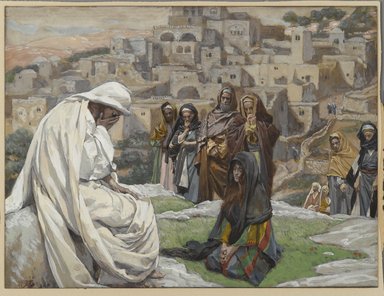
So we see that the term can have the meaning of anger and indignation, but that this has to be determined from the context. So what about the context at the tomb of Lazarus? Two things there indicate that Jesus probably was not “furious,” but “deeply moved” (as many English versions put it; Bauer’s Greek-English Lexicon of the New Testament lists this as a further meaning of the word). First, Jesus wept. And second, the text says that the strong emotion being reported was internal, “in his spirit.” One would expect “furious indignation” to have primarily an external expression instead.

So I think we need to conclude that embrimáomai is used figuratively in the gospels to indicate strong emotion, but that we need to determine from the context whether this is anger, urgency, or grief. One further observation is that even if Jesus actually was “furious” at the tomb of Lazarus (and the context suggests otherwise), the text itself would not be telling us why this was the case. Pearcey and Guiness would be supplying their own theological rationale for this, but many other explanations could also be offered. Nothing in the account intrinsically rules out death having a place in how God works in the world.

Personally I find that the following quotation, taken from a longer meditation that has been making the rounds recently on social media, captures very well what Jesus was actually doing at the tomb of Lazarus:

”He cried. He knew Lazarus was dead before he got the news, but still, he cried. He knew Lazarus would be alive again in moments, but still, he cried. … He wept because knowing the end of the story doesn’t mean you can’t cry at the sad parts.”

James Tissot, “Jesus Wept” (Brooklyn Museum)