Are Christians required to keep the Sabbath? (Part 3)

Q. Is it honoring to God for Christians who are Gentiles to keep the Sabbath? If so, how should they observe it? Or it is not required of them to observe the law in any shape or form? I had never observed the Sabbath or other laws on the understanding that as Christians, we weren’t required to do so. But a few years ago, when I was worn down from overwork, I prayed about the issue and I felt led to observe the Sabbath. (Not that I thought it would make me more righteous, or that I was trying to be.) But now that I have largely recovered from being worn down, I’d like to be able to do some of my academic research work on that day, or simple things like cooking, which I haven’t been doing. Would that be all right?

In my first post in response to this question, I described generally how the obligations of the Old Covenant, such as keeping the Sabbath, become opportunities under the New Covenant. In my next post, I talked about the reasons for the Sabbath: rest for weary bodies; worship of our Creator; and becoming part of God’s own work, which flows from His “rest.” In this post, I’d like to conclude this series by offering some suggestions for how you might keep the Sabbath practically.

The first important question is whether to keep the Sabbath as one particular day during the week or instead try to fulfill the purposes of the Sabbath on each day of the week. This will be a matter of individual guidance and conviction for each believer, but allow me to make a suggestion that may prove helpful. It seems to me that if your “work” is usually done at a particular place (for example, an office, a factory, or a shop), it’s prudent to make sure you get away from that place and get a good, solid break for at least one day every week. (Nothing wrong with a whole weekend, either.) But if your work can be done, and is done, in a variety of settings because it depends primarily on your inspiration, insights, and creativity (this would apply, for example, to writers, artists, researchers, composers, inventors, strategists, etc.), then you might repeatedly be frustrated if you tried to keep your work out of a specific day of the week. Chances are that the break you gave yourself from the usual routine would release your creative processes and you’d be flooded with ideas that you weren’t supposed to pursue that day! So think about what kind of work you do and whether it would lend itself best to “honoring one day as more sacred than others” or “honoring all days alike.”

A related question is the definition of “work.” Assuming that, for the most part, we are supposed to rest rather than work on the Sabbath, how can we know when we’re working and when we’re at rest? As I said in my second post, in general, anything that interferes with the purposes of the Sabbath should be recognized as “work,” while anything that promotes those purposes should be considered “rest.”

The Gospel of Luke reports how Jesus healed a woman who’d been disabled for eighteen years, unable to stand up straight. “He put his hands on her, and immediately she straightened up and praised God.” But the synagogue leader criticized him for doing this on the Sabbath. Jesus responded, “Should not this woman, a daughter of Abraham, whom Satan has kept bound for eighteen long years, be set free on the Sabbath day from what bound her?” This was one of the many times when Jesus offered an “argument from the lesser to the greater”: If it was appropriate for people to be granted rest from fatigue on the Sabbath, how much more appropriate was it for this woman to be granted freedom from her disability on the Sabbath! Or as Jesus put it on another occasion, recorded in the Gospel of Matthew, when he healed a man’s withered hand, “It is lawful to do good on the Sabbath.

Alexander Master, “Jesus Heals the Crippled Woman” (detail)

So, to use your specific example of cooking, if cooking is more for you than just getting meals on the table—if it’s a creative outlet and a source of joy and refreshment for you—then by all means, go ahead and cook, even on a day you might have set apart from “work.” It’s lawful to “do good” on that day. In the same way, if your research isn’t just a job, if it’s a way for you to use your talents to pursue something that you’re passionate about, then don’t feel that you have to shut it down for a whole day once a week—particularly not if some of your best insights occur to you on that day! But you’re on the honor system here. You’ll know in your own conscience whether you’re “pushing” to keep going when you should really be resting.

One other observation to make is that in the Old Testament, there wasn’t just a weekly Sabbath. There were also several week-long annual festivals that began and ended with days free from work. (And we can safely assume that in many cases, the entire festival was different from the usual work week; for example, during the Festival of Tabernacles, the Israelites lived in temporary shelters—kind of like going camping!) God also commanded the Israelites to give their farmland a sabbatical year every seven years. And beyond that, they were to observe a Year of Jubilee every fifty years, when all debts were cancelled and everyone returned to their ancestral property. This had the effect of freeing the rising generation from any bad financial legacy the older generation may have left, and at the same time it required each generation to make its own way in the world.

So let me leave you with this question and challenge: How will you observe the Sabbath over longer time periods? Will you make sure you get vacations every year and that they are genuine times of refreshment, restoration, and adventure? I trust that, as an academic, you’ve already had sabbatical experiences every several years that have permitted breakthroughs in your research and at the same time enabled you to step out of your regular life in a significant way so that you could return to it as a fresh person. And have you experienced a “Jubilee”? Around age 50, many people move from a traditionally defined position into a more creatively designed one that suits them personally and will allow them to use their gifts with maximum effectiveness for the rest of their careers. (This can happen within an institution they have been serving, or it may take them out of that institution into a consultancy, freelance, or similar role.)

There seems to be a biblical precedent for this type of move. God told Moses that Levites who were “twenty-five years old or more shall come to take part in the work at the tent of meeting, but at the age of fifty, they must retire from their regular service and work no longer. They may assist their brothers in performing their duties at the tent of meeting, but they themselves must not do the work.” So the more senior Levites became advisors and assistants who were not to keep doing the regular work themselves. Sounds to me as if they were then observing the Sabbath for the rest of their lives.

However, it may not not be practical or possible in many situations for our outward work to be transformed in this way. Nevertheless, we can all be transformed inwardly so that we are no longer restlessly striving for the rewards of work. Instead, may our work flow from who we are and who we are becoming, by the grace of God, so that we may truly “enter His rest” and, as God’s co-workers, cease from our labors as He ceased from His on that first Sabbath day.

Are Christians required to keep the Sabbath? (Part 2)

Q. Is it honoring to God for Christians who are Gentiles to keep the Sabbath? If so, how should they observe it? Or it is not required of them to observe the law in any shape or form? I had never observed the Sabbath or other laws on the understanding that as Christians, we weren’t required to do so. But a few years ago, when I was worn down from overwork, I prayed about the issue and I felt led to observe the Sabbath. (Not that I thought it would make me more righteous, or that I was trying to be.) But now that I have largely recovered from being worn down, I’d like to be able to do some of my academic research work on that day, or simple things like cooking, which I haven’t been doing. Would that be all right?

Based on what I wrote in response to your question in my last post, in which I explained how the obligations of the Old Covenant become opportunities under the New Covenant, you won’t be surprised to learn that I do encourage Christians to continue observing the Sabbath, as a spiritual discipline and as an opportunity to do good. So the answer to the first part of your question is yes, it is honoring to God when we keep the Sabbath in those ways. And this brings me to the second part of your question: How should we observe it?

The New Testament suggests that there are different ways a person can fulfill the purposes behind the Sabbath. One way is indeed to refrain from work on a given day of the week. The definition of “work” is very much up to the individual under the New Covenant; as with giving, it’s a matter of what you “determine in your heart.” But I’d say generally that any activity that interferes with the purposes of the Sabbath is likely “work” and should be left aside during Sabbath time. (I’ll say more shortly about what those purposes are.)

Some people choose to do no work on Saturday, the seventh day, the day God “rested” after creation and the day that was observed under the Old Covenant. Others choose Sunday, the first day, the day of Christ’s resurrection, symbolic of our entrance into new life. Both choices have good theological foundations and are time-honored practices in the community of Jesus’ followers.

However, in his letter to the Romans, Paul says that the Sabbath can also be kept as an everyday practice. When discussing two issues about which believers in his day had different convictions, Sabbath observance and eating meat that had been offered to idols, he wrote, “One person considers one day more sacred than another; another considers every day alike. Each of them should be fully convinced in their own mind. Whoever regards one day as special does so to the Lord. Whoever eats meat does so to the Lord, for they give thanks to God; and whoever abstains does so to the Lord and gives thanks to God.” We can infer from this overall argument that Paul would also say that “whoever considers every day alike does so to the Lord.” So it’s also possible for a person to keep the Sabbath by looking for opportunities every day to fulfill its purposes.

And what are those purposes? One primary reason for the Sabbath is to allow weary bodies to rest and recover. The Law of Moses said, “The seventh day is a sabbath to the Lord your God. On it you shall not do any work, neither you, nor your son or daughter, nor your male or female servant, nor your ox, your donkey or any of your animals, nor any foreigner residing in your towns, so that your male and female servants may rest, as you do.” God designed for all creatures, human and animal, to have regular opportunities for their finite bodies to recover from the exertions of life.

No one who had power over another person or animal was to deny them this necessary refreshment: “Remember that you were slaves in Egypt and that the Lord your God brought you out of there with a mighty hand and an outstretched arm. Therefore the Lord your God has commanded you to observe the Sabbath day.” It’s crucial to emphasize, in our overworked culture, that this also means we must not deny our own bodies the opportunity to rest. I’m glad that you recognized this in your own case and that you have pursued this purpose of the Sabbath to the point where you feel largely recovered.

But there are other purposes for the Sabbath as well. As an admission of our creaturely finiteness, it is also supposed to be an act of humility and worship, in acknowledgment of God’s infinite greatness. And so it’s appropriate that communities of believers that observe a given day as the Sabbath also tend to hold worship services on that same day. One inference is that anyone who keeps the Sabbath as an everyday spiritual discipline should look for opportunities each day to express humble and grateful worship.

The book of Hebrews, however, suggests another very intriguing purpose of the Sabbath. Its author writes, “There remains, then, a Sabbath-rest for the people of God; for all who enter God’s rest also cease from their works, just as God did from his.” This means, for one thing, that we cease from trying to be righteous before God through our works and instead rely in faith on what Jesus has done for us. In light of this, it’s certainly appropriate that you haven’t been keeping the Sabbath itself to try to become more righteous before God.

But there’s a lot more going on here. The Gospel of John relates how, one Sabbath day, Jesus healed a man who couldn’t walk. When the Jewish leaders criticized him for doing this, he replied, “My Father is always working, and so am I.” In my study guide to John, I explain what Jesus meant by this:

The Jews of his day already accepted that God had to be at work sometimes on the Sabbath. They believed, for example, that God actively sent rain, and it often rained on the Sabbath. But human work was forbidden. Jesus explained, however, that the work he was doing was not his own, but the Father’s: “The Son can do nothing by himself; he can only do what he sees his Father doing, because whatever the Father does the Son also does.” This is actually a good description of Jesus’ “glory”: his intimate relationship with the Father and his sensitivity to the work that the Father wanted to do through him at any given moment. The point is that followers of Jesus can have this same kind of relationship with the Father and be actively involved in God’s own work on every single day of the week.

Bartolomé Esteban Murillo, “Christ healing the Paralytic at the Pool of Bethesda” (1667-70), The National Gallery, London

In other words, if the Sabbath is a time when we refrain from our own work, that only means that it’s the ideal time for us to take our part in God’s work, which He is always doing. This is the idea of “co-operation” that’s a leading theme of the Gospel of John: God operates and we operate with Him, discerning where and how He is acting and joining in. This understanding of the Sabbath clearly calls for us to approach it as a sacred time that’s not limited to one day of the week, even though we may still “consider one day more sacred than another” as we seek to fulfill other Sabbath purposes.

But there’s a paradox here, which the author of Hebrews notes: We are called to join with God in his work, “and yet his works have been finished since the creation of the world.” After all, Scripture says, “On the seventh day God rested from all his works.” Jewish interpreters were fascinated to note that while Scripture marks the ending of the first six days of creation with a repeated formula about mornings and evenings, no ending is specified for the seventh day. So God’s “rest” has continued from then until the present. In effect, it’s still the seventh day of creation, and God is still resting. So how can He be working?

The solution to this paradox is offered in the specific instructions for the Sabbath in the book of Exodus, which say, “For six days work is to be done, but the seventh day is a day of sabbath rest, holy to the Lord. . . . For in six days the Lord made the heavens and the earth, and on the seventh day he rested and was refreshed.”

In what way could an infinitely powerful God be refreshed, if by definition He could never get tired in the first place? Many interpreters consider the “refreshment” of God to be, in effect, the “aaah” feeling He got when He surveyed “all that He had made” and saw that it was “very good.” While God first got this overview at the end of the sixth day, He devoted the entire next day to contemplating and admiring the beauty of the entire finished creation.

And apparently that day extends right down to the present. This means that God’s “work” flows from his unending seventh-day “rest,” that is, from his view of the finished creation as very good. This means that God has never acted out of desperation to try frantically to fix something that has apparently gone wrong with the world He made. I’ve discussed in other posts on this blog how God built freedom into the creation, and with it the possibility that people might choose things that were contrary to His  purposes. But God has known from the start that this is something He can accommodate within His original plans, as He takes an active part to bring the creation to its intended fulfillment. (As I write in another post, for example, “God is able to work through the free choices, both good and bad, of moral agents to accomplish His purposes.”)

So God’s actions flow from his Sabbath rest, his confident assurance, informed by his survey of the finished creation, that all of His purposes will be accomplished and that the beautiful world of creatures He made will ultimately fulfill its intended purpose. We are to lay aside our own work and join in His work with that same confident assurance, in our case based on faith in Him, informed by our understanding of His works from creation down to the present. This is what it means, in the deepest sense, to keep the Sabbath.

But I would like, in my final post in this series, to offer some specific suggestions for how you can work a Sabbath observance into your life that will fulfill all of its purposes, from this most lofty one to the practical necessity of bodily rest.

Are Christians required to keep the Sabbath? (Part 1)

Q. Is it honoring to God for Christians who are Gentiles to keep the Sabbath? If so, how should they observe it? Or it is not required of them to observe the law in any shape or form? I had never observed the Sabbath or other laws on the understanding that as Christians, we weren’t required to do so. But a few years ago, when I was worn down from overwork, I prayed about the issue and I felt led to observe the Sabbath. (Not that I thought it would make me more righteous, or that I was trying to be.) But now that I have largely recovered from being worn down, I’d like to be able to do some of my academic research work on that day, or simple things like cooking, which I haven’t been doing. Would that be all right?

My answer your question will have three parts. In this post, I’ll talk about the general difference between the obligations of the Old Covenant and the opportunities of the New Covenant. In my next post, I’ll apply those biblical and theological observations specifically to Sabbath observance. And in my final post, I’ll offer some practical suggestions in response to your concerns.

I was reading just the other day in 2 Chronicles about how Abijah, the king of Judah, warned Jereboam, the king of Israel, that he shouldn’t try to attack him, because God wouldn’t be with him. Abijah said:

“You are indeed a vast army and have with you the golden calves that Jeroboam made to be your gods. But didn’t you drive out the priests of the Lord, the sons of Aaron, and the Levites, and make priests of your own as the peoples of other lands do? Whoever comes to consecrate himself with a young bull and seven rams may become a priest of what are not gods. As for us, the Lord is our God, and we have not forsaken him. The priests who serve the Lord are sons of Aaron, and the Levites assist them. Every morning and evening they present burnt offerings and fragrant incense to the Lord. They set out the bread on the ceremonially clean table and light the lamps on the gold lampstand every evening. We are observing the requirements of the Lord our God.”

On this basis, Abijah argued, Jereboam couldn’t hope to defeat Judah—and he was right. Jereboam lost the battle. But I was struck by the way that faithfulness to the Lord was defined at this time as scrupulously following the specific commandments God had given, not just for who could be priests, but even for how the bread should be set out on the table in the temple.

An artist’s rendition of the showbread on the golden table in the temple.

Now it wasn’t thought that these observances, in and of themselves, would have some specific effect. Rather, following God’s commandments accurately and carefully was an expression of the people’s loyalty, obedience, and devotion. God was their Lord and Master, and it was their duty as faithful servants to carry out his wishes to the letter. But it was their devotion that really mattered, not the specific arrangements.

We get evidence of this distinction later in 2 Chronicles itself. The book records how, during the reign of Hezekiah, the king and the people realized that they needed to start celebrating Passover once again in order to be faithful to the Lord’s instructions. They were supposed to have done this in the first month of the year, but by the time they realized this, it was too late for them to organize a celebration in that month. So they decided to celebrate Passover in the second month instead. This was not following God’s commandments to the letter, but “the plan seemed right both to the king and to the whole assembly.” It’s better for a person to have a heart that seeks to obey, even if they can’t do so exactly, than for a person not to try to obey at all.

And once the celebration got going, “although most of the many people who came from Ephraim, Manasseh, Issachar and Zebulun had not purified themselves, yet they ate the Passover, contrary to what was written. But Hezekiah prayed for them, saying, ‘May the Lord, who is good, pardon everyone who sets their heart on seeking God—the Lord, the God of their ancestors—even if they are not clean according to the rules of the sanctuary.'” And the Lord accepted Hezekiah’s prayer.

So even within the Old Covenant itself, there’s a movement from an emphasis on a scrupulous observance of specific commandments to an emphasis on a person’s heart genuinely seeking God. Jesus took that developing emphasis and made it explicit in his teaching. In terms of the food laws, for example, he said that it wasn’t what went into a person (what they ate) that made them unclean, but what came out of them, because “from the inside, from your heart, come the evil ideas that lead you to do immoral things.” To give another example, the Law of Moses was very specific that the people of the Old Covenant were to worship the Lord in only one place, Jerusalem. But when a Samaritan woman asked Jesus whether she should worship in Jerusalem or on the mountain where her ancestors had always worshiped, he replied, “A time is coming when you will worship the Father neither on this mountain nor in Jerusalem . . . a time is coming and has now come when the true worshipers will worship the Father in the Spirit and in truth, for they are the kind of worshipers the Father seeks.” So once again it’s the devotion of the heart, not the letter of the law, that matters.

In this light, the obligations of the Old Covenant are transformed into opportunities under the New Covenant. Tithing provides a good example of this. Under the Old Covenant, the people were required to give a tithe (that is, 10%) of their crops and other income to the Lord. But the New Testament never speaks of tithing as a requirement. Rather, it says things such as, “Each of you should give what you have decided in your heart to give, not reluctantly or under compulsion, for God loves a cheerful giver.” (Another way to put this is, “Don’t give if you wish you could keep it; don’t give if you feel you have to. God loves those who give because they want to give.”)

So the emphasis in giving is on the desire of the heart to honor and obey God. This doesn’t mean, however, that Christians shouldn’t tithe. Tithing is actually a very good spiritual discipline for us to adopt. A spiritual discipline is a structure that we build into our lives to make sure that we actually do what we want to do in our hearts. So by keeping track of our giving, and making sure that it’s at least 10% (after all, those who give because they want to can reasonably be expected to give at least as much as those who give because it’s a requirement), we structure our lives in such a way that our good intentions are actually fulfilled.

When we do carry out the desire of our heart to express our devotion to God in tangible ways, then we take advantage of an opportunity to do good. In the conclusion to the passage about the “cheerful giver,” Paul explains, “This service that you perform [i.e., your giving] is not only supplying the needs of the Lord’s people, it is also overflowing in many expressions of thanks to God.”

Perhaps you can already see the implications of all this for Sabbath observance, but I’ll talk about those in my next post.

Does the Bible say that people shouldn’t immigrate?

Q. When God tells the Israelites, You are not to go back that way again,” meaning that they shouldn’t return to Egypt, in what context are we to understand that? We know that the Israelites originally went to Egypt mainly because of economic hardships in the land where they were living. Abraham went there, and so did Jacob, both because of famine, which we can translate as modern readers to mean economic hardships. If this is the case, does this statement now imply that when we are in hardships, we should stay where Lord has put us? I ask this because we have seen a lot of immigration in our time, people leaving their places of birth, sometimes because of political persecution or economic hardships. How are we to navigate though hardships, remaining faithful to the Kingdom of God while at the same time seeking self preservation?

I’ll explore shortly what the statement you’re asking about means. But let me say first that it quite clearly cannot mean that people shouldn’t leave their countries of birth because of political persecution or economic hardship, because in the Bible we see God repeatedly commanding people to do just that, even after He has said here, “You are not to go back that way again.”

The clearest example comes from the life of Jesus himself. When he was just a baby, an angel of the Lord appeared to his father Joseph in a dream and told him, “Take the child and his mother and escape to Egypt. Stay there until I tell you, for Herod is going to search for the child to kill him.” So at God’s command, Jesus became a refugee in a foreign country to escape deadly political persecution. (We are filled with humble gratitude when we realize that Jesus willingly shared our human condition to such an extent.)

But this is not the only example in the Bible of God commanding someone to leave their country for reasons such as you’ve mentioned. The prophet Elijah announced to king Ahab that because of his wickedness, there would be no rain in the kingdom of Israel. This drought led to famine, and Ahab tried to kill Elijah. So God commanded him to leave the country to find both food and safety: Go at once to Zarephath in the region of Sidon and stay there. I have directed a widow there to supply you with food.”

The prophet Elisha, who was Elijah’s successor, himself commanded someone in the name of the Lord to leave the country to escape economic hardship. He told a woman who had been very helpful to his ministry, “Go away with your family and stay for a while wherever you can, because the Lord has decreed a famine in the land that will last seven years.” The Bible reports that she “proceeded to do as the man of God said. She and her family went away and stayed in the land of the Philistines seven years.”

So we can recognize that when, as you observed, Abraham and Jacob both left the land of Israel and went to Egypt to escape famine, this wasn’t something exceptional that happened before God established a commandment against immigration. Rather, it’s consistent with something that God does throughout the whole Bible. While we’re not told that God specifically encouraged Abraham to leave Israel to escape famine, we are told that God did tell Jacob to do this. His son Joseph had already urged him to come to Egypt without delay, “so you, your household, and everyone with you won’t starve.” Jacob had started out for Egypt with his extended family and on the way God appeared to him in a vision and said, “Do not be afraid to go down to Egypt, for I will make you into a great nation there.

We might add that in the Bible God sometimes commands people to leave their countries for positive reasons, not just to escape extreme danger or hardship. For example, God’s whole sequence of redemptive covenants begins when he tells Abraham, “Go from your country, your people and your father’s household to the land I will show you.” In this new land Abraham and his descendants become a great nation and a blessing to all the peoples on the earth.

Later in the Bible a woman named Ruth leaves her home country of Moab and returns to Israel with her mother-in-law Naomi (who originally left Israel to escape a famine) after they are both widowed. While God does not specifically command Ruth to do this, she is nevertheless commended for leaving her country for positive reasons. Boaz, her future Israelite husband, blesses her in the name of the Lord for showing compassion to Naomi and for choosing to live where she can worship the true God: “I’ve been told all about what you have done for your mother-in-law since the death of your husband—how you left your father and mother and your homeland and came to live with a people you did not know before. May the Lord repay you for what you have done. May you be richly rewarded by the Lord, the God of Israel, under whose wings you have come to take refuge.”

So if God repeatedly commands people to leave their countries (or they are commended for doing so), for both positive and negative reasons, then it cannot be the case that when the Lord tells the Israelites, “You are not to go back that way again,” this establishes a precedent for all subsequent believers never to leave their home countries, but instead to “stay where the Lord has put them” and deal with any hardships right where they are. What, then, does this statement mean?

The statement is actually found within the instructions Moses gives the Israelites, recorded in the book of Deuteronomy, for the kind of king they may appoint. He tells them first that their king must not be a foreigner, who would not be familiar with God’s laws and ways, but an Israelite. In fact, the king is require to write out a copy of the law and read it every day so that he will follow it carefully. Moses also specifies that the king “must not accumulate large amounts of silver and gold,” have a large harem, or build a large chariot force. Regarding this last provision specifically, he says that the king must not make anyone return to Egypt to get more chariot horses, “for the Lord has told you, ‘You are not to go back that way again.'”

At first it sounds as if this prohibition applies to returning physically to Egypt, even to making short trips back to Egypt to get things such as chariot horses. But we discover that it has a broader meaning when we try to find out exactly where, in the story of the Bible, God has told the people, “You are not to go back that way again”—and we discover that he hasn’t!

Well, not in so many words, anyway. Most interpreters agree that this is actually a paraphrase of what God told the Israelites when they were hemmed in at the Red Sea and Pharaoh’s army was closing in on them. They thought they were all going to be killed for trying to escape and they said, “It would have been better for us to stay and be slaves to the Egyptians than to come out here and die in the desert.” But Moses told them, “Do not be afraid. Stand firm and you will see the deliverance the Lord will bring you today. The Egyptians you see today you will never see again.” And sure enough, Pharaoh’s whole army was drowned in the Red Sea while the Israelites passed through it safely to a new life of freedom.

As most interpreters see it, Moses is referring to that last sentence in his words of encouragement at the Red Sea—”The Egyptians you see today you will never see again“—when he tells the people in Deuteronomy that God had told them they were “not to go back that way again.” In other words, he means, specifically regarding the kind of king they might appoint, “You are not to go back to being slaves again.” That is, don’t appoint a king who will oppress you by seeking great wealth and building a large army.

This meaning is confirmed by a reprise of the statement later in the book of Deuteronomy. Moses warns that if the people don’t keep God’s laws, they will suffer various punishments and curses, and if they continue to rebel, ultimately they will be conquered by their enemies and exiled from their land. At the end of this long warning he says, “The Lord will send you back in ships to Egypt on a journey I said you should never make again. There you will offer yourselves for sale to your enemies as male and female slaves, but no one will buy you.

So the statement “you are not to go back that way again” means “you are not to go back to being slaves again.” It’s not a prohibition of immigration, it’s a commandment not to appoint a king who would be economically and politically oppressive. And so when we ask how we should translate the statement as modern readers and apply it to the conditions of our time, we realize that it is a call to resist and oppose economic and political oppression. If some people actually have to flee their own countries to escape these things, then the implications of the statement are that we should welcome such people and help them.

In fact, the book of Deuteronomy itself contains nearly twenty commandments that list specific ways in which the Israelites are to care for the foreigners among them. For example, when they harvest their fields, they aren’t to go back and pick up any grain that has been left behind; they are to leave it for foreign refugees, who may have no other source of support. (This was how Ruth was cared for when she came to Israel with Naomi.) Every third year, the Israelites were to give the “tithe” of their crops, the 10% that usually went to the priests at the tabernacle, instead to those who had no land of their own to raise crops: “the Levite, the foreigner, the fatherless and the widow, so that they may eat in your towns and be satisfied.” And so forth.

All of these commandments are summed up in a further statement in Deuteronomy: “You are to love those who are foreigners, for you yourselves were foreigners in Egypt.” In other words, the experience of Jacob going to Egypt with his extended family out of economic hardship was not an exception that was later ruled out by a rule against immigration. Rather, it was something that was supposed to give the people of God a sympathetic and practical compassion for those who’d had to leave their own countries themselves. So if we’re asking how we can and should live this out today, it’s by welcoming and caring for the immigrants and refugees in our midst.

Immigration is never a person’s first choice; they would always prefer to stay in their familiar country, culture, and language, surrounded by family and longtime friends. But sometimes they feel that for the sake of their very survival and that of the family they’re responsible for, they must leave. And when they must, our faithfulness to the kingdom of God is demonstrated in our help and support for them in this desperate situation.

Was Jesus angry when he turned the tables of the money changers at his Father’s house?

Q. Was Jesus angry when he turned the tables of the money changers at his Father’s house?

Rembrandt, “Christ driving the money-changers from the Temple,” 1626

I believe that Jesus was angry—very angry—at the money changers and merchants for turning his Father’s house into a “den of robbers.” That’s why he drove them out of the Temple—according to John, by making and using a whip of cords! John also records that when Jesus’ disciples saw what he was doing, they thought of the Scripture that says, “Zeal for your house will consume me.” “Consumed by zeal” is another way of saying “angry.”

But I don’t believe that Jesus was in an uncontrollable rage. That would have been a sin, and Jesus did not sin.

The Bible says, “Be angry, but do not sin.” This helps us recognize that anger is simply an emotion; it’s what we do with our anger that makes it either sinful or not sinful.

Anger can actually be a positive and constructive force. Because it’s an emotion that fills us with energy, anger can be a great motivator. We can “get good and mad at ourselves” and find the motivation to succeed at something that has defeated us so far or complete a project we’re tired of seeing half-finished. Anger can also motivate us to establish proper boundaries in our lives and to confront injustice. I think that’s what was going on in Jesus’ case: The money changers and merchants were exploiting poor people who wanted to come into the house of God to worship, and Jesus got mad enough to take action against them. (I don’t think he explained to them quietly and gently, “It is written, My house will be called a house of prayer, but you are making it a den of robbers”!)

But we have to be careful, because anger can also be a very destructive force. If we don’t control it (if we “lose our temper”), all that energy can be released in the verbal, emotional, and even physical abuse of others. This is something that the Bible warns against strongly and repeatedly. James warns, for example, that “human anger does not produce the righteousness that God desires” (meaning out-of-control anger). One of the many proverbs on the subject says that “fools give full vent to their rage, but the wise bring calm in the end.” Psalm 39 says, “Let go of anger and leave rage behind! Don’t get upset—it will only lead to evil.” And so forth.

Followers of Jesus look to him as their example, and I think that in the case of driving the money changers and the merchants out of the temple, Jesus sets us a good example to follow of being angry but not sinning. Let’s get mad enough about the things that are wrong in our world to do something about them, but let’s not give in to rage and become destructive ourselves.

Have the majority of Christians gotten it wrong that it doesn’t matter how they live?

Q. Just recently stumbled upon your blog, and I’m definitely enjoying reading through everything and even the comments. I was raised in the Christian faith but now, as a young adult, for the first time in my life I’m really taking my faith to the next level by asking ‘why’ I believe what it is I believe.

One of the things I’ve been wrestling with recently is the idea of being saved by grace. I know historically, the Christian faith has led people to believe that once they accept Jesus as the Son of God, believe He died on the cross and rose again, and we accept the gift of the Holy Spirit, we’re saved, no matter how we choose to live our lives. I know our faith will show by the fruit we bear, but I can’t help but wonder if the majority of Christians got it wrong.

So much of Scripture and the NT is that after Christ we’re a new creation. Paul wrote in Romans, for example, “Therefore, do we go on sinning so grace may abound? By no means! We’re dead to sin, why should we live in it longer?” But, despite texts like that, I see so many Christians claiming the label of Christianity but choosing to live a life contrary to their faith. Makes me wonder if they’ll be saved by grace alone or if their blatant disregard for structure and living the Christian life will set them apart from God in the end.

With that, and I could be misinterpreting the parable, but the Parable of the Talents: I view it as a parable of salvation. In the end, the master doesn’t let the servant who buries his talents into his house. That’s all the more reason I wonder if there’s more to just grace for salvation.

My structured thought is this:

1) It was grace that made God send His son to die on the cross for mankind.
2) We are saved, if we chose to accept his grace.
3) Like in the parable, if we live a life contrary to our faith, then will that restrict our entrance into heaven?

There’s other Scriptures as well, like in Matthew when Jesus describes the kingdom of heaven being a narrow road not many will take. Not sure if I’m taking that out of context, but regardless, I’d really appreciate any insight you might have on this topic.

First of all, welcome to the blog, thanks for your encouraging words, and good for you for “taking it to the next level” and inquiring diligently into why you believe what you believe. Those who are raised as Christians (myself included) begin with a second-hand faith: We believe things because people we trust (parents, pastors, teachers) believe them and have taught them to us. It’s crucial, however, for this to become a first-hand faith at some point. We need to understand and believe these things on our own, as a matter of direct experience with the Lord.

I see you pursuing that course and I encourage you to continue it until you have satisfactory answers to all of your questions and you feel well grounded in a first-hand faith of your own. I call this blog Good Question because I firmly believe that there’s no such thing as a bad question, as long as it’s asked in a sincere desire to know and understand. You’re asking good questions that will lead good places, so keep at it!

In terms of your specific question, I have earlier shared some reflections on this blog in response to two very similar questions, and I invite you to read and consider those posts:

Don’t Our Works Actually Matter to God?

Are We Saved Simply by Believing, or Are There Works We Need to Demonstrate?

As you will see, you’re not alone in being uncomfortable with the idea that “once we accept Jesus, . . . we’re saved no matter how we choose to live our lives.” This is a serious misunderstanding of the gospel that is apparently being communicated, whether intentionally or unintentionally, quite widely today, so it’s good to “call it out” and question it.

One source of the misunderstanding is likely the conception that we are saved from something, rather than that we are saved for something. If we’re asking whether we can get into heaven just by trusting Jesus no matter how we live afterwards, we’ve misunderstood the point of the gospel, which is that God has “rescued us from the dominion of darkness and brought us into the kingdom of the Son he loves.” So yes, we are saved from something, the dominion of darkness, but this is specifically done to save us for something—to allow us to participate in the ongoing work and expansion of God’s kingdom, which begins right here and now; it’s not just in heaven. If we are still doing the works of darkness, we’re not living out the life of the kingdom of the Son he loves. And that’s a problem that needs to be addressed now, not just as a matter of deathbed assurance.

I would actually disagree with the statement that “historically, the Christian faith has led people to believe that once they accept Jesus . . . we’re saved no matter how we choose to live our lives.” That’s actually a false teaching that Paul and the other New Testament writers go to great lengths to oppose.  In your question, you quoted some of Paul’s remarks in Romans about this; in fact much of that epistle, and of Galatians as well, is devoted to countering this idea that the implications of salvation by grace are that it doesn’t really matter how we live in this world. Much of what Paul writes to the Corinthians in his first letter to them is also designed to counter that idea.

John addresses this same misunderstanding in his first epistle. I’ve also written a post about his teaching on the matter, which I think will speak further to your concern:

Does anyone has been born of God really not sin?

I think you will be encouraged to see that the question I’m answering in that post comes from a person who’s wondering whether their life as a follower of Jesus is pure and holy enough for them to be confident that they have truly been born of God. Clearly not all Christians have become convinced that it doesn’t matter how we live after we accept Jesus!

What makes Jesus’ sacrifice different from human sacrifices?

Q. When we read though the Old Testament, we learn that God was against human sacrifice, which was practiced  by the Canaanites. We see God’s anger at Manasseh, one of the kings of Judah, who “sacrificed his own son in the fire.” But our faith as Christians is based on the sacrifice of Jesus for the atonement of our sins. My question is, “What makes Jesus’ sacrifice different?” Isn’t human sacrifice still human sacrifice, regardless of the  fact that Jesus was willing to die in submission to the will of the Father? (If he wasn’t willing, he would have defended himself when he was brought before the leaders of the day. We see the submitted condition of His heart when He was in prayer in the garden of Gethsemane just before He was betrayed.) It would seem to me that his death was an act of human sacrifice.

I’d put it this way: Our faith as Christians is actually based on the death of Jesus for our atonement. That term literally means at-one-ment, that is, humans becoming united with God again. But how the death of Jesus restores us to God is such a complex question that throughout the ages Christians have offered many different explanations for it. I personally believe that the death of Jesus for us on the cross is so profound and meaningful that we need to look at it from multiple perspectives even to begin to understand it. In other words, there’s no one right answer; each perspective contributes something valuable. And so while, as I’ve just explained, “atonement”  refers initially to reconciliation (a restored relationship), the term also covers all of the different accounts of how Jesus’ death saves us.

One of those accounts holds that Jesus’ death was a sacrifice on our behalf. This is said against the background of sacrifices in the Old Testament, which had their counterparts in other cultures, as you’ve noted. But while those sacrifices provide the background that makes the statement about Jesus’s death meaningful, there’s an important difference.

The idea behind a religious sacrifice is that those who offer it are giving up something valuable as an expression of their devotion. For example, in the Old Testament, animal sacrifices were used to show that an individual or the community was sorry before God for committing sin. They were also used in other ways, such as to provide a feast that was understood to be shared by the worshipers, the priests, and God. (God’s portion was burned up on the altar and it ascended to heaven as “a pleasing aroma.”) Since meat was scarce and expensive in this culture, it was only eaten on rare occasions, and so hosting such a fellowship meal was a significant investment in devotion.

There was also a notion that the sacrifice would be pleasing to the deity, so that it had value for propitiation (changing the deity’s disposition from hostile to favorable). This is another account of how Jesus’ death saves us, but it’s not the primary idea behind sacrifice. Also, in most cases sacrifices were animals or inanimate objects, meaning that there was no issue of their consenting to being sacrificed. Even in those cultures that practiced human sacrifice, the focus was on the king or the society giving up something valuable to demonstrate devotion, not on the attitude of the person who was being sacrificed.

But Jesus’ death is not understood as a sacrifice along those lines. The human race did not offer him to God as a precious expression of its devotion. As the Bible makes clear, humans were estranged from God and Jesus needed to restore the relationship. And so he actually sacrificed himself. As Paul writes in Ephesians, “Christ loved us and gave himself up for us as a fragrant offering and sacrifice to God.”

How the self-sacrifice of Jesus came to be accepted on our behalf by God is a matter of further perspectives on the atonement. For example, we may understand it by analogy to the people who have sacrificed their lives in military service to protect our freedoms; this would be the perspective of rescue or ransom from oppression and bondage. Another analogy would be a person giving up their place in a lifeboat so that another could survive a sinking ship; this would be the perspective of substitution. And so forth.

So how, then, do the Old Testament sacrifices provide background to help us understand Jesus’ death? I find it interesting that the New Testament writers concentrate on the effects of Jesus’ sacrifice, explaining it by analogy to the effects of certain Old Testament sacrifices, rather than drawing an equivalence between the nature of those sacrifices and his. Jesus’ sacrifice is compared, for example, with the sacrifices on the Day of Atonement, which opened up the way into the Most Holy Place (the direct presence of God). His sacrifice is also compared frequently to the sacrifice of the original Passover lambs, whose blood spared the Israelites from God’s punishment. The book of Hebrews sees Jesus’ sacrifice as something that qualifies him to become a high priest forever. But these are all the effects of him sacrificing himself, understood against the Old Testament background. The New Testament does not portray Jesus’ death as similar in nature to the earlier sacrifices; as I’ve said, it was not something valuable that we offered to God to express our devotion.

I’d like to note in conclusion that as Christians we are called not only to trust in the sacrifice of Jesus on our behalf, but also to sacrifice ourselves for him, as he did for us. Paul writes in Romans, for example, “Therefore, I urge you, brothers and sisters, in view of God’s mercy, to offer your bodies as a living sacrifice, holy and pleasing to God—this is your true and proper worship.” And the wider context of the Scripture I quoted above about Jesus sacrificing himself is this: “Follow God’s example, therefore, as dearly loved children and walk in the way of love, just as Christ loved us and gave himself up for us as a fragrant offering and sacrifice to God.”

We may never fully understand in this life exactly how Jesus’ death saved us. But God can help us understand each day how to “walk in the way of love.”

“Paschal Lamb” stained glass window, Our Lady of Perpetual Help Catholic Church, Carrollton, Georgia. Christian art has long depicted the association between the blood of the Passover lambs and the blood Jesus shed on the cross, memorialized in the communion cup.

Were any women killed for worshiping the golden calf?

Q. Were any women killed for worshiping the golden calf? If not, why? Didn’t they contribute their gold to make the image and engage in the same behavior as the men?

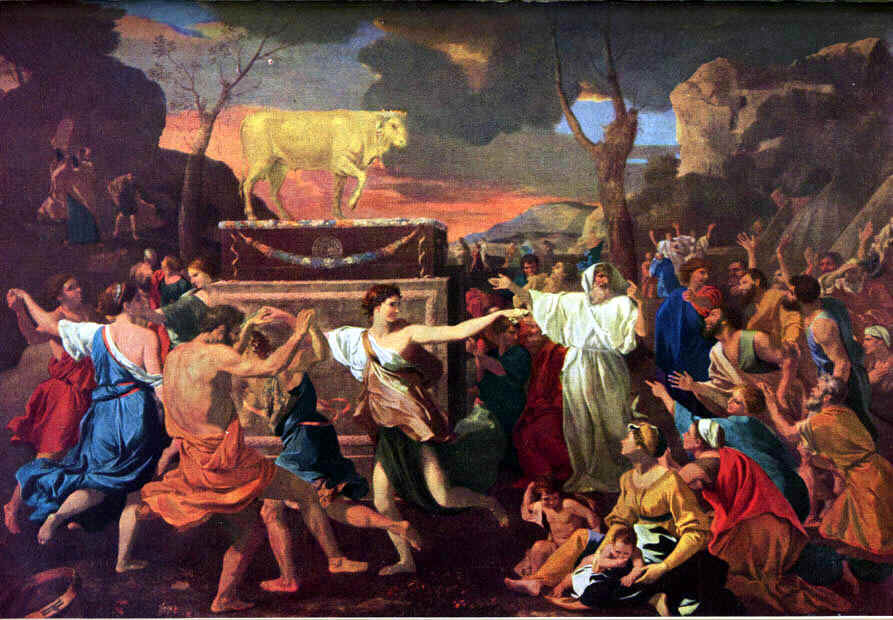
Nicolas Poussin, “The Adoration of the Golden Calf”

The account in the book of Exodus that describes how the Israelites made and worshiped the golden calf does leave us with the impression, at least at first, that only men were killed in punishment. Moses told the Levites, who had remained loyal to the Lord, “Go back and forth through the camp from one end to the other, each killing his brother and friend and neighbor.” All of these terms are masculine, suggesting that only men were  targeted.

However, there are at least three things that suggest women were likely killed in punishment as well. First, the Hebrew language, by convention, uses such terms in the masculine when both men and women are in view. For example, the commandment in Leviticus to “love your neighbor as yourself” clearly applies to both men and women. And while the preceding commandment in Leviticus says literally, “You shall not hate your brother in your heart,” many modern translations, recognizing that this word in Hebrew can apply to any relative, male or female, in such a context, translate the expression as “anyone of your kin” or “a fellow Israelite.”

Also, the account of the golden calf concludes by telling us that “the Lord struck the people with a plague because of what they did with the calf Aaron had made.” So even if no women were killed by the Levites for their part in making and worshiping the idol, it appears that some women did die in this plague.

Finally, in the New Testament, Paul describes to the Corinthians several things the Israelites did that constituted a pattern of disobedience and rebellion, as a result of which “their bodies were scattered in the wilderness.” This was in keeping with the punishment that God announced when the people rebelled definitively at Kadesh and refused to enter the promised land. So any women who were involved in the golden calf episode but who were not killed in punishment at the time nevertheless died in the desert as the result of chronic disobedience that included that episode.

In other words, anyone who contributed to making the calf and participated in its worship was subject to punishment—women as well as men. There was no unfairness in that regard.

Still, the account of the golden calf and of these divine punishments is one that  thoughtful readers of the Bible wrestle with today. We may wonder why people were killed for making and worshiping an idol. But worshiping a different god meant becoming an entirely different kind of culture than the one envisioned in the Law of Moses. In Old Testament times, every society was a theocracy that mirrored the character of the god it worshiped. The Canaanite gods were bloodthirsty, power-hungry, and immoral, while Yahweh was pure, holy, compassionate, and concerned for the poor and weak. Even as the Israelites first started to worship the golden calf, they  began to change the character of their society, engaging in “revelry” (sexual immorality, though described euphemistically as “dancing”) as part of the proceedings. The decay was spreading so fast that it needed to be halted immediately. The overt violence may trouble us, but it seems to have been intended to prevent the subtle, crushing violence of injustice and oppression that would have settled into the society if it had adopted Canaanite-style gods.

What does it mean that the Holy Spirit lives in us?

Q. I struggle with the concept of the Holy Spirit living in us due to two things that I have recently become aware of.

One is that in creation, God breathed life into us; wasn’t this the Holy Spirit? So since the Holy Spirit is the source of life and is living in us, how does this imagery work? If Mary had already conceived Jesus through the Spirit of God, what was happening when the Spirit descended on Him after His baptism?

My second question is the language used to describe the Pentecost event. It’s somehow similar to the temple imagery. I believe that I have the Spirit in me, but I have never experienced what happened to the early believers, as described in Acts. Well, maybe there are exceptions, but can you please help clarify what it means that we have the Spirit in our lives?

Thank you for your questions. Let me share some reflections in response.

First, the book of Genesis does say that “God formed a human from the dust of the ground and breathed into his nostrils the breath of life.” But while the word for “breath” in Hebrew can also mean “spirit,” in this case, the Bible is not talking about the Holy Spirit. Rather, it’d depicting how God brought humans to physical life as his creatures.

However, there’s an interesting parallel to this account in the Gospel of John. After Jesus rose from the dead, he met with his disciples and “breathed on them and said, ‘Receive the Holy Spirit.'” This seems to be an intentional re-enactment on Jesus’ part of the Genesis creation event, to signify that his followers would each become “a new creation” (as the apostle Paul would later put it) as their lives were transformed specifically by the influence of the Holy Spirit within.

This leads directly to your further question about Pentecost. If the disciples had already received the Holy Spirit when Jesus breathed on them, what was going on when they were “filled with the Holy Spirit” on Pentecost? I think you’re right to perceive temple imagery at work in this account. As I say in another post on this blog:

As I understand it, Pentecost is the occasion on which the community is  filled with the Holy Spirit. The New Testament speaks of the community of Jesus’ followers as “God’s temple” or a “temple in the Lord.” The physical temple in Jerusalem was destroyed in A.D. 70, and the New Testament envisions a new kind of temple, built of “living stones” (as Peter puts it—that is, of people), taking its place.  And so the scene on the day of Pentecost is just like the ones in the Old Testament when God’s Spirit fills the tabernacle built by Moses and the temple that Solomon built. (Along these lines, I once preached a Pentecost sermon entitled “The Filling of the New Temple.”)

Your question about Jesus can be answered along similar lines. Jesus was conceived through the power of the Holy Spirit, but this was what brought him to life physically, similarly to the way the breath/spirit of God first brought a human to life. Jesus would not, through this means, have been filled with the Holy Spirit from birth, any more than the first human was filled with the Spirit at his creation. (However, we shouldn’t necessarily conclude that Jesus was not filled with the Holy Spirit from his very conception; an angel promised that this would be true about John the Baptist, and there’s no reason to think that anything less was true of Jesus, whom John said was “greater than I am.” The fact that John was able to recognize Jesus when they were both still in the womb and their mothers met suggests to me that they were each already very much alive spiritually at that point.)

Jesus was already a genuine and committed follower of God and an instrument of God’s inbreaking kingdom activity even before he was baptized, so I don’t doubt that the Holy Spirit was already living in him by that time. But nevertheless the Holy Spirit descended on Jesus in a visible way at his baptism.

For one thing, this signified his identity and mission as the Messiah. It confirmed the Father’s voice from heaven, “This is my Son, whom I love; with him I am well pleased.” (As I observe in this post, “Generally all of the activities of the Trinity involve all of its persons.” That is, the Father, Son, and Holy Spirit do their work together. When Jesus publicly and officially began his ministry with his baptism, the other two persons of the Trinity took part in the event.)

However, I don’t doubt that the Holy Spirit descending on Jesus was also a special equipping for the ministry that lay ahead—beginning immediately with the wilderness temptations that followed his baptism, and continuing on to further great challenges after that. We discover the same thing in many other passages in the Bible, that God sometimes gives a person a special filling of the Spirit to equip them for an urgent and difficult task. For example, the book of Acts tells us that when the apostles were arrested in Jerusalem for speaking and teaching in the name of Jesus, Peter was “filled with the Holy Spirit” so that he could offer a bold defense. The apostles were threatened and intimidated and then released, and the whole community of Jesus’ followers prayed for boldness. “After they prayed, the place where they were meeting was shaken, and they were all filled with the Holy Spirit and spoke the word of God boldly.” Similar episodes of people being specially filed with the Spirit for bold action are found throughout the Old and New Testaments.

So, to sum up, people who haven’t yet experienced the new birth by receiving Jesus as their Lord and Savior do not have the Holy Spirit living within them, although they do have the “breath of life” as a gift from God and they bear the image of God, and on that basis they can already begin to contribute to God’s kingdom activity. Once a person does come to follow Jesus, they are born again and become a “new creation,” and the Holy Spirit comes to live within them. The Holy Spirit will work within them to make them more and more like Jesus in their character, conduct, and attitudes, and the Holy Spirit will also give them gifts and opportunities for service.

It’s true that some people seem to experience a filling of the Holy Spirit as something separate from, and subsequent to, their initial commitment to follow Jesus. I recognize that some Christian groups teach that this is normative, that the two experiences are separate. While I respect their beliefs, my personal view is that when someone experiences the filling of the Holy Spirit later, some time after they’ve chosen to follow Jesus, it’s not that they get more of the Holy Spirit, it’s that the Holy Spirit gets more of them. They have opened up wide areas of their heart and life to the Spirit’s influence and control, and as a result they are experiencing the Spirit rushing in. (Indeed, even those groups that teach a subsequent experience of the “baptism of the Holy Spirit” associate it closely with “entire surrender” and “complete sanctification.”)

So, at least in my view, if you are a follower of Jesus, the Holy Spirit is already living within you, at work to make you like Jesus and equip you for service. You don’t need to get more of the Spirit. But make sure the Spirit gets all of you!

Did Pharaoh drown with his army?

Q. When God parted the Red Sea for the Israelites to cross, and when God then made the waters sweep back over the pursuing Egyptians, did Pharaoh drown with his army?

This question is much debated by biblical scholars. Many say yes, while others say no. I can only give you my own opinion on the matter, which is that Pharaoh did not drown with his army.

The book of Exodus does say that when the king of Egypt was told that the people had fled . . . he had his chariot made ready and took his army with him to pursue the Israelites. So it seems that Pharaoh did personally accompany the army out into the desert.

However, the further details in the account suggest that he didn’t join the actual pursuit of the Israelites. Rather, Exodus says that all Pharaoh’s horses and chariots and horsemen followed them into the sea. It describes God telling Moses, “Stretch out your hand over the sea so that the waters may flow back over the Egyptians and their chariots and horsemen.” And the book then says that “the water flowed back and covered the chariots and horsemen—the entire army of Pharaoh that had followed the Israelites into the sea.”

Pharaoh himself was apparently not included in this group (“the entire army of Pharaoh”), because when Moses and the Israelites  compose and sing a song afterwards to celebrate the event, they say:

Pharaoh’s chariots and his army
    he has hurled into the sea.
The best of Pharaoh’s officers
    are drowned in the Red Sea.

It seems to me that if Pharaoh, the ruler of all Egypt, had also been killed, the song would have mentioned this as the high point of the victory and not spoken only of his best officers.

I think that in this light, we should understand the statement in Psalm 136 that God swept Pharaoh and his army into the Red Sea to mean that God swept Pharaoh, personified in his army, into the sea. This would be in keeping with the view in the ancient world that the host of a ruler (that is, his army or troops) was an extension of the ruler himself. (In Daniel’s vision of the Ancient of Days, God is depicted that way, surrounded by the heavenly host emanating from his throne: A river of fire was flowing, coming out from before him. Thousands upon thousands attended him; ten thousand times ten thousand stood before him.)

As I said, others might answer the question differently, but this is what the biblical account suggests to me.

“Crossing the Red Sea,” a wall painting from the 1640s in Yaroslavl, Russia