
Was Peter really “naked” in the boat?

Q. What does it mean when Jesus comes to the boat and finds Peter naked? I don’t understand why we need to know that, but it’s in the Bible so I expect Jesus had reason to tell us.

I believe the passage you’re referring to is the one at the end of the gospel of John in which the disciples go fishing after Jesus’ resurrection. They fish all night and catch nothing, but in the morning Jesus appears on the shore and tells them where to throw their net. The gospel then says:

So they cast it, and now they were not able to haul it in because there were so many fish. That disciple whom Jesus loved said to Peter, “It is the Lord!” When Simon Peter heard that it was the Lord, he put on some clothes, for he was naked, and jumped into the sea. But the other disciples came in the boat, dragging the net full of fish, for they were not far from the land, only about a hundred yards off.

For many of us, when we read this passage and hear that Peter was naked in the boat, our reaction is, “TMI.” (Too much information. We don’t need to know that.)

But the first thing I’d say in response to your question is that Peter was almost certainly not completely naked. The Greek word that’s used here is gymnos. While it often means “naked,” its general meaning is “lacking clothes,” so we have to determine its specific meaning from the context.

For example, James asks in his epistle, “If a brother or sister is gymnos and lacking in daily food, and one of you says to them, ‘Go in peace, be warmed and filled,’ without giving them the things needed for the body, what good is that?” While some English versions translate the term gymnos as “naked” there, James’ meaning seems to be instead that the brother or sister has not enough clothing and not enough food, and that genuine faith with express itself by providing for such a person. And so various other versions translate the term as “poorly clad,” “needing clothes,” “lacking adequate clothing,” etc.

In the same way, the context in the gospel of John suggests that Peter was not literally naked, as that is not how a fishermen would dress (or not dress) for work. Rather, as other English versions suggest, he was “stripped to the waist” or “stripped for work” or “lightly clad” or “had taken off some clothes to work.” The Voice Bible says, “He threw on his shirt (which he would take off while he was working).”

But this still doesn’t answer your question of why the Bible would give us these details about how Peter was dressed for work, and tell us that he put his outer tunic back on before he swam to shore to see Jesus. John is very careful about what details he includes in his gospel and there is usually some thematic or theological significance behind each one. (One of my favorites is when John says that the woman at the well left behind her water jar when she went to tell the other people of her village about Jesus. This detail has symbolic significance: She didn’t need the jar any more because she’d found living water!)

I haven’t found other interpreters discussing the particular detail of Peter’s tunic, but let me offer some reflections of my own about it. I do think it’s significant that three other scenes of taking a garment off or putting one on lead up to this scene at the end of the gospel. Even though different words for the specific “garment” in view are sometimes used in the earlier scenes, I think there’s still significant thematic continuity.

– At the Last Supper, Jesus lays aside his outer garment in order to dress as a servant would as he washes the disciples’ feet.

– When Jesus is on trial before Pilate, the soldiers put a purple robe on him, mocking his claim to be the “King of the Jews.”

– At the cross, as the soldiers are dividing up Jesus’ clothing, they don’t want to rip his tunic into pieces, so they cast lots for it. (In this case, the term for the garment is the same as in the fishing scene.)

Each of these details reveals something about Jesus’ identity. He has come to earth in the role of a servant; nevertheless, he really is a king—the soldiers’ mocking gesture is truer than they know; his death fulfills what Scripture says about God’s redemptive plans, so it’s actually a defeat for his enemies and a victory for God.

I’d argue that Peter putting his tunic back on also reveals something about his identity at that point. I think it symbolizes how he isn’t yet ready to lay aside his “garments” (symbolizing his role and authority) and become a servant as Jesus did. But as Peter speaks with Jesus on the seashore, and Jesus offers him the opportunity to affirm his love for him three times, undoing his threefold denial, Jesus also offers him the role of a servant who will “tend his sheep” and ultimately give his life for them, too. And Peter actually did this: John says that Jesus was showing Peter “by what kind of death he was to glorify God.

Particularly since Jesus’ act of laying aside his garments stands out as something we wouldn’t expect at a banquet, and Peter’s act of putting on his tunic stands out as something we wouldn’t expect of someone who was just about to dive into the sea and swim, I think we are supposed to associate the two scenes and understand that Peter was just about to learn something necessary about servanthood and embrace that role.

I hope these reflections on your question are helpful.

One person responded to this post by observing that Jesus says to Peter on the shore, “When you were young, you put on your own clothes and went about wherever you wanted. But when you are old, you’ll stretch out your hands, and someone else will dress you up and take you where you don’t want to go.” This suggests that Peter putting on his tunic is indeed being contrasted symbolically with the way of suffering and sacrifice that Jesus invites him to follow.
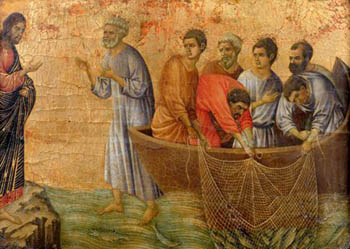
“The Miraculous Catch of 153 Fish,” Duccio, 14th Century. Note that the artist identifies Peter symbolically by having him walk on the water, even though that actually happened in an earlier episode in the gospels. He has already put his tunic back on.


How can I show my friends that I’m not a wacko just because I’m a Christian?

Q. How do we handle the tension that comes from being truly and deeply different as Christians while simultaneously wanting to reach a culture that ​is​ ​easily put off by “strange” religious behavior and especially ​of​​ being “converted” to ​something​? ​Since religious believers are often portrayed as complete wackos, it would seem that showing people how normal most of us are would be a good step. But it makes me wonder how far is too far when it comes to trying to appear “normal.” ​

To what degree one should bring up faith or try to steer conversations in that direction in personal relationships? Is it more important to focus on living such an attractive life that people inevitably “want what we have” and ask us about our faith? Or is that even realistic?

Along the same lines, to what degree should Christians emphasize that they are “just normal people” and not “crazy cult followers”? For example, say that after work some coworkers invite you to go to a local bar for some drinks. Obviously some personal judgement is called for (how shady is this bar?), but would it be a better approach to go with the “hey, I want these people to know that Christians are normal too” approach and go grab a drink, or would it be better to make a point of emphasizing that as a Christian you don’t really feel comfortable drinking at a bar (and thereby potentially get tuned out by them in the future)?

Your question is very pertinent to the contemporary cultural and religious landscape. I recently saw a college chaplain quoted to this effect: “Given their distrust of authorities and institutions, millennials are seeking out extended experiences and real, authentic spiritual relationships before they will commit to a world view or ideology.”

In other words, nobody these days is going to be “converted” to a faith or religion simply because somebody talks to them about it. They will need to watch your experiences over a period of time first and come to some judgment about whether they agree God is in these experiences as you say. They will also need to validate the genuine quality of your relationships with them and with others. So this is not a matter of a brief “gospel presentation” over lunch or on a bus. It’s a matter of living out your life with credibility and authenticity over time, with people watching.

The practical questions you ask suggest some very good illustrations of this. If you go into a conversation with somebody not really wanting to talk about what they want to talk about, but instead looking for a chance to bring up your faith, that’s fake. Don’t do that. On the other hand, if faith would come up naturally, but you don’t mention it because you think your friend might consider you a “wacko,” that’s also fake. You’re not being yourself.

For example, suppose on a Monday somebody at work asks, “So what did you do this weekend?” If, among other things, you went to church, there’s nothing wrong with mentioning that, and even describing something interesting or inspiring that happened there. (And then you ask, “And what did you do this weekend?”)

As for going to a bar with co-workers, for me personally the question really would be, “How shady is this bar?” If the place is basically a restaurant that happens to serve beer, I wouldn’t have a problem with going there and hanging out with people from work. (Hopefully they have a good selection of draft beers on tap!) On the other hand, if the place is a near-criminal enterprise, a haven of immoral, illegal, and exploitive activities, I’d tell my co-workers, “I’d love to grab a drink with you, but I find that place kind of sketchy. Could we go to such-and-such a place instead?”

(I recognize that whether to drink alcohol at all is one of those questions about which Christians each need to develop their own convictions and be “fully convinced in their own minds.” But even if you abstain from liquor, you could still go out with your friends and order a non-alcoholic drink. If anyone asks or seems like they’re wondering, you can just explain naturally, “I don’t drink alcohol.” Many people abstain for lots of different reasons and these days it should be “no big deal.” However, if you’re a recovering alcoholic and being in a bar would be too great a temptation, then it wouldn’t be wise to go. Additionally, if the whole purpose of the outing is not to be with friends, but to get drunk, then that’s not something it would be valuable to be a part of.)

Let me stress, however, that the point of going out for a drink with co-workers is not to demonstrate to them that Christians are normal people and not crazy cult followers. The point is to go out for a drink with co-workers. In other words, your intentions need to be sincere and authentic. You can’t have a “hidden agenda.” Otherwise, you’re not really demonstrating a quality of life that others might recognize and want to find out more about.

And this brings me to your final specific question: Yes, I do think it’s realistic to believe and expect that modeling the new life God is creating inside you will make that same life attractive to others. One of my favorite stories in the gospels is about Zaccheus. To say that everybody in Jericho wanted him to repent would be an understatement. As a tax collector, he was collaborating with the Romans and enriching himself by extorting money from everyone else. All Jesus said to him was, “I want to have dinner with you.” But at that dinner, Zacchaeus stood up and said, “Here and now I give half of my possessions to the poor, and if I have cheated anybody out of anything, I will pay back four times the amount.” He knew Jesus was extending an unconditional welcome to him, he wanted to accept that welcome (he’d already braved a crowd that was likely hostile just to see Jesus), but he also recognized that a life change came with accepting the welcome.

I think these are actually exciting times for us to live in. We can speak about our faith without worrying about offending people, so long as we do so freely, openly, and naturally, because these days people are supposed to accept and respect where other people are coming from. But we also need to recognize that it’s the quality of our lives and relationships that will ultimately make that faith credible to others. And that’s a good challenge for us to embrace. As Jesus said, people have to recognize us as his followers by the fruits of our lives.


Is Jesus insulting the Canaanite woman by calling her a “dog”?

Q. I read the story of Jesus and the Canaanite woman the other day and I have no idea what Jesus is talking about in the parable when he references crumbs and dogs eating the crumbs. Can you shed some light on this passage?

“The Woman of Canaan” by Michael Angelo Immenraet, 1670s

This story is confusing and sometimes upsetting to readers of the gospels because it appears that Jesus is not only rebuffing someone who comes to him for help, he’s actually insulting her in the process.

A Canaanite woman asks Jesus to deliver her daughter, who’s suffering at the hands of a demon, but he won’t even speak to her. When his disciples urge him to help, he replies, “I was sent only to the lost sheep of the house of Israel.” (The woman is a non-Israelite.) And when she appeals to Jesus personally, he responds, “It is not right to take the children’s bread and throw it to the dogs.”

So Jesus seems to have a very callous and insulting attitude. However, I think something different is actually going on here.

This was an oral culture whose ways were embodied in popular sayings. These were often cited in support of a particular course of action. When two people had different courses in mind, they would pit different sayings against each other until one person had to admit, “Okay, you’ve got me there.”

This kind of thing can happen in our own culture. For example, two friends might visit a new part of town on a weekend, looking for a restaurant where they can have dinner. The first place they consider says it can seat them immediately. One of them might say, “Maybe we should eat here. After all, ‘A bird in the hand is worth two in the bush.'” But if the other thinks there could be a better restaurant down the street that would be worth the wait, he might reply, “Yes, but ‘nothing ventured, nothing gained.'”

Similarly, I think Jesus is actually quoting a popular saying to the woman: “It’s not right to throw the children’s bread to the dogs.” This saying probably had a general application meaning something like, “Don’t use something expensive or valuable for a common purpose.” Jesus is applying it to the mandate he has, during his limited time on earth, to concentrate his efforts on ministry to the people of Israel, as their Messiah. (After his resurrection, his message will spread to all the people of the world from that starting point.)

The woman, however, comes up with what I think is an original saying of her own in response: “Yes, but even the dogs eat the crumbs that fall from their masters’ table.” Jesus responds, in effect, “You’ve got me there,” and he heals her daughter.

But this was not merely a battle of wits that the woman won by her cleverness and quick thinking. Rather, I believe Jesus evaluated every situation he encountered in order to discern how God might be at work in it. In the gospel of John he’s quoted as saying, “The Son can do nothing of his own accord, but only what he sees the Father doing.” So Jesus was always on the lookout for when his Father might be doing something that he could join in with.

I believe, for example, that when his mother Mary came to him at the wedding in Cana and told him that the hosts had run out of wine, while Jesus thought initially that the time hadn’t come yet for him to do “signs” in public, he ultimately recognized that Mary’s persistent and trusting faith was an indication that God was at work in the situation. And so he did his first miracle there, turning water into wine.

I believe that Jesus similarly recognized the Canaanite woman’s bold request and audacious persistence as indications that God was giving her the faith to believe her daughter could be delivered if she sought help from Jesus. It was in response to that recognition, inspired by the woman’s reply to his challenge, that Jesus acted to heal the daughter, giving an advance glimpse of how his influence would soon extend beyond the borders of Israel.


Why does Peter call Jesus a “living stone” and his followers “living stones”?

Q. Peter writes in his first letter, “As you come to him [Jesus], the living Stone—rejected by humans but chosen by God and precious to him—you also, like living stones, are being built into a spiritual house.” What is a “living stone”? What does that mean?

The references to Jesus as a living stone, and to us his followers as living stones, actually look forward to the quotation from Isaiah that Peter offers shortly afterwards. In the original context in Isaiah, the “cornerstone” is a figure for justice. The correct lines for a stone building (i.e. the placement of all the other blocks) were all derived from a perfectly squared-off cornerstone that was laid down first. In the same way, God says, He will establish justice so that all of the Judeans can know whether their actions are “within the lines” or not. (“I will make justice the measuring line and righteousness the plumb line.”)

As often happens when New Testament authors see a Messianic meaning in an Old Testament prophecy, Peter is “escalating” the language so that the cornerstone (justice) becomes personified in Jesus. That’s what “living” means: An abstraction, justice, is now embodied in a person, Jesus the Messiah. He is, in effect, the “first block laid down,” and we who are “being built into a spiritual house” (that is, into a new kind of temple, as other New Testament writers also say) need to take our bearings and find our placement from Jesus. Not in a physical sense, but in the sense of moral purpose: “How can my life and actions fit in with what God has already started doing in the world through Jesus?”

We today probably aren’t very familiar with the approach to construction that involves first laying down a cornerstone. So let me offer a modern analogy. When a baseball field is laid out, the first thing put down is home plate. The foul lines are drawn out from the back of it. And those foul lines tell you whether a batted ball is “in” or “out.” The life, teachings, and example of Jesus establish the lines in our lives of what’s “in” and “out,” not just morally, but also in keeping with God’s expanding purposes in the world. He is, in effect, a “living home plate,” and we are a “living infield” and a “living outfield.”

Did Jesus have any earthly brothers?

Q. Did Jesus have any earthly brothers? Near the beginning of the book of Acts there’s a reference to “Mary the mother of Jesus and . . . his brothers.” I went on to browse online and got nothing concrete. Some say it is referring to brothers by faith while others have their own theories. Some even mentioned that Judas was Jesus’s real brother. Thank you in advance for your answer.

Thank you for your question. I hope that this earlier post will help answer it.


How does Christian faith promote scientific endeavor?

Last Saturday (April 22, 2017) I participated in the March for Science. You can see in the picture above what my sign said.

Lots of people took photos of it. Several engaged me in conversation. One person looked at the sign in near disbelief and asked, “Is that all true?” “Yes,” I replied, “I support science, and I have a Ph.D. in theology.” “Well,” she responded, “it sounds like you and I could have a great philosophical discussion some day. But in the meantime, thanks for being here.” I told her I’d felt it was important for me to be there.

Our local NPR station had a reporter covering the event. When she spotted my sign, she took my picture (that’s her photo above) and interviewed me along the route. I shared the coverage on Facebook and one person commented, “You should post an article on your blog about how exactly your theology leads you to support modern science.” I thought that was a great idea. So here goes!

As George Harrison said in the movie Help!, “I don’t want to knock anyone’s religion,” but faiths such as Buddhism teach that the material world is an illusion. We need to look past it and escape from it in order to find enlightenment and truth. The Judeo-Christian world view, by contrast, is that the material creation is a genuine reality with positive spiritual import. It was created intentionally by a good God (not by mistake by a bad demigod, as the Gnostics taught) and declared to be “very good.”

In fact, the Bible holds that creation itself can speak to us about God. “The heavens declare the glory of God; the skies proclaim the work of his hands,” Psalm 19 says. Paul writes in Romans that “since the creation of the world, God’s invisible qualities—his eternal power and divine nature—have been clearly seen, being understood from what has been made.” So Christian faith gives us confidence that when we observe the world around us, in effect, we can trust our eyes—what we’re seeing is not a spiritual illusion.

Beyond this, the Judeo-Christian world view is that the created world is orderly and harmonious. It’s not hopelessly swirling about in confusion and chaos. Of course the Bible, since it comes from a pre-scientific era, doesn’t say specifically that the universe is governed by rules and laws such as the Law of Gravity or the Law of Thermodynamics. (When it comes to this view of the universe, which is no longer the state of the art but which has made indispensable contributions to our understanding, we may quote Alexander Pope’s intended epitaph for Isaac Newton: “Nature and Nature’s laws lay hid in night: God said, ‘Let Newton be!’ and all was light.”) But the Bible does portray the creation as intentionally well-organized and regular, allowing observations of phenomena to be made today that will still be valid tomorrow, and permitting conclusions drawn in one area to be applied in other areas. If all were chaos instead, we couldn’t make sense of out anything.

And ultimately I would argue that Christian faith actually encourages us to go out and explore the created world. As I told the reporter along the march, I believe that science answers questions of what, when, and how, while religion answers questions of who and why. The two are not in competition because they’re answering different questions. Science intentionally limits itself to what can be observed and measured, so it does not properly get into metaphysics. (Saying that there is nothing beyond what can be observed and measured, for example, is not a scientific statement!) Similarly, the Bible was not written to give us comprehensive information about the natural world. Instead, I believe it pushes us out into that world to find the information out for ourselves.

Let me advocate for this, in conclusion, by quoting some relevant thoughts from the book Paradigms on Pilgrimage: Creationism, Paleontology, and Biblical Interpretation, which I co-authored with my brother-in-law Stephen Godfrey, who is curator of paleontology at the Calvert Marine Museum. (We have now put this book online as a series of blog posts, followed by a question-and-answer forum.)

“It is the glory of God to conceal a matter; it is the glory of kings to search out a matter.” King Solomon, who wrote these words, was noted for his natural-scientific investigations: “He described plant life, from the cedar of Lebanon to the hyssop that grows out of walls. He also taught about animals and birds, reptiles and fish.” In these days when many of us enjoy the kind of leisure for cultural, artistic and scientific pursuits that only kings formerly enjoyed, we may paraphrase Solomon’s words in this way: “God has hidden countless fascinating and wonderful things in his creation, and he wants us to delight in discovering them.” When we do, we bring him pleasure by fulfilling his purposes. So all those who are called to scientific enterprise should pursue that calling without fear or doubt, but rather with joy and enthusiasm. There is no script that you need to follow, no predetermined conclusion that your results need to square with. If there were, God would not really have “hidden” these treasures for us to find. They’re out there – go get them!

Why can’t I feel God’s presence in my life?

Q. Does God leave people even if they’re trying to be a good Christian, if they make mistakes but confess them afterwards and truly seek forgiveness? I personally do not feel anything of God in my life, but I try and try every day. I read the Bible and go to church every Sunday. I feel empty and have felt that way for a long time. I have forgiven people who’ve wounded me deeply. But my joy is gone. What’s going on?

Thank you for your question. I sympathize deeply with your situation. I can’t speak to it as knowledgeably as I’d like without knowing the specifics, but let me share some thoughts based on my 20 years’ experience as a pastor and my lifelong study of the Bible.

I can assure you that you’re not alone in your situation. I’ve counseled many other people who seemingly were doing everything they should (pursuing spiritual disciplines such as Bible reading and worship, asking and granting forgiveness, etc.) but somehow didn’t feel God’s presence or the joy of the Lord.

First, to answer your opening question directly, no, God never abandons a person who’s earnestly and sincerely seeking him. We do hear in the Bible about God withdrawing his presence from an individual or community, but this is always the last step in a long process of God trying to bring them back from unfaithfulness to obedience. This does not happen to people who are already seeking God. David recognized after his grave sins against Bathsheba and Uriah that he had put himself in danger of this, so he pleaded desperately, “Cast me not away from your presence, and take not your Holy Spirit from me.” The prophet Nathan assured him, “The Lord has taken away your sin.”

The book of Hebrews in the New Testament, speaking to people who are earnestly following God like you, reminds us, “God has said, ‘Never will I leave you; never will I forsake you.’ So we say with confidence, ‘The Lord is my helper; I will not be afraid.'”

So if God has not left you—and I feel confident assuring you of that, on biblical grounds—then, as you ask, “What’s going on?” Why don’t you feel God’s presence, if he really is present in your life, and why don’t you feel the joy that usually accompanies obedience, since you’re faithfully doing things such as asking and granting forgiveness, which require sincere willingness?

Let me suggest a couple of possibilities, which is the most I can do without knowing the particulars of your situation.

One possibility is that you might not be using the spiritual disciplines that are best for you, or not using the spiritual disciplines generally in the right way. As a rule, it’s good for us to build some structure into our lives to make sure that we invest in our relationship with God as we want to. For example, if our desire is to give regularly and appropriately to God’s work, then the discipline of tithing (giving 10% of our income) is a good way to make sure that happens.

However, the disciplines we often stress as the key to a close relationship with God—Bible reading, prayer, and church attendance—are actually only three of some three dozen disciplines that Jesus’ followers have honored and practiced over the centuries. Not every discipline works equally well for each person, and the ones that work for you can change at different points in your life.

I suspect that there are actually some disciplines you’re already practicing, without recognizing them as such, that would more effectively help you draw close to God than the ones you’re pursuing deliberately right now. For example, theologians have long spoken of the “two books” of God, Scripture and nature. Psalm 19 seems to speak of these two books because it begins by saying, “The heavens declare the glory of God; the skies proclaim the work of his hands. Day after day they pour forth speech; night after night they reveal knowledge.” But in its second half, the psalm talks about how “the law of the Lord is perfect, refreshing the soul; the statutes of the Lord are trustworthy, making wise the simple.” Two books, nature and Scripture.

You may be one of those people who appreciates and learns about God when you are out in his creation; you might just not be recognizing this as just as valid a spiritual discipline as Bible study or church attendance. Or maybe that’s not one of the disciplines that does it for you, but some others might. I’d encourage you to read a book or books about the various spiritual disciplines in order to recognize the ones that will most effectively help you draw close to God. The most comprehensive discussion I know is in Adele Calhoun’s Spiritual Disciplines Handbook. You might start there, and once you identify some approaches that seem promising, investigate them further in books that discuss them in more detail.

But I also said you might be pursuing the disciplines in the wrong way. You said, “I try and try every day.” The effort is admirable, but I’d encourage you to see the spiritual disciplines as “means of grace,” that is, doors that we open in our lives for the grace of God, which is already waiting just outside, looking for a way to get in. In other words, God sends his grace to us first; we just need to open a door for it. Jeff van Vonderen discusses this distinction in his book Tired of Trying to Measure Up, which, he says, “is written for Christians who live under a deeply ingrained code of expectations and rules that shame them and drain them of spiritual strength.” If that rings any bells for you, I’d recommend you have a look at his book, or another one on the same theme.

But here’s one more thought. It’s also possible that your feeling of spiritual dryness is actually a sign of growth and strength. Many people reach a place where their experience of God has outstripped their beliefs about God. When this happens, people can often have doubts. They need to realize that they no longer believe in the God they once knew simply because now they know God better. A person in such a situation can also feel as if God is absent, but this is only because they can no longer feel close to the kind of God they don’t believe in any more.

This doesn’t mean that they don’t believe in God at all, or that God is truly absent. They just need to recognize that the God they now understand better is waiting there to meet them in their new place of maturity and wisdom. This is actually a process that can be repeated over and over again in our lives, because as finite creatures we are always learning more about the infinite God we love and serve.

It’s a bit like the process that takes place in a healthy marriage. As a pastor I often explained, in premarital counseling or wedding sermons, that marriage is “the process of getting to know the same person over and over again for the rest of your life.” Married couples can hit a “dry patch” and discover that they need to relate to one another differently, and start doing different kinds of things together, to get that spark back because they’ve both grown and changed. This is a healthy and inevitable process, and the same thing needs to happen in our relationship with God. (Although we’re the ones who’ve grown and changed, not God!)

I hope these reflections are helpful to you, and I certainly wish you every blessing from God as you pursue the close relationship with him that you desire.


Does studying church history lead a person to support Roman Catholic doctrine?

Q. I appreciated your writing on pre- and post-millenialism. I thought it was very interesting. Thank you. You have a Ph.D. in Church History. What do you think of this video? Thank you for your time.

In the video in question, a Presbyterian minister who has converted to Catholicism is interviewing a Baptist minister who has also converted to Catholicism. The Baptist actually grew up Methodist, but he changed denominations when he got married. Divisions arose in his family over the doctrinal differences between the two denominations. He realized that the differences were due to the way people were interpreting the Bible, and he wondered who had the authority to say how the Bible should be interpreted.

He also started studying church history and through these studies, he says, he first began to be persuaded of Roman Catholic doctrine. He quotes John Henry Newman, an Anglican who became Catholic, to the effect that “to be deep in history is to cease to be a Protestant.” In other words, the claim is that if you really understand what followers of Jesus have believed from the start and for most of their history, you see that Catholics have it right and Protestants don’t.

As someone who, as you noted, has earned a Ph.D. in church history, I do not find this claim convincing. (Full disclosure: I am a Protestant.) What I have seen instead is that throughout history, different understandings of various doctrines have continually been arising within the community of Jesus’ followers. And it is not always the earliest understandings that have been carried forward into Catholic teaching today. To give just one example, the split between the Catholic and Orthodox churches was occasioned by the addition, by Western popes, of a phrase to the Nicene Creed, so that it then stated that the Holy Spirit proceeded “from the Father and the Son.”

The Orthodox churches objected more to the Pope adding this phrase to the creed unilaterally than they did to the phrase itself. The creed had been adopted by a council of all the bishops of the church, and they felt that if it were going to be changed, this could only be done by a similar council. But this illustrates the essential issue here: the question is not so much who has the authority to interpret Scripture (though Catholics grant this authority to the Magisterium or official teaching of the church), but who has the authority or power to enforce various interpretations. The Pope, it turned out, did not have the power to keep the Orthodox churches in line, and this caused a split that lasted nearly a thousand years and was only reconciled relatively recently.

We might say that the Pope at the time of the Reformation similarly did not have the power or authority to bring the new Protestant groups back under Rome’s doctrinal control, and another split occurred that has persisted to this day. One difference is that while the Orthodox churches remained essentially unified in their understandings, the Protestant groups have continued to split and bicker. So I can certainly understand how someone would want an authority to step in and say, “This is how we’re going to understand things,” and be comfortable finding that authority in the Catholic Magisterium.

But that’s different from saying that this authority is reflecting what followers of Jesus have basically believed from the start and in almost all places and times. Actually, the Catholic Church as we know it today dates essentially from the Council of Trent in the mid-16th century, when the variety of practices then in use were standardized. Before that, the Catholic Church itself exhibited great diversity, as frankly it still does in many respects today.

In conclusion, I have no problem with people being on a spiritual pilgrimage as followers of Jesus that leads them to find a new home in a different denomination. I have no problem with Protestants, even Protestant clergy, converting to Catholicism if they come to find their heart’s home there. But I am a bit uncomfortable with the way this video speaks of the Roman Catholic communion as the “true church,” as if Protestant expressions of Christianity were somehow “false,” and of converts “coming home,” as if those of us who remain Protestant are still wandering off somewhere. Let’s recognize all sincere followers of Jesus as “true” Christians, honor one another’s convictions, and make sure that we explore and discuss our differences peacefully and respectfully.


Nicholas Kristof, you are not far from the kingdom

New York Times columnist Nicholas Kristof has been having a fascinating series of conversations with Christian leaders, beginning last Christmas with Timothy Keller and continuing this Easter with Jimmy Carter, asking “Am I a Christian?” if I don’t believe in Jesus’ virgin birth, miracles, and resurrection. Here is my response to those interviews.

Nicholas Kristof

Dear Mr. Kristof,

I’ve read with great interest your recent interviews with Timothy Keller and Jimmy Carter—two men whom, like you, I respect greatly. Please allow me to share my own (completely unsolicited!) thoughts in response.

I actually disagree with the implicit premise behind your questions to these men: that the boundary around Christianity consists of beliefs. You asked Timothy Keller, for example, whether you could be a Christian if you didn’t believe in things such as the virgin birth and the resurrection. He replied at one point (granting this premise): “In general, if you don’t accept the Resurrection or other foundational beliefs as defined by the Apostles’ Creed, I’d say you are on the outside of the boundary.”

I personally believe in Jesus’ virgin birth, miracles, and resurrection. Like Mr. Keller and Mr. Carter, I find these to be reasonable beliefs, well substantiated in the authentic gospel accounts of Jesus’ life. I also find them vital to a coherent understanding of who Jesus is and what Jesus has done for us. I even think that if anyone chose to follow Jesus, this might well lead them to these same conclusions eventually. But all of that is different from saying that such beliefs determine who is or isn’t a Christian.

I have been a pastor myself, and in one of my churches I once preached a sermon entitled “A Wall that Lets People In.” The sermon was about Nehemiah rebuilding the wall around Jerusalem after the exile. I noted that the regathering community needed such a boundary in order to establish its own identity. But those walls, I also noted, had gates. In fact, just as much is made of the rebuilding of the gates, which were designed to let people in, as of the rebuilding of the wall that we would otherwise think was designed to keep people out. That’s just the kind of boundary that now surrounds the Christian community: one that defines the community so people can find it, but which then invites people in rather than keeping them out.

So what is that boundary? Is it a collection of beliefs? Certain regular worship practices? A set of behaviors adopted or avoided? No, because boundaries like those would simply place a barrier between those who were already in and who were not yet in.

The defining-but-inviting boundary around the Christian community is supposed to be the love that its members have for God, and as a result for all other people, out of gratitude for what Jesus has done for them. Love of the character that Jesus modeled and taught is so distinctive that it identifies the community of his followers, and at the same time it draws others in to become part of the shared life it creates. “This is how everyone will know that you are my disciples,” Jesus said, “by the love that you have for one another.” Before his followers were ever known as Christians, their community was called The Way, because people recognized that they were following a certain way of life.

At one point Jesus was speaking with a scribe who asked him what the most important commandment was in the Jewish law. Jesus replied, “Love the Lord your God with all your heart, and with all your soul, and with all your mind, and with all your strength” and “love your neighbor as yourself.” The scribe agreed: “‘You are right, Teacher,’ he said, ‘To love God with all the heart, and with all the understanding, and with all the strength, and to love one’s neighbor as oneself—this is much more important than all whole burnt offerings and sacrifices.” (That is, than regular worship practices.) Jesus told him in response, “You are not far from the kingdom of God.”

In other words, because love for God and neighbor were the truly important things, Jesus ultimately defined membership in the community of his followers not in terms of a boundary, but in terms of proximity. The issue was not out or in, but far or near. So when I hear you say, “What I admire most about Christianity is the amazing good work it inspires people to do around the world,” my response is, “If you want to love in the way that Jesus loved, then surely you, too, are not far from the kingdom of God.”

My best wishes to you in your continuing journey of faith, and a happy Easter to you!

Christopher R. Smith

“No offense, but are Pentecostals and Catholics genuine followers of Christ?”

Q. The following question might be a little offensive to some, but I truly, truly mean no offense. I would like to know your thoughts on Pentecostalism and Catholicism. I know some people frown upon Pentecostalism, which I do not understand why. Are they considered as orthodox and genuine followers of Christ? As for Catholicism, I cannot come to terms with how they can be considered as Christians when they worship Mary, saints and erect statues of their saints. Isn’t that specifically forbidden by God in the Bible?

The simple answer to your question is yes, Pentecostals and Catholics are orthodox and genuine followers of Christ. That is to say, we shouldn’t think that people aren’t true Christians just because they are Pentecostal or Catholic. I’m not talking here about simple church attendance or church membership. I’m talking about people whose faith and trust is in Jesus. If that’s true of people who are Pentecostal or Catholic, then they are fellow believers and “joint heirs of the grace of life.”

You should know that the official teaching of the Catholic church is that followers of Jesus should not worship Mary or pray to the saints. However, Catholics do believe (as I do myself, even though I’m Protestant) that one of the most important ministries of those who have gone on ahead of us into the presence of God is to pray for us who remain here on earth. And so as followers of Jesus, we may reasonably ask any of the saints in heaven (including our departed loved ones) to pray for us, just as we would ask a brother or sister in Christ to pray for us here on earth.

Moreover, the Bible does not actually forbid making statues and other representational works of art, including those that depict human forms. When God gave Moses instructions to build the tabernacle, for example, He told him to include images of almond blossoms, pomegranates, and cherubim (angelic figures in human form). Some of these images were embroidered, but others were carved. Solomon’s temple similarly had images of cherubim, palm trees, and flowers.

What the Bible does forbid is making images of God and bowing down to those images—in other words, idolatry. But artistic depictions are acceptable if they celebrate the lives of faithful people who came before us and remind us that with them, we form a community that embraces believers both in heaven and on earth. (These images create a visual arts version of the “hall of fame of faith” whose literary version is found in the book of Hebrews.)

I’m grateful, for instance, that Mary, our sister in Christ, obeyed God by agreeing to become the mother of Jesus and by supporting him in his ministry right to the end. Though all the disciples fled, she stood by him at the cross. Her life is an inspiration and example to us, and it’s good to be reminded of it. A statue or painting can do that.

Unfortunately, in actual practice, popular piety sometimes does turn these acceptable activities into praying to the saints instead of asking the saints to pray for us. (For example: “Lost something? Pray to St. Anthony to help you find it.”) In the same way, popular piety can consist of worshiping statues instead of letting the statues lead us into worship. It’s been well said that an icon is something that you see through into the spiritual realm, whereas an idol stops your gaze and makes you see only it. Statues are supposed to be icons, but unfortunately they can become idols.

But as I said, this is not the official teaching or practice of the Catholic church. Catholic leaders and teachers would be just as dismayed as you if they discovered that any of their people were actually praying to the saints or treating statues as idols rather than icons. Their response would be to “explain the way of God more adequately,” as the Bible puts it.

As for Pentecostals, some people have a problem with their belief that certain gifts of the Holy Spirit remain available today, such as prophesy, healing, miracles, and “speaking in tongues” (that is, praying or bringing a message in a language one has not formally acquired). It’s specifically people who don’t believe these gifts are still available today who object to Pentecostals’ pursuit and use of them. (But I have no problem with this!)

Some people also disagree with the Pentecostal teachings that the “baptism of the Holy Spirit” is an experience separate from and subsequent to receiving salvation by trusting Jesus, and that the sign of this experience is speaking in tongues. These are classic Pentecostal teachings that have not been continued, by and large, in the charismatic groups that have emerged from the Pentecostal movement. (I discuss the baptism of the Holy Spirit somewhat in this post and speaking in tongues in this post. You’ll see that I respectfully disagree with the way these beliefs have classically been articulated within Pentecostalism, though I encourage both the experience of being filled with the Spirit and, for those who are given that gift, speaking in tongues.)

Let me say in conclusion that my Christian faith has been deeply enriched by my interactions with both Catholic and Pentecostal sisters and brothers, and that I’m honored and grateful to be part of one household of faith with them.