Jesus: One with the Father, distinct from the Father

Q. Our Bible group is wondering if you can give us your thoughts on the following question from your John study guide so we can better understand what you were thinking when you asked the question (in Session 20, 2nd discussion section):

In the gospel of John, Jesus speaks both of his unity with the Father (“Anyone who has seen me has seen the Father”) and of their distinct personalities (“the Father is greater than I”). They are one, but they’re distinct. What are the dangers of losing sight of either side of this paradox, and saying either that the Father and Son aren’t distinct, or that they aren’t one?

As I mention in that particular discussion section, the unity that Jesus enjoys with the Father even while the two of them remain distinct persons is “one of the most profound and difficult concepts in the gospel of John.”  So I’m not surprised that you’ve asked about this question, and I’m glad to have the opportunity to expand on it a bit further here.

Basically I wanted groups like yours that are working through the gospel of John to think about what is lost from the paradoxical but magnificently balanced picture we get in that book of Jesus’ relationship with the Father if we lose sight of either their unity or their distinctness.

For example, if we see Jesus as operating too independently from the Father (losing sight of their unity), we might conclude that he is able to do the significant things he does simply because he’s divine himself.  In that case, we miss out on the way Jesus in his humanity provides an example and model for all of us of how to be a channel for God’s powerful works through attentive obedience.  Jesus explains earlier in the gospel, “The Son can do nothing by himself; he can do only what he sees his Father doing, because whatever the Father does the Son also does. For the Father loves the Son and shows him all he does.”  This is the phenomenon of “co-operation” (working together) that I explain in Session 21 of the study guide and it is a model for all followers of Jesus today.

On the other hand, if we lose sight of the way Jesus is nevertheless a distinct person from the Father, we might make the mistake of believing that he was in some way just an “appearance” or “manifestation” of God on earth.  In that case he would not have taken up our humanity and he would not have become the agent of our salvation as a representative of the entire human race, as a “second Adam” (as Paul puts it in 1 Corinthians).  Or, as the second-century Christian theologian Irenaeus of Lyon expressed it (as described in this post), “What has not been assumed has not been healed.”  If Jesus was just a “manifestation” of God and he did not take on our humanity, then he did not redeem that humanity.

In addition, if we don’t see Jesus and the Father as distinct, then we can fail to recognize the amazing community between persons that lies at the heart of the Godhead.  John writes in his first epistle that “God is love,” and we come to appreciate some of what this profound declaration means when we recognize that a loving community between persons that has existed from all eternity, and which will have no ending, is a constitutive part of the very essence of God.

I wonder, however, whether in expanding on my original question here I might be introducing further profound and difficult concepts in order to try to explain the first one!  But that’s the nature of John’s gospel:  it poses profound paradoxes for our consideration, but it then rewards us with deeper insights into the character of God when we ponder them, even though we can never resolve them completely.  Those are the rewards I wanted for groups like yours when I invited reflection on the paradox of Jesus’ simultaneous oneness with and distinction from the Father.

I hope you continue to have a good experience using the John study guide in your group, and thanks again for your question!

How does biblical literacy today compare with earlier generations? A case study

One of my recent freelance projects has been to proofread a new edition of John Wesley’s Plain Account of Christian Perfection (forthcoming from Whitaker House).  In addition to learning from (and marveling at) Wesley’s profound theological insights, I was also struck by the way he referenced (actually, didn’t reference, in most cases) the quotations from Scripture that saturate his thought and writing.

Wesley provided actual Scripture references almost exclusively in the few places where he adopted a question-and-answer format.  There he used them either on the part of his hypothetical interlocutor, or in the guise of the respondent. For example:

Q. Is there any example in Scripture of persons who had attained to [Christian perfection]?

A. Yes; St. John, and all those of whom he says, “Herein is our love made perfect, that we may have boldness in the day of judgment; because, as He is, so are we in this world” (1 John 4:17).

In other contexts Wesley may name the biblical author and book, but not provide a specific reference:

Did not St. Paul pray according to the will of God, when he prayed that the Thessalonians might be “sanctified wholly and preserved” (in this world, not the next, unless he was praying for the dead) “blameless in body, soul and spirit, unto the coming of Jesus Christ”?

Or, he may name the biblical author, but not even the book, expecting his readers to recognize the source of the quotation:

The words of St. Paul, “No man can call Jesus Lord, but by the Holy Ghost,” show us the necessity of eyeing God in our good works, and even in our minutest thoughts; knowing that none are pleasing to Him, but those which He forms in us and with us.

And in some cases, to support his points, Wesley quotes Scriptures from different places without even identifying the authors:

Be “slow to speak,” and wary in speaking. “In a multitude of words there wanteth not sin.” Do not talk much; neither long at a time. Few can converse profitably above an hour. Keep at the utmost distance from pious chit-chat, from religious gossiping.

Seeing how Wesley was able to quote the Bible this way, with the full expectation that his readers would recognize the source of his citations, to such an extent that chapter-and-verse references were not generally required, made me think that biblical literacy was much higher in his day than it is in ours, when a book like the Plain Account of Christian Perfection could hardly be published without chapter-and-verse references.

Can you identify the source of the last three quotations used as examples here (the biblical book, at least?)


Why does God call Ezekiel “Son of Man”?

Q. Ezekiel is constantly referred to as “Son of Man.” Since this is a reference often used for Jesus, why is it that Ezekiel seems to singled out for same designation?

Basically, the phrase “Son of Man” means something different in the book of Ezekiel than it does in the gospels.

In Ezekiel, “son of man” means “human being.”  It’s a poetic Hebrew expression that’s used with that same meaning in several other places in the Old Testament, for example, in Psalm 8, where the ESV translates the Hebrew terms literally: “What is man that you are mindful of him, and the son of man that you care for him?”  The NLT expresses the meaning of these terms: “What are mere mortals that you should think about them, human beings that you should care for them?”

Since “son of man” means “human being” in Ezekiel, in the Common English Bible, that prophet is addressed as “human one”; in the Good News Bible as “mortal man”; in the New Century Version as “human”; and in the New Revised Standard Version as “mortal.”

Why does God address Ezekiel in this particular way?  Some have suggested that this is done to distinguish the prophet from the various supernatural beings in his visions–Ezekiel needs to know that God is speaking to him, rather than to one of them!  But I think it’s more likely, as others have suggested, that by calling Ezekiel “son of man” (“mortal”), God is stressing the difference between His own powerful words and deeds, described in the visions Ezekiel receives (for example, breathing life into dead bodies, symbolic of restoring the exiled nation), and the few things, paltry by comparison, that the Judeans might accomplish without God.

In the gospels, “Son of Man” means something different.  It’s an allusion to the Old Testament, though not to the book of Ezekiel, but rather to the book of Daniel.  As I explain in my study guide to the gospel of Mark:

This expression comes from a vision the prophet Daniel had of “one like a son of man” who was given “authority, glory and sovereign power” by God.  Jesus chooses this expression to describe himself because it communicates his divine mission without having the nationalistic and militaristic overtones of some of the other titles that were used for the Messiah at this time (such as “Son of David,” which he’ll be called later in the book).  The title Son of Man particularly highlights the humanity and humility of Jesus.  He will invoke this title repeatedly in the second part of the gospel as he speaks of his coming sufferings and death.  But here it captures the authority he has, as a divinely-appointed representative of humanity, to forgive sins and determine how to make appropriate use of the Sabbath.

As I explain further in my study guide to Daniel and Revelation, commenting on Daniel’s vision of the “Ancient of Days,” books like these:

. . . use humans to represent divine figures.  The person who’s presented to the Ancient of Days here is described as “like a son of man.” This Aramaic phrase means that he “looked like a human being,” but the implications within the vision are that he was divine.  The Jewish people took the phrase “son of man” from this vision and used it as a title (“Son of Man”) to describe the divine savior figure they were expecting.  Jesus often applied this title to himself, both to show that he was the Savior sent from God, and also, paradoxically, to show that he had given up his divine prerogatives and come to earth humbly, in human form, to identify completely with those he came to save.

So Ezekiel is not really being given a title that properly belongs to Jesus alone.  Rather, the poetic phrase that meant simply “human being” in Ezekiel’s time had become a Messianic title by the time of Jesus.

Why is Daniel not among the Prophets in The Books of the Bible?

Q. I have two questions. Our group has read all The Books of the Bible series that are available to date and we are just finishing The Prophets. Why is Daniel not in the Prophets book and instead is slated for the Writings?

Second, Ezekiel is constantly referred to as “Son of Man.” Since this is a reference often used for Jesus, why is it that Ezekiel seems to singled out for same designation?

We have found The Books of the Bible to be an incredible read and one that I feel everyone should experience. Your blog is also a great source for thoughtful answers.

I’ll get to your questions in just a moment.  But first, let me thank you very much for your appreciative words! I’m glad your group is having such a great experience engaging the Scriptures in The Books of the Bible format. We’ve heard the same thing from countless others–when the Bible is presented in a way that allows readers to recognize and engage its fascinating variety of literary forms, it indeed becomes “an incredible read.”

You’ve probably noticed that in my posts I often refer to the Understanding the Books of the Bible study guides.  These were actually designed to accompany the new format and provide a “next step” for people who “read big” through large portions of Scripture using The Books of the Bible.  After you “read big,” the next thing is to “go deep” by returning to one or more of the books in that part of the Bible to study in more detail.

For example, after you’ve “read big” through The Books of the Bible New Testament, you can “go deep” by using the study guides to John or to Paul’s Journey Letters.  After reading through the Covenant History (Genesis-Kings), you can look at some of its material in more detail with the help of the Genesis or Joshua-Judges-Ruth study guides. Once you’ve read The Prophets, you can study Isaiah or the Minor Prophets Before the Exile.  Ideally a rhythm of reading and studying, of “reading big” and “going deep,” will help a group become deeply steeped in the Scriptures over the years and steadily transformed by the power of God’s word.  So if you’re enjoying the discussions here on this blog, I hope you might find the study guides just as helpful in understanding the Bible, but in an even more systematic way, and using the new edition you’re enjoying so much.

But now let me get to your questions.  I’ll answer the one about Daniel and The Prophets in this post, and the one about Ezekiel in my next post.

As I describe here, I was a member of the team that created The Books of the Bible. We put the biblical books in a non-traditional order because we realized that the customary order can actually hinder readers’ understanding in many cases.  As we explain in the Preface to The Books of the Bible (found in Biblica editions but unfortunately not in Zondervan ones), Paul’s letters “are badly out of historical order, and this makes it difficult to read them with an appreciation for where they fit in the span of his life or for how they express the development of his thought. . . . James has strong affinities with other biblical books in the wisdom tradition. But it has been placed within a group of letters, suggesting that it too should be read as a letter.”

Placing Daniel among the prophets is another way in which the traditional order leads us to have the wrong expectations about a book.  Daniel is actually unlike the prophetic books, which consist largely of poetic oracles.  Instead it’s made up of six stories of Judeans in exile, similar to the book of Esther, followed by a series of visions that have many characteristics of apocalyptic literature, like the book of Revelation.

In the Hebrew Bible, Daniel is not placed among the Prophets, but among the Writings.  It was moved to the prophets in the Septuagint (Greek Old Testament), whose book order our English Bibles largely follow.  We felt that the the distinctive kind of literature represented in the book of Daniel could be best recognized if that book were once again placed among the Writings, which we grouped according to literary type in The Books of the Bible.  (For a broader discussion of the distorting effects of the traditional book order in the Bible, see pp. 67-75 in my book After Chapters and Verses.)

I hope this explanation is helpful, and thanks again for your encouragement!

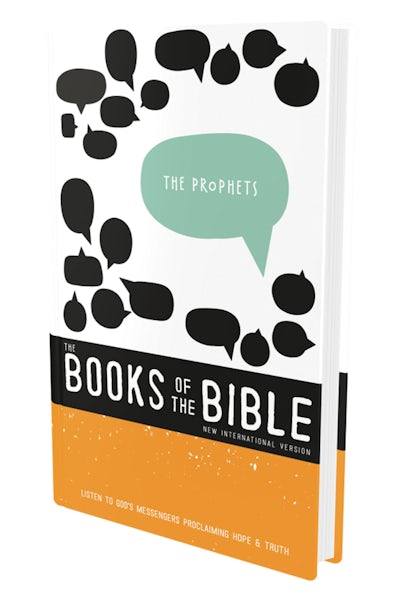
The Books of the Bible: The Prophets from Zondervan

Were Daniel and his friends eunuchs?

Q. Were Daniel and his friends (Shadrach, Meshach, and Abednego) eunuchs?

This is an important question because the answer helps inform how the community of Jesus’ followers should relate to those who are not able to have children.

The book of Daniel tells us that these young exiles were taken to Babylon and placed in the care of the “chief of the eunuchs” (ESV).  The Hebrew word is saris, the specific word that was used to describe a man in the ancient world who had been emasculated in order to fill a religious or governmental role.

However, saris also came to have a more general meaning, “government official,” not implying emasculation, because those who were actually eunuchs eventually filled a variety of important positions, after first being used to guard royal harems. Potiphar in Genesis, for example, is called a saris even though he is married (the ESV calls him an “officer”).  And according to Jeremiah, the Judean kings had officials known as sarisim (the plural) in their courts, even though emasculation was strictly forbidden in the law of Moses and, to discourage the practice, eunuchs were excluded from religious and civic life in ancient Israel.  So these Judean officials were likely not emasculated, either.

So we see that the Hebrew word saris, used to describe Daniel and his friends, can  mean either a literal eunuch, or more generally a government official.  For this reason the NASB calls the Babylonian officer in charge of Daniel and his friends the “commander of the officials,” the NLT calls him the “chief of staff,” and the NIV the “chief official.”

So how can we tell whether saris in the story of Daniel and his friends is being used in the literal sense, meaning “eunuch,” or in the more general sense, simply meaning “government official”? We have two clues elsewhere in the Bible that suggest the literal meaning is actually in view.

After Hezekiah shows the Babylonian envoys all the treasures of the kingdom of Judea, the prophet Isaiah warns him, “All that is in your house, and that which your fathers have stored up till this day, shall be carried to Babylon. . . . And some of your own sons, who will come from you, whom you will father, shall be taken away, and they shall be eunuchs [sarisim] in the palace of the king of Babylon.”  If this simply meant “leading officials,” it would not be an ominous warning of judgment.  But if it meant “eunuchs,” then it would be as dreaded an outcome as the plundering of the entire royal treasury, because (in addition to the dishonor already associated with being a eunuch) it would represent the destruction of the kingdom’s future hope in addition to its past heritage.  So this is likely a prediction that some Judean exiles of royal blood, such as Daniel and his friends, would be made eunuchs by the Babylonians.

The other clue comes after the time of exile.  The book of Isaiah addresses two groups of people who would have come back to Judea with the returning exiles but who would have wondered whether they had any place in the restored community.  The response to them is a splendid passage that is worth quoting in its entirety:

Let not the foreigner who has joined himself to the Lord say,
    “The Lord will surely separate me from his people”;
and let not the eunuch say,
    “Behold, I am a dry tree.”
For thus says the Lord:
“To the eunuchs who keep my Sabbaths,
    who choose the things that please me
    and hold fast my covenant,
I will give in my house and within my walls
    a monument and a name
    better than sons and daughters;
I will give them an everlasting name
    that shall not be cut off.

And the foreigners who join themselves to the Lord,
    to minister to him, to love the name of the Lord,
    and to be his servants,
everyone who keeps the Sabbath and does not profane it,
    and holds fast my covenant—
these I will bring to my holy mountain,
    and make them joyful in my house of prayer;
their burnt offerings and their sacrifices
    will be accepted on my altar;
for my house shall be called a house of prayer
    for all peoples.”

The basis of inclusion in the community is now simply faithful covenant-keeping.  The former restrictions against eunuchs and foreigners, which had the original important intention of protecting the community from pagan religious influences and practices, are now superseded by a more vital consideration in these post-exilic circumstances.

But more specifically to our point here, it appears that some Judeans had indeed been made eunuchs in the exile, and that is why they were wondering what their place was in the restored community. In light of these two clues it does seem likely, although not altogether certain, that Daniel and his friends were made eunuchs by the Babylonians.

And yet Daniel is one of the most honored and respected figures in the rest of the Bible.  God tells Ezekiel, for example, “When a land sins against me by acting faithlessly, and I stretch out my hand against it . . .even if these three men, Noah, Daniel, and Job, were in it, they would deliver but their own lives by their righteousness.”  That’s pretty good company for Daniel to be in.  And Jesus himself honored Daniel as a prophet and spoke of his visions being fulfilled.

So while we should grieve at the cruelty that Daniel and his friends suffered at the hands of the Babylonians, we should also recognize that if a person is not able to have children, for whatever reason, this does not mean that they should be treated as a second-class citizen (or even worse, as unwelcome) in the community of Jesus’ followers.  Instead, they should be seen as someone potentially with faith and gifts as great as Daniel’s.  The community should provide encouragement and opportunities for every such person to serve and share fully in its life, so that they may have “a monument and a name better than sons and daughters in God’s house and within His walls.”

Briton Rivere, “Daniel in the Lions’ Den” (1890). One of several incidents in Daniel’s life that expressed his great faith and courage.

Is it possible to sin in your dreams?

Q. Is it possible to sin in dreams? Do you think that dreams in any sense reflect one’s state of morality absent of inhibitions or consequences? Do you think that they serve as warnings in terms of what might be the consequences of various actions? Or are they just dreams and shouldn’t be paid much attention?

Whether it’s possible to sin in a dream depends on what sense of sin is in view.

The Bible envisions sin in two different senses. In one sense it’s conscious willful disobedience to the known wishes of God, or, put more simply, doing something that you know is wrong.  This involves a choice of the will, and that’s why it’s not possible to sin in this sense in your dreams.

Dreams are symbolic subconscious expressions of our imagination, impulses, wishes, and desires.  They tend to depict something we want to happen, or else something we don’t want to happen, or they represent the realization of something that’s been apparent before us but hasn’t previously registered in our consciousness. (In this last sense a dream may indeed serve as a warning.)

We are not morally responsible for every idea that pops into our heads, every thought that flits through our minds, or every feeling or desire that wells up inside us.  So dreams don’t really reflect what we would be like morally if we had no consequences to fear.

What we are responsible for is what we choose to do with these things that come into our minds and show up in our dreams. It’s not a sin to become angry with someone, for example.  (The Bible itself says, “Be angry, but do not sin.”)  But it is a sin to choose to take a further step and hold a grudge, plot revenge, or lose our temper and become verbally or physically abusive.

For example, suppose you have an argument with someone during the day.  That night, you dream about killing them.  This is not a sin.  It’s the expression of a feeling.  But when you wake up, you are morally responsible for what you choose to do in response to that feeling, which you have now become vividly aware of.  Following the Bible’s teaching, you should seek forgiveness and reconciliation with that other person.

In other words, what happens in dreams represents only the first stage in the process–an idea, or wish, or desire.  Since our wills are not active in our dreams, but instead our unconscious mind paints a lively symbolic scenario based on an idea, wish, or desire, there is no moral culpability–no sin–on our part, no matter what happens in the dream.

But as I said, there is another sense in which the Bible envisions sin.  It’s also a force that’s active within us to shape our thoughts, words, and actions towards evil, in ways we are often not aware of.  This force is active even in our dreams.  The very things we imagine, desire, and wish for are not necessarily morally neutral, but influenced by the force of sin.

And in that sense, while we still do not sin in our dreams, we dream while under the influence of sin, and so the way we put things together in our heads while dreaming, the way we organize the events and incidents of the day and week while we are asleep, may be “sinful” in the sense that it does not reflect God’s perfect balance of love and justice, but rather some skewed version of it that appeals to us in our sinful state.

So while we still do not need to “repent” of anything that happens in our dreams in the sense of confessing guilt and asking forgiveness, we do need to “repent” in the literal sense of re-thinking the way we have put things together in a dream, critiquing that apparent resolution or aspiration in light of biblical teaching prayerfully under the guidance of the Holy Spirit, in the full light of day.


Marc Chagall, “Jacob’s Dream.” Jacob’s dream represented a recognition of the holy place he was in and of the God who had come to meet him there.

Did Jesus and Paul have different focuses in their teaching–the kingdom of God vs. salvation by grace?

Q. Why does Jesus seem to focus so much on “the kingdom of God” while Paul seems to focus on “salvation by grace”? Are they two sides of the same thing, or are they different focuses?

I think it is fair to say that Jesus’ teaching was essentially about the kingdom of God.  That’s how Matthew, Mark, and Luke actually summarize his teachings in their gospels—in Luke, for example: “Jesus traveled about from one town and village to another, proclaiming the good news of the kingdom of God.”

But I don’t think it’s quite accurate to say that Paul’s teaching is essentially about salvation by grace.  As Gordon Fee has shown quite convincingly in his book God’s Empowering Presence (abridged in Paul, the Spirit, and the People of God), we actually have that impression about Paul because we read him through the eyes of the Reformation.

The Reformers were trying to respond to a situation in which salvation was being depicted, explicitly or implicitly, as the result of works.  Beginning with Luther, the Reformers found in the opening parts of epistles such as Galatians and Romans a strong insistence that salvation is by grace alone, through faith alone, and they made this the centerpiece of their response.  All Protestants are heirs of the Reformation and so we see Paul through this lens.

But Paul was not actually writing to counter people who taught salvation by works.  Rather, he was correcting the teaching that salvation was by grace and sanctification was then by works—specifically works such as circumcision (the main issue in Galatians) or keeping kosher and Jewish festivals (as in Colossians).

So Paul emphasizes salvation by grace, not works, in the earlier parts of such epistles so that he can make the argument that sanctification should and must come by similarly by God’s work in us, not our work for God.  As he challenges the Galatians, “Are you so foolish? Having begun by the Spirit, are you now being perfected by the flesh?”

This reference to the Spirit is the key element.  Paul’s opponents said that people, once saved by grace, needed to be trained and restrained by the law; otherwise, what would keep them from running wild?  Paul countered that the transforming influence of the Holy Spirit in believers’ lives would change them into people who desired and delighted to obey God.

But the very fact that the Holy Spirit was and operating in this fashion was, for Paul, evidence that the “age to come” or the “kingdom of God” was breaking into human history.  In other words, the essential incentive to live by the Spirit and not by the flesh is that we are already citizens and heirs of the kingdom of God.

Towards the end of Romans, for example, Paul turns aside a legalistic concern for sanctification through keeping kosher in favor of the transforming influence of the Spirit by explaining, “The kingdom of God is not a matter of eating and drinking but of righteousness and peace and joy in the Holy Spirit.”  And he warns the Galatians against the “deeds of the flesh” by reminding them that “those who do such things will not inherit the kingdom of God”—in other words, those who will inherit the kingdom of God do not do such things.

So we see that the notion of the “kingdom of God” is not an emphasis that’s central to Jesus’ teaching but missing from Paul’s.  Rather, for Paul the presence of the kingdom is evidenced in the coming of the Spirit and in the Spirit’s transforming influence, which allows people not only to be saved by grace rather than works, but also to be sanctified by the Spirit rather than by works.

(This is only a brief overview; I develop this understanding further in my study guides to Paul’s Journey Letters and Paul’s Prison Letters.)

(Also see the series of four posts that begins here for a further discussion of how the teaching of Jesus compares with that of Paul: “How does New Testament teaching progress from Jesus to Paul?”)

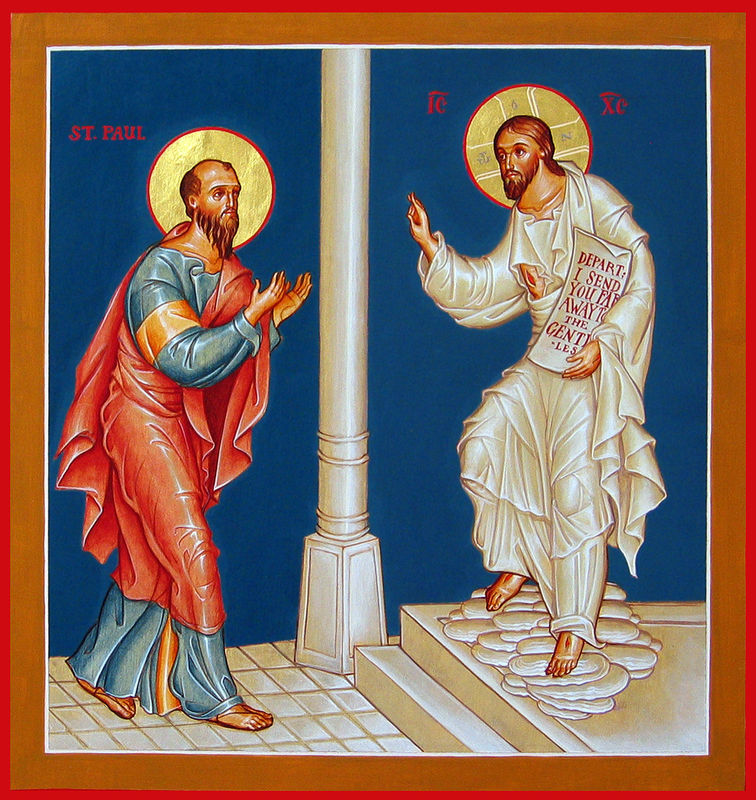
An icon depicting Paul receiving his apostolic commission from Jesus.

How could David’s sons have been priests?

In my last two posts I’ve been exploring the boundary God established between kings and priests in ancient Israel.  Saul was rejected as king, I argued, because he overstepped that boundary by offering sacrifices; this was likely an indication of the aggrandizing direction his rule and dynasty would have taken had they continued.  David, by contrast, didn’t actually overstep the boundary when he ate the consecrated bread, since this was a priestly privilege but not a priestly function (and in addition,David wasn’t yet king at that point, although he had been anointed).

Before I leave the topic of the king-priest boundary I’d like to address one more question related to it.  The book of Samuel-Kings lists David’s royal officials once he has been established as king in Jerusalem, and at the end of this list it notes, “David’s sons were priests.”  How could they have been, when only Levite descendants of Aaron were supposed to be priests?  As I asked last time, was David trying to go through the “back door”  and set up a priest-king dynasty starting in the next generation?

Some have suggested that the Hebrew word kōhēn, the general word for priest through the Old Testament, may have either another meaning or a broader meaning (“as a term of grandeur and position, rather than specifically tribal priest,” as noted here), so that what is really intended is that David’s sons served as royal advisors. The NIV observes in a footnote that the parallel passage in Chronicles says they were “chief officials” and suggests that this could be the meaning in Samuel-Kings as well.  However, because the term kōhēn so commonly means priest, and it could so easily have been misunderstood to mean that in the case of David’s sons, I doubt any biblical writer would have used it in such a sensitive context when less ambiguous terms were available.

Another suggestion, also noted here, is that David’s sons were in charge of the priests.  In this understanding, the statement about them should be understood together with the description of the preceding official and it should all be translated, “Benaiah son of Jehoiada was over the Kerethites and Pelethites and David’s sons were [over the] priests.”  However, I don’t think this really works syntactically.  There is no article (“the”) before “priests,” and there would be no need for the verb that follows directly afterwards if the meaning were being carried forward from the previous phrase.  To me it’s a pretty clear statement in Hebrew:  “sons-of David priests were.” Besides, it was the chief priest of Israel who was supposed to be in charge of all the other priests; usurping that role would be no less a violation of the king-priest boundary.

So the explanation that makes the most sense to me is that David’s sons were considered priests in the order of Melchizedek.  As I explain in this post, quoting from my study guide to Deuteronomy and Hebrews, “After the Israelites conquered Jerusalem, their own kings took over the title Melchizedek from the Jebusite kings who formerly ruled there. Since those kings had also been priests, the Israelite kings  assumed an honorary role as priests and interceded for the nation in prayer. But they were not allowed to offer sacrifices; this was reserved for the descendants of Aaron under the law of Moses.”  “Accordingly,” as the New American Commentary explains, “Davids sons would have possessed the inherited title and performed whatever duties were associated with the office.”  But these duties would not have included any of the functions reserved for the Levitical priests, so that there would have been no violation of the king-priest boundary.

It’s interesting to realize that Jesus Christ himself may therefore have become a priest in the order of Melchizedek as an heir to the throne of David–not through descent from the tribe of Judah, as the book of Hebrews carefully notes, reserving the hereditary priesthood for the Levites–but by way of royal succession.

If Saul wasn’t allowed to offer sacrifices, why could David eat the consecrated bread?

This question was asked in a comment on my previous post.

Q. I agree with you that Saul was wrong to offer sacrifices, but I think you also need to explain how you see David eating the bread of the presence. (Jesus refers to this episode in Matthew, Mark, and Luke.) In both cases the royal/priest boundary was crossed.

You’re right that both Saul and David did things that only priests were supposed to do.  And as I observed last time, it was extremely important in ancient Israel that the monarchy and the priesthood not be combined. So we do need to account for why Saul is punished for his actions while David is not.

This issue arises again during the reign of Uzziah, and in his case, the nature of the offense is made very explicit:  “But after Uzziah became powerful, his pride led to his downfall. He was unfaithful to the Lord his God, and entered the temple of the Lord to burn incense on the altar of incense. Azariah the priest with eighty other courageous priests of the Lord followed him in. They confronted King Uzziah and said, ‘It is not right for you, Uzziah, to burn incense to the Lord. That is for the priests, the descendants of Aaron, who have been consecrated to burn incense. Leave the sanctuary, for you have been unfaithful; and you will not be honored by the Lord God.’”

For crossing the royal/priest boundary, Uzziah was struck with leprosy and he lived out his reign in seclusion, with his son acting in his place as regent.  For the same offense, Saul was rejected as king. So you’d think that God would have had as much of a problem with David eating the consecrated bread as He did with Saul offering sacrifices or Uzziah burning incense.  But instead, Jesus cites David’s actions as a precedent for his own disciples lawfully plucking and eating grain as they travel through a field on the Sabbath.  In Matthew and Luke, this incident is paired with a Sabbath healing episode, suggesting that David also provides a precedent for Jesus healing on the Sabbath.  In other words, his actions are seen as positive and exemplary, not negative and dangerous.

So what’s going on here?  I think the best explanation is that there is a distinction between the privileges of a priest and the functions of a priest.

One of the privileges of a priest is that “those who serve in the temple get their food from the temple, and . . . those who serve at the altar share in what is offered on the altar,” as Paul observes in 1 Corinthians when arguing for his own right to be supported as an apostle. In other words, as Leviticus explains, once consecrated bread has been replaced with fresh bread and removed from God’s presence, it “belongs to Aaron and his sons, who are to eat it in the sanctuary area, because it is a most holy part of their perpetual share of the food offerings presented to the Lord.”  So no one but the priests had a right to this bread, as it was part of the priests’ support.  But Ahimelek the priest was nevertheless free to share this bread with David and his hungry companions–to “do good,” as Jesus put it, with the food at his disposal.  David was not arrogantly demanding priestly privileges for himself as king; he wasn’t even king yet at this point.  He was simply a hungry man asking for food and receiving it from God’s sanctuary.

By contrast, both Saul and Uzziah were usurping priestly functions, and in both cases it seems they were doing so as an assertion of their own expanded powers.  This, as I noted last time, threatened to assimilate the Israelite monarchy to the Canaanite priest-king or god-king model, and it could not be allowed.

There’s one more related issue that I’ll take up in my next post.  According to the book of Samuel-Kings, during his reign in Jerusalem, “David’s sons were priests.”  Was David trying to go through the “back door”  and set up a priest-king dynasty starting in the next generation?  I’ll explore that one next time.

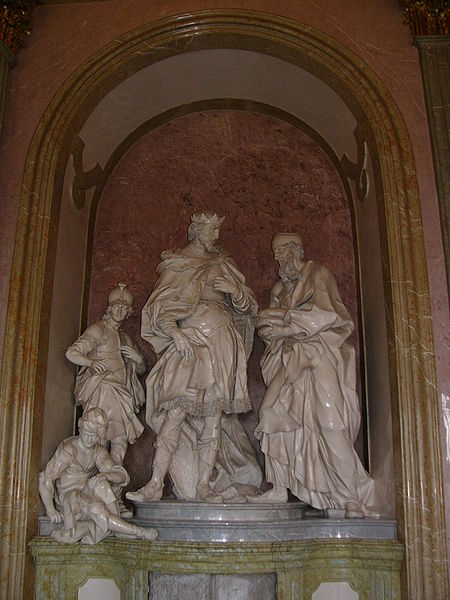
Statuary, “David receives sacral bread from the priest Ahimelech,” in the Ceremoniall Hall of the Hradisko Monastery, Olomouc, Czech Republic. Sculptor: Josef A. Winterhalder, 1734.

If God gave Saul a “new heart,” how could Saul disobey and be rejected?

Q. I recently noticed (for the first time) that God gave Saul a brand new heart when He chose him to be king over Israel. So how could Saul then disobey God, to the point where God rejected him as king?

The Bible does say that God gave Saul a “new heart” (NLT) or “another heart” (ESV) or “changed his heart” (NIV, NASB) when God chose him to be Israel’s first king.  Just before this happened, Samuel told Saul, “The Spirit of the Lord will come powerfully upon you . . . and you will be changed into a different person” (NIV, NLT) or “another man” (ESV, NASB).  The Hebrew word translated “different” or “another” here is the same word used to describe the “new” or “changed” heart.

So this definitely seems to be genuine spiritual rebirth–both regeneration and Spirit-filling.  And there is evidence of it in Saul’s subsequent conduct.  At first Saul was so timid that when Samuel wanted to proclaim him king to all the Israelites, Saul hid among the supplies!  But soon afterwards, galvanized by God’s Spirit, Saul boldly led a successful campaign to rescue an Israelite city that was being besieged by a longtime deadly foe, the Ammonites.  In the wake of this success, Saul was given the opportunity to put to death all those who had opposed his kingship.  But he insisted that their lives be spared.

So what went wrong?  After Saul had been king for many years, he was facing another dangerous foe, the Philistines.  Samuel agreed to come and offer sacrifices to seek God’s favor on Israel’s army, but when he didn’t arrive at the appointed time, and Saul’s army was so intimidated by their enemies that the soldiers began to desert, Saul decided to offer the sacrifices himself.

Samuel arrived just then and when he saw this he told Saul, “You have done a foolish thing. “You have not kept the command the Lord your God gave you; if you had, he would have established your kingdom over Israel for all time. But now your kingdom will not endure; the Lord has sought out a man after his own heart and appointed him ruler of his people, because you have not kept the Lord’s command.”

Why was offering the sacrifices such a severe violation that it cost Saul his kingdom?  Because God had carefully separated the kingship from the priesthood in the law of Moses.  The kings of the surrounding nations, by contrast, were priests; some were even revered as gods.  But God wanted the Israelites always to understand that He alone was their God, and He wanted them always to seek him through the priests who were descended from Aaron, whom He had chosen as Israel’s first high priest.

But Saul, most likely influenced by the example of the kings of the nations around him, did not hesitate to try to concentrate the roles of king and priest together in his own person, contrary to God’s design for the nation.  This led to disobedience and a break with Samuel’s godly influence, and it was all downhill from there.

The lesson is that a new heart and the filling of the Spirit are necessary but not sufficient conditions for a life that remains true to God.  We also have to be very careful of the examples around us that we allow to influence our thinking and conduct.  We need to pick our friends and role models carefully, and be careful what we watch and what we think about it.  We also need to be aware that the temptations we encounter in a position of power and influence are much greater than ordinary temptations. Otherwise, even genuinely reborn and Spirit-filled people like Saul–or ourselves–can be led down the wrong path.

John Singleton Copley, “Samuel Reproving Saul” (1798)