Was James a carpenter like his half-brother Jesus?

Q. We’re using your study guide to biblical wisdom literature in our Sunday School class.  We’re currently studying the book of James and we have a question about its author, the half-brother of Jesus.  Would he have been a carpenter too?

John Everett Millais, “Christ in the House of His Parents” (“The Carpenter Shop”), c. 1849. Is this how we should understand the biblical references to Jesus as a “carpenter”?

The place to begin answering this question is by asking whether Jesus was actually a carpenter himself.  Mark records in his gospel that when Jesus returned to Nazareth and taught in the synagogue there, the hometown crowds were amazed at his wisdom and power and asked, “Where did this man get these things? . . . Isn’t this the tektōn?”  In Matthew‘s version of the same episode, the people ask, “Isn’t this the son of the tektōn?”

In these cases the Greek term tektōn is traditionally translated “carpenter,” and this has led to popular pictures of Jesus at work with his father in a carpenter’s shop, building tables and chairs for friends and neighbors.  But the term actually has a broader meaning.  In classical texts in can refer to a worker in wood (for example, someone who makes plows and yokes for farming).  But it can also refer to a “joiner,” that is, a construction worker who puts together buildings out of wood.  In other texts it describes workers in stone, i.e. masons, and in rarer cases it even describes a metal-worker.

So we should really understand tektōn to mean something like “construction worker.”  This gives us a very different picture of Jesus from the one that has him working in the family carpentry business.  Jesus most likely took construction jobs wherever he could find them, such as over in the larger city of Sepphoris near Nazareth.  He was, in effect, a day laborer. This helps us appreciate, for one thing, how Jesus shared all aspects of our human condition during his incarnation, including uncertainty over employment.

But knowing the broader meaning of the term tektōn also helps us appreciate that Jesus may have been regarded as socially inferior by many in his home town because of his occupation.  The word seems to have those associations.  For example, according to Walter Bauer’s Greek-English Lexicon, Aristoxenus says that the father of Sophocles was a tektōn. But the Life of Sophocles rejects this idea and suggests instead that the father may have had tektōnes among his slaves.  So the occupation was considered lower class and perhaps even dishonorable.

This gives a more dismissive and condescending ring to the comments Jesus heard from the townspeople when he returned to Nazareth.  But this is another way in which Jesus “made himself nothing” and took on the “nature of a servant” when he came to earth, as Paul says in Philippians.

And as for his half-brother James, if the father and the eldest brother were each a tektōn, then it’s likely that this was a landless family of day laborers and that all of the brothers would have worked in this same profession.  One can easily imagine people from Nazareth hearing the wisdom teaching that was later collected in the book of James and wondering similarly, “Where did this man get these things? . . . Isn’t this the tektōn?”

Does God command particular actions because they are morally right, or are actions morally right because God commands them?

Q. How would you answer the “Euthyphro Dilemma,” that is, the question that asks, “Does God command particular actions because they are morally right, or are they morally right because God commands them?” If you accept the first option, it would seem that God is not the basis of morality, but is simply a “recognizer” of morally right things. On the other hand, if an action is morally right because God says so, it means that it could be potentially morally right and obligatory to inflict pain and suffering on others. There is more to the discussion than just that, obviously, but I was just wondering which (if either) path you tend to favor and how you answer this “dilemma”?

(This question was asked in a comment on my recent post on the topic “Why does the Bible say it’s wrong to have sex outside of marriage?” because I said both that God had set apart sex as holy and that sex was intrinsically holy.)

The “Euthyphro Dilemma” (so called because it is first raised in Western literature and philosophy in Plato’s dialogue Euthyphro) is a truly vast question that has received much consideration over the whole history of Christian moral theological reflection. I won’t be able to do much justice in a short blog post, but let me say briefly that I’m among those who consider this actually to be a false dilemma.  I believe that the inherent moral structure of the universe reflects the character of the God who created it, and that God’s own assessment of actions (whether they should be commanded or forbidden) similarly reflects His own character, so we don’t have to choose between where we think the rightness or wrongness of an action should be grounded.

From this perspective of mine, there’s no problem of God being subject to a moral authority outside himself. There’s also no problem of anything morally questionable that God might command (such as lying, killing, etc.) being “good,” because we have things like conscience and natural law, built into the moral fabric of the universe, to help us recognize that when God does tell people to do such troubling things, this must be under exceptional circumstances and for exceptional reasons that are somehow justifiable.

However, there still are a couple aspects of the question that remain something of a “dilemma” for me.  First, exactly what is going on in those “exceptional” circumstances?  How could a good God command lying or killing at all?  I’ve discussed this in some other posts on this blog; for example, for lying or deception, see the series of posts that begins here; for killing or “holy war,” see this post.  I say in these posts that these “exceptional” cases are among the most difficult and troubling passages in the entire Bible for thoughtful readers, and so in saying that I consider the Euthyphro Dilemma to be a false dilemma, I don’t want to minimize that at all.

The second aspect of the question that remains a dilemma is that there is no outside standard by which to determine whether what God has generally commanded and built into the moral fabric of the universe as an expression of His own character is objectively good on any other basis.  We are, in effect, “trapped” within the creation of this God, and as His creatures we can only flourish within it by conforming ourselves more and more to His character.  Now personally I have no problem with this!  But for those who might want to be able to hold God accountable to some objective standard, that actually isn’t possible.  (This is one of the main issues raised and debated in the book of Job, as I show in my study guide to that book.)

Nietzsche argued that the Christian ethic of love, compassion, humility, and forgiveness bred “weaklings” who failed to assert themselves, as they should, in acts of power against other creatures.  Nietzsche didn’t believe in God, but if he did, he would no doubt have said that the wrong kind of God had made our world and given us the wrong kind of guidance in our tender consciences and innate sense of fair play.

There’s no way to answer such a perspective, which is really an expression of faith in a way of life opposite to the one the Christian faith teaches, except by faith itself.  We can’t prove that we love and serve the best possible God from within a beautifully ordered moral universe of His creation.  We can only say that as we are getting to know Him and serve Him better and better, this certainly seems to be the case.  We have to take all the rest on faith.

The meaning of Daniel’s seventy weeks

Q.  . . . Which elements of dispensationalism do you most find fault with? Perhaps you could touch on your understanding of Daniel’s seventy weeks, the “great” tribulation, and the status of the nation of Israel in regards to the promises God had made specifically to it in the Old Testament.

I answered the first part of this question more generally in my last post. Let me address here some of the specifics you’ve asked about.

Daniel’s “seventy weeks” are literally “seventy sevens.”  Dispensational interpreters take this to mean seventy periods of seven years each, and they understand the “great tribulation” described in Revelation to be the last of these periods. The events that will take place over this whole period of time are described at the end of Daniel’s third vision.  There the angel Gabriel explains:

The archangel Gabriel, depicted in a fresco in a church in Tsalnjikha, Republic of Georgia

“Seventy ‘sevens’ are decreed for your people and your holy city to finish transgression, to put an end to sin, to atone for wickedness, to bring in everlasting righteousness, to seal up vision and prophecy and to anoint the Most Holy Place. Know and understand this: From the time the word goes out to restore and rebuild Jerusalem until the Anointed One, the ruler, comes, there will be seven ‘sevens,’ and sixty-two ‘sevens.’ It will be rebuilt with streets and a trench, but in times of trouble. After the sixty-two ‘sevens,’ the Anointed One will be put to death and will have nothing. The people of the ruler who will come will destroy the city and the sanctuary. The end will come like a flood: War will continue until the end, and desolations have been decreed. He will confirm a covenant with many for one ‘seven.’ In the middle of the ‘seven’ he will put an end to sacrifice and offering. And at the temple he will set up an abomination that causes desolation, until the end that is decreed is poured out on him.”

As I explained last time, John Nelson Darby, who developed dispensationalism as we know it today, believed that the Jewish nation would replace the multinational community of Jesus’ followers as the people of God on earth at the end of history.  And so he was inclined to apply these words to the Jews and to believe that they would be fulfilled in the “end times,” as world history reached its culmination.

But expecting a future fulfillment of biblical words like these inevitably involves much speculation, and continual revision as world events overtake whatever scenario is originally conceived.  That is why you are probably familiar with numerous timetables for how these “seventy sevens” play out and various versions of the “great tribulation” or last “seven” at the end.

I think it is more responsible, and more in keeping with the way we interpret the rest of the Bible, to ask first whether Gabriel’s words in Daniel’s third vision might not already have had their specific historical fulfillment, so that anything we can anticipate in the future will be something analogous, not something directly predicted.  Here’s what I say about this in my study guide to Daniel and Revelation:

– – – – –

Biblical scholars have discussed and debated Gabriel’s words extensively, but they haven’t reached any consensus about how to interpret them.  It’s not obvious how they line up with events in later history, and attempts to explain them can quickly become speculative and fanciful.  One observation we can make, however, is that many of the details Gabriel provides seem to correspond with events in the reign of Antiochus IV Epiphanes:

– “The anointed one will be put to death” may describe the murder of the Jewish high priest Onias by his rival Jason in 171 B.C.;
– “He will make a covenant with many” may refer to the agreement Antiochus made with the Jewish nation once Jason seized power;
– “In the middle of the ‘seven’ he will put an end to sacrifice and offering” may describe how Antiochus suppressed Jewish worship three and a half years after making this agreement;
– “He will set up an abomination that causes desolation” may indicate how Antiochus desecrated the temple;
– “The end that is decreed is poured out on him” could describe Antiochus’s sudden death from disease in 164 B.C.

The explanation of what Daniel found “beyond understanding” in the previous vision, therefore, is that the temple, desolate in his day, will be rebuilt, but then desolated again by an evil ruler who will ultimately be judged by God. This is a further warning to God’s people that they need to be faithful, even to death, and refuse any compromise.  It’s still not evident, however, how the “seventy sevens” get the reader down to the time of Antiochus from Daniel’s day.  So, much remains to be understood in this fascinating but cryptic prophecy.

– – – – –

You can see that I take quite a different view from the one that characterizes dispensationalism.  But it’s because my interpretive presuppositions are so different.  In the same study guide I explain the four ways that the book of Revelation is interpreted, and the same approaches can be taken to the book of Daniel:

– – – – –

The book of Revelation is interpreted in four major ways.  The futurist approach understands it to be a description of the events of the “end times,” at the end of human history.  (Works like the novels and movies in the Left Behind series follow this approach.)  The historicist view sees the book as a prediction of the whole course of history, from Jesus and the apostles down through the present to the end of the world.  The idealist interpretation is that Revelation depicts the struggles and triumphs that followers of Jesus will experience everywhere, but it doesn’t have any particular place or time in view.  The preterist approach is to try to understand the book by reference to the time and place it was written in–western Asia Minor towards the close of the first century.

– – – – –

After this review of approaches I explain, “This study guide will consistently pursue a preterist interpretation.  If this is new for you, and you’re much more used to hearing the book treated differently, just try to keep an open mind and look for the potential benefits of this approach as you and your group do the following sessions together.”  I should say the same thing about the posts on this blog!

One last item you asked about was “the status of the nation of Israel in regards to the promises God had made specifically to it in the Old Testament.”  Let me refer you to this post for my thoughts on that.  And yes, that post, too, is written from a preterist perspective.


Why doesn’t God actively judge today, as in the Bible?

This question, like the one I answered last time, was asked in a comment on my post about “Why did God create Satan?”

Q. If God is the same, yesterday, today and forever, why is He not dealing with our immoral, worldly society as He so often did in the Bible? Be it the flood, Sodom & Gomorrah, or any other references, He did not drag His feet, so to speak, and rendered swift judgment. The more I read the Bible, it seems like there are actually three different Gods in one, in the regard of how He was, is and will be.

At least as I understand it, the statement in Hebrews that “Jesus Christ is the same yesterday and today and forever” was intended to encourage second-generation followers of Jesus to hold fast to the faith they had been taught by His first-generation followers. (Right before this statement the author says, “Remember your leaders, who spoke the word of God to you. Consider the outcome of their way of life and imitate their faith.”) So this not so much an assertion that God, over the course of the whole Bible, has never changed the way He deals with humanity as it is a claim that we can continue to have confidence in the gospel, the good news about Jesus and what he has done for us, even though those who personally witnessed his earthly ministry have long passed away.

As for whether God deals with humanity differently now than He did in the Bible, here’s what I said about that in response to the question, “Does God change over the course of the Bible?”:

“From the start we see that God is consistent in his character qualities:  creative, loving, generous, merciful even in judgment, and so forth. But these qualities do seem to get expressed in different ways as the divine-human relationship unfolds over the course of the Bible.  . . . For example, when humans turn out to be so wicked, God regrets making them and destroys almost all of them through the flood.  But afterwards, recognizing that ‘every inclination of the human heart is evil from childhood,’ he resolves never to destroy them all again.”

In other words, to use one of the examples you cited—the flood—God says explicitly in the Bible that He will not again respond to human wickedness the way He did at that time. I suggest in the same post I just quoted that “God himself actually changes in terms of how much relational experience He has with humans.” So it is not so much a case of there being three different Gods—a past judgmental one, a present merciful one, and a future judgmental one—but a matter of God’s relationship with us changing as it unfolds over history and experience.

The prelude to the gospel of John says that “the law was given through Moses; grace and truth came through Jesus Christ.” So we today are very blessed to live in a period of redemptive history when the mercy that is always balanced with justice in the character of God is at the forefront. But we must be careful not to presume on that mercy, but remember, in light of all the judgment passages you mentioned, as Peter writes in a long and unforgettable sentence (with which I will close):

“If God did not spare angels when they sinned, but sent them to hell, putting them in chains of darkness to be held for judgment; if he did not spare the ancient world when he brought the flood on its ungodly people, but protected Noah, a preacher of righteousness, and seven others; if he condemned the cities of Sodom and Gomorrah by burning them to ashes, and made them an example of what is going to happen to the ungodly; and if he rescued Lot, a righteous man, who was distressed by the depraved conduct of the lawless (for that righteous man, living among them day after day, was tormented in his righteous soul by the lawless deeds he saw and heard)— if this is so, then the Lord knows how to rescue the godly from trials and to hold the unrighteous for punishment on the day of judgment.”

Why didn’t God protect the children he created from an evil being like Satan?

This question was asked in a comment on my post about “Why did God create Satan?” It reflects the same concern as the person who asked the question I originally addressed in that post: If earthly fathers would do everything they could to protect their children from evil people, why didn’t God protect the children he created from an evil being like Satan?

Q. Even as an earthly father, if I had the ability to place my daughter in a perfect environment and allow her to be spotless and live forever, why would I ever create something evil to tempt her, all the while knowing she would give in?

I don’t believe that God deliberately and intentionally made a creature whose role would be to tempt humans to do wrong and so forfeit their innocence and their place in an earthly paradise. As I tried to explain clearly in my original post, I believe that God created Lucifer, not Satan, an angel with great powers and the awesome responsibility of choosing how to use those powers. There was as great potential for good as there was for evil. Unfortunately Lucifer fell through pride and so became Satan.

I also don’t believe that God knew in advance that Eve and Adam would inevitably give in if they were tempted and deceived. I believe they were given freedom that was so genuine that what they would ultimately choose was unknowable in advance.

I am aware of a stream within theology (technically known as “infralapsarianism”) that says God ordained the fall so that it would become the occasion for redemption. This is the felix culpa or “happy fall” idea expressed in the traditional Latin mass for the Easter vigil:
O felix culpa quae talem et tantum meruit habere redemptorem =
“O happy fault that merited such and so great a Redeemer.”
I personally see such serious implications for the character of God that I don’t celebrate the fall in these terms.

I’m rather what’s known as a “supralapsarian.” God did not ordain the fall, but once it happened, God worked from “above” it, not from “within” it, to bring about our redemption. For me this idea preserves God’s love and human freedom even while it correctly portrays God as the sole agent of our salvation.

I hope these further thoughts are helpful.

What “sea creatures” had been “tamed” in New Testament times?

Q. I am doing the James sessions from your wisdom literature study guide in my Sunday School class and this question came up: When James is talking about taming the tongue, he says, “All kinds of animals, birds, reptiles and sea creatures are being tamed and have been tamed by mankind.” What “sea creatures” had been tamed by the time of the early church?  (Dolphins??) Or does “tamed” means subdued or mastered rather than domesticated?

Rather than having specific “sea creatures” in mind that humans had trained and domesticated, I think James here is using another one of those “marvelous Hebrew expressions for totality” that I also discuss in this post.  In effect, he means that “every creature” can be at least subdued, if not tamed, by humans.  (The verb is damazō and in this context, as you suspect, it more likely means “subdued” or “controlled” than “tamed” or “domesticated.”)

One way the biblical authors speak of every creature is to refer to “the beasts of the field and the birds of the air and the fish of the sea,” as Hosea does, echoing the three-part division of the creation in Genesis into land, sky, and sea.  But sometimes the land creatures are subdivided, as when Zephaniah speaks of “man and beast . . . the birds in the sky and the fish in the sea.”

Another distinction among land creatures is between those that go on all fours and those that creep on the ground.  In the Genesis creation account, on the sixth day God makes “the livestock according to their kinds, and all the creatures that move along the ground according to their kinds.”  Significantly, the word used in the Septuagint or Greek New Testament for creeping creatures is herpetos, the same word that’s translated “reptiles” in James.  It should probably be understood with this broader meaning there.

This allows for a fourfold division of all creatures, such as appears in God’s words to Noah after the flood in Genesis:  “The fear and dread of you will fall on all the beasts of the earth, and on all the birds in the sky, on every creature that moves along the ground, and on all the fish in the sea.”  (In this case, the Septuagint uses the Greek word for “moving” rather than herpetos, but the same distinction is in view.)

In the story of Peter’s vision in Acts, the narrator says similarly that the sheet he saw lowered from heaven “contained all kinds of four-footed animals, as well as reptiles [herpeta] and birds.”  When Peter himself describes this vision later in the book, he divides the land animals even further into “four-footed animals of the earth, wild beasts, reptiles [herpeta] and birds,” arriving at the characteristic four-fold division meaning “all creatures” even without citing sea creatures.  Paul does something similar in Romans when he speaks of “images made to look like a mortal human being and birds and animals and reptiles.”

So we should recognize James’ phrase about “animals, birds, reptiles and sea creatures” as his own version of the variable three-fold or four-fold formula meaning “all-creatures.”  It’s important not to think the Bible is providing specifics when it’s speaking generally this way.  Otherwise we get into questions like the one asked in your class that can needlessly call the accuracy and thus the truth of the Bible into question.

More importantly, we might misunderstand James means when he says that “no human being can tame the tongue.”  That’s the whole point he wants to make by drawing his comparison to the taming of creatures.  If we believe he’s making a universal statement, rather than a general one, then we’ll conclude it’s pointless to try to tame our own tongues.  But that is precisely what James is encouraging us to do here.  He says, holding up an ideal standard we should aspire to, “Anyone who is never at fault in what they say is perfect, able to keep their whole body in check.”  More is at stake than just our understanding of the Bible in cases like this; our obedience depends on it.

Henry Davenport Northrop, “Peter’s vision of a sheet with animals,” 1894.

Why does the Bible say it’s wrong to have sex outside of marriage?

Q.  In the Bible, sex before marriage is considered immoral. It’s called the sin of “fornication.”  But the Bible gives no explanation (that I have seen) of why it’s wrong to have sex before marriage. In 1 Corinthians, for example, Paul calls those who do this “sexually immoral.”  But why, why is it wrong? How could having sex, something that all married couples do regularly, be unclean and immoral before two people are married?

This is an excellent question, because we don’t usually consider the morality of an action to depend on its setting or context.  If something is a good thing to do, such as telling the truth, it should be good for everyone, everywhere to do it.  And if something is wrong, such as striking another person in anger and causing them bodily harm, then it should be wrong for everyone, in every context.  Husbands and wives certainly don’t get an exemption that permits them to engage in domestic violence.

So why does the Bible allow and encourage sex within marriage but say it’s wrong outside of marriage?  Why shouldn’t two people who love each other be able to express it in this way even if they aren’t married?

The Bible actually does give the reason why, in places like the book of Hebrews, where it says, “Let marriage be held in honor by all, and let the marriage bed be undefiled.”  But in order to recognize the reason that’s being given here, we need to understand what the Bible means when it uses specific terminology like this.

In the first part of the Bible, in the law of Moses, things are generally considered “common” and “clean.”  But if something is set apart for a special purpose, it becomes “holy” rather than “common.”  And if a person or thing becomes exposed and vulnerable through some breach in its creaturely integrity, that person or thing becomes “unclean.”

“Unclean” doesn’t mean “dirty” or “bad.”  It means that special care and protection is needed, usually involving temporary separation from the community until the breach is repaired.  In the law of Moses things like a skin disease, which breached the integrity of the body’s outer layer, created this kind of ceremonial “uncleanness.”  The example I like to use from modern life is a person who has lost their hair because of chemotherapy treatments.  We usually allow and encourage such a person to stay home or wear a wig until their hair has grown back.  We protect their dignity and preserve a proper sense of who they are by not making them engage others when most of their hair has visibly fallen out.  (Alternatively, I’ve heard of friends and family shaving off their own hair as a gesture of solidarity and identification, so that the person will know that they are loved and unconditionally accepted.  The family and friends are saying, “We know the real you and that’s not affected by superficial considerations.”)

There are two other important biblical terms for us to appreciate.  To treat something holy as if it were common is to “profane” that holy thing.  Jesus spoke of the way the priests “profaned” the sabbath (that is, they treated it as if it were an ordinary working day) because their shifts were scheduled on every day of the week.  (In this case, maintaining continual worship took precedence over sabbath observance for priests whose shifts fell on that day; no individual priests worked seven days a week.)

And to treat something holy as if it were unclean is to “defile” that holy thing.  This is a more serious matter, because in the Bible anything that is made holy—set apart for a special divine purpose—has to be uncompromised in its creaturely integrity.

And this is what the Bible is saying in the book of Hebrews about keeping sex within marriage so that it will be undefiled.  It’s saying that God has made sex “holy,” that is, God has set sex apart for a special reason, and to that end God has limited sex to within marriage.

So what is that reason, and why the limitation?

Is it so that a desire for the pleasure of sex will serve as an incentive for people to commit to marriage?  Well, the pleasure certainly isn’t a disincentive, but pleasure is not the ultimate purpose of sex, and so that’s not the reason why it’s limited to marriage.

Is it so that children who are conceived through sex will be raised in a stable home?  This is another additional benefit of God’s plan, since marriage is meant to provide a stable, loving environment for children, but since procreation is not the ultimate purpose of sex, this is not the real reason, either.

The ultimate purpose of sex is intimacy.  The Bible explains this at its very beginning, in the book of Genesis, when it says that “a man leaves his father and mother and is united to his wife, and they become one flesh.”  It’s sometimes hard for us to appreciate today how revolutionary this statement was in its day.  In ancient cultures (as in some modern ones) blood relations were supreme.  Primary loyalty was owed to one’s family and clan of origin. When a man married, his wife was simply added to the clan as a junior member, and both had to be careful to obey his parents and the other senior members of the clan.

But God’s plan was that husband and wife would create a whole new family of their own, with their primary loyalty being to one another.  They would be “one flesh”—they would belong to one another more than they belonged to their blood relatives.  And this would be established, affirmed, and celebrated through the act of sex, in which the two, for a time, would literally join their bodies together.  The Bible is describing this ideal situation of intimacy when it says that the first couple “were both naked, and they felt no shame.”

So sex was something that already existed (in the animal kingdom, for example), but among humans God made it holy, that is, God set it apart for a special purpose, as the joyful and triumphant expression of the new oneness between husband and wife.

So how does having sex outside of marriage make this holy thing “unclean,” that is, something that makes a person exposed and vulnerable?  Since the ultimate purpose of sex is intimacy, when you make love with someone, you don’t just reveal your body to them.  You inevitably expose your soul—your hopes, dreams, fears, your deepest and most powerful thoughts and emotions.  And God wants this kind of exposure to happen within the protection of an unconditionally committed lifelong relationship, because only within the safety and security of such a relationship can two people help each other explore and work out all the powerful, complicated, and potentially beautiful things they have inside.

In other words, sex for people is actually something that is intrinsically holy.  In other cases God chose things that could just as easily be common to serve holy purposes, and in those cases there could be exceptions to their exclusive use for holy purposes.  Jesus cited the example of David and his men eating the bread that was reserved for the priests to justify his work of healing on the Sabbath.  Bread is just bread, and Saturday is just Saturday, until God chooses to set them apart for other purposes, and sometimes even higher considerations can intervene.

But sex is never just sex.  It always involves the exposure of heart, soul, and body to another person, and God means for that to happen in a context of safety, security, and lifetime commitment—within marriage.  That’s why Paul says in another of his letters, 1 Thessalonians, that if we have sex with another person not in this “holy and honorable” way, but in the “passion of lust,” we sin against and defraud that other person.  In other words, we take something from them that we’re not entitled to:  we take their intimate self-disclosure without providing the security and protection they deserve and require.

These are the reasons that the Bible gives for why sex is to be reserved for marriage.  Now I realize that someone who doesn’t believe in God or in the teachings of the Bible, at least to the extent of believing that God considers some things common and has set other things apart as holy, may not agree with these reasons.  They may feel, in fact, that there are times when sex is just sex and they may believe that there’s nothing wrong with that.  I can’t convince someone otherwise if they don’t share this biblical view of God’s creative purposes.  But for those who do share it, I hope that I have been able to explain here why the Bible teaches what it does about God setting aside sex for a special purpose within marriage.

Why wasn’t Aaron punished for making the golden calf?

Q.  I have some questions about the golden calf episode.

First, when Moses asked who was “for the Lord” and the Levites came to him, he told them to “slay each his brother, his companion, and his neighbor.”  He said, “Consecrate yourselves each upon his son and brother that the Lord may bestow upon you a blessing.” I gather they were slaying fellow Levites as a consecration.  This is hard to understand.

I’m also wondering why Aaron wasn’t punished for his part in the episode. Moses asked him, “What did these people to to you that you caused them to commit such a great sin?”  And Aaron reported correctly, “They asked me to make gods for them because they did not know what had become of you.”  However, Aaron was not removed from his priesthood or slain. He just went on being the respected associate of Moses.

I find all this mysterious and hard to understand.

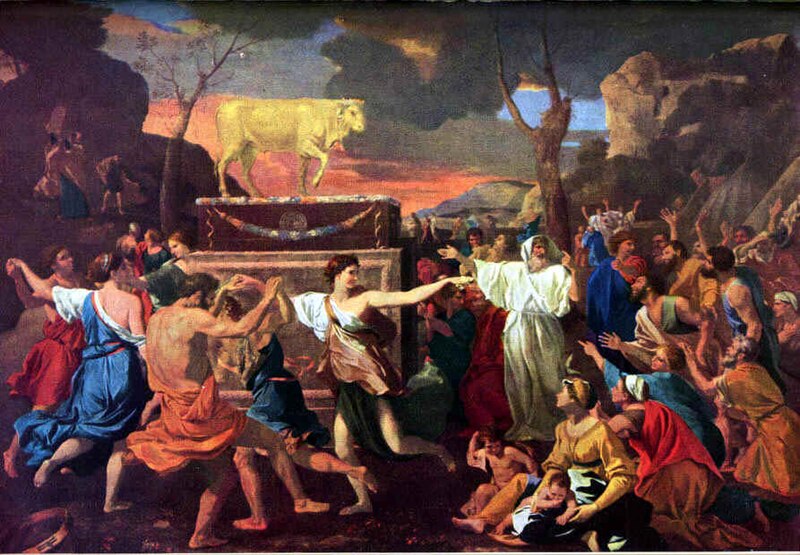
Nicolas Poussin, “The Adoration of the Golden Calf”

I think it helps to realize, to begin with, that in this episode the Israelites didn’t believe they were worshiping a god other than Yahweh.  Rather, they thought they were still worshiping Yahweh, but they were now doing this as if He were a god like the ones the Egyptians and Canaanites worshiped.  Such gods had physical representations in the form of idols, and they were worshiped through immoral revelry.

The episode reveals that to this point the Israelites had been regarding Moses as the physical representation of Yahweh.  That’s why they spoke of him as the one who had “brought them up out of Egypt.” So when he was delayed on the mountain and the people didn’t know what had become of him, they wanted something else to represent Yahweh for them physically.  They “assembled against” Aaron (not just “gathered around” him) and told him to make them a god.  (The Hebrew word is ‘elohim, a plural form that most English versions translate as “gods,” but it should likely be taken as a “plural of excellence” meaning “God,” as the context seems to call for; see the translation note in the NIV.)

Under this pressure, Aaron makes a golden calf, and when the people see the finished product, they exclaim, “This is your God, Israel, who brought you up from Egypt!”  Going along with this identification, Aaron announces, “Tomorrow there will be a festival to Yahweh!”

Unfortunately, if Yahweh were indeed the kind of god who could be represented by a golden calf, then such a festival would involve immoral revelry.  Traditional English versions tend to translate the terms “play” and “dance” in the account with discreet literalism, but the NIV’s “revelry” and “running wild” capture the meaning well.

The people were so “out of control,” in fact, that “they mocked anyone who opposed them,” as a footnoted alternative rendering in the New Living Translation puts it.  Most versions say something like “they were a laughingstock to their enemies,” but as there were no enemies present to observe the incident, I think this NLT alternative captures the sense of the Hebrew term well, which refers literally to those who “stood against” them.

So the people were being recklessly indulgent and they would not listen to their leaders when they tried to restrain them.  it was a near-riot, and desperate measures were called for to prevent the situation from disintegrating completely.  (Otherwise the people might have turned violently against Moses and even killed him.)

And so Moses called out, “Whoever is for the Lord, come to me.”  In other words, “Whoever still respects my leadership and my revelation about what Yahweh is really like, I need your help right away!”  When the Levites rallied to Moses, he told them, ““This is what the Lord, the God of Israel, says: ‘Each man strap a sword to his side. Go back and forth through the camp from one end to the other, each killing his brother and friend and neighbor.’”

This is actually characteristic language referring to all Israelites, not just Levites.  And it was only after the Levites did this to stop the situation from spinning completely out of control that Moses told them, ““You have been set apart to the Lord today, for you were against your own sons and brothers, and he has blessed you this day.”  In other words—in response to your first concern—Moses didn’t say to them, “God will bless you if you slay your fellow Levites.”  He said, after the fact, “Because you were willing to take the Lord’s side, even though this meant killing your fellow Israelites because they were rioting against Him, you have been set apart to the Lord.”  And that was the blessing—being set apart.  The blessing wasn’t something material that was promised in advance as a reward or incentive for taking up the sword.

In response to your second concern, I would suggest that Aaron was not punished for making the golden calf because he did this only when he was pressured by the people.  He may even have feared for his own safety and life if he refused.  He still should not have made the idol, but the responsibility was much more with the people than with him.  (This was a case similar to the one in which Miriam instigated a revolt against Moses’ leadership and enlisted Aaron to support her; she was punished but he was not, as I discuss in this post.)  The law of Moses would later distinguish between cases in which a leader sins and cases in which “the whole Israelite community” sins, and I think this was one of those latter cases.  In fact, the community was punished for their sin on this occasion not just by the Levites’ swords, but also through a plague that God struck them with afterwards.

I hope this explanation helps address your concerns.  But many aspects of the episode, including as the methodical slaughter of Israelites at God’s command, may still remain troubling and difficult to understand for thoughtful readers today.

A reader comments: Note that Moses says in Deuteronomy 9:20 that he had to pray 40 days snd 40 night for all that sinned, but the first he prayed for was Aaron his brother.

Why was only Miriam punished with leprosy when she and Aaron rebelled against Moses?

Q. When Aaron and Miriam rebelled against Moses, why was only Miriam punished with leprosy?

“The Leprosy of Miriam,” woodcut from 1583 Bible.

The main explanation seems to be that Miriam was held more responsible because she instigated the challenge in the first place and then enlisted Aaron to support her.  There are two things in the text that show us this:
• Miriam is named before Aaron at the start of the account.  In every other place in the Bible where they are named together, including later in the same account, Aaron is mentioned first (conventionally, as the eldest brother in the family).
• The verb “speak against” is actually in the feminine singular in Hebrew:  “She spoke, Miriam, and Aaron, against Moses . . .”
Both of these things suggest, as I said, that Miriam originated the challenge and enlisted Aaron to support her, so she is held more responsible and given a greater punishment.  This shows us the fairness of divine justice.

One additional possibility to consider is that God spared Aaron specifically so that he could intercede as Israel’s high priest, approaching Moses with a renewed recognition of him as God’s representative, to ask forgiveness for Miriam’s sin and for his own:  “Please, my lord, I ask you not to hold against us the sin we have so foolishly committed.”  If Aaron had been struck with leprosy, he would not have been able to function as a priest according to the laws in Leviticus.  So God may have spared him in mercy specifically so that he could intercede for sin in this way as a priest. (It’s Moses who actually prays for Miriam’s healing).  We see that God’s very judgments are tempered with mercy, even if this sometimes makes them seem unfair.

Sparing the high priest so he could intercede for sin is a bit like the way God spared King David from direct personal punishment after he sinned by taking a census of his fighting men.  God may have spared David because the people still needed a king to rule their nation and lead their armies. When David saw the plague that was striking down the people, he recognized his own responsibility and prayed, “I have sinned; I, the shepherd, have done wrong.  These are but sheep.  What have they done?  Let your hand fall on me and my family.”  But instead of afflicting David directly at that point, God in mercy ended the plague entirely.

This is a warning to people in vital offices:  You may be spared immediate personal judgment not because you are entirely innocent, but because God still needs someone in your role and you’re not bad enough yet to be removed from it!  Aaron should not have concluded that he was less deserving of some punishment than Miriam for the same revolt, even if not the same punishment. Leaders today who “think they are standing firm” should “be careful that they don’t fall.”

Are we saved simply by believing, or are there works we need to demonstrate?

Q.  Jesus says near the end of the Sermon on the Mount, “Not everyone who says to me, ‘Lord, Lord,’ will enter the kingdom of heaven, but the one who does the will of my Father who is in heaven. On that day many will say to me, ‘Lord, Lord, did we not prophesy in your name, and cast out demons in your name, and do many mighty works in your name?’ And then will I declare to them, ‘I never knew you; depart from me, you workers of lawlessness.’”

The point of the passage seems to be that those who are rejected were trusting in their works since the justifications they bring to Jesus are the things they did in His name—they weren’t trusting in what He did for them. If that is truly the point, is it enough to simply understand intellectually what Jesus did and believe that we are saved by grace as an unearned gift ? It seems that the Bible kind of says that one is saved solely on an intellectual basis, but at the same time that one isn’t truly saved unless one demonstrates works as well. How do you read that?

That passage from the Sermon on the Mount might not be the best one to use in order to address your question, because at least as I see it, the issue there isn’t believing vs. works.  The issue is trying to use Jesus’ name in exorcisms or prophecies as if it were some kind of magic word, without being a committed follower of Jesus personally–like the sons of Sceva we read about in Acts who were trying to cast out demons by saying, “In the name of the Jesus whom Paul preaches, I command you to come out.”  (Note that the statement you quote comes in the section of the Sermon on the Mount that begins with Jesus saying, “Watch out for false prophets.”)

I think a better way to address your concern would be to compare and contrast the biblical perspectives you summarized at the end of your question:  either that salvation comes by grace through faith, apart from works, or else that some kind of works are needed.  For example, Paul writes in Ephesians, “For it is by grace you have been saved, through faith—and this is not from yourselves, it is the gift of God— not by works, so that no one can boast.”  But James writes, seemingly contradictorily, that “a person is justified by works and not by faith alone.”

However, we can tell that Paul and James really aren’t contradicting one another by the way they both appeal to the biblical statement that says, “Abraham believed God, and it was credited to him as righteousness.”

In Romans Paul appeals to the fact that this was said of Abraham before he was circumcised.  Thus he didn’t have to do any kind of works (such as being circumcised or anything else) in order to earn righteousness.  His salvation was a gift that came by faith.

But James appeals to the very same statement to argue that we would never know that Abraham had genuinely saving faith unless he did something to demonstrate it.  That’s why James says that “Abraham was justified by works when he offered his son Isaac on the altar”–not justified in the sense of being made righteous, but in the sense of being shown to be righteous.  Only a person who was truly trusting God in faith would have obeyed such a difficult command.

And so if we claim to have been saved by trusting and believing in what Jesus did for us, we should reasonably expect that salvation to manifest itself in “works,” not things we do to earn or secure our salvation, but things that flow naturally from it:  deeds of obedience, consecration, sacrifice, and service.  These, both Paul and James would agree, are the signs of true faith.