What makes Jesus’ sacrifice different from human sacrifices?

Q. When we read though the Old Testament, we learn that God was against human sacrifice, which was practiced  by the Canaanites. We see God’s anger at Manasseh, one of the kings of Judah, who “sacrificed his own son in the fire.” But our faith as Christians is based on the sacrifice of Jesus for the atonement of our sins. My question is, “What makes Jesus’ sacrifice different?” Isn’t human sacrifice still human sacrifice, regardless of the  fact that Jesus was willing to die in submission to the will of the Father? (If he wasn’t willing, he would have defended himself when he was brought before the leaders of the day. We see the submitted condition of His heart when He was in prayer in the garden of Gethsemane just before He was betrayed.) It would seem to me that his death was an act of human sacrifice.

I’d put it this way: Our faith as Christians is actually based on the death of Jesus for our atonement. That term literally means at-one-ment, that is, humans becoming united with God again. But how the death of Jesus restores us to God is such a complex question that throughout the ages Christians have offered many different explanations for it. I personally believe that the death of Jesus for us on the cross is so profound and meaningful that we need to look at it from multiple perspectives even to begin to understand it. In other words, there’s no one right answer; each perspective contributes something valuable. And so while, as I’ve just explained, “atonement”  refers initially to reconciliation (a restored relationship), the term also covers all of the different accounts of how Jesus’ death saves us.

One of those accounts holds that Jesus’ death was a sacrifice on our behalf. This is said against the background of sacrifices in the Old Testament, which had their counterparts in other cultures, as you’ve noted. But while those sacrifices provide the background that makes the statement about Jesus’s death meaningful, there’s an important difference.

The idea behind a religious sacrifice is that those who offer it are giving up something valuable as an expression of their devotion. For example, in the Old Testament, animal sacrifices were used to show that an individual or the community was sorry before God for committing sin. They were also used in other ways, such as to provide a feast that was understood to be shared by the worshipers, the priests, and God. (God’s portion was burned up on the altar and it ascended to heaven as “a pleasing aroma.”) Since meat was scarce and expensive in this culture, it was only eaten on rare occasions, and so hosting such a fellowship meal was a significant investment in devotion.

There was also a notion that the sacrifice would be pleasing to the deity, so that it had value for propitiation (changing the deity’s disposition from hostile to favorable). This is another account of how Jesus’ death saves us, but it’s not the primary idea behind sacrifice. Also, in most cases sacrifices were animals or inanimate objects, meaning that there was no issue of their consenting to being sacrificed. Even in those cultures that practiced human sacrifice, the focus was on the king or the society giving up something valuable to demonstrate devotion, not on the attitude of the person who was being sacrificed.

But Jesus’ death is not understood as a sacrifice along those lines. The human race did not offer him to God as a precious expression of its devotion. As the Bible makes clear, humans were estranged from God and Jesus needed to restore the relationship. And so he actually sacrificed himself. As Paul writes in Ephesians, “Christ loved us and gave himself up for us as a fragrant offering and sacrifice to God.”

How the self-sacrifice of Jesus came to be accepted on our behalf by God is a matter of further perspectives on the atonement. For example, we may understand it by analogy to the people who have sacrificed their lives in military service to protect our freedoms; this would be the perspective of rescue or ransom from oppression and bondage. Another analogy would be a person giving up their place in a lifeboat so that another could survive a sinking ship; this would be the perspective of substitution. And so forth.

So how, then, do the Old Testament sacrifices provide background to help us understand Jesus’ death? I find it interesting that the New Testament writers concentrate on the effects of Jesus’ sacrifice, explaining it by analogy to the effects of certain Old Testament sacrifices, rather than drawing an equivalence between the nature of those sacrifices and his. Jesus’ sacrifice is compared, for example, with the sacrifices on the Day of Atonement, which opened up the way into the Most Holy Place (the direct presence of God). His sacrifice is also compared frequently to the sacrifice of the original Passover lambs, whose blood spared the Israelites from God’s punishment. The book of Hebrews sees Jesus’ sacrifice as something that qualifies him to become a high priest forever. But these are all the effects of him sacrificing himself, understood against the Old Testament background. The New Testament does not portray Jesus’ death as similar in nature to the earlier sacrifices; as I’ve said, it was not something valuable that we offered to God to express our devotion.

I’d like to note in conclusion that as Christians we are called not only to trust in the sacrifice of Jesus on our behalf, but also to sacrifice ourselves for him, as he did for us. Paul writes in Romans, for example, “Therefore, I urge you, brothers and sisters, in view of God’s mercy, to offer your bodies as a living sacrifice, holy and pleasing to God—this is your true and proper worship.” And the wider context of the Scripture I quoted above about Jesus sacrificing himself is this: “Follow God’s example, therefore, as dearly loved children and walk in the way of love, just as Christ loved us and gave himself up for us as a fragrant offering and sacrifice to God.”

We may never fully understand in this life exactly how Jesus’ death saved us. But God can help us understand each day how to “walk in the way of love.”

“Paschal Lamb” stained glass window, Our Lady of Perpetual Help Catholic Church, Carrollton, Georgia. Christian art has long depicted the association between the blood of the Passover lambs and the blood Jesus shed on the cross, memorialized in the communion cup.

Were any women killed for worshiping the golden calf?

Q. Were any women killed for worshiping the golden calf? If not, why? Didn’t they contribute their gold to make the image and engage in the same behavior as the men?

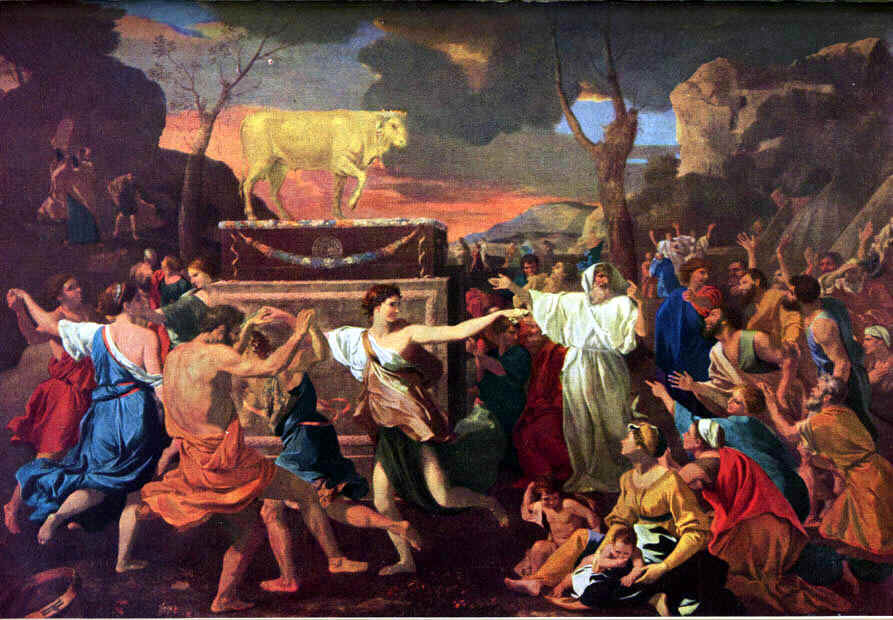
Nicolas Poussin, “The Adoration of the Golden Calf”

The account in the book of Exodus that describes how the Israelites made and worshiped the golden calf does leave us with the impression, at least at first, that only men were killed in punishment. Moses told the Levites, who had remained loyal to the Lord, “Go back and forth through the camp from one end to the other, each killing his brother and friend and neighbor.” All of these terms are masculine, suggesting that only men were  targeted.

However, there are at least three things that suggest women were likely killed in punishment as well. First, the Hebrew language, by convention, uses such terms in the masculine when both men and women are in view. For example, the commandment in Leviticus to “love your neighbor as yourself” clearly applies to both men and women. And while the preceding commandment in Leviticus says literally, “You shall not hate your brother in your heart,” many modern translations, recognizing that this word in Hebrew can apply to any relative, male or female, in such a context, translate the expression as “anyone of your kin” or “a fellow Israelite.”

Also, the account of the golden calf concludes by telling us that “the Lord struck the people with a plague because of what they did with the calf Aaron had made.” So even if no women were killed by the Levites for their part in making and worshiping the idol, it appears that some women did die in this plague.

Finally, in the New Testament, Paul describes to the Corinthians several things the Israelites did that constituted a pattern of disobedience and rebellion, as a result of which “their bodies were scattered in the wilderness.” This was in keeping with the punishment that God announced when the people rebelled definitively at Kadesh and refused to enter the promised land. So any women who were involved in the golden calf episode but who were not killed in punishment at the time nevertheless died in the desert as the result of chronic disobedience that included that episode.

In other words, anyone who contributed to making the calf and participated in its worship was subject to punishment—women as well as men. There was no unfairness in that regard.

Still, the account of the golden calf and of these divine punishments is one that  thoughtful readers of the Bible wrestle with today. We may wonder why people were killed for making and worshiping an idol. But worshiping a different god meant becoming an entirely different kind of culture than the one envisioned in the Law of Moses. In Old Testament times, every society was a theocracy that mirrored the character of the god it worshiped. The Canaanite gods were bloodthirsty, power-hungry, and immoral, while Yahweh was pure, holy, compassionate, and concerned for the poor and weak. Even as the Israelites first started to worship the golden calf, they  began to change the character of their society, engaging in “revelry” (sexual immorality, though described euphemistically as “dancing”) as part of the proceedings. The decay was spreading so fast that it needed to be halted immediately. The overt violence may trouble us, but it seems to have been intended to prevent the subtle, crushing violence of injustice and oppression that would have settled into the society if it had adopted Canaanite-style gods.

What does it mean that the Holy Spirit lives in us?

Q. I struggle with the concept of the Holy Spirit living in us due to two things that I have recently become aware of.

One is that in creation, God breathed life into us; wasn’t this the Holy Spirit? So since the Holy Spirit is the source of life and is living in us, how does this imagery work? If Mary had already conceived Jesus through the Spirit of God, what was happening when the Spirit descended on Him after His baptism?

My second question is the language used to describe the Pentecost event. It’s somehow similar to the temple imagery. I believe that I have the Spirit in me, but I have never experienced what happened to the early believers, as described in Acts. Well, maybe there are exceptions, but can you please help clarify what it means that we have the Spirit in our lives?

Thank you for your questions. Let me share some reflections in response.

First, the book of Genesis does say that “God formed a human from the dust of the ground and breathed into his nostrils the breath of life.” But while the word for “breath” in Hebrew can also mean “spirit,” in this case, the Bible is not talking about the Holy Spirit. Rather, it’d depicting how God brought humans to physical life as his creatures.

However, there’s an interesting parallel to this account in the Gospel of John. After Jesus rose from the dead, he met with his disciples and “breathed on them and said, ‘Receive the Holy Spirit.'” This seems to be an intentional re-enactment on Jesus’ part of the Genesis creation event, to signify that his followers would each become “a new creation” (as the apostle Paul would later put it) as their lives were transformed specifically by the influence of the Holy Spirit within.

This leads directly to your further question about Pentecost. If the disciples had already received the Holy Spirit when Jesus breathed on them, what was going on when they were “filled with the Holy Spirit” on Pentecost? I think you’re right to perceive temple imagery at work in this account. As I say in another post on this blog:

As I understand it, Pentecost is the occasion on which the community is  filled with the Holy Spirit. The New Testament speaks of the community of Jesus’ followers as “God’s temple” or a “temple in the Lord.” The physical temple in Jerusalem was destroyed in A.D. 70, and the New Testament envisions a new kind of temple, built of “living stones” (as Peter puts it—that is, of people), taking its place.  And so the scene on the day of Pentecost is just like the ones in the Old Testament when God’s Spirit fills the tabernacle built by Moses and the temple that Solomon built. (Along these lines, I once preached a Pentecost sermon entitled “The Filling of the New Temple.”)

Your question about Jesus can be answered along similar lines. Jesus was conceived through the power of the Holy Spirit, but this was what brought him to life physically, similarly to the way the breath/spirit of God first brought a human to life. Jesus would not, through this means, have been filled with the Holy Spirit from birth, any more than the first human was filled with the Spirit at his creation. (However, we shouldn’t necessarily conclude that Jesus was not filled with the Holy Spirit from his very conception; an angel promised that this would be true about John the Baptist, and there’s no reason to think that anything less was true of Jesus, whom John said was “greater than I am.” The fact that John was able to recognize Jesus when they were both still in the womb and their mothers met suggests to me that they were each already very much alive spiritually at that point.)

Jesus was already a genuine and committed follower of God and an instrument of God’s inbreaking kingdom activity even before he was baptized, so I don’t doubt that the Holy Spirit was already living in him by that time. But nevertheless the Holy Spirit descended on Jesus in a visible way at his baptism.

For one thing, this signified his identity and mission as the Messiah. It confirmed the Father’s voice from heaven, “This is my Son, whom I love; with him I am well pleased.” (As I observe in this post, “Generally all of the activities of the Trinity involve all of its persons.” That is, the Father, Son, and Holy Spirit do their work together. When Jesus publicly and officially began his ministry with his baptism, the other two persons of the Trinity took part in the event.)

However, I don’t doubt that the Holy Spirit descending on Jesus was also a special equipping for the ministry that lay ahead—beginning immediately with the wilderness temptations that followed his baptism, and continuing on to further great challenges after that. We discover the same thing in many other passages in the Bible, that God sometimes gives a person a special filling of the Spirit to equip them for an urgent and difficult task. For example, the book of Acts tells us that when the apostles were arrested in Jerusalem for speaking and teaching in the name of Jesus, Peter was “filled with the Holy Spirit” so that he could offer a bold defense. The apostles were threatened and intimidated and then released, and the whole community of Jesus’ followers prayed for boldness. “After they prayed, the place where they were meeting was shaken, and they were all filled with the Holy Spirit and spoke the word of God boldly.” Similar episodes of people being specially filed with the Spirit for bold action are found throughout the Old and New Testaments.

So, to sum up, people who haven’t yet experienced the new birth by receiving Jesus as their Lord and Savior do not have the Holy Spirit living within them, although they do have the “breath of life” as a gift from God and they bear the image of God, and on that basis they can already begin to contribute to God’s kingdom activity. Once a person does come to follow Jesus, they are born again and become a “new creation,” and the Holy Spirit comes to live within them. The Holy Spirit will work within them to make them more and more like Jesus in their character, conduct, and attitudes, and the Holy Spirit will also give them gifts and opportunities for service.

It’s true that some people seem to experience a filling of the Holy Spirit as something separate from, and subsequent to, their initial commitment to follow Jesus. I recognize that some Christian groups teach that this is normative, that the two experiences are separate. While I respect their beliefs, my personal view is that when someone experiences the filling of the Holy Spirit later, some time after they’ve chosen to follow Jesus, it’s not that they get more of the Holy Spirit, it’s that the Holy Spirit gets more of them. They have opened up wide areas of their heart and life to the Spirit’s influence and control, and as a result they are experiencing the Spirit rushing in. (Indeed, even those groups that teach a subsequent experience of the “baptism of the Holy Spirit” associate it closely with “entire surrender” and “complete sanctification.”)

So, at least in my view, if you are a follower of Jesus, the Holy Spirit is already living within you, at work to make you like Jesus and equip you for service. You don’t need to get more of the Spirit. But make sure the Spirit gets all of you!

Did Pharaoh drown with his army?

Q. When God parted the Red Sea for the Israelites to cross, and when God then made the waters sweep back over the pursuing Egyptians, did Pharaoh drown with his army?

This question is much debated by biblical scholars. Many say yes, while others say no. I can only give you my own opinion on the matter, which is that Pharaoh did not drown with his army.

The book of Exodus does say that when the king of Egypt was told that the people had fled . . . he had his chariot made ready and took his army with him to pursue the Israelites. So it seems that Pharaoh did personally accompany the army out into the desert.

However, the further details in the account suggest that he didn’t join the actual pursuit of the Israelites. Rather, Exodus says that all Pharaoh’s horses and chariots and horsemen followed them into the sea. It describes God telling Moses, “Stretch out your hand over the sea so that the waters may flow back over the Egyptians and their chariots and horsemen.” And the book then says that “the water flowed back and covered the chariots and horsemen—the entire army of Pharaoh that had followed the Israelites into the sea.”

Pharaoh himself was apparently not included in this group (“the entire army of Pharaoh”), because when Moses and the Israelites  compose and sing a song afterwards to celebrate the event, they say:

Pharaoh’s chariots and his army
    he has hurled into the sea.
The best of Pharaoh’s officers
    are drowned in the Red Sea.

It seems to me that if Pharaoh, the ruler of all Egypt, had also been killed, the song would have mentioned this as the high point of the victory and not spoken only of his best officers.

I think that in this light, we should understand the statement in Psalm 136 that God swept Pharaoh and his army into the Red Sea to mean that God swept Pharaoh, personified in his army, into the sea. This would be in keeping with the view in the ancient world that the host of a ruler (that is, his army or troops) was an extension of the ruler himself. (In Daniel’s vision of the Ancient of Days, God is depicted that way, surrounded by the heavenly host emanating from his throne: A river of fire was flowing, coming out from before him. Thousands upon thousands attended him; ten thousand times ten thousand stood before him.)

As I said, others might answer the question differently, but this is what the biblical account suggests to me.

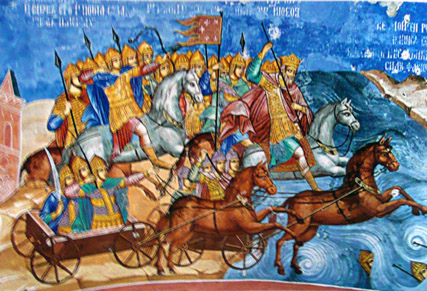
“Crossing the Red Sea,” a wall painting from the 1640s in Yaroslavl, Russia

How could Jesus heal a man based on his friends’ faith?

Q. In the episode where a man’s friends lower him through the roof to Jesus, it says that “when Jesus saw their faith,” he forgave and healed the man. Does this mean that my friends can be healed if I have enough faith for them? Aren’t we supposed to have faith for our own healing?

Matthäus Merian the Elder, “The Healing of the Paralytic,” 1625-27

Actually, I see this as one of those places in the gospels where Jesus recognizes that God is at work by the faith God has given someone to believe He will intervene.

For example (as I explain in my study guide to John), at the wedding feast in Cana, “When the wine runs out, Jesus’ mother Mary asks him to help. Jesus expects that the power of God will only be increasingly demonstrated through him as his ‘hour’ draws near (meaning the time of his death as the Savior of the world). But Mary’s persistent faith and implicit trust show that God is powerfully at work in this very moment. Jesus performs a miracle and transforms well over a hundred gallons of water into fine wine. This demonstrates God’s concern to provide for material needs, even for celebrations. It also illustrates the joy and abundance God wants people to experience. This first sign reveals Jesus’ ‘glory’—not so much his miraculous powers, but his intimate relationship with God and his sensitivity to the work that God wants to do through him at each moment.”

As I explain more generally in another post on this blog, “Jesus pursued what scholars often call ‘co-operation’ with the Father.  Within the context of his overall life mission as he understood it, Jesus discerned where God was already at work and considered how he could join in. His classic statement of this approach was, ‘The Son can do nothing by himself; he can do only what he sees his Father doing, because whatever the Father does the Son also does. For the Father loves the Son and shows him all he does.'” And one way Jesus often discerned where God was at work was by recognizing when God had given people special faith to believe and trust for God to do something that would transform a situation.

So I’d encourage you to frame the question in this way: It’s not a matter of you trying to have enough faith for God to heal your loved ones. Rather, the faith you already have for this (or you wouldn’t be asking about it!) may have been given to you by God and it may be an indication that God is disposed to work in the situation. You should certainly investigate that possibility by praying earnestly according to that faith and seeing what God will do.

In fact, as I also say in that other post, “‘Co-operation’ can also work in the other direction. Besides seeing where God is already at work and joining in, we can also take sanctified initiative within the context of our life mission, and see whether God will join in with us!” It’s certainly never wrong to pray for the healing of the sick, knowing that Jesus always had compassion on them.

However, as I explain further in a post on my other blog Endless Mercies, “Prayer for healing must be understood as the first step in a process of seeking guidance. It’s an appropriate and necessary first step; whenever we hear someone is sick, we should always pray first for their healing. But then we should be watching and listening to discern what God might show us about the purposes He wants to accomplish through the illness. (We don’t believe that God actively causes someone to be sick or injured, but rather that God is always looking for a way to advance His own purposes in the face of these unfortunate realities of our broken world.) Particularly if what we discern suggests that a person might indeed be going to die, we need to help them die well. That means being lovingly cared for, in a way that allows them to say goodbye and leave a legacy. But ultimately this all comes down to the faith God gives us to respond to a situation. Prayers for the recovery of a friend who appears to be going to die may be offered in audacious defiance of what seems to be happening. So praying about and responding to a sickness as if it were ‘unto death’ or ‘unto the glory of God’ is not a matter of conforming to the circumstances, but rather of following guidance actively received from God.”

In those terms, “when Jesus saw their faith,” he was actively receiving guidance from God about what God wanted to do in the situation. We may do the same and trust that God will still do things today through our own prayers that are offered according to the faith He gives us.

Don’t our works actually matter to God?

Q. Many times I’ve heard sermons and read that we are not saved by our works but by grace. However, in reading some passages in the New Testament, I’m not sure that is true according to Jesus. Matthew, particularly, has several of Jesus’ sermons that make me think it does matter how we live and what we do and that we can’t just ask for forgiveness and start over each day. Can you point me to passages that will bring clarity to this?

I think the simplest way to summarize the New Testament position on this subject is to explain that while it doesn’t teach we are saved by works, it does teach we are saved for works. That is, God has saved us so that we will be able to live in the way He has designed.

Paul writes in Ephesians, for example, that “we are God’s handiwork, created in Christ Jesus to do good works, which God prepared in advance for us to do.” Paul argues long and hard, particularly in Romans and Galatians, against the idea that people who are saved by grace can then live in any way they want, and just ask forgiveness for the sins they keep committing. “How can we who died to sin still live in it?” he asks. Paul’s opponents are legalists who are arguing that people have to be bound by rules in order to keep them from going astray. He responds that the law cannot give people the power to do what it commands; however, those who “walk by the Spirit” are able, by the Spirit’s power, to live in the way that God wants and expects.

James, for his part, argues that those who say they are saved by faith can only demonstrate this fact through their works. He challenges those who would say otherwise, “Show me your faith apart from your works.” The implication is, they can’t. James then counters, “I will show you my faith by my works.” But he’s not saying that we are saved by doing works; rather, he’s saying that if our faith does not issue in the kind of works that God has prepared for us, then it’s not saving faith.

And so it’s a parody of the gospel to say that because salvation is by grace, it doesn’t matter how we live once we become followers of Jesus; we can just keep asking for forgiveness for the sins we keep committing. It certainly does matter to God how we live after we accept his gracious offer of salvation, and God has given us the Holy Spirit to live inside us and transform us into people whose lives will consistently and increasingly reflect the righteous character of our Savior Jesus Christ.

[Also see this earlier post: “Are we saved simply by believing, or are there works we need to demonstrate?]

How old was Jesus when his parents brought him back from Egypt?

Q. How old was Jesus when his parents brought him back from Egypt?

In my post entitled “How long did Jesus live in Egypt?” I suggest that his family went to that country “no more than two years after Jesus was born” and that all told “the journey to Egypt lasted no more than two years, and perhaps as little as a few weeks or months.” So Jesus would have been between two and four years old when his parents brought him back from Egypt.

Introduction to Jonathan Edwards’ The End for Which God Created the World

In my post in response a reader’s question, “Why couldn’t God defeat Jacob in a wrestling match?” I suggested, among other things, that the “man” Jacob wrestles with (he’s actually a representative of God, like the “angel of the Lord” elsewhere in the Old Testament) was probably “giving Jacob an opportunity to demonstrate, in a dramatic way on a single occasion, the tenacity and endurance God had seen him develop throughout twenty difficult years in exile. Those years had transformed Jacob from a conniving and grasping young man to the mature leader of a large clan who was now willing to face the brother he’d cheated and make things right with him.” I noted that Jonathan Edwards had written in The End for Which God Created the World that when things are “in themselves excellent,” it is also “an excellent thing” for them to become known. And so this wrestling match was a chance for Jacob’s acquired excellent qualities to be demonstrated. A reader of that post commented, “I would love to hear more of your thoughts about the Edwards book. It’s tough sledding.” So here is an overview of the argument that Edwards makes, which I hope will be helpful.

Today we might express the question as, “Why did God create the world?” (I’m sure many of us have wondered this.) But Edwards puts it this way: “To what end did God create the world?” That is, what “end” or purpose was God pursuing through the creation?

Edwards begins his treatise by explaining what kind of “end” he’s talking about. He notes that a person might pursue one end as a means to another. For example, someone might go on a journey to get some medicine to heal a sickness. The ultimate end being pursued is healing. Getting the medicine is a subordinate end to that purpose, and going on the journey is a subordinate end to getting the medicine. (Even if we took a walk just for the pleasure of it, the pleasure would be the ultimate end, and taking the walk would be a subordinate end towards that goal.)

Edwards explains that he wants to explore what God’s ultimate end was in creating the world. That is, God might have made the world in pursuit of a number of purposes, but some of them might have been means to other ends. So what was the “bottom line,” as we would say today?

Edwards also specifies that he’s looking for God’s original ultimate end, that is, the one that God began with before the creation existed. This distinction is necessary because it’s possible that once the world had come into being, some other ultimate end might have been recognized that creating the world was also an appropriate means of reaching.

For example, a man and a woman might get married because they feel called together into a lifetime partnership. But after they got married, they might have children, and they might realize that they now actually value being a family even more than they valued being a couple—their original ultimate end. In such a case, Edwards would say that becoming a family turned out to be their chief end, that is, the one they valued most highly. But it would still not be their original ultimate end.

In the same way, it might turn out that God considered the relationship with his creatures to be the most valuable thing that had come out of the creation. But that would be after the fact; what purpose did God begin with? Edwards leaves off this line of the argument there; he doesn’t follow up on the question of God’s chief end in creating the world, since his task is to explore God’s original ultimate end.

Edwards approaches this question from two angles. He asks first what reason suggests the answer would be, and he then seeks to confirm this from Scripture. We today might approach things in the reverse order. We would first ask what the Bible teaches, and then we would try to make sure that we had understood the Bible correctly by asking whether our answer was reasonable.

But Edwards was living right in the middle of the Enlightenment period, when Western societies had great confidence in reason as a gift that God had redeemed. “The revelation which God has given to men,” he wrote, “has been the occasion of great improvement of their faculties” and it has “taught men how to use their reason.” Edward acknowledges that “it would be relying too much on reason” to try to use it to answer the question at hand “without being . . . principally guided by divine revelation.” But since, he says, some have offered objections to a proper Scriptural understanding of the question “from the pretended dictates of reason,” he will begin by explaining “what seems rational to be supposed concerning this affair,” and then turn to the Scriptures to “consider what light divine revelation gives us in it.”

Edwards then observes that it would not be “agreeable to reason” to think that God created the world because he needed something from the creatures he would make. Rather, God must have had himself in view as the ultimate end of the creation. “God esteems, values, and has respect to things according to their nature and proportions,” and so “he must necessarily have the greatest respect to himself.” Specifically, Edwards says, God created the world with his own glory in view as its ultimate end.

“It seems to be in itself a thing fit and desirable,” he continues, that the glorious attributes of God should be exerted, that they should be known, and that once seen and known, that they should be “valued and esteemed, loved and delighted in,” in a way suitable to their dignity. All of this was accomplished by the creation of a world whose “rational, intelligent creatures” could witness and value God’s glory. (However, Edwards specifies, we should not conclude that God’s desire to “communicate himself to the creature” led him to create the world. Rather, “a disposition of God, as an original property of his nature, to an emanation of his own infinite fullness, was what excited him to create the world.”)

After addressing at length various questions and objections that his argument to this point may have raised, Edwards then concludes his treatise by offering an extensive demonstration that “the Scriptures represent God as making himself his own last end in the creation of the world.” I will not even try to summarize Edwards’ elaborate and comprehensive Scriptural argument here. It is certainly not a matter of a handful of proof-texts that could be taken to say, “God created the world for his own glory.” Rather, it is an exegetically grounded case that reaches throughout the whole Bible to establish this point. So I will commend it to the reader of The End for Which God Created the World, trusting that I have at least helped thereader get to this point in the treatise, that is, onto what should be more familiar ground for us today.

Jonathan Edwards, 1703-1758

Did Jesus once live in the “land of Goshen”?

A reader has submitted the following question, which I take to refer to my post entitled Where Did Jesus Live in Egypt?

Q. Could it have been in the land of Goshen, where the descendants of Joseph and the sons of Jacob settled?

I argue in that other post that Joseph, Mary and Jesus most likely settled in the city of Alexandria when they fled to Egypt to escape from King Herod. That city was founded by Alexander the Great many centuries after Moses, but it actually lies within the territory that is traditionally associated with the land of Goshen, in the Nile delta. So you’re suggesting a very interesting connection!

How can non-believers overcome destructive patterns without the Spirit’s help?

Q. The non-believer goes to various secular sources for help in areas like drugs and alcohol, anger management, eating disorders, etc. The believer goes to the Lord trusting the Holy Spirit for power to help because he’s powerless. My question is, “What is the advantage for the believer?” He sees the non-believer progressing in these areas without the Spirit’s help, doesn’t he? Are there some domains of sin where the believer can say, “I received victory in these areas only by the power of God?”

I think it’s actually inaccurate to draw a contrast between non-believers getting help from community resources without God and believers getting help from God all on their own.

On the one hand, classic Christian theology holds that those who have not yet benefited from the “special grace” of God that leads us to salvation in Jesus Christ nevertheless still benefit from the “common grace” of God that is in the world because it is God’s good creation and because God is actively exerting a redemptive influence throughout the earth. So the non-believer is not necessarily making progress in finding freedom from destructive patterns of life “without the Spirit’s help.” This is particularly true if he or she is participating in a group whose members are all working together to overcome a common problem. Human community, when it is cooperative and directed towards a positive end, reflects the character of God and can be a powerful channel of common grace.

On the other hand, the biblical portrayal of salvation is not that we are saved in isolation and need to work out our sanctification (progress towards Christ-like character and life) all alone, just between ourselves and God. Paul writes to the Corinthians, for example, regarding our entrance into the Christian life, that “we have all been baptized into one body by one Spirit.” We are saved into community, not into individual self-reliance. (That’s the American individualistic version of “salvation” instead.)

So it’s not a matter of vindicating the need for faith by identifying certain areas of life where destructive patterns can only be overcome by the Holy Spirit’s help. Rather, it’s a matter of recognizing that we live out the model of life that God intended for us humans when the take part in a community whose members offer one another mutual support and encouragement. This is so powerful that it can have many beneficial effects for members even when the community is not built on a shared faith commitment. (Although many “secular” groups actually do talk about the need to rely on a “higher power.”) But I honestly believe that when followers of Jesus form close communities in which members can share their struggles honestly and receive help from people who do not judge them, but rather support and help them, even more powerful things can and do happen. That’s the kind of community I wish for you and for all of my readers.