Why does the Bible say it’s wrong to have sex outside of marriage?

Q.  In the Bible, sex before marriage is considered immoral. It’s called the sin of “fornication.”  But the Bible gives no explanation (that I have seen) of why it’s wrong to have sex before marriage. In 1 Corinthians, for example, Paul calls those who do this “sexually immoral.”  But why, why is it wrong? How could having sex, something that all married couples do regularly, be unclean and immoral before two people are married?

This is an excellent question, because we don’t usually consider the morality of an action to depend on its setting or context.  If something is a good thing to do, such as telling the truth, it should be good for everyone, everywhere to do it.  And if something is wrong, such as striking another person in anger and causing them bodily harm, then it should be wrong for everyone, in every context.  Husbands and wives certainly don’t get an exemption that permits them to engage in domestic violence.

So why does the Bible allow and encourage sex within marriage but say it’s wrong outside of marriage?  Why shouldn’t two people who love each other be able to express it in this way even if they aren’t married?

The Bible actually does give the reason why, in places like the book of Hebrews, where it says, “Let marriage be held in honor by all, and let the marriage bed be undefiled.”  But in order to recognize the reason that’s being given here, we need to understand what the Bible means when it uses specific terminology like this.

In the first part of the Bible, in the law of Moses, things are generally considered “common” and “clean.”  But if something is set apart for a special purpose, it becomes “holy” rather than “common.”  And if a person or thing becomes exposed and vulnerable through some breach in its creaturely integrity, that person or thing becomes “unclean.”

“Unclean” doesn’t mean “dirty” or “bad.”  It means that special care and protection is needed, usually involving temporary separation from the community until the breach is repaired.  In the law of Moses things like a skin disease, which breached the integrity of the body’s outer layer, created this kind of ceremonial “uncleanness.”  The example I like to use from modern life is a person who has lost their hair because of chemotherapy treatments.  We usually allow and encourage such a person to stay home or wear a wig until their hair has grown back.  We protect their dignity and preserve a proper sense of who they are by not making them engage others when most of their hair has visibly fallen out.  (Alternatively, I’ve heard of friends and family shaving off their own hair as a gesture of solidarity and identification, so that the person will know that they are loved and unconditionally accepted.  The family and friends are saying, “We know the real you and that’s not affected by superficial considerations.”)

There are two other important biblical terms for us to appreciate.  To treat something holy as if it were common is to “profane” that holy thing.  Jesus spoke of the way the priests “profaned” the sabbath (that is, they treated it as if it were an ordinary working day) because their shifts were scheduled on every day of the week.  (In this case, maintaining continual worship took precedence over sabbath observance for priests whose shifts fell on that day; no individual priests worked seven days a week.)

And to treat something holy as if it were unclean is to “defile” that holy thing.  This is a more serious matter, because in the Bible anything that is made holy—set apart for a special divine purpose—has to be uncompromised in its creaturely integrity.

And this is what the Bible is saying in the book of Hebrews about keeping sex within marriage so that it will be undefiled.  It’s saying that God has made sex “holy,” that is, God has set sex apart for a special reason, and to that end God has limited sex to within marriage.

So what is that reason, and why the limitation?

Is it so that a desire for the pleasure of sex will serve as an incentive for people to commit to marriage?  Well, the pleasure certainly isn’t a disincentive, but pleasure is not the ultimate purpose of sex, and so that’s not the reason why it’s limited to marriage.

Is it so that children who are conceived through sex will be raised in a stable home?  This is another additional benefit of God’s plan, since marriage is meant to provide a stable, loving environment for children, but since procreation is not the ultimate purpose of sex, this is not the real reason, either.

The ultimate purpose of sex is intimacy.  The Bible explains this at its very beginning, in the book of Genesis, when it says that “a man leaves his father and mother and is united to his wife, and they become one flesh.”  It’s sometimes hard for us to appreciate today how revolutionary this statement was in its day.  In ancient cultures (as in some modern ones) blood relations were supreme.  Primary loyalty was owed to one’s family and clan of origin. When a man married, his wife was simply added to the clan as a junior member, and both had to be careful to obey his parents and the other senior members of the clan.

But God’s plan was that husband and wife would create a whole new family of their own, with their primary loyalty being to one another.  They would be “one flesh”—they would belong to one another more than they belonged to their blood relatives.  And this would be established, affirmed, and celebrated through the act of sex, in which the two, for a time, would literally join their bodies together.  The Bible is describing this ideal situation of intimacy when it says that the first couple “were both naked, and they felt no shame.”

So sex was something that already existed (in the animal kingdom, for example), but among humans God made it holy, that is, God set it apart for a special purpose, as the joyful and triumphant expression of the new oneness between husband and wife.

So how does having sex outside of marriage make this holy thing “unclean,” that is, something that makes a person exposed and vulnerable?  Since the ultimate purpose of sex is intimacy, when you make love with someone, you don’t just reveal your body to them.  You inevitably expose your soul—your hopes, dreams, fears, your deepest and most powerful thoughts and emotions.  And God wants this kind of exposure to happen within the protection of an unconditionally committed lifelong relationship, because only within the safety and security of such a relationship can two people help each other explore and work out all the powerful, complicated, and potentially beautiful things they have inside.

In other words, sex for people is actually something that is intrinsically holy.  In other cases God chose things that could just as easily be common to serve holy purposes, and in those cases there could be exceptions to their exclusive use for holy purposes.  Jesus cited the example of David and his men eating the bread that was reserved for the priests to justify his work of healing on the Sabbath.  Bread is just bread, and Saturday is just Saturday, until God chooses to set them apart for other purposes, and sometimes even higher considerations can intervene.

But sex is never just sex.  It always involves the exposure of heart, soul, and body to another person, and God means for that to happen in a context of safety, security, and lifetime commitment—within marriage.  That’s why Paul says in another of his letters, 1 Thessalonians, that if we have sex with another person not in this “holy and honorable” way, but in the “passion of lust,” we sin against and defraud that other person.  In other words, we take something from them that we’re not entitled to:  we take their intimate self-disclosure without providing the security and protection they deserve and require.

These are the reasons that the Bible gives for why sex is to be reserved for marriage.  Now I realize that someone who doesn’t believe in God or in the teachings of the Bible, at least to the extent of believing that God considers some things common and has set other things apart as holy, may not agree with these reasons.  They may feel, in fact, that there are times when sex is just sex and they may believe that there’s nothing wrong with that.  I can’t convince someone otherwise if they don’t share this biblical view of God’s creative purposes.  But for those who do share it, I hope that I have been able to explain here why the Bible teaches what it does about God setting aside sex for a special purpose within marriage.

Why wasn’t Aaron punished for making the golden calf?

Q.  I have some questions about the golden calf episode.

First, when Moses asked who was “for the Lord” and the Levites came to him, he told them to “slay each his brother, his companion, and his neighbor.”  He said, “Consecrate yourselves each upon his son and brother that the Lord may bestow upon you a blessing.” I gather they were slaying fellow Levites as a consecration.  This is hard to understand.

I’m also wondering why Aaron wasn’t punished for his part in the episode. Moses asked him, “What did these people to to you that you caused them to commit such a great sin?”  And Aaron reported correctly, “They asked me to make gods for them because they did not know what had become of you.”  However, Aaron was not removed from his priesthood or slain. He just went on being the respected associate of Moses.

I find all this mysterious and hard to understand.

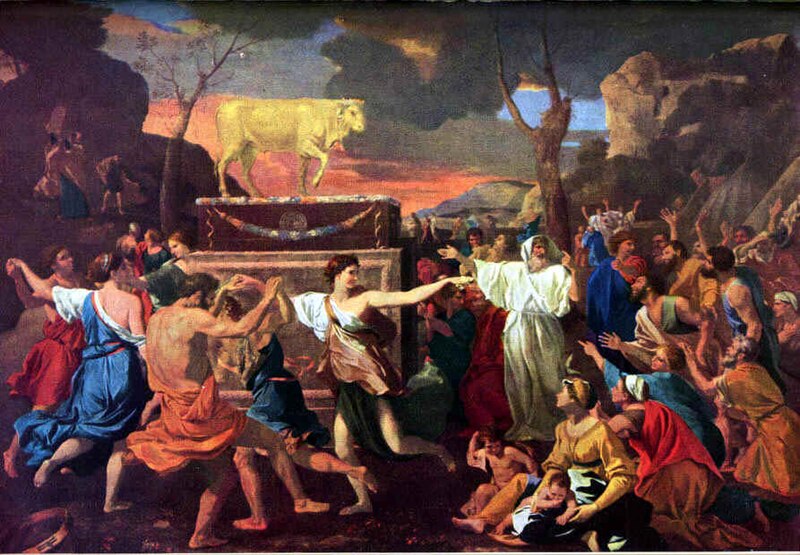
Nicolas Poussin, “The Adoration of the Golden Calf”

I think it helps to realize, to begin with, that in this episode the Israelites didn’t believe they were worshiping a god other than Yahweh.  Rather, they thought they were still worshiping Yahweh, but they were now doing this as if He were a god like the ones the Egyptians and Canaanites worshiped.  Such gods had physical representations in the form of idols, and they were worshiped through immoral revelry.

The episode reveals that to this point the Israelites had been regarding Moses as the physical representation of Yahweh.  That’s why they spoke of him as the one who had “brought them up out of Egypt.” So when he was delayed on the mountain and the people didn’t know what had become of him, they wanted something else to represent Yahweh for them physically.  They “assembled against” Aaron (not just “gathered around” him) and told him to make them a god.  (The Hebrew word is ‘elohim, a plural form that most English versions translate as “gods,” but it should likely be taken as a “plural of excellence” meaning “God,” as the context seems to call for; see the translation note in the NIV.)

Under this pressure, Aaron makes a golden calf, and when the people see the finished product, they exclaim, “This is your God, Israel, who brought you up from Egypt!”  Going along with this identification, Aaron announces, “Tomorrow there will be a festival to Yahweh!”

Unfortunately, if Yahweh were indeed the kind of god who could be represented by a golden calf, then such a festival would involve immoral revelry.  Traditional English versions tend to translate the terms “play” and “dance” in the account with discreet literalism, but the NIV’s “revelry” and “running wild” capture the meaning well.

The people were so “out of control,” in fact, that “they mocked anyone who opposed them,” as a footnoted alternative rendering in the New Living Translation puts it.  Most versions say something like “they were a laughingstock to their enemies,” but as there were no enemies present to observe the incident, I think this NLT alternative captures the sense of the Hebrew term well, which refers literally to those who “stood against” them.

So the people were being recklessly indulgent and they would not listen to their leaders when they tried to restrain them.  it was a near-riot, and desperate measures were called for to prevent the situation from disintegrating completely.  (Otherwise the people might have turned violently against Moses and even killed him.)

And so Moses called out, “Whoever is for the Lord, come to me.”  In other words, “Whoever still respects my leadership and my revelation about what Yahweh is really like, I need your help right away!”  When the Levites rallied to Moses, he told them, ““This is what the Lord, the God of Israel, says: ‘Each man strap a sword to his side. Go back and forth through the camp from one end to the other, each killing his brother and friend and neighbor.’”

This is actually characteristic language referring to all Israelites, not just Levites.  And it was only after the Levites did this to stop the situation from spinning completely out of control that Moses told them, ““You have been set apart to the Lord today, for you were against your own sons and brothers, and he has blessed you this day.”  In other words—in response to your first concern—Moses didn’t say to them, “God will bless you if you slay your fellow Levites.”  He said, after the fact, “Because you were willing to take the Lord’s side, even though this meant killing your fellow Israelites because they were rioting against Him, you have been set apart to the Lord.”  And that was the blessing—being set apart.  The blessing wasn’t something material that was promised in advance as a reward or incentive for taking up the sword.

In response to your second concern, I would suggest that Aaron was not punished for making the golden calf because he did this only when he was pressured by the people.  He may even have feared for his own safety and life if he refused.  He still should not have made the idol, but the responsibility was much more with the people than with him.  (This was a case similar to the one in which Miriam instigated a revolt against Moses’ leadership and enlisted Aaron to support her; she was punished but he was not, as I discuss in this post.)  The law of Moses would later distinguish between cases in which a leader sins and cases in which “the whole Israelite community” sins, and I think this was one of those latter cases.  In fact, the community was punished for their sin on this occasion not just by the Levites’ swords, but also through a plague that God struck them with afterwards.

I hope this explanation helps address your concerns.  But many aspects of the episode, including as the methodical slaughter of Israelites at God’s command, may still remain troubling and difficult to understand for thoughtful readers today.

A reader comments: Note that Moses says in Deuteronomy 9:20 that he had to pray 40 days snd 40 night for all that sinned, but the first he prayed for was Aaron his brother.

Why was only Miriam punished with leprosy when she and Aaron rebelled against Moses?

Q. When Aaron and Miriam rebelled against Moses, why was only Miriam punished with leprosy?

“The Leprosy of Miriam,” woodcut from 1583 Bible.

The main explanation seems to be that Miriam was held more responsible because she instigated the challenge in the first place and then enlisted Aaron to support her.  There are two things in the text that show us this:
• Miriam is named before Aaron at the start of the account.  In every other place in the Bible where they are named together, including later in the same account, Aaron is mentioned first (conventionally, as the eldest brother in the family).
• The verb “speak against” is actually in the feminine singular in Hebrew:  “She spoke, Miriam, and Aaron, against Moses . . .”
Both of these things suggest, as I said, that Miriam originated the challenge and enlisted Aaron to support her, so she is held more responsible and given a greater punishment.  This shows us the fairness of divine justice.

One additional possibility to consider is that God spared Aaron specifically so that he could intercede as Israel’s high priest, approaching Moses with a renewed recognition of him as God’s representative, to ask forgiveness for Miriam’s sin and for his own:  “Please, my lord, I ask you not to hold against us the sin we have so foolishly committed.”  If Aaron had been struck with leprosy, he would not have been able to function as a priest according to the laws in Leviticus.  So God may have spared him in mercy specifically so that he could intercede for sin in this way as a priest. (It’s Moses who actually prays for Miriam’s healing).  We see that God’s very judgments are tempered with mercy, even if this sometimes makes them seem unfair.

Sparing the high priest so he could intercede for sin is a bit like the way God spared King David from direct personal punishment after he sinned by taking a census of his fighting men.  God may have spared David because the people still needed a king to rule their nation and lead their armies. When David saw the plague that was striking down the people, he recognized his own responsibility and prayed, “I have sinned; I, the shepherd, have done wrong.  These are but sheep.  What have they done?  Let your hand fall on me and my family.”  But instead of afflicting David directly at that point, God in mercy ended the plague entirely.

This is a warning to people in vital offices:  You may be spared immediate personal judgment not because you are entirely innocent, but because God still needs someone in your role and you’re not bad enough yet to be removed from it!  Aaron should not have concluded that he was less deserving of some punishment than Miriam for the same revolt, even if not the same punishment. Leaders today who “think they are standing firm” should “be careful that they don’t fall.”

Are we saved simply by believing, or are there works we need to demonstrate?

Q.  Jesus says near the end of the Sermon on the Mount, “Not everyone who says to me, ‘Lord, Lord,’ will enter the kingdom of heaven, but the one who does the will of my Father who is in heaven. On that day many will say to me, ‘Lord, Lord, did we not prophesy in your name, and cast out demons in your name, and do many mighty works in your name?’ And then will I declare to them, ‘I never knew you; depart from me, you workers of lawlessness.’”

The point of the passage seems to be that those who are rejected were trusting in their works since the justifications they bring to Jesus are the things they did in His name—they weren’t trusting in what He did for them. If that is truly the point, is it enough to simply understand intellectually what Jesus did and believe that we are saved by grace as an unearned gift ? It seems that the Bible kind of says that one is saved solely on an intellectual basis, but at the same time that one isn’t truly saved unless one demonstrates works as well. How do you read that?

That passage from the Sermon on the Mount might not be the best one to use in order to address your question, because at least as I see it, the issue there isn’t believing vs. works.  The issue is trying to use Jesus’ name in exorcisms or prophecies as if it were some kind of magic word, without being a committed follower of Jesus personally–like the sons of Sceva we read about in Acts who were trying to cast out demons by saying, “In the name of the Jesus whom Paul preaches, I command you to come out.”  (Note that the statement you quote comes in the section of the Sermon on the Mount that begins with Jesus saying, “Watch out for false prophets.”)

I think a better way to address your concern would be to compare and contrast the biblical perspectives you summarized at the end of your question:  either that salvation comes by grace through faith, apart from works, or else that some kind of works are needed.  For example, Paul writes in Ephesians, “For it is by grace you have been saved, through faith—and this is not from yourselves, it is the gift of God— not by works, so that no one can boast.”  But James writes, seemingly contradictorily, that “a person is justified by works and not by faith alone.”

However, we can tell that Paul and James really aren’t contradicting one another by the way they both appeal to the biblical statement that says, “Abraham believed God, and it was credited to him as righteousness.”

In Romans Paul appeals to the fact that this was said of Abraham before he was circumcised.  Thus he didn’t have to do any kind of works (such as being circumcised or anything else) in order to earn righteousness.  His salvation was a gift that came by faith.

But James appeals to the very same statement to argue that we would never know that Abraham had genuinely saving faith unless he did something to demonstrate it.  That’s why James says that “Abraham was justified by works when he offered his son Isaac on the altar”–not justified in the sense of being made righteous, but in the sense of being shown to be righteous.  Only a person who was truly trusting God in faith would have obeyed such a difficult command.

And so if we claim to have been saved by trusting and believing in what Jesus did for us, we should reasonably expect that salvation to manifest itself in “works,” not things we do to earn or secure our salvation, but things that flow naturally from it:  deeds of obedience, consecration, sacrifice, and service.  These, both Paul and James would agree, are the signs of true faith.


Why are the details of some episodes in different gospels irreconcilable?

Q. Why do several of the stories told by multiple Gospels have details that seem to be contradictory? I would expect that different authors would bring out different (non-contradictory) details when telling the same story, but there seem to be details that just flat-out can’t be reconciled in some cases. Stories I’m thinking of include the woman who poured perfume on Jesus (did that happen on two occasions?), the time Jesus walked on water, and the time when Judas betrays Jesus in the garden.

Ivan Aivazovsky, “Jesus Walks on Water”

You’re right that when the same story is told in more than one gospel, sometimes there are not just differences in which details are included, there are also differences in the specific facts of the story.

For example, when Jesus walks on the water, Matthew includes the detail that Peter wanted to walk on the water, too; Mark and John don’t mention this.  Matthew and Mark simply say that the wind died down when Jesus got into the boat; John says that “immediately the boat reached the shore where they were heading.”  These could  be cases of one gospel writer knowing about something the others didn’t, or at least of one writer choosing to include something the others left out.

But there is another difference in detail between the versions of this story that can’t be reconciled this way.  Both Matthew and Mark have the disciples starting across the lake at the end of the day or in the evening, and Jesus walking out to them “shortly before dawn.”  In other words, the disciples were on the lake all night.  But John says that they saw Jesus approaching the boat “after they had rowed about three or four miles.”  We would have to make a deliberate effort to harmonize the stories by insisting, “Ah, the winds must have been so strong and the waters so rough that they were only able to row 3-4 miles all night.”  But that’s not what John says, and it doesn’t seem to be his meaning; instead, he depicts the episode as taking place once evening has given way to “dark,” not with dawn approaching.  So there is a time difference.

Similar points could be made about the other episodes you mentioned.  In Matthew, Mark, and Luke, Judas identifies Jesus in the Garden of Gesthemane by kissing him on the cheek, the customary respectful greeting of the time.  But in John, Jesus identifies himself after asking the soldiers, “Who is it you want?”  And while all four gospel writers agree that a woman anointed Jesus with perfume in the city of Bethany, and it’s not impossible to reconcile all the accounts to conclude that this took place in the home of a man named Simon, Luke sets the episode early in Jesus’ ministry, while the other gospel writers place it near the end of his life.

But I don’t personally see irreconcilable details such as these as diminishing the truth or authority of the Bible in any way.  Rather, as many have observed, these differences actually show that the gospel writers weren’t all trying deliberately to tell the same story as the others.  This should give us even greater confidence in the independence and authenticity of their reports.  If some minor details differ, the main points are always confirmed.  And so we can be confident, based on multiple independent reports, that Jesus did walk on the water–the gospel writers agree about this miracle that testified to who he was.  Judas did betray Jesus by bringing the soldiers to the garden.  And a woman did anoint Jesus with perfume, and he acknowledged this as an appropriate, if extravagant, act of worship.

We only have problems with the differences in minor details if we embrace the idea that if the Bible is to be the word of God, it has to present only exactly what happened, without dispute or variation, down to the last detail every time.  That’s simply not the kind of Bible God has given us.  We should recognize that we have instead a Bible whose human character, including such variation in minor details, only helps it to be an even better authoritative witness to divine truth.


Why does a serpent represent what Jesus did on the cross?

Q.  In the gospel of John, when Jesus is speaking with Nicodemus, why does he liken Himself to the serpent that was lifted up in the desert in the Old Testament, considering that serpents are usually associated with Satan? Why was a serpent chosen as a type/foreshadowing of what Jesus would do on the cross, especially in light of the Bible always emphasizing the “lamb” that was slain? I’ve thought that perhaps in a sense sin/evil was on the cross since Jesus “became sin” to put an end to it, but other than that it just seems weird to me.

Sebastien Bourdon, “Moses and the Brazen Serpent”

Jesus refers to the way Moses made a bronze serpent and put it up on a pole in order to make one specific point to Nicodemus.  Jesus has just told him that he needs to be “born again” in order to enter the kingdom of God.  Nicodemus has misunderstood this and thinks that Jesus is describing something physical rather than something spiritual.  (This happens often in Jesus’ conversations with people in this gospel, as I explain in my study guide to John.)  “How can someone be born when they are old?” Nicodemus asks.

Jesus tries to explain that he’s talking about being “born of the Spirit,” but Nicodemus still asks, “How can this be?”  So Jesus uses the episode of the bronze serpent to explain more precisely what he means by being “born again.”

This episode is related in the book of Numbers.  The Israelites are traveling through the wilderness and they start complaining about the very manna that God has been providing miraculously to feed them in the desert.  (They say, “We detest this miserable food!”)  As a punishment for their ingratitude, God sends poisonous snakes among them and many of the Israelites start dying from snake bites.  So they come to Moses and admit, “We sinned when we spoke against the Lord and against you.”  They ask him to “pray that the Lord will take the snakes away from us.”  God forgives the people and tells Moses to make a bronze snake and put it up on a pole.”  God promises, “Anyone who is bitten can look at it and live.”

In other words, an admission of sin and a response of hopeful faith, looking to the means God provided for deliverance, was how the Israelites could be rescued from physical death in this instance.  Jesus is telling Nicodemus that the same thing will be true, on a much grander scale in the spiritual realm, when he is “lifted up” onto the cross.  Anyone who is sincerely sorry for the way they’ve disobeyed and offended God, and who looks in hopeful faith to Jesus’ death on the cross for their sake, will be rescued spiritually and given the chance to live anew.  This is what it means to be “born again.”

So that is the single point of comparison:  just as the Israelites needed to look in hopeful faith to God’s provision for their physical deliverance in the wilderness, so Nicodemus (and anyone else, ever since, who hears about Jesus’ conversation with him) needs to look in hopeful faith to God’s provision for their spiritual deliverance in the form of Jesus’ death on the cross.

We should not make any further points of comparison, such as “Jesus must be like a serpent in some way, rather than a lamb, because he said he had to be lifted up just as the serpent was lifted up.”

However, we should keep in mind that in the gospel of John, there are always multiple levels of meaning at work.  Behind physical references there is often spiritual significance.  We’ve already seen that this is true when Jesus speaks about being “born,” and it’s also true when he speaks of himself being “lifted up.”  This can mean simply being raised onto the cross, but as a footnote in the NIV explains each time this phrase occurs in John, “The Greek for lifted up also means exalted.”  We need to recognize that this spiritual meaning is also in view when Jesus says things like, “When I am lifted up from the earth, I will draw all people to myself.”

Why does the Bible say that the moon could hurt us?

Q.  I’m reading Psalm 121 and I’m puzzled that it says, “The sun will not harm you by day, nor the moon by night.”  I can see the dangers of things like sunstroke and heat exhaustion, but how can the moon hurt us?

As I explain in my study guide to the Psalms, Psalm 121 is one of the “songs of ascents” that were composed to reassure the Israelites of God’s protection as they went up to Jerusalem for the annual pilgrimage festivals.

One approach to answering your question is to try to argue that the moon actually can hurt us (for example, by observing that there are more car accidents when the moon is full, etc.), on the premise that the Bible’s authority is somehow at risk if it suggests the moon could hurt us when it really can’t.

Another approach is to say that in statements like this, the Bible is preserving a popular belief that has since proved unscientific, but this doesn’t put the Bible’s authority at risk; rather, the preservation of such ancient beliefs is part of the Bible’s human witness to God’s deeds and character.

I personally wouldn’t have a problem with that second approach, but in this case I don’t think it’s necessary, because there’s a third approach that’s actually more in keeping with Hebrew thought and language.

We need to hear the statement that “the sun will not harm you by day, nor the moon by night” in light of the understanding, articulated in the Genesis creation account, that God established the “sun to rule the day and the moon to rule the night.”  Psalm 121 is saying, “Not even the ruler of the day will hurt you; how much less any of the servants of the ruler of the day (that is, anything else during the day).  Not even the ruler of the night will hurt you; how much less anything else during the night.”

In other words, this is one of those marvelous Hebrew expressions for totality that we find so often in the Scriptures (which include others such as “from the least to the greatest,” “from the heaven above to the earth beneath,” etc.).  In fact, in Moses’ blessing on the tribe of Joseph at the end of Deuteronomy, there’s a very similar statement to the one in Psalm 121, which illustrates this point: “May the Lord bless his land with . . . the best the sun brings forth and the finest the moon can yield.”

Obviously crops grow from the light and warmth of the sun, not from anything that comes from the moon.  But this is simply another expression for totality:  May God bless you with everything that day and night can yield, that is, everything, all the time.

I hope this perspective helps explain the statement in Psalm 121.

For a discussion of another expression for totality, see this post.

What does the Bible tell us about the “third heaven”?

Q.  Paul mentions that he knew of a man caught up to the third heaven (which he proceeds to call a paradise). Is there more information about each of the seven heavens in the canonical books of the Bible? There is some information in  books not included in the canon (the book of Enoch, for example). How trustworthy is this information?

Nicolas Poussin, “The Ecstasy of St. Paul”

When he speaks of the “third heaven” in 2 Corinthians, Paul most likely means the place of God’s abode.  His language echoes the cosmology found throughout the Bible in which the “first heaven” is the firmament or sky, in which the sun shines and birds fly; the “second heaven” is the “waters above the firmament”; and the “third heaven” is the place of God’s throne:  according to Psalm 104, God “lays the beams of his upper chambers on their waters” (i.e. the waters of the second heaven).  And so when Psalm 148 says “Praise him, you highest heavens and you waters above the skies,” it’s saying, in a poetic parallel, “Praise him, you third heaven, and you second heaven.”

But Paul doesn’t do much more than allude to this cosmology.  He does refer to the “third heaven” also as “paradise,” which could mean the blessed abode of departed souls.  But we can’t say for sure, because Paul quickly shuts down his story by saying that “no one is permitted to tell” about the things seen and heard there.

This single and simple New Testament account of a journey into heaven contrasts strikingly with other more highly elaborated accounts from this period.  The Theological Dictionary of the New Testament notes, “The reserve which leads [Paul] to make only a brief reference distinguishes his account from the fantastic descriptions of heavenly journeys by contemporary Hellenistic mystics and Jewish apocalyptists.”  One of these is found in the book of Enoch, which describes seven heavens, and there are similar descriptions in other apocalyptic works.

But I think we do well to take our cue from Paul’s reticence and not speculate about various “heavens” and what they might contain.  His real point in telling this story was that he had all the credentials of an apostle, including visions and revelations, but that even so he should be recognized as genuine by the way God’s power shone through his weakness.

That being the case, even someone today who was entrusted with a vision of heaven should probably be very reserved about how much of it they shared.  And we should probably be wary of the “fantastic descriptions of heavenly journeys” in books like Enoch.  If the Bible doesn’t want to tell us much about such things, then there are much better areas of inquiry that we can more profitably devote ourselves to.

Are we really supposed to give thanks for everything?

Q. I wonder if you’ve encountered the idea that we’re supposed to thank God for everything, even for the bad things that happen to us.  I’ve heard Paul’s statement in Ephesians referenced to support this notion:  “always giving thanks to God the Father for everything, in the name of our Lord Jesus Christ.”  This concerns me mainly because I can’t recall examples in Scripture where people thanked God for bad things that happened to them.  Did Jesus thank God for sending him to the cross?  Did Job thank God for taking everything from him?  And so forth.   Am I missing something?

Bible translations are generally agreed that when Paul says there in Ephesians that we should give thanks hyper pantōn, he does mean “for” everything (as opposed to “in” everything” or “in all circumstances,” as he says in 1 Thessalonians).  Hyper followed by a noun in the genitive (in this case an adjective used as a substantive), when paired with verbs of thanksgiving or praise, clearly means “because of” or “on account of,” as these other examples from Paul’s writings show:

“that the Gentiles might glorify God for his mercy”
“many will give thanks on our behalf
“something I thank God for

But regarding that substantive pantōn, the NET Bible makes the interesting suggestion that Paul is actually saying we should give thanks “for one another.”  The term pantōn can be either neuter (“everything”) or masculine (“everyone”), and the context in Ephesians does have to do with relationships in the community of Christ’s followers.  But practically all other translations take it to be neuter, meaning “everything” or “all things.”  So the broad consensus understanding is that Paul is saying we should give thanks “for everything.”

What does he mean by that?

I understand him to mean that we can always be thankful for what God is doing in a given situation or circumstance.  God is always active to make all things work together for our good.  But I agree with you that we’re not called to be thankful or grateful directly for things that are destructive and evil.  I don’t see Scriptural examples of this, either.

To use one of your illustrations, Jesus didn’t thank God for sending him to the cross.  In fact, he prayed that he’d be spared the cross if at all possible.  But I think he was aware of what God wanted to accomplish through the cross (which he calls his “hour of glory” in the gospel of John), and he celebrated that even in advance.

To use a contemporary situation as another illustration, I don’t think a follower of Jesus would be called to thank God directly for a loved one’s serious disease.  But they could still be very grateful for what they were learning through it about God’s grace and sustaining power, and for the way they were discovering that they were surrounded by a community of caring, loving people.

I hope this is a helpful distinction.  We don’t give thanks directly for evil or destructive things.  But we do give thanks for the way God is at work in every situation.

Insider and outsider language

My recent post about the altar inscription Paul saw in Athens–did it say “To an unknown god” or “To the unknown God”?–was prompted, as I noted there, by a conversation I had with a friend who does sociolinguistic analysis of the New Testament and early Christian literature.  One thing she has helped me see much more clearly is the way biblical characters employ either “insider” or “outsider” language depending on the audience.  (To give a contemporary example, a follower of Jesus today might speak of “the Lord” to a known fellow believer, but of “God” instead to someone whose faith they aren’t sure of.)

Since this conversation I’ve been seeing more ways in which recognizing “insider” and “outsider” language can help us appreciate the possible dynamics of biblical episodes.  Consider, for example, the episode in Acts in which a believer named Ananias is asked to visit Saul of Tarsus (later known as Paul) right after Jesus has appeared to Saul on the Damascus Road.

Ananias first greets him as “Brother Saul” (Saoul adelphe).  This is how followers of Jesus addressed one another.  Does this mean that Ananias is immediately acknowledging Saul as a fellow believer?  Not necessarily.  This is also the way one Jew would typically greet another in the Roman Empire.  My friend thinks, and I agree, that the original audience of Acts would have sensed the ambiguity here, and many of them may have thought, “Okay, he’s playing it safe, appealing to their shared Jewish identity to create some common ground with this man who, for all he knows, might still be an enemy.”

However, Ananias says next, “The Lord has sent me” (ho kurios apestalken me), using insider language for Jesus (“the Lord”), as if he were sure that Saul really was a follower of Jesus now.  This suggests that “brother Saul” maybe was intended as the greeting of a fellow believer.

But then it appears that Ananias worries he may have gone too far out on a limb too early, because he immediately qualifies who “the Lord” is:  “Jesus who appeared to you on the road as you were coming here.”  This is outsider language:  the proper name Jesus with a descriptor, like “Jesus of Nazareth . . . a man accredited by God” in Peter’s Pentecost sermon.

We don’t get much more of the dialogue, but I’m sure that when Ananias saw the scales fall from Saul’s eyes, he was probably comfortable going back to “the Lord” as a name for Jesus!  But the movement from language that could be taken “safely,” to insider language, to outsider language shows that Ananias was obediently going into a dangerous situation courageously but carefully.  (As we all should do when God–you know, the Lord–sends us into one.)

What “insider” and “outsider” language are you seeing as you read the Word–you know, the Bible?

Pietro da Cortona, Ananias Restoring the Sight of St. Paul, 1631