Was Acts really written around 150 AD?

Q.  Recently at our Bible Study someone mentioned that the book of Acts was written much later than the gospel of Luke (like about 150 AD). This was released by the Jesus Seminar — which already has my warning lights blinking. Is there any concrete evidence (like in Church history) to refute this?

Some scholars believe that there are allusions to the book of Acts in the first epistle of Clement, which is generally dated to the 90s AD.  If these are indeed allusions, they would be a “smoking gun” that positively ruled out a date of 150 AD.

Irenaeus of Lyon, who was born around 120 AD, makes definite references to the book of Acts in Against Heresies, which he likely wrote around 180 AD.  In III:12.1, for example, he offers this nearly verbatim quotation from the book: “The Apostle Peter, therefore, after the resurrection of the Lord, and His assumption into the heavens, being desirous of filling up the number of the twelve apostles, and in electing into the place of Judas any substitute who should be chosen by God, thus addressed those who were present: ‘Men and brethren, this Scripture must needs have been fulfilled, which the Holy Ghost, by the mouth of David, spake before concerning Judas, which was made guide to them that took Jesus. For he was numbered with us: … Let his habitation be desolate, and let no man dwell therein; and, His bishop-rick let another take.'”  This is not definitive proof of a first-century date for Acts, but it’s highly unlikely that Irenaeus would treat Acts as so authoritative if that book had only been around for a few decades.

But I think the main evidence for the date of Acts comes from the ending of the book itself.  It leaves Paul in prison, with the outcome of his trial undetermined.  Certainly if it had been known at the time of writing that Paul had been acquitted and released, Luke would have included this information, since he takes pains throughout the book to demonstrate that Jesus’ followers are good citizens–reasonable, peaceful, and charitable–on good terms with Roman officials.  (Acts is dedicated to Theophilus and Luke addresses him as “most excellent,” using a title customarily reserved for such officials, so they are a primary audience for the book.)

In other words, what is known in historiography as the “criterion of embarrassment” (an author wants to say something, but can’t, or has to explain something difficult) makes the book of Acts itself a piece of historical evidence for its own original composition sometime during the lifetime of Paul, meaning no later than the 60s AD.

Uncial 0189, the oldest surviving parchment manuscript of the New Testament, containing a fragment from the book of Acts, dated to around AD 200

Why would Jesus tell the disciples to bring swords and then rebuke Peter for using one?

Q. Why do you suppose Jesus would tell the disciples to bring swords, and then they do, and then Peter cuts off someone’s ear, and then Jesus clearly thought that was a dumb move, and heals the guy? It seems like a weird sequence of events.

The events you’re describing happen on the last night of Jesus’ life on earth.  At the Last Supper, he predicts Peter’s denial, and then warns the disciples that the circumstances of their lives and witness are going to change.  He asks them, “When I sent you out to preach the Good News and you did not have money, a traveler’s bag, or an extra pair of sandals, did you need anything?”  When they say “no,” he responds, “But now take your money and a traveler’s bag. And if you don’t have a sword, sell your cloak and buy one.”

It appears that there are some contexts that will be favorable to the life and witness of the community of Jesus’ followers, and in those contexts, it can count on what appears to be spontaneous support as God actually moves in people’s hearts to respond.  (This happens, for example, when Paul proclaims the good news in Thyatira and a woman named Lydia is listening. Luke, who was traveling with Paul at the time, describes what happened:  “The Lord opened her heart to respond to Paul’s message. When she and the members of her household were baptized, she invited us to her home. ‘If you consider me a believer in the Lord,’ she said, ‘come and stay at my house.’”)

However, there are other contexts that are very unfavorable, indeed hostile, to the life and witness of the community of Jesus’ followers.  In those contexts, it shouldn’t expect the support of outsiders.  It has to supply its own provisions and it also needs to be prepared to defend and protect its members by reasonable means and precautions.

I think it’s significant that when the disciples reply to Jesus at the Last Supper, “Look, Lord, we have two swords among us,” he answers, “That’s enough.”  Many biblical interpreters believe that Jesus is saying it’s all right for the disciples to have some weapons as a deterrent and basic protection in a hostile environment.

However, in the Garden of Gesthemane, Peter moves from defense to offense by attacking first.  He also does this in a situation where the disciples are outnumbered and much less well armed than their opponents.  Jesus rebukes him and heals the man he injured, in order to prevent a bloodbath.

So it appears that while the community of Jesus’ followers can adopt basic protections and precautions, when it encounters an overwhelming force bent on doing harm, its response must not be to fight to the last one standing, but to be willing to accept suffering as the means of continuing its witness.

Dirck van Baburen, “The Arrest of Christ,” depicting the episode in which Peter strikes with his sword.

Doesn’t the Bible teach election based on God’s foreknowledge?

Q. Doesn’t 1 Peter 1:2 teach that election is based on foreknowledge? Then why do people preach otherwise? Isn’t it very wrong to do so?

I believe that God’s sovereign choice in election and our morally accountable response to God are two sides of a mystery or paradox, and that we need to hold to both sides at once in order to be faithful to the full counsel of God in the Scriptures.

It’s true that there are statements in the Bible that seem to say that people are saved essentially because God has chosen them in election.  For example, Luke describes in the book of Acts how Paul and Barnabas proclaimed the gospel in Pisidian Antioch, and he describes the response to their proclamation this way:  “All who were appointed for eternal life believed.”

But other statements in the Bible make it appear that salvation depends on our response to God.  When Jesus is speaking of the resurrection in the gospel of John, for example, he says, “Those who have done what is good will rise to live, and those who have done what is evil will rise to be condemned.”

Some statements even seem to have no problem proclaiming divine sovereignty and human moral responsibility in the same breath.  Peter says in his message on the day of Pentecost, “This Jesus, delivered up according to the definite plan and foreknowledge of God, you crucified and killed by the hands of lawless men.”

So I don’t think it’s wrong to preach and teach that the principle of human moral responsibility complements the principle of divine sovereignty in a well-rounded understanding of the Bible.

As for the particular passage you asked about, it’s interesting to me that what Peter says we have been chosen for is not salvation, but sanctification.  He writes to those “who have been chosen according to the foreknowledge of God the Father, through the sanctifying work of the Spirit, to be obedient to Jesus Christ and sprinkled with his blood.”  In the same way Paul says that “those God foreknew he also predestined to be conformed to the image of his Son, that he might be the firstborn among many brothers and sisters.”  And I understand the foreknowledge here as relational knowledge (in a sense, God has been in a relationship with us since eternity past), not an advance knowledge of what choice a person will make.  I don’t think that is predetermined.  (See this post for a longer discussion of God’s foreknowledge in connection with a different question.)

So election based on foreknowledge is only part of the story, and it’s not wrong to bring out the other parts of the story.

What did the ancient priests do with offerings and money taken to the temple?

Q.  What did the ancient priests do with offerings and money taken to the temple?

For the most part, the money and other offerings (animal sacrifices, grain, etc.) were used to fund the activities of Israel’s worship center, which was first the tabernacle and then the temple, and to provide a living for the priests and Levites who worked there.

(Although the tribe of Levi had no territorial inheritance within Israel, the Levites had their own individual homes where they lived when they weren’t on duty at the temple, and they worked the fields around them to provide some of their own support.  But when they were on duty, they were fed and clothed from the offerings that worshipers brought.  This was necessary to make up for their lack of a tribal territory.)

However, there was one other important way that these offerings were used.  The law of Moses also told the Israelites:

At the end of every three years, bring all the tithes of that year’s produce and store it in your towns, so that the Levites (who have no allotment or inheritance of their own) and the foreigners, the fatherless and the widows who live in your towns may come and eat and be satisfied, and so that the Lord your God may bless you in all the work of your hands.

In other words, as I explain in my study guide to Deuteronomy and Hebrews, “every third year, the tithe [one tenth of the year’s produce] was gathered and stored locally to provide for the poor.  These were the food banks of ancient Israel.”

In the guide I then ask these group discussion questions:

• Should followers of Jesus today give a tenth of their income to God? If so, should they give all of it to their church, or can they also give some of it to help the needy?

• Are there food banks or soup kitchens in your community? Have any of your group members volunteered there? If so, ask them to share about their experiences. (Your group may wish to arrange a time to serve together at one of these places.)

We today can support a community life of worship and help those in need by emulating the generosity that is modeled for us in ancient Israel’s system of tithes and offerings.

Donations to a food pantry operated by an Episcopal church in San Francisco

Questions about the creation of man and woman in Genesis

Q.  My last set of questions after reading your book Paradigms on Pilgrimage is about what to do with Genesis chapter 2.  It is quite clear to me from your book that reading Genesis chapter 1 the way Young Earth Creationists do is unfair to the text and hermeneutically irresponsible. It is obviously written in a very poetic literary style and immediately conflicts with chapter two in terms of the alleged order of creation and so on. On coming to chapter two, though, it isn’t written in such a poetic literary style and does assume a natural order in its account of creation, which leads to a couple questions.

First off, would you say that Genesis 2:4 is something of a header introducing the section as Genesis 1:1 does following Hebrew writing conventions?

This statement is a header not just to the story of the creation of the man and the woman, but also to the stories of the fall and of Cain and Abel.  It’s one of eleven instances in Genesis of the same formula, translated “This is the account of” in the NIV.  These formulas divide Genesis into twelve parts that each discuss what came from the figure named in the formula, e.g. Adam, Noah, Noah’s sons, etc.  The first one is the most elaborately stated.  It’s actually a chiasm:
A  This is the account of the heavens and the earth
B  when they were created
B  when the Lord God made
A  the earth and the heavens.
This formula introduces what “came from” the heavens and the earth, what they “brought forth.”  In the account that follows, God “forms from the ground” all the wild animals and birds, and God also forms the man from the “dust of the ground.”

Secondly, since Genesis 2 isn’t written in a poetic style, would you say that it is trying to be more of a literal description of how and in what order creation occurred?

The account of the creation of the man and the woman belongs to a particular literary genre known as an “etiology,” which tells the story of how some contemporary phenomenon first originated.  Most of the stories early in Genesis belong to this genre.  They explain, for example, why there is a rainbow in the sky after it rains, or why people speak different languages.  The story of the man and the woman flows into the story of the fall and together these stories explain why weeds come up when you only plant good seeds, why women have pain in childbirth, and why the snake crawls on its belly.  So we need to take these stories for what they are and understand the meaning and message behind them, without regarding them as a literal, journalistic description of exactly what happened at the beginning of the human race.

Thirdly, in verses 8 and 19 it says, “Now the Lord God (had) formed…”. Depending on the translation, the word “had” isn’t always there, which kind of messes with the order of creation. If it is there, evolution is pretty easily accounted for within the text.  But if it isn’t, then the text more or less says that man came before plants and animals, which contradicts the claims of the scientific theory of evolution.

Hebrew verbs are not marked for tense, indicating time.  They are only marked for aspect, indicating either continuing or completed action.  The verbs in this account all indicate completed action.  So they could be translated either “formed,” “made,” “took,” etc. or “had planted,” “had formed,” etc.  I personally see no reason, linguistically or grammatically within the account, why any of them need to be translated with “had.”  I think we have a simple progressing narrative without review statements referring to earlier actions.  I think “had” is only introduced in some translations as a means of harmonizing the chronology with the earlier account.  I don’t think we need to do this.  The original author of Genesis was comfortable with the two accounts side-by-side even though their chronology doesn’t seem to line up, and we need to work out how we can be, too.

Finally, if evolution does account for the rise of all animals and eventually people, it seems strange that God would have had to make Eve because there was no suitable helper for Adam. If during the evolutionary process God granted consciousness, etc. upon early humans, there should have already been women present who would have been suitable for Adam. Of course, all these questions may simply arise from me trying to fit the story of Genesis 2 to actual history and not taking it from the observational perspective and so on. However, since Genesis 2 isn’t written in a literary style like Genesis 1, how exactly should it be taken?

I think you’ve identified where the problem comes from when we ask why a helper was needed for Adam if people had been around for so long.  It comes from trying to line up the details in these stories one-to-one with the events of natural history.  I don’t think we can or should do that.  As I say in response to your second question above, this account of the creation of the man and the woman should be taken as an “etiology.”  It answers the question of how some contemporary phenomena came to be by relating a story from the past that ultimately has a moral message.

Thanks very much for your thoughtful questions after reading our book.  I hope it continues to be helpful to you in your reflections! (The entire text of the book is now available free online.)

Another question from Paradigms on Pilgrimage: Was Noah’s flood local or global?

Q. Another question I have after reading your book Paradigms on Pilgrimage is what to do with the story of Noah’s flood. Creationists claim that many cultures across the world in isolated regions have “flood legends” in which one of their ancient ancestors is said to have survived a world-wide flood. This ancestor was named something similar to “Noah” like “Nehu.” I don’t know how to interpret such claims if Noah’s flood was just a small scale or local flood. I also don’t know what to do with the Bible’s claims that God essentially wiped out all life except sea life if it wasn’t a global flood. Of course, the section in your book in which Dr. Godfrey discusses trace fossils is pretty much the scientific nail in the coffin of there having been a global flood, but I don’t know how to reconcile these other details with the Bible’s description of the flood.

I think the most important thing to realize when considering your question is this: whether Genesis is envisioning a local flood or a global flood, it’s not picturing it happening in the world as we know it today.  Rather, it’s describing the flood within an observational ancient cosmology, so that the very word “global” is misleading.

Genesis doesn’t envision the earth as a globe, but rather as a flat stretch of land surrounded by heaped-up waters on all sides.  As I say in response to a comment on the previous post (which was also written in response to one of your questions about our book), any attempt to “establish a one-to-one correspondence between details in the biblical text and events in natural history” is doomed, precisely because of this difference in cosmology.  “You can’t get there from here.”

In the flood episode, God is basically wiping out the wicked human race by destroying the place of its abode.  In the creation account, God makes “a place for everything” and then puts “everything in its place”:  birds in the sky, fish in the sea, humans and animals on the land.  The flood is an un-creation scene:  the dry land disappears beneath the waters, just as it originally appeared from under them, and the whole race of wicked people disappear with it.

That’s the theological message of the account from within its ancient cosmology. We really can’t extrapolate from that to try to determine what actually happened in natural history.  Comparative anthropology, as you note, may shed some light, and geology can as well, but we’re not getting natural historical details about the world as we know it today from the flood story in the Bible, precisely because of its ancient observational cosmology.  This is a case like the many others we discuss in the book in which the Bible answers questions of “who” and “why,” but not (at least to our satisfaction) questions of “what,” “how,” or “when.”

(I earlier shared some additional thoughts about the question of a local versus worldwide flow in this post.)

Did the other biblical authors understand the Genesis creation account literally?

A reader of this blog recently submitted several questions after re-reading my book Paradigms on Pilgrimage: Creationism, Paleontology, and Biblical Interpretation, which I co-authored with Dr. Stephen J. Godfrey, curator of paleontology at the Calvert Marine Museum in Solomons, Maryland.  The book argues that the Genesis creation account should be understood as literally intended and accurate from an observational perspective, meaning that there is no inherent conflict between believing this account and believing that more complex life forms have developed from simpler ones in a process that has extended over a long period of time.  I will answer this reader’s questions in a series of posts, starting with this one.  The full text of the book is available online at this link.

Q. I recently reread your book Paradigms on Pilgrimage and I can safely say that it is by far the best book I have read on the Creation/Evolution controversy. (And that’s saying a lot, because I’ve probably read upwards of thirty.) I’ve come to the conclusion that the position you advocate is the most reasonable and cogent and makes the most sense in light of the big picture.

I still have some questions, however.  First, what are we to make of how other biblical authors understood Genesis? Creationists often argue that they viewed Genesis as literal truth, which would make these supposedly inspired authors wrong if evolution were a valid theory, unless they were affirming Genesis from a purely observational perspective. In the case of Jesus in particular, what’s important for me to resolve is to what degree he gave up his omniscience while he was a man. If he was still fully omniscient, then in affirming the Genesis account of origins he would have been affirming something he knew was empirically wrong.

Thanks very much for your kind words about our book.  I’m glad it has been helpful to you.

In answer to your first question, as we show in the book, the other biblical authors express the same observational cosmology that’s in the Genesis creation account.  For example, just as Genesis depicts God as creating the sky as a “vault” (literally a “spread-out” object), so Psalm 104 speaks of God “stretching out the heavens like a tent” and Isaiah says that God “stretches out the heavens like a canopy, and spreads them out like a tent.”  And just as Genesis says that God made the seas by saying “Let the water under the sky be gathered to one place,” so Psalm 33 says, in speaking of creation, “He gathers the waters of the sea into a heap; he puts the deep into storehouses.”

Perhaps it is not too surprising or unsettling to hear other biblical authors speak like this, if we accept that the Bible is written from an observational perspective.  Its human authors are simply describing how things appear to them.  But we might expect that Jesus would have spoken from a different, objective perspective (that is, not that of an earth-bound observer) if he really was God and so was omniscient.

However, what we find is that Jesus also describes the created world from the same observational perspective as the other biblical authors.  He says in the Sermon on the Mount, for example, that God “causes his sun to rise on the evil and the good, and sends rain on the righteous and the unrighteous.” This is the same perspective expressed by Job when he says that God “speaks to the sun and it does not shine,” explaining days when the sun does not appear in the sky not just from an observational perspective but also from the standpoint that God actively commands weather phenomenon.  (Jesus is not speaking in poetry or metaphor here.)  And Jesus also appealed to the way things were “from the beginning,” quoting directly from the Genesis account of the creation of man and woman, when he answered a question about divorce.

So it seems reasonable to conclude that Jesus had the same earth-bound perspective as the other biblical authors.  If that was indeed the case, then he couldn’t have been omniscient in his incarnation.  Is that a problem?

Not really.  As I explained in response to a recent comment on this post, “Christians believe that when Jesus, the Son of God, came to earth, he ’emptied’ himself of certain divine attributes, the ones known as ‘non-communicable’ (in other words, the ones that humans cannot share), which include omniscience, omnipotence, and omnipresence. Jesus fulfilled his mission on earth by complete obedience to God, rather than by drawing on powers not available to other humans.”  It may take us a while to wrap our minds around the idea that we today might understand natural phenomena and natural history better than Jesus did when he was on earth, but those seem to be the implications of the Christian doctrine of the Incarnation.

What order would you put the books of the Bible in?

You walk in to your adult group at church and the leader gives you a collection of paper strips with the names of the books of the Bible written on them.  “What order would you put these in?” the leader asks.

A friend of mine actually did this in the group he leads, and he got some interesting responses.

One person said immediately, “Well, THE order, of course!”  For that person, custom and use had already fixed the books of the Bible in THE order, and there could be no deviation.

But others felt freed by the exercise to think about some possible alternatives.  One person put books like John and James first and the “hard stuff” last.  Why?  They said they were thinking about people who were new to the Bible; they wanted to make it more accessible to them.  Another person put the books in chronological order so a reader would progress sequentially through time when going through the Bible.  And someone else tried to put books together that spoke to the same audience, so readers could see how they addressed similar situations and concerns.

There’s nothing improper about doing an exercise like this.  Book order was actually quite fluid for the first three quarters of the Bible’s history.  “THE order” that we know today only appeared around 1500 with the advent of printing.  Before that, a variety of orders were used, in pursuit of different literary, historical and liturgical goals.  So there’s nothing that says various orders can’t still be used today.

The non-traditional order of the biblical books in The Books of the Bible, it should be specified, is not intended to create a new fixed order, another version of “THE order” to replace the conventional one.  Rather, that order was chosen because it served the goals of the edition, which were to encourage the reading of whole books with an appreciation for their historical and literary contexts.  But other orders could legitimately serve other goals, such as the ones just described.

How about you?  What order would you put the books of the Bible in?

A “periodic table” of the books of the Bible created by Tim Challies. Note that if you go from top to bottom and read straight across from left to right, rather than reading down the left column and then down the right column, you get a non-traditional order that helps you appreciate books of similar literary genres in both testaments.

Did Jephthah really sacrifice his daughter?

Q. Did Jephthah really sacrifice his daughter?  Or is the other point of view correct that says that she lived her life as a virgin and in that sense was sacrificed?

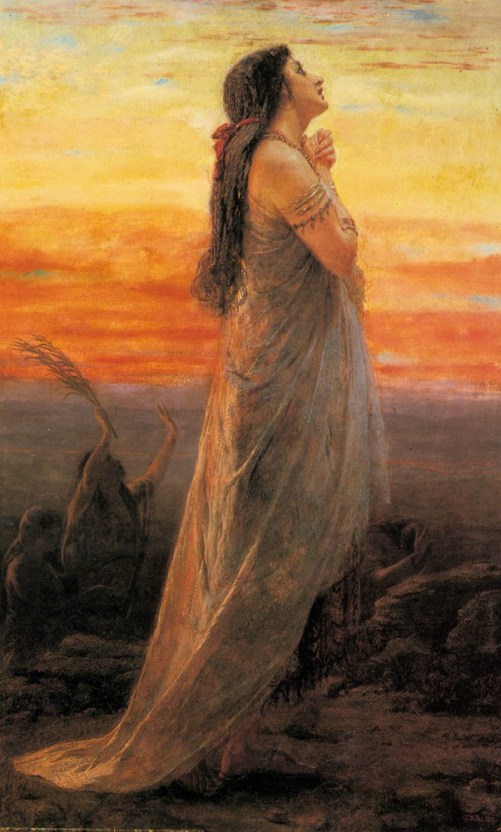
George Elgar Hicks, “The Lament of Jephthah’s Daughter”

Unfortunately Jephthah most likely did sacrifice his daughter after he vowed to make a burnt offering of “whatever comes out of the door of my house to meet me when I return in triumph.”  The author of Judges includes this story as one of several horrific examples of what happened in the days when “Israel had no king” and “everyone did as they saw fit.”  These examples support the overall argument of the book, that the people need a king to help ensure that they will know God’s law and follow it.  As I explain further in my study guide to Joshua, Judges, and Ruth:

* * * * *

It wasn’t unusual for an Israelite who was counting on the LORD to make a vow, as Jephthah does.  This was a promise to acknowledge God publicly when he brought deliverance.  Vows like this are described often in the Psalms, for example, in Psalm 66:  “I will come to your temple with burnt offerings and fulfill my vows to you—vows my lips promised and my mouth spoke when I was in trouble.”

There would have been nothing wrong with Jepthah’s vow if he had only known the law.  Moses allowed the Israelites to offer anyone or anything they wanted to the LORD in payment of a vow, but it specified that if they dedicated a human being, they had to “redeem” that person by offering the value of their labor instead.  (These regulations are found at the end of the book of Leviticus.)  Jephthah should have paid ten shekels of silver into the LORD’s treasury, rather than sacrificing his daughter as a burnt offering.  But by now the Israelites were so used to Baal-worship, which included human sacrifices, that they were actually prepared to offer human sacrifices to the LORD–even though he had expressly forbidden them in the law.  And so Jephthah’s daughter suffers a horrific fate.

* * * * *

After offering this explanation, I then make these further reflections on the story of Jephthah:  “However, apart from his ignorance of the law and these tragic consequences, Jephthah is in other ways an exemplary judge.  He continually acknowledges the LORD as the one who delivered Israel in the past and who should be trusted to do so again.  The narrative says that the ‘Spirit of the LORD’ was on him, and that ‘the LORD gave [the Ammonites] into his hand.’  The book of Hebrews names him as a hero of the faith.”

In light of these observations, I ask these questions in the guide:

• Was Jephthah the best man he could have been, given his nation’s state of spiritual decline?  Or could he have been better?  If so, how?

• What consequences do you see in your own culture of an ignorance of God’s ways?  What activities are accepted, perhaps without question, that God doesn’t want people to practice?

What would you say in response to these questions?

Do we in the West need to worry that Jesus said, “Woe to the rich”?

Q.  In the “Sermon on the Plain” in Luke, Jesus says,
Woe to you who are rich,
for you have already received your comfort.
Woe to you who are well fed now,
for you will go hungry.
Woe to you who laugh now,
for you will mourn and weep.”
Do we in the West need to worry? I mean, we’re rich compared to a lot of the world, we’re well fed, we’re doing pretty ok, you know?

When we consider the full counsel of Scripture, I don’t think we are led to conclude that being wealthy, in and of itself, brings on God’s judgment.  Many of the sayings in Proverbs, for example, teach that wealth is a sign of God’s blessing and a reward for living right, according to godly wisdom:

“The blessing of the LORD makes rich,
and he adds no sorrow with it.”

Wisdom is more precious than rubies;
nothing you desire can compare with her.
Long life is in her right hand;
in her left hand are riches and honor.”

But we do need to have the proper attitude towards wealth.  Paul writes to Timothy, “Teach those who are rich in this world not to be proud and not to trust in their money, which is so unreliable. Their trust should be in God, who richly gives us all we need for our enjoyment.  Tell them to use their money to do good. They should be rich in good works and generous to those in need, always being ready to share with others.”

These are important warnings for us to hear in the West, where we get so many cultural messages that we can and should trust in wealth, and where we don’t always get this kind of encouragement to be generous and share.

I think the kind of wealth that brings judgment, according to the Bible, is wealth that has been acquired at the expense of others who have been reduced to destitution through oppression and exploitation.  James, writing in the same wisdom tradition as Proverbs, warns about this:

“Now listen, you rich people, weep and wail because of the misery that is coming on you. Your wealth has rotted, and moths have eaten your clothes. Your gold and silver are corroded. Their corrosion will testify against you and eat your flesh like fire. You have hoarded wealth in the last days. Look! The wages you failed to pay the workers who mowed your fields are crying out against you. The cries of the harvesters have reached the ears of the Lord Almighty. You have lived on earth in luxury and self-indulgence. You have fattened yourselves in the day of slaughter. You have condemned and murdered the innocent one, who was not opposing you.”

The book of Proverbs itself, while it generally regards wealth as the result of hard work and poverty as the result of laziness, also recognizes the reality of oppression:
A poor person’s farm may produce much food,
but injustice sweeps it all away.

I think this is the kind of wealth Jesus is warning about in the Sermon on the Mount:  wealth that has been acquired through injustice and oppression.  And so there are some implications for those of us who live in the West.

First of all, we must pay others fairly and not exploit them.  (For example, we shouldn’t underpay recent immigrants who don’t have the means to ensure that they’re compensated fairly for their work.)

But we also need to do what we can to support equitable economic relations globally.  It must be admitted that we currently enjoy many unfair advantages in global trade.  To do what we can to counteract this, we need to be aware of sourcing, make an effort to purchase fair trade products, boycott companies until their overseas workers are treated properly, and so forth.  This means an investment in awareness and a commitment to action in response to what we learn.

Hopefully in this way we can become people who are “rich in good works and generous to those in need,” as the Bible encourages us to be, and we will not be the subjects of any of the woes that Jesus pronounces in the Sermon on the Mount.