Q. Why, in the Old Testament, did Miriam become leprous for speaking against her brother Aaron?
Please see this post:
https://goodquestionblog.com/2014/02/07/why-was-only-miriam-punished-when-she-and-aaron-rebelled/

Q. Why, in the Old Testament, did Miriam become leprous for speaking against her brother Aaron?
Please see this post:
https://goodquestionblog.com/2014/02/07/why-was-only-miriam-punished-when-she-and-aaron-rebelled/

Q. Why were the disciples afraid when Jesus appeared?
I’m assuming you mean to ask why the disciples were afraid when Jesus appeared to them after his resurrection. Luke explains in his gospel that “they were frightened and terrified because they thought they were seeing a ghost.” This was even after they’d gotten several independent reports that Jesus had risen from the dead, and even though he said to them, as soon as he arrived, “Peace be with you.” But fear is actually not an unusual reaction when someone in the Bible encounters a visitor from the spiritual world.
Gideon, for example, realizes that he’s been speaking with the angel of the Lord when the angel first sets on fire the food he has served him, just by touching it with tip of his staff, and then vanishes. God has to tell Gideon, “Peace! Do not be afraid. You are not going to die.”
Similarly, when a mighty angel appears to Daniel, he collapses on the ground, and then gets up “trembling.” (Understandably, because the angel’s “body was like topaz, his face like lightning, his eyes like flaming torches, his arms and legs like the gleam of burnished bronze, and his voice like the sound of a multitude.“) Daniel, too, is told, “Do not be afraid.”
When the angel of the Lord comes to tell Zechariah that his prayers have been answered and he and his wife are about to have a son (John the Baptist), even though this is good news, Zechariah is “startled and gripped with fear.” The angel reassures him, “Do not be afraid.”
During Jesus’ earthly ministry, he once walked on the Sea of Galilee to join the disciples in their boat far out on the water. Matthew records that “when the disciples saw him walking on the lake, they were terrified. ‘It’s a ghost,’ they said, and cried out in fear. But Jesus immediately said to them: ‘Take courage! It is I. Don’t be afraid.'”
And in the book of Revelation, John reports an experience similar to Daniel’s. He says that when he first saw Jesus in his exalted glory, “I fell at his feet as though dead. Then he placed his right hand on me and said: ‘Do not be afraid.‘”
I think it would only be natural for us humans to be startled and alarmed if we encountered a heavenly visitor. But it’s very encouraging to read in the Bible how God always reassures each frightened person by saying, “Don’t be afraid.” This helps us realize that whenever God steps into our lives—even if we don’t experience a supernatural appearance, but instead sense a divine hand at work in our circumstances—we can be confident that God has come to bring about good, not to harm us. So even if we’re startled (and maybe it’s good for us to be shaken up by the reality of spiritual things from time to time), we don’t need to be afraid.
In this post, I’m chiming in on a comment that I read online, rather than answering a question that was specifically asked of me.
[The comment I read:] As a big fan of Wesley’s hymns (he was adamant about singing them “as written”), I’m upset that a modern hymnal changes the line in “And Can it Be” from “emptied himself of all but love and bled for Adam’s helpless race” to “emptied himself (so great his love) and bled for all his chosen race.” This appears to support predestination or a limited atonement. Wesley’s words are more in keeping with Scripture—the promise was to Adam and his descendants (his “race”). Altering “all but love” suggests that Christ retained other elements of his attributes as God even when “emptied.” What other motivation is there for a sacrificial, atoning death on our behalf than love incarnate? This change is very odd.
[My thoughts:] When I first came to Christ and was introduced to this hymn, these lines spoke to me very powerfully. I was moved by the idea that Jesus “emptied himself of all but love” and “bled” for all of us. I, too, have encountered the changes that have been introduced to this hymn recently, and I, too, am “upset” about them.
Apparently some hymnal editors have felt that the theology of Charles Wesley, the author of this hymn, needs to be corrected at a couple of points. For one thing, it’s clear that these editors want the hymn to present the idea of a limited atonement, rather than an unlimited one. In the original hymn, Jesus dies for the whole human race. In the modified version, He dies only for his “chosen” ones.
In addition, these editors apparently feel that Wesley has taken the idea of Jesus “emptying” himself a bit too far. The Bible teaches clearly that He “emptied himself by taking the form of a servant, being born in human likeness.” But it’s generally understood that while Jesus gave up the so-called non-communicable divine attributes (the ones that humans cannot share with God) such as omniscience and omnipresence, He retained communicable attributes such as holiness. So, for these editors, saying “all but love” wasn’t strictly true. Love wasn’t the only attribute He retained.
It should be noted that various groups change the words to hymns all the time, to words that they find more suitable. Or at least they try to. A few years back, the new hymnal of the Presbyterian Church U.S.A. got into the news for leaving out the hymn “In Christ Alone.” It turns out that its editors wanted to change the ending of the line “till on that cross as Jesus died, the wrath of God was satisfied” to “the love of God was magnified.” But the copyright holder wouldn’t grant permission, and the editors didn’t want to include the hymn as it was originally written.
To give a further example, I have an otherwise lovely Christmas CD on which another of Charles Wesley’s hymns is altered. In “Hark, the Herald Angels Sing,” the line “offspring of a virgin’s womb” is changed to “offspring of the chosen one.” Somebody obviously didn’t believe in the virgin birth.
I personally have no problem with the theology that Wesley originally expressed in “And Can It Be?” I believe in an unlimited atonement, and I think the phrase “all but love” is simply a beautiful poetic overstatement, meaning that Jesus came to save us out of pure love. Nevertheless, what upsets me most is not that some people are singing different words to the hymn these days, because I know this kind of thing happens. Rather, I’m more distressed by the way this change has been introduced.
“Bled for all his chosen race” is simply bad English. It should be either “bled for all of his chosen race,” or “bled for his whole chosen race,” or something like that, some correct expression that would fit the music. It’s also bad theology. The “elect” or “chosen” (for those who think in such terms) are not a race, they’re a host. They’re gathered one by one. You don’t become one of the elect by being born to people who are elect.
I find that the other change has also been introduced awkwardly. There’s already an interjection in the stanza: “So free, so infinite his grace!” If you put in interjections too often, they lose their force, and so they should be used sparingly. I doubt that a poet of Wesley’s caliber would have introduced another one in the very next line: “So great his love!” For that matter, the change reflects the mistake of taking a poetic overstatement literally. It’s like listening to the Hollies sing, “All I need is the air that I breathe, yes, to love you” and asking, “Don’t you need food, too?”
So I have one suggestion for anyone who dislikes these new words, as I do, on theological and literary grounds, and another suggestion for hymnbook editors.
I think that if a hymn gets changed like this, you can legitimately go ahead and sing the original words that you have come to love and admire, even while others in your current church are singing the new words. I say this as someone who was a pastor for twenty years and always wanted both oneness of spirit and freedom of conscience in worship.
I encountered what I think is a good model for this in the church I served as an associate pastor early in my ministry. This church would would provide optional words in the bulletin for older hymns that used masculine terms for people in general. That way people who no longer “heard” these terms as inclusive of women could sing words that were meaningful for them and that also captured the original intention of the hymn (since the original writers did not see the terms as exclusive). Those who still “heard” the original terms as referring to both men and women, for their part, could sing those words out of the hymnal at the same time. Different words, but sung with the same meaning and in the same spirit.
To give an example from a different liturgical practice that I think provides a good further analogy, a young Catholic woman once came to the service in one of my churches, as the guest of a friend, and asked me if it would be all right if she took communion with us believing in her own heart (as she knew we didn’t quite) that the bread and wine would become the actual body and blood of Christ. I said we would love to have her join us on that basis. After the service she made a point of telling me, perhaps for the sake of her own conscience, that she had indeed taken the communion elements with that understanding. I think having her join us that way was much better than me forbidding a fellow Christian to share the sacrament with us. Oneness of spirit and freedom of conscience.
So I think a person could sing the original words to “And Can It Be?” in their own church the same way, respectfully and in a spirit of unity. (You can bet that if I’m ever in a Christmas service where the phrase “offspring of the chosen one” is substituted in the bulletin or hymnal, I’m going to sing “offspring of a virgin’s womb.” Respectfully.)
And to hymnbook editors I would say, if there’s a hymn that’s so eloquent and lyrical that you want to sing it even though you disagree with parts of it, please think twice about changing the words. I feel it’s a shame that in this case Charles Wesley’s magnificent poetry has been turned into, frankly, something average at best. If you really don’t like what he says in his hymns, why not write your own?
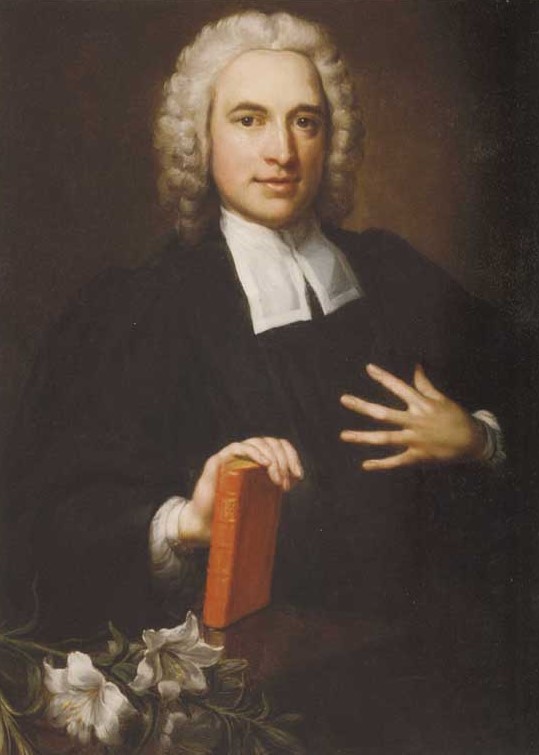
Crossway recently announced that the English Standard Version (ESV) of the Bible would “remain unchanged in all future editions . . . to guard and preserve the very words of God as translated in the ESV Bible.” That way “people who love the ESV Bible can have full confidence in the ESV, knowing that it will continue to be published as is, without being changed, for the rest of their lives, and for generations to come.”
Update: The next month, Crossway issued a statement saying, “We have become convinced that this decision was a mistake. We apologize for this and for any concern this has caused for readers of the ESV.” Crossway said it would “allow for ongoing periodic updating of the text to reflect the realities of biblical scholarship such as textual discoveries or changes in English over time.”
This so-called “permanent text” of 2016 represents a third revision of the translation, which was first published in 2001 and then revised in 2007 and 2011. This last text incorporates what the publisher calls “a very limited number of final changes” (“52 words . . . found in 29 verses”) that are designed to make “a substantial improvement in the precision, accuracy, and understanding” of the text at these places.
One of these changes has already become very controversial. In the account of the fall, in previous editions of the ESV, God says to Eve:
“I will surely multiply your pain in childbearing;
in pain you shall bring forth children.
Your desire shall be for your husband,
and he shall rule over you.”
The permanent text now reads, “Your desire shall be contrary to your husband, but he shall rule over you.” I am not aware of any statement that Crossway or the ESV Translation Oversight Committee may have offered explaining the rationale for this change. But it appears to me that the concern was that the phrase “your desire shall be for your husband” would be misunderstand to mean that Eve would still want to be emotionally and relationally close to Adam, and that to accomplish this she would accept to live in a household in which he was in authority.
These phrases actually do mean something different. They appear again, in word-for-word parallel, shortly afterwards in Genesis when God warns Cain, “If you do well, will you not be accepted? And if you do not do well, sin is crouching at the door. Its desire is for you, but you must rule over it.” Sin is represented metaphorically as a wild animal poised to pounce on Cain, and this makes clear the meaning of “its desire is for you”: Sin wants to have Cain in its power, but Cain must not succumb to that power; he must remain in control of his own actions.
So it is important to correct the misimpression that Eve has a “desire for” closeness and affection with Adam. No, she wants to have him in her power. But he will resist and dominate her instead. In other words, after the fall, marriage is no longer a cooperative enterprise but a struggle between husband and wife for dominance.
However, I don’t think that the ESV has gone about correcting this misimpression the right way. The expression “your desire will be for your husband” (= “its desire is for you”) is an idiom. (Like Muhammad Ali famously saying “I want Joe Frazier,” emphasis his, before one of their fights.) It is not describing an actual desire or longing that a person feels. Instead, it means, as the New English Translation puts it, “You will want to control your husband.” The New Living Translation says similarly, “You will desire to control your husband”—desire in the sense of wanting to do something.
But the ESV now uses, for the first time in any English translation, a qualifying adjective, “contrary,” instead a preposition (“for” or “against”) as in Hebrew. The presence of this adjective requires us to understand this literally as an actual wish, desire, or longing, and one that is necessarily opposed to the husband’s wishes. Now “he shall rule over you” means not “you won’t be able to control him,” but he will get his way, you won’t get yours!
Still, does this really matter that much, since in any event it portrays a formerly cooperative relationship dissolving into conflict? I believe it does. The essential issue here is interpretation rather than translation, but a given translation can serve to advance one interpretation and hinder or prevent another.
The interpretive question is whether redemption restores God’s original intention for marriage, so that within the kingdom of God couples can live out a cooperative enterprise once again, or whether male authority needs to be insisted upon even among regenerate people.
I’d observe that we do everything we can to mitigate all the other effects of the fall as described in Genesis. We use every technique and medication available to make sure that women have as little pain as possible in childbirth. I don’t know one man who doesn’t try to make his work as efficient and labor-saving as possible. (Another effect of the fall was painstaking toil to earn a living.) So shouldn’t we also believe that we’re supposed to mitigate the distortions in husband-wife relationships, and in male-female relationships generally, that resulted from the fall?
The mandate to do this is clear if the consequences of the fall are that husband and wife will both try to be in control. Once they become regenerate people, they will treat one another the way the New Testament says all followers of Jesus should treat each other: “Be of the same mind, having the same love, being in full accord and of one mind. Do nothing from selfish ambition or conceit, but in humility regard others as better than yourselves. Let each of you look not to your own interests, but to the interests of others.” Taking this attitude makes marriage a cooperative enterprise once again.
However, if the consequences of the fall are that husbands and wives will want “contrary” (opposing) things, and the solution is that the husband gets his way, and the wife has to “submit” to that—what’s there to fix? There’s no conflict when everybody knows who’s in charge.
But leaving things this way is dismal. How much better it is for both husband and wife to bring all of their increasingly sanctified hopes and wishes and desires to the table, and if some of them differ, for the two of them to seek God earnestly to find a greater plan, more comprehensive and far-reaching than either of them could imagine, that will catch up everything they could hope or dream for into an enterprise that calls for all of their gifts to be used to the fullest, interactively, to bless far more people than they ever could have anticipated.
We should not continue to see a husband’s and a wife’s desires, if they differ, as contrary, in light of provisional arrangements made after the fall. Instead, we should recognize them as complementary, just awaiting the hand of the Creator to weave them together into something unified and glorious.

Q. In conversations with the average Christian, it appears that they are quite prone to “conspiracy-theory” type reasoning and that distrust of science is fairly ubiquitous. There is an uncanny ability to “explain away” anything that challenges their views by claiming it is caused by the corrosive effects of secularism, demon activity, atheism, hedonism, the fallibility of human reasoning, the effects of the fall on rationality, the “tentative nature” of science, etc. Do you know of a good way to reason with these types, and in the end, is it even worth it?
First, I sincerely hope that what you say is not actually true of the “average Christian.” I’d like to think that the average or typical Christian is someone who takes seriously Jesus’ admonition to love God with heart, soul, mind, and strength, and who emulates the Bereans, whom the New Testament praises for “searching the Scriptures daily to see whether these things were so.” (That is, rather than uncritically accepting dogmatic teaching.) I see this as the norm, and feel that taking an open-minded, logical, inquisitive stance is perfectly compatible with being a person of faith.
That much said, I have to admit that over the years I’ve encountered people who’ve appealed to all of the various considerations you list to explain away beliefs different from the ones they were holding at the time. So what’s to be done when people clearly are not open-minded, and perhaps not even rational, in the way they engage other beliefs that are nevertheless within the spectrum of Christian orthodoxy?
One question I find helpful to ask is, “What do they think is at stake in the issue?” For example, people are sometimes encouraged to believe that if God didn’t actually create the universe in six 24-hour days about 6,000 years ago, then nothing the Bible says about anything is trustworthy. (The old “if you can’t trust what it says on the first page, you can’t trust anything else in the book” argument.) And I personally would be very resistant to any claim whose implications I thought were that I couldn’t trust anything in the Bible. This is because I know for a fact that I can trust everything in the Bible, so long as I understand and interpret it properly.
The key is to make sure that I’m doing that. But this already shifts the issue from the Bible’s reliability and trustworthiness to its interpretation. Maybe the person I’m speaking with isn’t prepared to make that shift. Maybe they think its trustworthiness is truly at stake. In that case, I find it helpful to suggest that there are many things that Christians of good will, equally committed to the authority of the Scriptures, can disagree about, and to demonstrate that Christians have in fact disagreed about such things over the whole course of church history. (Long before the corrosive effects of secular humanism set in, that is.)
For example, I might observe that we can find a disagreement in the 4th century between Ambrose and Augustine as to whether the “days” in Genesis are literal 24-hour periods. (Ambrose said they were, while Augustine maintained they weren’t.)
This will not persuade the person who believes that the truth of the entire Bible rests on one answer to this question. But in this conversation and others, I may be giving them an island to step onto if, at some time in the future, their ship starts leaking and taking on water. This, I think, is much better than leaving them no option other than having their entire faith go down with the ship (the current dogmatic package) if it ever sinks.
And if I maintain good will (that is, if I don’t lose my cool) and approach the question humbly and open-mindedly, searching the Scriptures with them, then I’m actually demonstrating how Christians of good will, with equal commitments to the authority of the Bible, can disagree on questions like this. That makes things a little less high-stakes.
Don’t underestimate the value that such a demonstration will have on anyone else who might be watching the two of you talk, listening to your conversation. You will likely have an audience larger than one. And the discussion can also help you be more “fully persuaded in your own mind.” It never hurts for us to have our own ideas challenged and to have the occasion to ground them even more firmly on a reasonable basis, at least to our own satisfaction.
So, as I said, if your goal is to persuade on the spot, that isn’t going to happen in the face of irrationality and conspiracy theory. But if your goal is to provide the person with information and tools that may be useful to them farther down the road, then I think you have every chance of doing that. I suspect that many of us start out holding our beliefs more dogmatically when we first become Christians, because we know we have received a “great salvation” and we simply don’t find anything credible that we think undermines it. But then, hopefully, we will discover how great that salvation truly is, how many different perspectives it accommodates and even requires if we are even to begin to understand everything God is and all that God has done. And then the adventure begins.
_-_WGA13181.jpg)
I’ve been an enthusiastic backer of The Word for Word Bible Comic since April 2014, when the project first went public with a Kickstarter campaign. (Here’s my original post endorsing it in its early stages: Can a graphic novel presentation of Scripture still be the Bible? In this case, yes.) It’s been a privilege to be one of the many resource people that the artist in England, Simon Amadeus Pillario, has reached out to repeatedly over the past two and a half years to ensure that his work is “historically accurate, unabridged, and untamed . . . with a high view of Scripture.”
Today the first two books in the series, Judges and Ruth, go on general release. I can heartily encourage all of you to get your own copies! (You can order them here.) For all of the reasons I give in my earlier post, this project will enable you to read these biblical books—every word of them—while immersing yourself in an authentic visual experience of the culture and customs of the times. (For example, Philistine warriors aren’t dressed like Roman soldiers. Pottery and furniture are authentic to the period. And, as I note in my first post, the art in the series even follows the shift from four-spoked wagon wheels to six-spoked wheels, when that shift occurs historically.)
Let me illustrate the kind of choices that Pillario has had to make along the way to giving us this authentic presentation through the example of one issue he asked for advice about last month, as the books were heading for the printer. Here’s the cover of Judges:

As you can see, it depicts several characters from the book, including (from top to bottom) the angel of Yahweh, Gideon, Deborah, and Samson. Samson has just killed a thousand Philistines with the jawbone of a donkey and, as should be expected, he is covered in their blood. This is different from the visual treatments of the episode we may be used to, such as this one, in which somehow no blood is spilled:
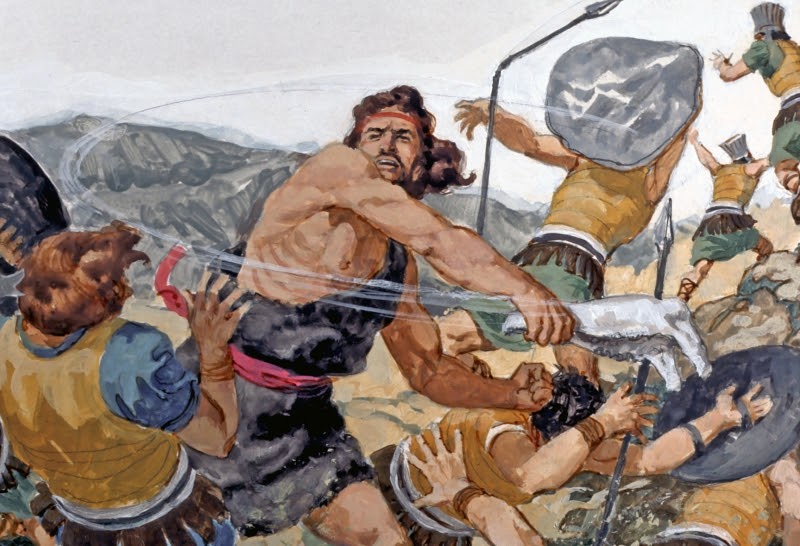
Pillario’s question was, Does my cover simply have too much blood on it? Someone had expressed a concern that it might be inappropriate, if these “Bible comics” were going to be placed where young children might see them. Pillario explained options such as making the blood brown rather than red, or presenting Samson as a red silhouette. (You can see all these options in his blog post on the topic.)
But by and large the people who responded, myself included, felt that the realistic depiction should be retained. I observed, “There’s already a 15+ advisory, so the comic isn’t supposed to be down where younger children can see it anyway. One of the best things going for Word for Word is its realism and authenticity. And, well, there’s lots of blood in the book of Judges.” (Of course we still need to come to terms theologically with how much blood is spilled in biblical books like this one. But the first step in that process is to admit that it’s there.)
Most others felt similarly. Another commented, “I think it’s cool. Top shelf in the church’s library, but cool.” And someone else advised, “I think you should make this, and everything in your adaptation of the Bible, as close and as faithful as possible. Definitely go with the bloody original. You wouldn’t make Christ’s crucifixion any less bloody and gory than it’s supposed to be.”
So the Judges graphic novel being released today still has its original cover. Pillario also invited input on the cover for the book of Ruth, in its early stages. For a look at all the considerations that went into that design, see this post on his blog.
But I don’t mean to focus all the attention on the covers. That’s just a way of giving you a feel for the care that has gone into these books. As a Kickstarter backer, I already have a prepublication coy of Judges, and I can testify that these graphic novels are full of amazing things inside. (For example, here’s a post with a link to a video about all that goes into a single interior page in Judges.)
Once again, I encourage you to get your copy of these eye-opening authentic treatments of the Scriptures!
Q. Why are the apostles “filled with the Holy Spirit” when they pray for boldness after Peter and John are arrested, when they had just recently received the Spirit on Pentecost? Isn’t the receiving of the Holy Spirit a one-time thing, as opposed to how it was in Old Testament times? If there are deeper levels or experiences, what do they consist of?

As I understand it, Pentecost is the occasion on which the community is filled with the Holy Spirit. The New Testament speaks of the community of Jesus’ followers as “God’s temple” or a “temple in the Lord.” The physical temple in Jerusalem was destroyed in A.D. 70, and the New Testament envisions a new kind of temple, built of “living stones” (as Peter puts it, that is, of people), taking its place. And so the scene on the day of Pentecost is just like the ones in the Old Testament when God’s Spirit fills the tabernacle built by Moses and the temple that Solomon built. (Along these lines, I once preached a Pentecost sermon entitled “The Filling of the New Temple.”)
This is indeed a one-time occasion. The Spirit came to live in the “new temple” only once, just as in the cases of the tabernacle and physical temple. And presumably anyone who was constituting the “new temple” at the time, that is, each the 120 followers of Jesus who were meeting together on Pentecost, was filled with the Holy Spirit as the community was filled. But this is something different from the kind of filling that’s described later in Acts, both in the passage you mention and in others.
In those cases, it’s almost as if the Holy Spirit takes up a person and uses them as an instrument for something on a particular occasion. We see this from what happens next: they speak the word of God boldly, or they announce God’s judgment on opponents, or (in Saul’s case) his lost sight is restored and he receives his divine calling.
This is directly analogous to the situations in the Old Testament where, in effect, the Spirit picks someone up and uses them for God’s purposes. The Hebrew idiom is quite striking: It says that the Spirit of Yahweh “clothed herself* in” the person chosen as an instrument. This is how Gideon, for example, was propelled into his mission of leading Israel’s tribes against an invading coalition of their enemies.
If you think about it, if the Spirit is wearing you like a garment, that’s the same thing as being filled with the Spirit: you’re the outside, and the Spirit is the inside!
This is a matter of special empowerment by the Spirit on a particular occasion for a particular purpose. I’d say that, for its part, it’s different from yet another kind of “filling with the Spirit.” I think that all believers receive the Spirit when they choose to follow Christ. But they are not necessarily filled with the Spirit if they haven’t yet opened up every area of their being to the Spirit’s presence and control. When we do “surrender all,” then the Spirit can flood our being throughout and we are filled.
This might be a gradual process for some people, but for others, it may be a powerful and moving experience that happens at a specific, memorable time. In the mid-to-late 1800s, the phrase “baptism of the Holy Spirit” was used to describe this experience, synonymously with “complete surrender” and “entire sanctification.” The idea was that people weren’t getting more of the Spirit, the Spirit was getting more of them, and so was able to fill them. (The Greek verb “baptize” actually means “to fill by immersing,” and so it’s a suitable term to use for such an experience.)
Later, specifically within the Pentecostal movement starting in 1906, the phrase “baptism of the Holy Spirit” became associated with receiving the “gift of tongues,” that is, the ability to speak a language not naturally acquired, as the followers of Jesus did on the day of Pentecost. But even within that movement, the primary emphasis remained on the complete surrender of one’s life and will to God. I believe that God does still give the gift of tongues today, in a variety of forms and for a number of purposes, but that it is not the identifying sign of having been filled with the Holy Spirit. Rather, a greater empowerment for service with whatever gifts God has given, and a greater consecration to God, are the evidence of that filling.
I hope this is helpful!
*I use the feminine pronoun because the word for “Spirit” is feminine in Hebrew. The language has no neuter pronoun, and even if it did, I don’t think either using the impersonal pronoun from English (“it”), or using a masculine pronoun (“him”) to represent a feminine word, would be appropriate for the Spirit as depicted in the Hebrew Bible.
Q. I’ve just noticed that there’s an actual warning in the Bible not to be overly righteous. Ecclesiastes says, “Be not overly righteous, and do not make yourself too wise.” Can you give us the reason for this?
I think in this case the term “righteous” doesn’t refer to to our degree of inward Christ-likeness. That’s something we can never get too much of. Rather, it refers to our degree of fastidiousness in following religious observances, such as the spiritual disciplines we adopt to make sure our relationship with God keeps growing. Being “overly righteous” in this sense means missing the “spirit of the law” because we are so concerned about following the “letter of the law.”
This was something Jesus was always trying to warn the Pharisees about, and correct them. For example, when a synagogue leader got upset because on one Sabbath Jesus healed a woman who’d been disabled for many years, and this leader told the people only to come to Jesus for healing on the other six days of the week, he was definitely being “overly righteous”! Jesus rebuked him publicly and “his adversaries were put to shame,” but “all the people rejoiced at all the glorious things that were done by him.”
The statement you’re asking about is in keeping with the general emphasis in the book of Ecclesiastes on being free to enjoy life in the present, as a good gift from God, because we can never count on being able to do things in the future. In other words, it’s saying that we shouldn’t be so “righteous” (in the fastidious sense) that we miss God’s good gifts in this life.
This means that we need to be flexible (though not compromising) in how we understand the way to live out our spiritual disciplines. For example, suppose you’re committed to attending church on Sundays. If some friends you made from another country are back in the U.S. for a visit, and they can only reunite with you at a time that would make you miss that week’s service, should you say, “Too bad, I’m going to church instead”?
I don’t think so. That’s the kind of thing Ecclesiastes is warning us about.

Q. Your most recent post comparing the God of the OT and NT made me think of a question. What do you see as the relationship between the Mosaic covenants and the new covenant? As far as I can tell from Jeremiah, the new covenant has the same information, it is just that all the previous terms of the Biblical covenants were written on stone and scrolls, where in the new covenant, they will be written on one’s heart. Therefore the new covenant will be better, as we will want to do the stipulations in it.
I think this is basically right. The covenant with Moses had some things that I believe were identity markers for God’s people at the time, such as keeping kosher, observing certain days, etc. The New Testament makes clear that these are no longer obligations for followers of Jesus.
But certainly the ethical imperatives of the covenant, summed up by Jesus as “love the Lord your God with all your heart, and your neighbor as yourself,” remain. As you say, under the new covenant, we now want to fulfill them, as we are given new hearts. Our identity markers as covenant people are love, joy, peace, patience, kindness, goodness, faithfulness, gentleness, and self-control—the fruit of the Spirit.
As I believe you’re saying, when seen from the perspective of the character and actions that God wanted to produce all along in His people, there is more continuity than discontinuity between the Mosaic covenant and the new covenant.
Q. For years I’ve been struck by the stark contrast between how God’s judgment is portrayed in the Old Testament and how it is portrayed in the New Testament. Even before Jesus’s death, God seems to have a gentler spirit with his people. I pondered this for a long time but never came up with an explanation that seemed to make sense until the other day.
Let me run a hypothesis by you. Do you think God changed after Jesus walked on the face of the earth, because he experienced first-hand some of the struggles we face? This may seem like a pretentious suggestion, and I really don’t mean any disrespect to our sovereign God who created the universe and is all-knowing. But I do see a an inexplicable difference between the Old and New Testaments. Would love to hear your thoughts.
I think you may actually be on to something here, but let me offer a couple of qualifiers first.
We should observe, for one thing, that God actually shows mercy as well as judgment towards people in the Old Testament, and judgment as well mercy to people in the New Testament.
For example, there’s a beautiful passage in Hosea that speaks of God’s love for the wayward nation of Israel: “Therefore I am now going to allure her; I will lead her into the wilderness and speak tenderly to her. . . . I will betroth you to me forever; I will betroth you in righteousness and justice, in love and compassion.” And then there are the words that open the second part of the book of Isaiah: “Comfort, comfort my people, says your God. Speak tenderly to Jerusalem . . . He tends his flock like a shepherd: He gathers the lambs in his arms and carries them close to his heart; he gently leads those that have young.” And so forth, in the Old Testament.
On the other hand, in the New Testament, along with all the grace and mercy, we find passages like this one in 2 Thessalonians: “God is just: He will pay back trouble to those who trouble you . . . This will happen when the Lord Jesus is revealed from heaven in blazing fire with his powerful angels. He will punish those who do not know God . . . They will be punished with everlasting destruction.” Even from the lips of Jesus himself we hear things like this, spoken to the Pharisees: “You snakes! You brood of vipers! How will you escape being condemned to hell?” (I won’t even get into all the plagues and destruction in the book of Revelation.) So it seems there’s plenty of both mercy and wrath to go around in each testament.
Still, we have the impression that there’s more wrath in the Old Testament. What creates that impression? For one thing, in that period God was using the law to govern His relationship with His people. The New Testament itself says that the law has a positive purpose, to restrain and to teach. But laws need to specify what the consequences will be if they’re broken. That’s one reason why we hear so much about punishment in the Old Testament.
If teenagers found themselves constantly threatened with punishment, or actually being punished, they might marvel at how different their parents seemed from the days when they used to cuddle them and coo over them as babies. But the parents haven’t necessarily changed. The teenagers have actually moved into a life stage where they need the guidance and restraint of enforceable rules to help them become more mature and eventually independent adults. In the Old Testament, that’s the stage the people of God are in. Things do change in the New Testament, where God’s relationship with His people is governed instead by the Holy Spirit living in them. “The law was given through Moses; grace and truth came through Jesus Christ.”
One more consideration is that the Old Testament is the story of how the original chosen people kept disobeying the covenant through which they were supposed to be God’s instruments to reach the rest of the world, and how they needed to be corrected as a result. Ultimately, a new kind of covenant was promised. The New Testament is the story of how Jesus came to earth to live out perfect obedience, inaugurate that new covenant, and fulfill the intentions of the original covenant, to bring all peoples in. So the story of disobedience in the Old Testament is going to feature a lot more judgment and punishment than the story of obedience in the New Testament. It’s not so much God’s “learnings” as a human being that lead Him to be more merciful in the New Testament as the unfolding of a plan by which God, in Jesus, supplies the obedience that He was looking for from humans all along.
All of that said, however, let me return to your hypothesis and explain why I think you may still be on to something. The book of Hebrews says, “In the days of his flesh, Jesus offered up prayers and supplications, with loud cries and tears, to him who was able to save him from death, and he was heard because of his reverence. Although he was a son, he learned obedience through what he suffered. And being made perfect, he became the source of eternal salvation to all who obey him.” As a result, “we do not have a high priest who is unable to sympathize with our weaknesses, but one who in every respect has been tempted as we are, yet without sin.”
This seems to suggest that there was some kind of “learning” as a human being on Jesus’ part that has resulted in Him being a more effective intercessor for us in heaven. Should we therefore conclude that when Jesus intercedes for us, since God is talking to God (that is, God the Son is addressing God the Father), God is now more able to “sympathize with our weaknesses” in His own self-reflections? If so, this would reflect no prior deficiency in objective knowledge on God’s part, but rather a gain in God’s subjective or experiential knowledge. It makes sense to me, at least, that even if God knew everything from the beginning, He hadn’t necessarily experienced everything. Something to think about, anyway!
This would not account for any difference in God’s dealings with us “before Jesus’s death,” however, because Jesus had not yet taken His place back in heaven as our intercessor at that point. So I wouldn’t appeal to this to explain how justice and mercy work in the Old and New Testaments. But I would still marvel, and worship, at the thought that Jesus came and shared our humanity to such an extent that He could bring an experiential appreciation of it back to share with the Father in heaven.
I don’t know that this has necessarily changed God’s character, to make Him more merciful. Even as God is first giving the law through Moses, He describes compassion as His primary and outstanding characteristic, at length, before describing justice as well: “The Lord, the Lord, the compassionate and gracious God, slow to anger, abounding in love and faithfulness, maintaining love to thousands, and forgiving wickedness, rebellion and sin. Yet he does not leave the guilty unpunished . . .” Still, I recognize that God in His graciousness has identified with us in an amazing way through Jesus, and this must give a very special quality to His compassion.

 Good Question