Are names written in the Book of Life, or blotted out of it?

Q. I’m reading a book that says names are not added to the Book of Life, they are blotted out.  The book refers to the place in Exodus where Moses prays, “But now please forgive their sin, but if not, then blot me out of the book you have written,” and God replies, “Everyone who has sinned against me I will blot out of my book.”

I’d always thought our names were added to the Lamb’s Book of Life when we accept Christ as our Savior (as in the hymn, “There’s a New Name Written Down in Glory”).  However, if our names are already there, it seems to make more sense.  After all, it is not God’s will that any should perish.  Names would only be blotted out if a person refused forgiveness of their sins.  This would explain why infants who die and the mentally handicapped are able to enter heaven: they have not attained the capacity for accountability, therefore their names have not been removed.  It also explains why the whole human race is the beneficiary of what Jesus did.  Salvation is provided for all, but only becomes an individual reality when a person asks Him for it.

A. I find the idea very appealing that God writes everyone’s name in the Book of Life when they are born (or conceived), in the hopes that they will embrace salvation, and only blots people’s names out of the book if they definitively reject salvation.  Since none of us humans can ever really tell whether another person has done that, we can keep hoping and praying and reaching out friends and loved ones, patiently inviting them to embrace the love God has shown to them through Jesus.

In addition to the Scripture passage you mention in Exodus, the letter to Sardis in the book of Revelation seems to support the idea of names being blotted out, rather than written in, based on a person’s response. Speaking of those who do not deny Him in order to save their lives in this world, Jesus says, “I will never blot out the name of that person from the book of life, but will acknowledge that name before my Father and his angels.”

Moreover, in Psalm 69, speaking of those who are his “enemies without cause,” David prays, “Do not let them share in your salvation. May they be blotted out of the book of life and not be listed with the righteous.”  Interestingly, a couple of passages from this psalm are treated as Messianic in the New Testament.  John says that when Jesus cleansed the temple, “His disciples remembered that it is written: ‘Zeal for your house will consume me.'” And John later says, “So that Scripture would be fulfilled, Jesus said, ‘I am thirsty,'” and he was given vinegar to drink.  This seems to be an allusion to another statement in Psalm 69, “They gave me vinegar for my thirst.”  All four gospels actually record this incident, and Luke specifies that the vinegar was given mockingly.  So if we see David as a type of the Messiah, then the enemies whose names he asks to be blotted out of the book of life can be associated with those who definitively choose to reject Jesus, to mock rather than accept the salvation he accomplished for us on the cross.

I would observe, however, that the case is not entirely clear-cut.  Some other Scriptures seem to suggest that names may be written into rather than blotted out of the Book of Life.  For example, there are a couple of different ways we might interpret Paul’s comment in Philippians about the co-workers whocontended at [his] side in the cause of the gospel,” that their “names are in the book of life.”  On the one hand, it doesn’t seem necessary for him to describe their genuineness this way if being written in were the default, and that nothing short of a definitive rejection of Christ would blot someone out.  On the other hand, he may be contrasting them with the people he has just described, who “live as enemies of the cross of Christ” and whose “destiny is destruction.”  In that case, Paul would be saying that his co-workers, by contrast, have not been blotted out like these people.

One more reference to consider is the one in Revelation that says the beast from the abyss will impress and terrify “the inhabitants of the earth whose names have not been written in the book of life from the creation of the world.”  This seems to suggest that not everyone’s name is written in from the start.

So how we might resolve this difference?  We should admit that it’s unlikely that there’s an actual physical book somewhere in the spiritual realm into which names are entered in ink, or blotted out with ink. Instead, we should perhaps understand the Book of Life as a metaphor that biblical writers use for salvation, speaking either of names blotted out (most commonly) or written in (in a few apparent cases).

Nevertheless, this metaphor represents a genuine spiritual reality.  As Paul put it in his second letter to Timothy, “God’s solid foundation stands firm, sealed with this inscription: “The Lord knows those who are his.'”  In other words, the Book of Life, however physically or spiritually we understand it, exists somewhere, somehow, as a representation of God’s sure knowledge of those who are His.

That may be one good takeaway from this investigation:  If we have genuinely trusted in Jesus, we never have to wonder whether He knows that and will honor it.  As He said to the people of Sardis, “I will acknowledge that name before my Father and his angels.”

And I do have to say that I personally come down on the side of your statement, “Salvation is provided for all.”  If pressed to choose one understanding or the other of the Book of Life, I’d say that all names were written in first, and they would only be blotted out in cases where a person understood but definitively rejected God’s offer of salvation through Jesus.

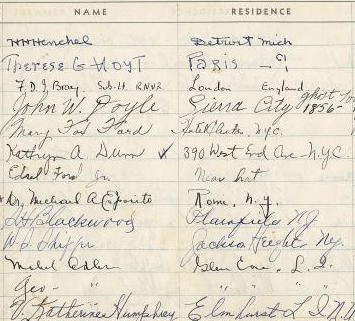
This page from an old hotel guest book suggests an interesting approach to the Book of Life idea. Once we do accept God's offer of salvation through Jesus, do we find that our names are written there in our own handwriting?
This page from an old hotel guest book suggests an interesting approach to the Book of Life idea. Once we do accept God’s offer of salvation, do we find that our names are written there in our own handwriting?

Does the NIV translation fail to reflect the “new perspective on Paul”?

I recently heard from a reader who became interested through this blog in The Books of the Bible, an edition of the Scriptures that can be read without the distractions of chapter and verse numbers, etc.  However, he was initially concerned about the NIV translation, used in that edition, because, he said, “of an article I read which makes me worried that the translation of Paul’s epistles is too much in the Reformed tradition and ignores the last 50 years of Pauline scholarship.”  I think those concerns can be addressed.

At issue here is the so-called “new perspective on Paul,” which is a vast and complicated discussion, but which involves questions such as whether Paul was saying that our salvation comes to us from God completely apart from works (the Reformation emphasis), or whether Paul was saying only that distinctively Jewish observances such as the Sabbath are not required of Gentiles, but that God expects everyone to produce good works as a result of their salvation.  Since the real question here is about the NIV translation, I won’t go into the “new perspective” any further, except to observe its implications for some specific translation choices.

In a 2003 public lecture, N.T. Wright, a noted exponent of one version of the “new perspective,” called the NIV’s translation of a certain phrase in Romans “appalling.” He felt it described God’s own righteousness, but the NIV rendered it as “a righteousness from God,” that is, one that would be imputed to a human being.  In the same lecture, Wright noted that the NIV, also in Romans, left out the word “or” before the question “is God the God of the Jews only?” This seemed to have been done in order to soften the impact of what would be, from the Reformation perspective, a sudden and difficult-to-explain shift from a discussion of individual salvation to the topic of how Jews and Gentiles together form the community of faith.

I don’t know exactly what article about the NIV and the “new perspective on Paul” my reader was referring to, but I suspect it may have been written before the latest update to the NIV was released in 2011, and so it was based on the 1984 second edition.  This most recent update includes changes to many of the passages that likely caused the concerns expressed in the article.  (I’m grateful to this post by T.C. Robinson on his blog New Leaven for much of the information that follows.)

For example, the statement whose translation N.T. Wright found “appalling” formerly read this way:  “But now a righteousness from God, apart from law, has been made known, to which the Law and the Prophets testify.”  In the latest update to the NIV,
it now reads, “But now apart from the law the righteousness of God has been made known, to which the Law and the Prophets testify.  The previously missing “or” has  been placed in front of the statement that follows shortly afterwards: “Or is God the God of Jews only? Is he not the God of Gentiles too?”

Within this same passage in Romans, the NIV now refers to God’s “righteousness” in a couple of places where it previously spoke of God’s “justice.”  And where the translation formerly said of Christ, “God presented him as a sacrifice of atonement, through faith in his blood,” it now reads, “God presented Christ as a sacrifice of atonement, through the shedding of his blood–to be received by faith.”

Other material that’s present in the Greek but formerly missing in the NIV is also now reflected in that translation.  As the discussion continues, Paul asks, according to the 1984 edition, “What then shall we say that Abraham, our forefather, discovered in this matter?”  This omits any representation of the phrase kata sarka, which follows the term propatēr (“forefather”).  The latest update to the NIV reads, “What then shall we say that Abraham, our forefather according to the flesh, discovered in this matter?”

It should be noted that some of these changes were actually made as early as the 2001 TNIV New Testament.  The TNIV was meant to be understood as the latest word from the NIV’s Committee on Bible Translation (CBT), and as such it was effectively the third edition of the NIV.  It would be folded into that translation as part of its 2011 update, which may be considered the fourth edition.  The TNIV NT changed “a righteousness from God” to “the righteousness of God,” for example, in the place we’ve been considering.

The TNIV also changed “through faith in his blood” to “through the shedding of his blood—to be received by faith.”  And it referred to Abraham as “the forefather of us Jews,” not simply as “our forefather,” beginning to reflect the way that proponents of the “new perspective” see the Jew-Gentile dynamic running through the book of Romans.  These changes all followed the TNIV into the NIV in its most recent update (with of us Jews becoming according to the flesh, a more literal rending of kata sarka).

This is not a comprehensive survey, and I have no first-hand knowledge of the exact reasoning behind the changes, but it certainly appears to me that the CBT has been working, in every update it has issued since the “new perspective” came to prominence, to ensure that their translation does reflect the most up-to-date scholarly understanding of Paul’s writings.  So I see no need to avoid the NIV based on the belief that it ignores the “new perspective on Paul.”

[Disclosure: I was a consulting editor for The Books of the Bible, which appeared first in the TNIV in 2007 and was reissued in the NIV in 2011.  I have also consulted with the CBT on specific projects such as the visual formatting of material like genealogies, lists, etc. in the NIV.]

A mosaic depicting St. Paul, Ravenna, Italy, late 5th century

Does the Sermon on the Mount present impossible demands and harsh penalties?

Q. I’ve seen it written that the Sermon on the Mount can be thought of as a job description for Christians.  I’m thankful that God has given us one!  Yet I find some of its passages confusing at best and very difficult, if not impossible, to carry out.  It also seems that Jesus is outlining some harsh judgements for us when we fail, which it seems most of us will.  So I then question, “What about Gods grace?”

What’s known as the Sermon on the Mount is the first extended collection of Jesus’ teachings found in the gospel of Matthew.

Matthew divides his account of Jesus’ life into five thematic sections. Each one begins with a series of narrative episodes, followed by a discourse made up of Jesus’ collected teachings.  The narrative and the discourse explore a common theme in each case. The first section, whose discourse is the Sermon on the Mount, is about the foundations of the kingdom, which are in an inward righteousness, not in external conformity to the law.  The concept of “righteous/ness” is introduced in the preceding narrative episodes (“Joseph was a righteous man,” etc.), and the term appears in a key location in each section of the Sermon on the Mount:

“Unless your righteousness surpasses that of the Pharisees and the teachers of the law, you will certainly not enter the kingdom of heaven.”
“Be careful not to practice your righteousness in front of others to be seen by them.”
“Seek first his kingdom and his righteousness, and all these things will be given to you as well.”
And so forth.

Since this is a matter of inward character, rather than of outward conformity to rules of behavior, it’s something that we have to grow into.  Jesus is presenting the ideal to which we should constantly aspire.  We should be encouraged as we see ourselves making progress towards it.  We shouldn’t beat ourselves up about the extent to which we still fall short, but instead let that be a spur towards greater maturity.

The penalties Jesus describes are simply his way of saying that this is what the law is truly aiming at.  For example:

“You have heard that it was said to the people long ago, ‘You shall not murder, and anyone who murders will be subject to judgment.’ But I tell you that anyone who is angry with a brother or sister will be subject to judgment. Again, anyone who says to a brother or sister, ‘Raca,’ is answerable to the court. And anyone who says, ‘You fool!’ will be in danger of the fire of hell.”

This is, on one level, the rhetorical device of hyperbole or exaggeration, a favorite of rabbis and of Jesus himself.  No one is going to be sent to hell for speaking two particular words.  But we need to see the point behind this hyperbole. If we think of the law as something with stipulations and penalties, then we should let the penalties described help us recognize the stipulations that the law is really aiming at: love for others, rather than hatred for them.  You’re not okay with God just because you manage to avoid murdering someone whom you hate in your heart.

In the so-called “Beatitudes” at the beginning of the Sermon on the Mount, we see the positive character qualities whose cultivation will enable us to fulfill the deepest intent of the law.  If we are merciful and peacemakers, for example, we won’t hate.  So this opening section is something of a key to all that follows.

I hope this is helpful.  And I’m glad you’re meditating on this material as a “job description”!  It really is meant to have the practical effect you’re envisioning.

Fra Angelico, “The Sermon on the Mount,” fresco, Friary of San Marco, Florence, mid-1400s

Should the Bible be interpreted based on methods that apply to any text generally?

Q. It seems that one could end up with any number of Biblical interpretations depending on the prior choice of which hermeneutics (the interpretive axioms from which everything else is derived) to follow. So how does one decide which hermeneutical method to use when interpreting the Bible?  Are biblical hermeneutics largely based upon what the Bible says of itself?  Or are they chosen based on broadly accepted methods of textual criticism? If they are based on methods that apply to any text generally, how does one account for the unique status of the Bible in its interpretation and not essentially reduce it to merely human literature?

You’re absolutely right that the message we get out of the Bible is dependent on the method we use to understand it and apply it to our lives.  And nowhere in the Bible is there a specific set of instructions for what method we should use.  Nevertheless, people who believe that the Bible is divinely inspired generally agree about what the appropriate method is.

The character of the Bible is understood by such people according to a Christological analogy.  That is, just as Jesus was fully human and fully divine, so the Bible is the word of God coming to us through the writings of human authors.  The books of the Bible need to be fully human literature, or the Christological analogy does not hold.  This means that, as Rudolph Bultmann aptly put it in his essay on “The Problem of Hermeneutics,” “The interpretation of biblical writings is not subject to conditions different from those applying to all other kinds of literature.”  (Bultmann’s theory of inspiration was different from the one familiar to many of us today, but he still considered the Bible to be divinely inspired.)

And this view corresponds to the character of the biblical writings themselves.  They are composed in ordinary languages and follow the conventions of recognizable literary genres.  It is only by faith, strengthened by the testimony of the Christian community throughout the ages and our own experience of the Bible as “living and active” in our own lives, that we recognize it to be the word of God.

But if someone does accept the Bible as God’s word to us, coming through human words that are spoken about and even to God, then they can be confident in responsibly interpreting it “based on methods that apply to any text generally,” as you put it.  This is actually very freeing, because it means that we don’t have to worry about finding some secret code or esoteric method that will really disclose the Bible’s message to us.

If we learn how to read well, we will read the Bible well.

Does Jesus have a tattoo on his thigh?

Q. In the book of Revelation, when Jesus appears a rider on a white horse, it says, “On his robe and on his thigh he has this name written: ‘King of kings and Lord of lords.'” Does this mean that Jesus has a tattoo on his thigh?

The book of Revelation is so highly symbolic that I doubt we are meant to take this literally.  The name that’s “written . . . on his thigh” is a symbol of Jesus’ supreme authority.  At the time when the book of Revelation was written, in the AD 80s or 90s, the Roman emperor Domitian was being called “Lord and God,” so the book is disallowing his claim and asserting that Jesus is “Lord of lords” instead.

I talk about Domitian and the book of Revelation in this post.

I discuss tattoos in this post.

And there’s an excellent further discussion of tattoos and Jesus as the rider on the white horse in this post by Jannette Hicks, which is where I also got the image below.

Are so-called miracles actually only things that could happen naturally, as Hitchens argued?

Q. I’ve heard of many seemingly credible instances of God working miracles of healing in our time.  But the late Christopher Hitchens, one of the “New Atheists,” made a point that I’ve wondered about. He asked why, if God is performing these miracles, they only happen in cases that could be explained by natural means. For example, miraculous cures are claimed in situations like cancer, where a remission is possible anyway. But why do we never hear of something like a person miraculously growing back a limb?

The first problem I have with Hitchens’ objection is that it can never be satisfied.  It starts by identifying the limits of what has been claimed as miraculous activity by God, and then insists that if God were real, He would do something beyond those limits.  If we actually did have attested cases of people growing back limbs in answer to prayer, Hitchens would just ask something like, “Why hasn’t God ever turned an 80-year-old back into a 20-year-old?”  Whatever the actual limits of what people of faith accept and claim as miraculous, there has to be something beyond these limits (God can’t have done everything we could possibly imagine), and so an atheist would simply argue that unless God did this or that other thing, God isn’t real.

My next problem with Hitchens’ argument is that the purpose of miracles is not to prove that God exists (even though people sometimes appeal to them as proof).  And so any failure to do miracles of some particular kind does not prove that God doesn’t exist.  The purpose of miracles is rather to proclaim that God’s kingdom is breaking into our world.  When Jesus sent out his disciples to expand his own mission, he told them, “As you go, proclaim this message: ‘The kingdom of heaven has come near.’  Heal the sick, raise the dead, cleanse those who have leprosy, drive out demons.”

If God really is selective about what kinds of miracles to perform, we might say that God chooses to do miracles that have a symbolic meaning that discloses the character of the kingdom they are announcing.  For example, the healing of lepers sounds the theme of cleansing so closely associated with God’s saving work.  The restoration of sight to the blind speaks of God’s light coming into the world, to enlighten those who are in darkness.  Enabling the lame to walk alludes symbolically to the Old Testament image of “walking” as a metaphor for following God’s ways.  Miracles of these types are all attested in the ministry of Christ and his apostles.

If there is any other kind of selectivity at work in the kinds of miracles God does, one might say, though only from observation, that it appears that in this present world, God has limited Himself to miracles of restoring what is there, rather than of re-creating what has been lost.  And so God might cure a lung of cancer, but not necessarily recreate a lost limb.  If this is so, it may be because a new creation, a re-creation, is coming, and we are all to look forward to that time, in faith and patience, when lost things will be restored.  In the meantime, we are called upon to use all of our compassion and ingenuity to support, comfort, strengthen, and empower people who have suffered losses.  In fact, if we are not out to disprove the existence of God, we can freely see how God is just as much at work through the efforts of people who design prosthetics and perform physical therapy as through more ostensibly “miraculous” means.

My final observation would be that there’s always a challenge that comes along with a miracle, that is, an intervention of God in our world.  The challenge is to recognize that God has done it.  The gospel of John, after its lengthy account of Jesus’ ministry, marvels, “Even after Jesus had performed so many signs in their presence, they still would not believe in him.”  So if it were generally true that God intervenes to do things that might happen naturally anyway (like a remission of cancer), this should not surprise us.  This provides a challenge and an opportunity to our faith, and I think this is intentional.

But there are things that help us be confident that God, rather than mere natural forces, have been at work.  For example, it has been observed that we can have confidence that God has answered our prayers through a certain means if (1) the answer comes while we are praying, or (2) if the answer comes when it is needed most, or (3) the answer comes with a special kindness attached, or (4) the answer comes despite great difficulties that make it unlikely, or (5) we receive above and beyond what we ask for.  And if all or most of these things happen together, we are likely to be so convinced that God really has intervened on our behalf that we cease wondering whether this is so, and simply praise and thank God, no matter how skeptical someone looking on from the outside might be!

Are the characters in the book of Job for real?

Q.  As I started going through the book of Job with the help of your study guide, I found myself wondering whether Job and the other men could have been fictitious characters. But that was cleared up by what you said in the introduction to session 1: “The book of Job is something like the historical novels we know today, which begin with actual people of the past and describe what they might have said and done at important times in their lives.”
 
However, this left me with another question.  You also say, “Most commentators agree that the author started with an ancient account of Job . . . passed down from as far back as the time of Abraham . . . a framework.”  I wondered how much embellishment the author would have applied in order for this ancient account to eventually become, over the centuries, the literary masterpiece you say it is.
 
For me, the dialogue seems too good to be true, as a suffering Job respectfully waits for each of his verbal assailants to criticize him and add to his misery.  But with incredible tact, candor and apparent patience, Job attempts to exhort them and defend himself.  How badly was he really suffering if he was able to conduct himself so well?

To use a couple of technical-sounding terms here, it appears that you began with the question of veracity—“Did this really happen?”  Once that was resolved, you still had the question of verisimilitude—“Can these guys be for real?”  Or put another way, “Are we supposed to believe that someone would really act like this?”

You’ve already quoted the place in my study guide where I address the question of veracity. The place where I address the question of verisimilitude is in the material at the beginning of the guide, in the “Why Should I Use This Book?” section.  There I say:

“The book of Job is a masterpiece of world literature that occupies a unique place within the Bible.  No other biblical book is like it in form.  It’s an extended dialogue between speakers who answer one another in eloquent poetic speeches.  Some works like this are known outside the Bible, but this is the only one in the Bible.”

In other words, the author is following an accepted convention of this ancient style of writing by having the characters take turns giving speeches.  It’s kind of like the “soliloquies” in Shakespeare’s plays, in which characters talk out loud to themselves, all alone, at length, in eloquent poetry. People don’t actually do this in real life.  But this is how Shakespeare shows us what a character is thinking.  So in one sense it’s not true-to-life, because people don’t do this.  But in another sense it is true-to-life, because people do think things out in their heads.

Similarly, Job’s friends would likely have had an extended conversation with him, trying to help him, as best they could, within the limitations of their rigid theology. The author is compressing and summarizing their arguments all together, while in real life there would have been much more give-and-take, and movement between different subjects and themes, in a “live” conversation.  But these are the conventions of this kind of writing.  It’s simply a kind of writing we’re not used to, an exchange of speeches.

The closest we come to it in our time and culture is at a wedding reception.  There the best man, maid of honor, parents of the bride and groom, etc. may take turns giving speeches, and at the end the bride and groom may respond with speeches of their own at the end.  This isn’t “normal conversation,” and if someone saw the text of it written out, they might say, “People don’t really talk like that.”  (They might also wonder why the groom silently endured so much good-natured ribbing from the best man!)  But when we understand that all this talking took place within the tightly scripted context of a ceremonial occasion, it does make sense, and we recognize that it is “for real.”

Similarly, the exchange of speeches between Job and his friends takes place within the tightly scripted context of a recognized genre of wisdom literature, and if we appreciate that genre, these speeches, too, make sense, and we recognize that they are “for real.”

Ilya Repin, “Job and His Friends,” 1869

Acronym chapter summaries for Genesis

Q.  Hello, Dr. Smith. Wanting to summarize an entire book of the bible chapter by chapter, I developed a system using 9 words as acronyms. Using this system I now know what each chapter of Genesis is about. Please review, would love to get feedback.

I think your system, which I’ve copied below from your original submission, is simply brilliant.  One of the essential disciplines for engaging Scripture is memorization, and making up “mnemonics” or memory devices is a time-honored component of that discipline.  I think you’ve been exceptionally creative and shown a mastery of the material in Genesis as you’ve developed your own mnemonics.  Great work.

I’d even suggest that you don’t need to drop the “L” in “ISRAEL” in your last section.  You can use it this way:

EL – End of Jacob’s Life; even then the brothers are afraid of Joseph; EviL by the brothers used for good by God.

My only reservation about what you’ve done is that the chapters in Genesis, and for that matter the chapters throughout the Bible, often don’t correspond to the natural divisions of the material.  For example, the opening creation account in Genesis clearly extends through the seventh day.  But the break between chapters 1 and 2 cuts off the seventh day from the other six.

To give another example, only about a third of chapter 11 is about the “interruption at the Tower of Babel,” as you aptly put it.  The other two thirds consists of “ancestry from Shem to Terah” and “Terah’s family line.”

Simply stated, Genesis is not a book that consists of 50 chapters.  Rather, it consists of 12 sections, each of them (except the first) introduced by the formula, “These are the generations of X.”  That is, “This is what came from X.”  Some of these sections are quite short, such as the “Generations of Ishmael,” which makes up only about a quarter of chapter 25.  Others are much longer and extend over many of the customary chapters.

In The Books of the Bible, the chapter-and-verseless edition of the NIV for which I was a consulting editor, Genesis is divided into these 12 sections, and its longer sections are further divided (using white space of varying widths) into their natural smaller pieces.  I’d be very interested in seeing someone with your creativity and knack for words summarize the book of Genesis according to this outline!

Thanks very much for sharing your work with me.


Key words:
CREATION, RAINBOW, HAGAR, SARAH, JACOB, ESAU, JOSEPH, DREAM, ISRAEL

Chapters 1-8

C- creation in 6 days
R- responsibilities, rib, restrictions
E- eating the fruit, exit from Eden
A- Able killed by Cain, a mark on Cain
T- timeline from Adam to Noah
I- instructions to Noah
O- obliteration of the earth by water
N- never again God promises

Chapters 9-15

R- rainbow, reckless with alcohol, rebukes his son with a curse
A- ancestry from Noah to Abraham
I- interruption at the Tower of Babel
N- not my wife but my sister, nation out of Abram’s seed
B- bad relations between Abram and Lot’s men, Better land taken by Lot
O- offensive by Abram to save Lot & kings of Sodom, offering to Melchizedek
W- warning to Abram that his seed would be placed into bondage

Chapters 16-20

H- handmaid taken as a wife
A- Abram to Abraham and Sara to Sarah
G- guest from heaven, giggling Sarah, grace if 10 righteous in Sodom
A- annihilation of Sodom, Ammonites and Moabites created
R- returning Sarah to Abraham by Abimelech

Chapters 20-25

S- son of Abraham and Sarah Isaac is born, sending away of Hagar and Ishmael
A- altar made to sacrifice Isaac, angel of the Lord stops him
R- resting place for Sarah
A- asking for a sign to find a wife for Isaac, answer animals given water
H- Here lies Abraham, Hostility Ishmael’s & his brothers’ seeds, heel grabber, hungry hunter sells birthright

Chapters 26-30

J- just like his father Isaac tells Abimelech his wife is his sister
A- animal skin used by Jacob & Rachel to trick Isaac
C- Canaanite women do not marry Isaac warns Jacob, climbing Jacob’s ladder, commits to give 1/10 to God
O- offered Leah to Jacob who was looking for Rachel tricked by Laban
B- baby boom Lord blesses Leah with 4 sons Reuben, Simeon, Levi, and Judah

Chapters 30-34

E- escape from Laban, exercise caution Laban is warned by God when pursuing Jacob
S- showdown with Esau, struggling all night with an angel until hip socket pulled out
A- amends made between Jacob and Esau
U- uncircumcised the Shechemites cannot marry Dinah who they rapped, unwelcome in the land after Simeon and Levi take revenge on the Shechemites

Chapters 35-40

J- journey to Bethel by Jacob and family, just call him Benjamin last son born by Rachel before she dies.
O- offspring of Esau
S- seventeen and hated by his brothers, Sold into slavery
E- Er’s widow Tamar poses as a prostitute to have a son by Judah her father-in-law
P- Potiphar’s house, prison
H- headless and hired the dreams of the baker and butler

Chapters 40-45

D- dreams by Pharaoh interpreted by Joseph, deputy under Pharaoh
R- reunited with his brothers, return with Benjamin while I hold Simeon
E- empty cupboards force return with Benjamin, extra food 5x’s given to Benjamin at Joseph’s dinner
A- any brother will go to prison for Benjamin who is accused of stealing from Joseph
M- masquerade over Joseph reveals himself to his brothers.

Chapters 45-50

I- instructions to Jacob to move to Egypt
S- settling in Egypt, selling grain for money, livestock, and land, Joseph’s plan
R- right hand of Jacob placed on Joseph’s youngest son and not the oldest to bless him
A- all Jacob’s sons are blessed by him, addresses their past and future
E- end of Jacob’s life, even then the brothers are afraid of Joseph, evil by the brothers used for good by God

(Had to drop the L.)

When will the rapture take place, before or after the great tribulation?

Q. When will the rapture take place, before or after the great tribulation?

Probably the best way for me to begin answering your question is to explain that the doctrine of the rapture is a relatively recent innovation in Christian teaching.  It dates back only to about 1830 and the work of John Nelson Darby.

Darby’s starting point was the doctrine of the “ruin of the church.”  He felt that the church, the body of Christ on earth, had become hopelessly corrupt and compromised.  It could no longer fulfill its purpose in God’s plan.  However, as Darby considered the Scriptures, he came to feel that maybe this had been inevitable.  He decided that all of the promises made to Israel in the Old Testament had to be fulfilled literally, and for that to happen, Israel would have to become the “people of God” on earth once again.  Darby concluded that the church had only been a “parenthesis,” an interval between the times in the Old Testament and in the future when Israel played this role.  It therefore made sense to him that God would remove the church from the earth at some future point.

Darby himself specified that the “ruin of the church” was an insight he had received from God by direct revelation, and that without it, a person would not derive his system from the Bible.  I personally find that the Bible teaches something very different.  I believe that Israel is actually the parenthesis.

The Bible begins with a universal scope, with God dealing with all of humanity at once, up to the story of the Tower of Babel, when humanity is divided up into languages and nations.  At that point, the Bible narrows to a particular scope, as God deals with Abraham and his descendants, who eventually become the nation of ancient Israel.  But the aim all along is to reach all of humanity through them.  God promises Abraham that through his descendants, all peoples on earth will be blessed.  On the day of Pentecost, the scope of the Bible becomes universal again, as the community of God’s people becomes multinational and speaks all languages.  Creating such a multinational community was God’s aim all along.  We see this purpose realized in the vision in Revelation of the “great multitude that no one could count, from every nation, tribe, people and language, standing before the throne and before the Lamb.”

So it’s difficult for me to comment either way about the timing of the “rapture,” the presumed removal of the church from the earth, relative to the “tribulation,” another innovation of Darby’s system, because I don’t believe God will ever take the multinational community of Jesus’ followers off the earth until it is combined at the end of time with the multinational community of Jesus’ followers in heaven.  In its final scenes, the Bible depicts the creation of “a new heaven and a new earth.” It shows the new Jerusalem coming down from heaven, so that heaven and earth are joined together and “God’s dwelling is with humanity.”  So the whole idea of God’s faithful people, as an entire community, somehow being taken “away” from earth “to” heaven doesn’t seem to me to fit the Bible’s vision of the culmination of God’s purposes.

Nevertheless, it is true that the Bible promises Jesus will come back and gather his people.  In the gospel of John, in the Upper Room Discourse, Jesus tells his disciples, “My Father’s house has many rooms; if that were not so, would I have told you that I am going there to prepare a place for you? And if I go and prepare a place for you, I will come back and take you to be with me that you also may be where I am.”  Paul writes in his first letter to the Thessalonians, “The Lord himself will come down from heaven, with a loud command, with the voice of the archangel and with the trumpet call of God, and the dead in Christ will rise first. After that, we who are still alive and are left will be caught up together with them in the clouds to meet the Lord in the air. And so we will be with the Lord forever.”

I’m personally looking forward to this wonderful event very much, though I don’t believe I can fit it into a particular sequence of predictable events that will herald the return of Christ.  Rather, I try to live out what the Bible says are the practical implications of this hope.  The Bible says we should “say ‘No’ to ungodliness and worldly passions, and live self-controlled, upright and godly lives in this present age, while we wait for the blessed hope—the appearing of the glory of our great God and Savior, Jesus Christ.”

In other words, rather than feeling I can draw any definite conclusions about the timing of “the coming of our Lord Jesus Christ and our being gathered to him” (as Paul describes the event in his second letter to the Thessalonians), I ask myself, “Is there anything that will make Him ashamed of me, or make me ashamed of myself, when He comes for me?”  In my view, that’s the most important question we can ask about this event, and the one that most affects us right now.  May we all examine ourselves and, by God’s grace, live in a way that will make us glad to meet Jesus when He comes.

“The Second Coming of Jesus,” unidentifed stained glass window, photograph by “Waiting for the Word” via Flickr.


Is it a sin for a man to be married to more than one woman?

Q. Is polygyny [a man having more than one woman] a sin? Is it adultery or lust if you marry the woman and she is not married?

Let me begin by telling a story.  When I was the pastor of a church near a university, we’d often have graduate students from Africa attending.  These were accomplished young adults from good Christian families and strong home churches.  As we got to know them, we’d ask questions like, “Do you have any brothers and sisters?”  Quite often, a student would tell us how many brothers and sisters they had “from my own mother,” and then how many more they had “from my father’s other wives.”

So a man having multiple wives didn’t seem to be a big issue for many even in the contemporary generation of African Christians.  But they were horrified, on the other hand, by the prevalence of divorce among American Christians, and our apparent easy tolerance of it.  “We’d never divorce our wives,” they insisted.  “Any of them.”

The covenant people, including their most exemplary leaders, did not shy away from polygamy, at least in Old Testament times.  Abraham had a wife and a concubine, and took another concubine after his wife died.  Jacob had two wives and two concubines.  David had six wives.  The most extreme case, by far, was Solomon, who had “seven hundred wives of royal birth and three hundred concubines.” (Most of these wives, however, were from marriage alliances with other kingdoms.)

Polygamy is not forbidden outright in the law of Moses, as it would be if it were always a sin, in and of itself.  Instead, it is regulated to prevent abuses.  In Exodus, Moses commands that if a man marries a second wife, “he must not deprive the first one of her food, clothing and marital rights.”  In Deuteronomy, he commands that a man must always give the customary double portion of his inheritance to his firstborn son, even if he has more than one wife and favors another wife above the mother of that son.

Lust—treating another person as an object to gratify our sexual desires, whether in thought or deed—is always a sin.  But there can be polygamy without lust, and lust without polygamy, so the two are not intrinsically connected.

Adultery—a single person having sexual relations with a person who’s married to someone else, or a married person having sexual relations with anyone other than their spouse—is always a sin.  But a man who marries more than one woman is not committing adultery, in this sense, when he has sexual relations with any of his wives.

So I think we have to conclude that polygamy is not inherently sinful, in one sense of the idea of sin.  Nevertheless, just because something isn’t sinful in that sense, this doesn’t mean that it’s the best thing we can do.  Jesus called us to live out the fullest and deepest meaning of the law, and not conform simply to its outward requirements.

I think divorce provides a good analogy.  It, too, was not forbidden outright in the law of Moses, but instead similarly regulated to prevent abuses.  A man who divorced his wife was expected to give her a certificate establishing that she was legally free to remarry, so that she would not be left destitute without the support that women had to depend on from men in that cultural context.

The Pharisees asked Jesus whether divorce should be permitted for any reason a husband might give.  He replied that it should not be allowed at all (except under strictly limited circumstances, at least according to Matthew.)  His argument was, “That was not what God originally intended.”  I’ve discussed in a recent post the exceptional circumstances that I believe regrettably but necessarily justify divorce in some cases (the safety of an abused wife and her children, when a chronic abuser shows no signs of changing).  Apart from such circumstances, however, I believe that God’s intentions are for husbands and wives to be committed to their marriages for life, and to do whatever is necessary to make sure that they become happy and thriving.

The same understanding applies to polygamy.  It is “not what God originally intended.”  At the very beginning of the Bible, God institutes marriage between the first man and the first woman and ordains that “the two be united into one.”  As the Bible continues, polygamy enters human history during the inexorable course of its drift away from God after the fall.  Polygamy starts with Lamech, a descendant of Cain.  He takes double wives as part of his overall program of arrogant self-assertion, which also includes his family forging the first weapons of iron and bronze, and his defiant boasting about killing someone who had merely injured him.

I think we should also find it significant that marriage—specifically monogamy—provides a central metaphor for God’s redemptive work throughout the Bible.  In the Old Testament, the nation of ancient Israel is often spoken of as Yahweh’s “wife” (in Hosea, for example: “In that day,” declares the Lord, “you will call me ‘my husband’ . . . I will betroth you to me forever; I will betroth you in righteousness and justice, in love and compassion”).  In the New Testament, Paul says that marriage is a picture of the relationship between “Christ and the church,” and in Revelation, the new Jerusalem, where God will dwell with redeemed humanity, descends from heaven “prepared as a bride beautifully dressed for her husband.”

So polygamy, while permitted and regulated in the Bible, and not explicitly forbidden anywhere in it, does not appear to me to express “what God originally intended.”  And in that sense, if we invite or bring another person into a polygamous relationship, we may well be sinning against them in a different sense, by keeping them from the best God has for them.

When Christian missionaries first went to Africa, they required their converts who had multiple wives to divorce all but one of them.  Later on, it was considered wiser to encourage converts to care faithfully for all of their wives instead, as Exodus commands, but not to allow believers in the future to marry more than one person.

I’m not well acquainted with the contemporary situation in Africa and I would not presume to speak to it.  But I do feel that we here in America, by practicing monogamy by consensus, have been expressing “what God originally intended” at least in that regard.  It would not surprise me, however, if our culture began to accept polygamy.  That seems to be the inevitable next step in our progression away from the ideal for marriage presented at the beginning of the Bible.  But I certainly hope, for all the reasons I’ve given here, that American Christian churches, at least Bible-believing ones, will not start performing marriages of men who already have wives to other women.

William Blake, “Lamech and His Two Wives,” 1795 (Tate Britain). In Blake’s image, Lamech seems distressed that he has killed the “young man” who injured him. The Bible portrays Lamech as arrogantly defiant instead.