The Rev. Dr. Christopher R. Smith is an an ordained minister, a writer, and a biblical scholar. He was active in parish and student ministry for twenty-five years. He was a consulting editor to the International Bible Society (now Biblica) for The Books of the Bible, an edition of the New International Version (NIV) that presents the biblical books according to their natural literary outlines, without chapters and verses. His Understanding the Books of the Bible study guide series is keyed to this format. He was also a consultant to Tyndale House for the Immerse Bible, an edition of the New Living Translation (NLT) that similarly presents the Scriptures in their natural literary forms, without chapters and verses or section headings.
He has a B.A. from Harvard in English and American Literature and Language, a Master of Arts in Theological Studies from Gordon-Conwell, and a Ph.D. in the History of Christian Life and Thought, with a minor concentration in Bible, from Boston College, in the joint program with Andover Newton Theological School.
Q. Some people say you have freedom of choice, however, if you believe that God knows all things, then he knows what you are going to choose. People think they have a choice but if you really think about it, you really don’t. If you say yes you do, then you don’t believe God knows all things. We may think we have a choice, but he knows what you are gonna choose. Yes or No. Peace to you. Oh, by the way, back in the ’60s when I asked this question I was slapped in the face.
First of all, let me say how sorry I am about the experience you had when you asked this question before. Though it was probably fifty years ago, I’ll bet it still hurts, physically and emotionally. I call this blog Good Question for a reason. I honestly believe that questions like yours are good. They allow us to probe more deeply into what we believe, to see what we can understand better, and to recognize that there are maybe some other things we just won’t understand in this life. But there’s no such thing as a bad question, if it’s asked out of a genuine desire to learn and understand. May God give you grace and peace to deal with the memory of that slap. It should never have happened.
Your question is one that has actually been asked before on this blog, from a number of different angles. For example, one person asked how God could ever have created Satan. Even though he began as a glorious angel (Lucifer), didn’t God know that he would disobey, fall, and turn into a monster who would wreak havoc on the earth for all of human history? In my response, I rephrase the issues this way:
“How do we explain the creation and continuing existence of Satan? Is God not all-knowing? (He didn’t realize Satan would rebel?) Or is God not all-powerful? (He thought he could stop Satan but then wasn’t able to?) Or is God simply not all-good? (He doesn’t care whether his creatures are destroyed?)”
I think you’re getting at some of these same issues in your question. So here’s what I say in that other post:
“I think the solution to this problem lies in appreciating the radical nature of the freedom that God has endowed each of His intelligent creatures with. It’s hard for us to understand this because we are created and finite, but an eternal and infinite God can make creatures who are so free that their moral choices are not predetermined and so cannot be known in advance.
But isn’t God supposed to be omniscient and know everything, even the choices that we’re going to make? No, it is no failure in omniscience not to know what cannot be known. And the freedom God has given us is so radical and profound that the essential moral choices we will make cannot be known in advance.”
I develop these thoughts further in that post, and in a follow-up that deals in more detail with the issue of how our freedom can be reconciled with God being all-knowing. At the end of the first post there are links to some other related posts as well. (As you can see, many people have this same question!)
I hope that this blog will always be a place where you and others feel comfortable and safe asking any questions you want.
Q. What passages in the Bible does the Roman Catholic church use to support its teaching that priests cannot marry?
I have to admit that I didn’t know the answer to this question when it was posed to my blog. But I did a bit of research online and came across what I thought was a very well articulated reply from Catholic Answers, “one of the nation’s largest lay-run apostolates of Catholic apologetics.” I’ll quote the part of the reply that speaks directly to this question and then offer some comments afterwards.
Theologically, it may be pointed out that priests serve in the place of Christ and therefore, their ministry specially configures them to Christ. As is clear from Scripture, Christ was not married (except in a mystical sense, to the Church). By remaining celibate and devoting themselves to the service of the Church, priests more closely model, configure themselves to, and consecrate themselves to Christ.
As Christ himself makes clear, none of us will be married in heaven. By remaining unmarried in this life, priests are more closely configured to the final, eschatological state that will be all of ours.
Paul makes it very clear that remaining single allows one’s attention to be undivided in serving the Lord. He recommends celibacy to all and especially to ministers, who, as soldiers of Christ, he urges to abstain from “civilian affairs.”
I think this appeal to the Scriptures actually makes the case very well that all of us, Catholic or Protestant, ordained or lay, should reflect seriously on whether God wants us to serve Him with the advantages that singleness provides, and in the process to proclaim the “eschatological state” that is even now breaking into our world. This is one side of the Bible’s teaching about marriage, and it’s one that I don’t think we consider often enough for ourselves.
However, there is another side to the Bible’s teaching as well. With no disrespect intended at all for the Catholic position on celibacy for priests, I’d like to describe what I believe were the benefits of marriage for me as a married Protestant minister for some 20 years.
The Bible also says, “He who finds a wife finds a good thing and obtains favor from the Lord.” When God created the world, He proclaimed one created thing after another “good,” and in the end declared it all “very good.” But there was one thing that God then said was “not good.” It was not good for the man to be alone, so He made Eve as a “helper” for Adam. The Hebrew term actually refers to a strong ally who is at your side in time of need. (Most often in the Bible the term refers to God, as in, “Where does my help come from? My help comes from the Lord, the Maker of heaven and earth.”)
While, if I had been single as a minister, I would have had the advantages described by Catholic Answers above, I feel that because I was married, I had other advantages. My wife truly was my “ally” (“helper”), not only jumping in wherever needed to use her gifts to advance our shared ministry, but, I think even more importantly, always being by my side to encourage and advise me.
Many people told us that our strong, happy marriage, which was clearly life-giving for both of us, causing us each to flourish, gave great credibility to the Christian message I was preaching. Accodring to Paul, this models the love between Christ and the church.
At the same time, Martin Luther described marriage itself as “a little church,” meaning a place where husband and wife live a life of worship together under God. I’ve also often spoken of marriage as “the great school of character.” The lessons you learn by making one life out of two, if you really want to make that work, truly build the character of Christ in you, and that gets transferred into your ministry.
I hope this post helps my Protestant readers to understand the practice of their Catholic brothers and sisters a bit better, and for that matter, that it helps Catholics understand and appreciate why Protestants support marriage for their clergy.
Q. The Gospel of Matthew says that Jesus was born in Bethlehem, and was in a home of some sort when the wise men visited Him. Jesus was soon afterwards taken to Egypt to flee from Herod and then brought to the city of Nazareth where he stayed.
The Gospel of Luke claims that Augustus Caesar took a worldwide census, and so Joseph and Mary left their original place of Nazareth and went to Bethlehem. Jesus was born in a manger, not a home, and afterwards was taken to Jerusalem. There is no mention of Egypt. And then he was taken back to Nazareth.
How can both stories be right? Matthew insinuates that Joseph and Mary had never lived in Nazareth before. Luke calls it “their own city.” Also, did such a census from Caesar ever occur as Luke describes?
It actually is possible to reconcile the accounts that Matthew and Luke give of Jesus’ birth, though once I have sketched out how that can be done, I will then explain why I think we should still find the differences between them the most significant thing, because they point to each author’s purposes in telling the story of Jesus.
You might be familiar with an English translation of Matthew that begins the story of his birth something like this: “When Jesus was born in Bethlehem of Judea in the days of Herod the king, wise men from the East came to Jerusalem saying, ‘Where is he who has been born king of the Jews? For we have seen his star in the East, and have come to worship him.'” This sounds very much as if the birth of Jesus is nearly contemporaneous with the wise men’s visit, and so we are surprised when they find him in a “house,” since according to Luke (and the traditional Christmas “manger scene” or crèche) he should be in a manger.
But Matthew actually uses a particular Greek construction to begin his account (the “genitive absolute”). It specifies what one subject was doing or had done before a different subject and their situation is introduced. We might translate more literally, “Jesus having been born in Bethlehem of Judea in the days of Herod the king, behold, wise men came from the east.” (In light of this, many English translations read, “After Jesus was born . . .”)
So the birth of Jesus is not so much a contemporaneous event as a background event, a “given” for the narrative that follows. When we pay attention to the fact that the wise men first saw the star two years earlier, it’s less surprising that Jesus is no longer in the manger. For that matter, there’s no reason for him to be in Bethlehem any more, either. The census is actually long over and Mary and Joseph could even have returned to Nazareth. (Matthew says simply that the star went ahead of the wise men and led them to “the place where the child was.” He doesn’t identify that place.) They would still have been within the jurisdiction of Herod the Great even in Nazareth, however, and would have had to take Jesus to Egypt for his safety.
I say they could have gone there because Matthew seems to suggest that Joseph’s plan after Herod died was to come to Judea, and that he only went up to Galilee and settled in Nazareth instead when he learned that Herod’s son had succeeded him as the ruler of Judea. So it’s also possible that Joseph and Mary stayed somewhere in Judea for two years after Jesus was born.
Much of this is a matter of “filling in the blanks” to try to reconcile the accounts, and I think its chief value is to show that they are not inherently contradictory. But as I said earlier, I think it’s much more fruitful to ask why there are differences, as these point to Matthew and Luke’s purposes in writing and thus to the “take homes” they each have for their original audiences, and for us.
Matthew was an observant Jew who was writing for an audience of Jews who had come to believe in Jesus as their Messiah. But at the time he was writing, his community was locked in a contest with groups led by the Pharisees over what the future of Judaism would be after the destruction of the temple in the first Jewish-Roman War of AD 66-70. So Matthew wants to portray Jesus not only as the Son of David (and heir to the Messianic promises) but as a “new Moses,” whose teachings should be followed rather than the strict literal reading of the law that the Pharisees are promoting.
So even if Joseph and Mary were living in Nazareth before the census, Matthew doesn’t mention this because he wants to highlight that Jesus was born in Bethlehem to fulfill Micah’s prophecy that the Messiah would be born there. Matthew describes Herod’s slaughter of the baby boys and the flight into Egypt to show how Jesus recapitulates events in the life of Moses: escaping from a murderous ruler and coming up out of Egypt. Matthew mentions Nazareth only at the end because he can then point out that Jesus being called a “Nazarene” is another in the chain of Scriptures that Jesus fulfilled.
Luke, on the other hand, is a Greek, and a Gentile, writing for his fellow Greeks and Gentiles. He wants to reassure them that the good news of Jesus is for them, too, not just for Jews (or for those who will convert to Judaism, or become culturally Jewish). There have been tensions about this question within the community of Jesus’ followers and Luke’s readers aren’t so sure any more that they are welcome. So he is interested in presenting things like the message of the angels to the shepherds that the birth of Jesus is “wonderful, joyous news for all people” and Simeon’s prayer in the temple in which he says that Jesus will be “a light for revelation to the Gentiles” as well as “for glory to your people Israel.” (However, Matthew’s report of the visit of the wise men shows that he, too, understood that while Jesus was the Messiah of the Jews, he was also the Messiah for Gentiles as well.)
I hope this is helpful. As for whether the so-called “census of Quirinius” actually happened, or happened around the time Luke says, there’s a good discussion here.
The Bible doesn’t answer this question directly, but I personally feel that the narrative in Genesis gives us some good reasons to believe that Adam was saved.
The most important is the announcement God makes that Eve’s descendant will crush the serpent’s head. Like most Christian interpreters, I see this as a statement that can be recognized, in light of later redemptive-historical developments, as a prophecy of the coming of Jesus and his victory over Satan at the cross. This “bad news” for the serpent was “good news” for Adam and Eve, and I personally believe that they trusted in it.
One significant reason why I say this is that the two of them accepted and wore the “garments from animal skins” that God made for them. Again like most Christian interpreters, because these required the death of the animals, I see them as foreshadowing the blood sacrifices that would come later under the covenant with Moses, which themselves foreshadowed Christ’s sacrifice on the cross. In other words, accepting the garments was a way of “looking forward” to the cross, as believers did for salvation in the First Testament (just as we, under the New Covenant, “look back” to the cross).
I personally don’t think it’s too much of a stretch to see these “garments from animal skins” in Genesis as the equivalent of the “white robes” that believers are symbolically portrayed as wearing in the book of Revelation: “They have washed their robes and made them white in the blood of the Lamb”; “The one who is victorious will be dressed in white. I will never blot out the name of that person from the book of life, but will acknowledge that name before my Father and his angels.”
So I don’t think Adam was lost. Paul does say about him in Romans, “Sin entered the world through one man, and death through sin, and in this way death came to all people, because all sinned.” But Paul goes on to say, “If the many died by the trespass of the one man, how much more did God’s grace and the gift that came by the grace of the one man, Jesus Christ, overflow to the many!” In other words, the same people—the whole human race—who were affected by the sin of Adam are also recipients of grace through Jesus. And that would include Adam himself, so long as he “looked forward” to the cross—as I believe he did.
William Blake, “The Angel of the Divine Presence clothing Adam and Eve with coats of skins,” watercolor, 1803, Fitzwilliam Museum, Cambridge, England
Q. Peter Enns has a book out called The Bible Tells Me So: Why Defending Scripture Has Made Us Unable to Read It. In this book, among other things, he argues that there is a huge lack of archaeological evidence for the exodus and for the Canaanite “genocides.” He says that outside of evangelical scholarship this is essentially an undisputed fact. He argues that these stories likely reflect a sort of “tribal deity” rhetoric/mentality and are full of hyperbole and would have been characteristic of how people in that time and place related to God. He also argues that to the extent that the Israelites did massacre the Canaanites, they were not in fact carrying out God’s will but were instead doing what they erroneously thought God was telling them to do (since they related to him as a tribal warrior god). What do you make of these claims?
I haven’t yet read this particular book by Enns, though I have read some of his other books and I appreciate him as an honest, thoughtful, careful, articulate, and provocative writer. But I do discuss the historicity of the Canaanite genocides and their theological implications in this post, in light of a review of another book that makes similar claims.
I’m not qualified to speak to the archaeological debate, though I can imagine how it could easily devolve into circular arguments: “Of course there’s no trace left of the campaign against the Canaanites, because the Israelites were told to ‘break down their altars, smash their sacred pillars, burn their Asherah poles, cut down their carved idols, and completely erase the names of their gods.’ You shouldn’t expect to find anything. It’s just an argument from silence that it didn’t happen because you haven’t found anything.” But basically I will leave the archaeology to others.
Instead, to address the biblical and theological side of things, let me say again that the biblical stories of genocide are so disturbing that it would be a great relief to think that they never really happened. However, I think we have to ask ourselves what the implications would be if they actually had happened, and for that matter what the implications are that the Bible says they happened. As I wrote earlier, I think we need to see these stories as exceptional and even incongruous within the Bible, and on that basis see whether we can account for them somehow.
The best I’ve been able to do with that is still to see the life and teachings of Jesus as normative for the interpretation of all of Scripture, and on that basis to conclude that no one today should emulate the actions or attitudes represented by the genocide stories in the Bible. Instead, we need to hold them in an uncomfortably painful tension with the normative teachings about loving our enemies and seeking forgiveness and reconciliation, pursue those things, and await the day when “we shall know fully, even as we are now fully known,” and hopefully then understand.
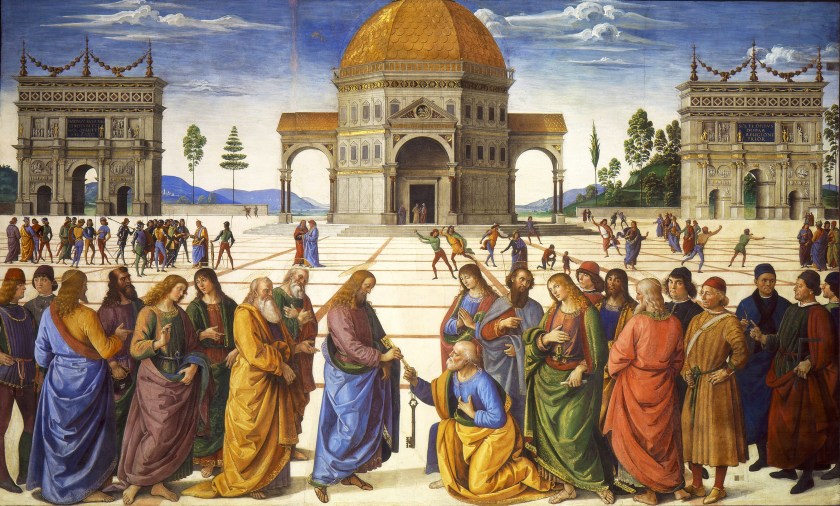
Q. I have a question about contrasting interpretations. Since we do not accept a Magisterium [an official, authoritative teaching], believers like me and you and many others seem to have no way to convince another about what Scripture teaches, if the other simply does not agree. This means we end up with the challenge of having many denominations, let alone many believers, each believing many different things, including things that are mentioned in Hebrews as being “milk” doctrines, things that are to be taught to new believers, yet even with these items, some teachers teach things that are incompatible with what others teach, so they cannot all be true; for example, either infant baptism or believer’s baptism. As far as I can see, we will only achieve unity in the faith when all of us sit at the Master’s feet. Do you have any wisdom about this state of affairs?
“Christ Giving the Keys to St. Peter,” fresco, Pietro Perugino, 1481–1482, Sistine Chapel. Roman Catholics believe that a definitive teaching authority now resides in the Church. What are Protestants to do to settle their disagreements?
I think you’re right that in the absence of a Magisterium (that is, a recognized authoritative teaching office such as there is in the Roman Catholic church), the principle of sola Scriptura—appealing to Scripture alone as our authority—does not bring about agreement among believers. I think the main reason for this is that people approach the Bible with different interpretive presuppositions, so that they can look objectively and honestly at the same data and come to opposite conclusions.
One of the best examples I’ve seen of how this works comes from my seminary days at Gordon-Conwell. Dr. Gordon G. Fee, who was then on the faculty, agreed to do panel discussion on the topic of women in ministry with a professor whose name I unfortunately no longer remember, but who was from a Presbyterian seminary. Dr. Fee didn’t feel it would be respectful to women to have a “debate” about them, so he suggested, and the other professor agreed, that the two of them should instead explain what they felt had led them to their positions on the issue, and allow the other person to ask questions about this. They met and prayed together beforehand.
Dr. Fee went first and explained that he’d grown up in the Assemblies of God denomination, where he’d seen many women pastors minister very effectively with the gifts God had given them. He felt he’d seen God bless their work and give it much fruit. And so, he said, to be honest, this was likely a significant factor why he wasn’t persuaded by arguments, even from the Bible, that said God didn’t want women to be in these roles.
The other professor then explained (and I really appreciated his honesty) that he’d grown up in a Presbyterian denomination that taught predestination, and it seemed to him that if God had chosen one group (the elect) to be saved, and another group (the reprobate) not to be saved, then certainly God might also have chosen one group (men) to be in certain roles in the church, and another group (women) not to be in those roles—that was a smaller thing.
I think this illustrates that while Protestants don’t have an official Magisterium, all of us who are Protestant probably do walk around with an unofficial Magisterium in our heads, consisting of the teachings, precedents, experiences, approaches to the Bible, etc. that we’ve been exposed to in the past. This whole constellation of things probably changes over time, but very slowly, as new things are added and others are dropped or come to be regarded as less authoritative. But it is this unofficial Magisterium that you need to move in order to persuade someone, from Scripture, of a viewpoint different from the one they currently hold. That’s unlikely to happen as the result of one conversation or online exchange, though they might budge things slightly.
So I guess I am granting that “we will only achieve unity in the faith when all of us sit at the Master’s feet.” How should we respond to this reality?
I think Dr. Fee and his conversation partner provide a further good example here. While they were on opposite sides of an issue that inflames great passions, they spoke to and about one another very charitably. Dr. Fee said of the other professor that he was “welcoming him to our campus as a brother.” They didn’t move an inch closer to one another’s positions during the conversation, and afterwards they both went back to communities that had different and mutually exclusive practices. But nevertheless I think something very positive was accomplished. They demonstrated that they had “unity in the faith” in another sense, in that while they didn’t agree, they were still part of one body and united by the love of Christ.
I think this is the most we can hope for in this world, but I think it’s actually something very positive and powerful. We often say that Christians are free to disagree on minor, non-essential points, so long as they agree on the major, essential ones. But then we discover intractable disagreements on things that seem pretty foundational, such as baptism (as you mention), and we realize how few “essential” beliefs there are that Christians really all do agree on (such as the divinity of Christ).
So failing that kind of agreement, I think instead we should first strive to be “fully convinced in our own minds,” as Paul writes in Romans about some issues that must have seemed pretty crucial for belief and practice in his day (keeping the Sabbath, and whether one could eat and drink certain things). The more settled our minds are, the more calmly and graciously we will be able to engage others. I think most of the damage is done not by the fact of disagreement itself, but by people vilifying those who differ, impugning their character and questioning their good faith. A gracious, Christ-like attitude is probably the best evidence we could ever offer someone for the possibility that we could be right about something we believe that they currently don’t.
Let me close by telling a story about baptism, which I agree is a good example of a “milk” or foundational doctrine that you’d think Christians should be able to agree about. My example once again comes from my seminary days.
One evening my wife and I hosted several friends for dinner and the topic turned to baptism. Those who baptize infants and those who baptize believers at least agree that a given person should only be baptized once. Churches either baptize infants and confirm believers, or else dedicate infants and baptize believers. But it turned out that in our dinner party of eight, my wife was the only person who’d been baptized just once. Everyone else had been baptized at least twice.
And it wasn’t just that several of us who’d been baptized as infants later felt that, with all due respect to our parents and home churches, we wanted to be baptized as believers. One woman had been baptized by immersion as a believer at age 12. She sincerely believed in Jesus at the time, but this was on the basis of what her parents and church had taught her. Later, as a young adult, her faith became more first-hand, through the ministry of a Methodist church she was then attending. Their help had been so meaningful to her that she wanted to be baptized as an adult, as her own personal expression of faith, “in the Methodist way”—by sprinkling. And another guest had been baptized once as an infant, again as a believer, and a third time, for good measure, in the Jordan River while on a tour of Israel.
So the fact that various churches held different positions on the issue of baptism had allowed us, as we moved back and forth between them, to have experiences (double and triple baptisms) that nobody was teaching were normative. For me, this is something of a parable: Maybe what matters most is not that all of these differences be resolved, even though they seem to be about very important things, but that people genuinely grow and learn and deepen their faith and commitment to God as they are exposed to these various understandings. Because it’s entirely possible that some of the truths of our faith are so profound that no one perspective entirely does justice to them. Maybe in some cases it’s the sum of the understandings resident in the community of faith that’s closest to the truth that will enable us to “reach unity in the faith and in the knowledge of the Son of God and become mature, attaining to the whole measure of the fullness of Christ.”
Duccio di Buoninsegna, “Jesus’ Appearance Behind Locked Doors,” 1308-11.
Q. Why were the disciples afraid when Jesus appeared?
I’m assuming you mean to ask why the disciples were afraid when Jesus appeared to them after his resurrection. Luke explains in his gospel that “they were frightened and terrified because they thought they were seeing a ghost.” This was even after they’d gotten several independent reports that Jesus had risen from the dead, and even though he said to them, as soon as he arrived, “Peace be with you.” But fear is actually not an unusual reaction when someone in the Bible encounters a visitor from the spiritual world.
Gideon, for example, realizes that he’s been speaking with the angel of the Lord when the angel first sets on fire the food he has served him, just by touching it with tip of his staff, and then vanishes. God has to tell Gideon, “Peace! Do not be afraid. You are not going to die.”
Similarly, when a mighty angel appears to Daniel, he collapses on the ground, and then gets up “trembling.” (Understandably, because the angel’s “body was like topaz, his face like lightning, his eyes like flaming torches, his arms and legs like the gleam of burnished bronze, and his voice like the sound of a multitude.“) Daniel, too, is told, “Do not be afraid.”
When the angel of the Lord comes to tell Zechariah that his prayers have been answered and he and his wife are about to have a son (John the Baptist), even though this is good news, Zechariah is “startled and gripped with fear.” The angel reassures him, “Do not be afraid.”
During Jesus’ earthly ministry, he once walked on the Sea of Galilee to join the disciples in their boat far out on the water. Matthew records that “when the disciples saw him walking on the lake, they were terrified. ‘It’s a ghost,’ they said, and cried out in fear. But Jesus immediately said to them: ‘Take courage! It is I. Don’t be afraid.'”
And in the book of Revelation, John reports an experience similar to Daniel’s. He says that when he first saw Jesus in his exalted glory, “I fell at his feet as though dead. Then he placed his right hand on me and said: ‘Do not be afraid.‘”
I think it would only be natural for us humans to be startled and alarmed if we encountered a heavenly visitor. But it’s very encouraging to read in the Bible how God always reassures each frightened person by saying, “Don’t be afraid.” This helps us realize that whenever God steps into our lives—even if we don’t experience a supernatural appearance, but instead sense a divine hand at work in our circumstances—we can be confident that God has come to bring about good, not to harm us. So even if we’re startled (and maybe it’s good for us to be shaken up by the reality of spiritual things from time to time), we don’t need to be afraid.
In this post, I’m chiming in on a comment that I read online, rather than answering a question that was specifically asked of me.
[The comment I read:] As a big fan of Wesley’s hymns (he was adamant about singing them “as written”), I’m upset that a modern hymnal changes the line in “And Can it Be” from “emptied himself of all but love and bled for Adam’s helpless race” to “emptied himself (so great his love) and bled for all his chosen race.” This appears to support predestination or a limited atonement. Wesley’s words are more in keeping with Scripture—the promise was to Adam and his descendants (his “race”). Altering “all but love” suggests that Christ retained other elements of his attributes as God even when “emptied.” What other motivation is there for a sacrificial, atoning death on our behalf than love incarnate? This change is very odd.
[My thoughts:] When I first came to Christ and was introduced to this hymn, these lines spoke to me very powerfully. I was moved by the idea that Jesus “emptied himself of all but love” and “bled” for all of us. I, too, have encountered the changes that have been introduced to this hymn recently, and I, too, am “upset” about them.
Apparently some hymnal editors have felt that the theology of Charles Wesley, the author of this hymn, needs to be corrected at a couple of points. For one thing, it’s clear that these editors want the hymn to present the idea of a limited atonement, rather than an unlimited one. In the original hymn, Jesus dies for the whole human race. In the modified version, He dies only for his “chosen” ones.
In addition, these editors apparently feel that Wesley has taken the idea of Jesus “emptying” himself a bit too far. The Bible teaches clearly that He “emptied himself by taking the form of a servant, being born in human likeness.” But it’s generally understood that while Jesus gave up the so-called non-communicable divine attributes (the ones that humans cannot share with God) such as omniscience and omnipresence, He retained communicable attributes such as holiness. So, for these editors, saying “all but love” wasn’t strictly true. Love wasn’t the only attribute He retained.
It should be noted that various groups change the words to hymns all the time, to words that they find more suitable. Or at least they try to. A few years back, the new hymnal of the Presbyterian Church U.S.A. got into the news for leaving out the hymn “In Christ Alone.” It turns out that its editors wanted to change the ending of the line “till on that cross as Jesus died, the wrath of God was satisfied” to “the love of God was magnified.” But the copyright holder wouldn’t grant permission, and the editors didn’t want to include the hymn as it was originally written.
To give a further example, I have an otherwise lovely Christmas CD on which another of Charles Wesley’s hymns is altered. In “Hark, the Herald Angels Sing,” the line “offspring of a virgin’s womb” is changed to “offspring of the chosen one.” Somebody obviously didn’t believe in the virgin birth.
I personally have no problem with the theology that Wesley originally expressed in “And Can It Be?” I believe in an unlimited atonement, and I think the phrase “all but love” is simply a beautiful poetic overstatement, meaning that Jesus came to save us out of pure love. Nevertheless, what upsets me most is not that some people are singing different words to the hymn these days, because I know this kind of thing happens. Rather, I’m more distressed by the way this change has been introduced.
“Bled for all his chosen race” is simply bad English. It should be either “bled for all of his chosen race,” or “bled for his whole chosen race,” or something like that, some correct expression that would fit the music. It’s also bad theology. The “elect” or “chosen” (for those who think in such terms) are not a race, they’re a host. They’re gathered one by one. You don’t become one of the elect by being born to people who are elect.
I find that the other change has also been introduced awkwardly. There’s already an interjection in the stanza: “So free, so infinite his grace!” If you put in interjections too often, they lose their force, and so they should be used sparingly. I doubt that a poet of Wesley’s caliber would have introduced another one in the very next line: “So great his love!” For that matter, the change reflects the mistake of taking a poetic overstatement literally. It’s like listening to the Hollies sing, “All I need is the air that I breathe, yes, to love you” and asking, “Don’t you need food, too?”
So I have one suggestion for anyone who dislikes these new words, as I do, on theological and literary grounds, and another suggestion for hymnbook editors.
I think that if a hymn gets changed like this, you can legitimately go ahead and sing the original words that you have come to love and admire, even while others in your current church are singing the new words. I say this as someone who was a pastor for twenty years and always wanted both oneness of spirit and freedom of conscience in worship.
I encountered what I think is a good model for this in the church I served as an associate pastor early in my ministry. This church would would provide optional words in the bulletin for older hymns that used masculine terms for people in general. That way people who no longer “heard” these terms as inclusive of women could sing words that were meaningful for them and that also captured the original intention of the hymn (since the original writers did not see the terms as exclusive). Those who still “heard” the original terms as referring to both men and women, for their part, could sing those words out of the hymnal at the same time. Different words, but sung with the same meaning and in the same spirit.
To give an example from a different liturgical practice that I think provides a good further analogy, a young Catholic woman once came to the service in one of my churches, as the guest of a friend, and asked me if it would be all right if she took communion with us believing in her own heart (as she knew we didn’t quite) that the bread and wine would become the actual body and blood of Christ. I said we would love to have her join us on that basis. After the service she made a point of telling me, perhaps for the sake of her own conscience, that she had indeed taken the communion elements with that understanding. I think having her join us that way was much better than me forbidding a fellow Christian to share the sacrament with us. Oneness of spirit and freedom of conscience.
So I think a person could sing the original words to “And Can It Be?” in their own church the same way, respectfully and in a spirit of unity. (You can bet that if I’m ever in a Christmas service where the phrase “offspring of the chosen one” is substituted in the bulletin or hymnal, I’m going to sing “offspring of a virgin’s womb.” Respectfully.)
And to hymnbook editors I would say, if there’s a hymn that’s so eloquent and lyrical that you want to sing it even though you disagree with parts of it, please think twice about changing the words. I feel it’s a shame that in this case Charles Wesley’s magnificent poetry has been turned into, frankly, something average at best. If you really don’t like what he says in his hymns, why not write your own?
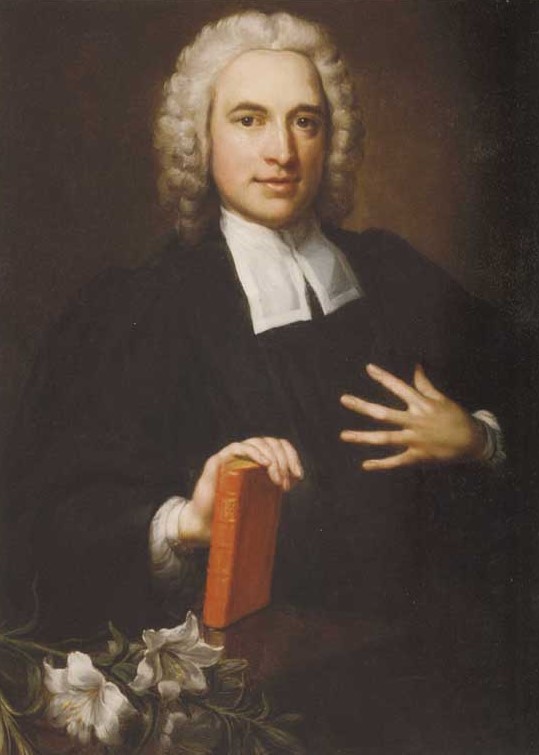
Charles Wesley. Possibly turning over in his grave.
Crossway recently announced that the English Standard Version (ESV) of the Bible would “remain unchanged in all future editions . . . to guard and preserve the very words of God as translated in the ESV Bible.” That way “people who love the ESV Bible can have full confidence in the ESV, knowing that it will continue to be published as is, without being changed, for the rest of their lives, and for generations to come.”
Update: The next month, Crossway issued a statement saying, “We have become convinced that this decision was a mistake. We apologize for this and for any concern this has caused for readers of the ESV.” Crossway said it would “allow for ongoing periodic updating of the text to reflect the realities of biblical scholarship such as textual discoveries or changes in English over time.”
This so-called “permanent text” of 2016 represents a third revision of the translation, which was first published in 2001 and then revised in 2007 and 2011. This last text incorporates what the publisher calls “a very limited number of final changes” (“52 words . . . found in 29 verses”) that are designed to make “a substantial improvement in the precision, accuracy, and understanding” of the text at these places.
One of these changes has already become very controversial. In the account of the fall, in previous editions of the ESV, God says to Eve:
“I will surely multiply your pain in childbearing; in pain you shall bring forth children. Your desire shall be for your husband, and he shall rule over you.”
The permanent text now reads, “Your desire shall be contrary to your husband, but he shall rule over you.” I am not aware of any statement that Crossway or the ESV Translation Oversight Committee may have offered explaining the rationale for this change. But it appears to me that the concern was that the phrase “your desire shall be for your husband” would be misunderstand to mean that Eve would still want to be emotionally and relationally close to Adam, and that to accomplish this she would accept to live in a household in which he was in authority.
These phrases actually do mean something different. They appear again, in word-for-word parallel, shortly afterwards in Genesis when God warns Cain, “If you do well, will you not be accepted? And if you do not do well, sin is crouching at the door. Its desire is for you, but you must rule over it.” Sin is represented metaphorically as a wild animal poised to pounce on Cain, and this makes clear the meaning of “its desire is for you”: Sin wants to have Cain in its power, but Cain must not succumb to that power; he must remain in control of his own actions.
So it is important to correct the misimpression that Eve has a “desire for” closeness and affection with Adam. No, she wants to have him in her power. But he will resist and dominate her instead. In other words, after the fall, marriage is no longer a cooperative enterprise but a struggle between husband and wife for dominance.
However, I don’t think that the ESV has gone about correcting this misimpression the right way. The expression “your desire will be for your husband” (= “its desire is for you”) is an idiom. (Like Muhammad Ali famously saying “I want Joe Frazier,” emphasis his, before one of their fights.) It is not describing an actual desire or longing that a person feels. Instead, it means, as the New English Translation puts it, “You will want to control your husband.” The New Living Translation says similarly, “You will desire to control your husband”—desire in the sense of wanting to do something.
But the ESV now uses, for the first time in any English translation, a qualifying adjective, “contrary,” instead a preposition (“for” or “against”) as in Hebrew. The presence of this adjective requires us to understand this literally as an actual wish, desire, or longing, and one that is necessarily opposed to the husband’s wishes. Now “he shall rule over you” means not “you won’t be able to control him,” but he will get his way, you won’t get yours!
Still, does this really matter that much, since in any event it portrays a formerly cooperative relationship dissolving into conflict? I believe it does. The essential issue here is interpretation rather than translation, but a given translation can serve to advance one interpretation and hinder or prevent another.
The interpretive question is whether redemption restores God’s original intention for marriage, so that within the kingdom of God couples can live out a cooperative enterprise once again, or whether male authority needs to be insisted upon even among regenerate people.
I’d observe that we do everything we can to mitigate all the other effects of the fall as described in Genesis. We use every technique and medication available to make sure that women have as little pain as possible in childbirth. I don’t know one man who doesn’t try to make his work as efficient and labor-saving as possible. (Another effect of the fall was painstaking toil to earn a living.) So shouldn’t we also believe that we’re supposed to mitigate the distortions in husband-wife relationships, and in male-female relationships generally, that resulted from the fall?
The mandate to do this is clear if the consequences of the fall are that husband and wife will both try to be in control. Once they become regenerate people, they will treat one another the way the New Testament says all followers of Jesus should treat each other: “Be of the same mind, having the same love, being in full accord and of one mind. Do nothing from selfish ambition or conceit, but in humility regard others as better than yourselves. Let each of you look not to your own interests, but to the interests of others.” Taking this attitude makes marriage a cooperative enterprise once again.
However, if the consequences of the fall are that husbands and wives will want “contrary” (opposing) things, and the solution is that the husband gets his way, and the wife has to “submit” to that—what’s there to fix? There’s no conflict when everybody knows who’s in charge.
But leaving things this way is dismal. How much better it is for both husband and wife to bring all of their increasingly sanctified hopes and wishes and desires to the table, and if some of them differ, for the two of them to seek God earnestly to find a greater plan, more comprehensive and far-reaching than either of them could imagine, that will catch up everything they could hope or dream for into an enterprise that calls for all of their gifts to be used to the fullest, interactively, to bless far more people than they ever could have anticipated.
We should not continue to see a husband’s and a wife’s desires, if they differ, as contrary, in light of provisional arrangements made after the fall. Instead, we should recognize them as complementary, just awaiting the hand of the Creator to weave them together into something unified and glorious.
“The Expulsion of Adam and Eve from Paradise,” Benjamin West (1791). How many of the effects of the Fall are mitigated by God’s redemption?