Is there a backstory lurking behind the Bible?

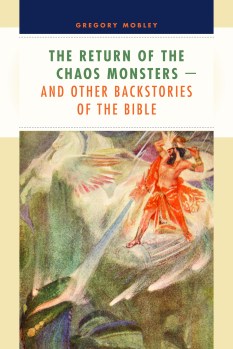
From time to time on this blog I offer reviews of books about the Bible, even though 9780802837462most posts are devoted to answering questions about the Bible itself.  In the next several posts I’d like to review Gregory Mobley’s book The Return of the Chaos Monsters.

I’m going to give so much space to this book because I find it to be a very significant one.  It suggests an approach to the Bible that many readers, tired of the typical method of trying to extract personal divine daily messages from isolated snippets, are likely to find appealing and refreshing.  But as I’ll argue in this series, I don’t believe Mobley ultimately presents an accurate picture of what the Bible is and what we are supposed to do with it, or of God, or of the place of suffering and evil in creation.  His book is written in a delightful style that carries the reader along in glad assent, and I’m concerned that some readers may not appreciate exactly where they’ve been carried by the time they get to the end.  So let me share some thoughts about where this book goes and how it gets there.

In the middle of the book, Mobley lays all of his cards on the table.  He summarizes his understanding of the relationship between God, creation, and humanity this way:  “Before time, the blinding Infinite Light exploded into a billion sparks, a happy accident for us since our very lives are merely infinitesimal reflections of this primeval divine effulgence.  But this creation of the many left the One diminished.  It is the sacred duty of every person to let his or her little light shine . . . and thus restore the full brilliance of the Light of Lights” (p. 82).

Mobley explains that the source of this understanding, in which God needs humans as much for His own restoration as they need God for theirs, is “medieval Jewish mystical theology, Kabbalah.”  But he also maintains that the Bible itself, read in a certain way, says the same thing.  Let’s explore how he makes his case.

Mobley’s first step, at the beginning of the book, is to turn all of the varied types of writing in the Bible into narrative.  Citing phenomena such as the traditional headings that “associate given psalms with events in the life of David,” he claims that “a narrative alchemy is at work in the process of the Bible that endlessly, inevitably seeks to transform every genre into story” (p. 4).

I would argue, however, that this is precisely the way to misunderstand the biblical books.  One of the first and most essential steps to understanding them on their own terms is to recognize their true genres and not approach them with expectations appropriate to different ones.  They are not all stories.  (I find that this presupposition causes problems for Mobley’s interpretations of many biblical books, as evidenced, for example, in his complaint that the “plot” of the book of Job “has been obscured by the poetic format.”  Job contains some of the most elegant poetry ever written, and to see this as an “obscuring” factor is surely to miss what that book is all about.)  Mobley’s approach is also precisely the way to misunderstand how the varying works collected in the Bible combine to become a grand story.  They don’t do this by all turning into narrative.  They instead together sketch out a story of God that is beyond themselves, and then they each find their own place within that story.

Nevertheless, let’s see where this leads.  Mobley then observes that every story has a backstory or prequel.  “No story starts ‘in the beginning.’ Every infant story is born into a narrative world that already exists” (p. 9).  Some backstories actually do get written up, like The Hobbit as a prequel to The Lord of the Rings.  But Mobley says that a true backstory is an “implied narrative” that has “not yet been composed, but looms, all latency, just before the horizon of a given narrative’s daybreak” (p. 9).  He says he will give us “a thematic overview of the entire Hebrew Bible” by sharing the backstories that guide the “meaning-making most characteristic of” each of its sections (p. 13).

Mobley begins with the first section, “the creation stories,” and suggests that even Genesis itself doesn’t begin “in the beginning.”  “Observant readers,” he says, “note that . . . there is something there: the primeval cosmic soup with its formless abyss.”  The backstory in circulation at the time when Genesis was composed told how one god or another had slain this “chaos monster” and built the creation out of its dismembered carcass.  But Genesis, Mobley acknowledges, is an example of how an author can “defy the conventional pattern and change the plot. . . . The chaos monsters . . . are not God’s mythological opponents; they are merely one more phylum of creation,” the “great dragons” (p. 10, “great sea creatures” in most English translations.

However, Mobley says, while this is the “official story,” there is an “alternate creation story” found elsewhere in the Bible.  While the “front story” (my term) does indeed take things in a new direction, Mobley would prefer to keep them where the backstory had them.  And so he cites two references in the Psalms and one in Isaiah about God slaying a chaos monster called Rahab or Leviathan.  We should understand this “slaying,” he says, as only an incomplete victory over chaos; quoting Timothy Beal, he insists, “It is difficult to keep a good monster down.  They have a tendency to reawaken, reassemble their dismembered parts, and return for a sequel.”  And so in Mobley’s understanding, “God has subdued chaos, just barely” (pp. 16-17).

As evidence that chaos monsters are actually “lurking in the background” in the rest of the Bible, despite the placid and orderly creation account in Genesis, Mobley cites Job’s wish for someone to “awaken Leviathan” so that his day of birth, which he is cursing, will cease to exist: “The clear implication is that once the dragon Leviathan is aroused from her slumbers . . . all hell will break loose and creation will start to come undone” (pp. 22-23).  I would argue, however, that the book of Job, by its end, also “changes the plot” and recasts Leviathan as one of God’s creatures, “one more phylum of creation,” not God’s mythical opponent.  This is one of the many ways in which Yahweh’s speeches to Job at the end of the book address and resolve concerns raised at the beginning.

Similarly, I would argue that Isaiah’s point in asking Yahweh, “Was it not you who cut Rahab to pieces?” is, “Was it not you, and not Marduk, who cut Rahab to pieces?”  In other words, Isaiah is appropriating the Babylonian propaganda and repurposing it as part of his sustained argument that “apart from Yahweh there is no other god.”  Beyond this, it is hardly suitable to cite this part of the book of Isaiah, which lyrically celebrates Yahweh as effortlessly creating “the ends of the earth” by his “great power and mighty strength,” as a source for the idea that God has “just barely” restrained chaos.  Nor is it really fair to cite the references to the mythological version of Leviathan in Psalm 74 and Rahab in Psalm 89 without noting the reference to the natural, creaturely version of Leviathan in Psalm 104, “which,” the psalmist says to God, “you formed to frolic” in the sea.  Apparently the psalmists knew the backstory myth and could appropriate it for their own purposes, but they also told the “official story” with delight, picturing Leviathan frolicking in the waves, rather than awakening to undo the rest of creation.

But however we understand such passages, if this backstory is only found in other parts of the Bible, it doesn’t seem legitimate to treat it as the backstory to the Genesis creation accounts (particularly since Mobley himself says it is “suppressed” there, p. 23), as if it provided a foundation for understanding the rest of the Bible.  But that’s precisely how he treats it, making it the basis for all the further steps in his argument.

I’ll explore those further steps in my next posts.

Why do some people seem to suffer more than others?

Q.  My question has to do with suffering and the fairness of God. Why do some people suffer, even terribly, while others do not?  Judging from the stories of Job and Peter, Satan was given permission to cause suffering in their lives.  It seems even worse that God would allow some people to suffer by this means.

I’ll do my best to answer your question, although it’s one that people of faith have struggled with for all of human history without definitively resolving.

Without freedom there can be no love.  But freedom creates the possibility, perhaps even the likelihood, of suffering, as freedom can be, and is, misused.  I believe that God knows, in a way that we cannot know, that a world with both love and suffering is infinitely better than a world with neither love nor suffering, and that those are the only two possibilities.  Love is worth what has to be for it to be.

But I don’t think this means that certain individuals are singled out for suffering. Every individual is liable to the possibility of suffering.  But precisely because suffering is the result of freedom (misused), the “free” (undetermined) nature of the world means that some will likely suffer more than others.  While the Bible does say that Satan specifically asked for and received permission to torment Job, and that Jesus warned Peter, “Satan demanded to have you, that he might sift you like wheat,” this is actually what Satan wants to do to everybody, with or without permission.  If God granted permission in those two cases, it was because God knew He could bring a result out of the suffering that would advance His own purposes and defeat Satan’s—turning Satan’s own weapons against him.

But this means that all of us must be willing to suffer if that will advance God’s purposes through our own lives.  The difficulty is that we see such a small part of the big picture that usually we can’t understand why we are suffering.  It feels pointless and useless.  But God is trusting us to trust Him, that He indeed is at work in the situation (that He has chosen to work in it, given the nature of the world He created, not that He directly caused the suffering) to bring about a purpose that is so positive and redemptive, that in the end, when we do understand, we will rejoice in this work of God.

Not that any of us should seek out situations of suffering.  But we should know that, as Amy Carmichael often said, “The love of God is very courageous,” and that God will therefore trust us to accept difficult situations as a part of His plan that we will only understand in the end, when we can see everything clearly.

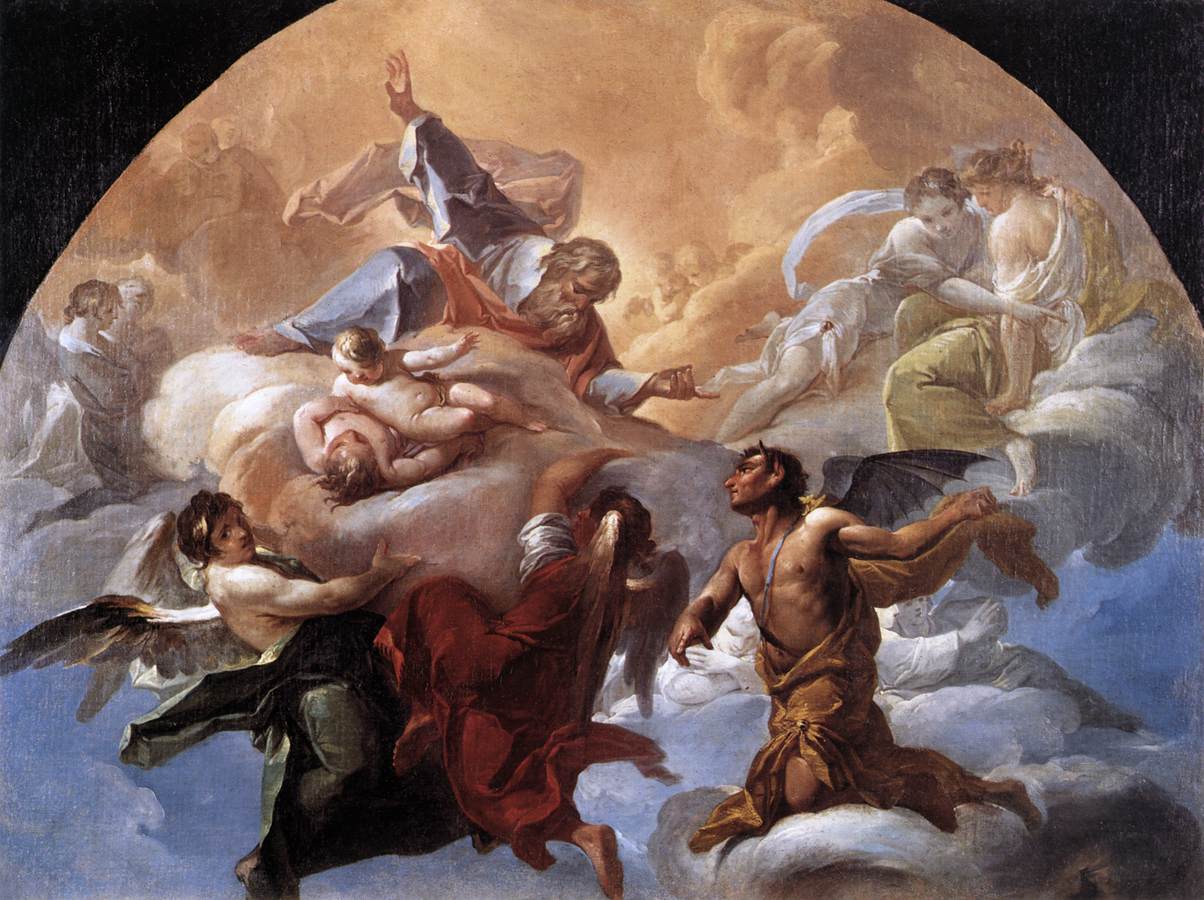
Giaquinto, “Satan Before the Lord” c. 1750, Vatican Museum. The painting depicts the scene from the book of Job in which Satan requests, and receives, permission to torment Job.

What does the Bible mean by the “sons of God” marrying the “daughters of humans”?

Q. Please explain in detail the passage in Genesis that says, “The sons of God saw that the daughters of humans were beautiful, and they married any of them they chose.”

I discuss that passage in detail in this post:

Who were the Nephilim?

I hope my discussion there is helpful to you.  Thanks for your question!

Do the gospel accounts of the resurrection contradict each other?

Q. How do you resolve a certain resurrection discrepancy? Did Mary Magdalene and Mary the mother of James find angels at the tomb, who told them that Jesus was alive and that they should go tell the disciples to meet him in Galilee?  Or did Mary Magdalene go by herself (as John indicates), find nothing, and go tell the disciples someone had stolen the dead body? The accounts seem to be contradicting each other.

I would answer your question along the same lines as I answered an earlier one in this post:

Why are the details of some episodes in different gospels irreconcilable?

The person who asked that earlier question wanted to know about the episodes in the gospels in which a woman pours perfume on Jesus, Jesus walks on water, and Judas betrays him in the garden.  There seem to be discrepancies in detail between the different accounts of these episodes, and as you observe, the same thing can be said about the accounts of Jesus’ resurrection.  But as I write in my other post:

I don’t personally see irreconcilable details such as these as diminishing the truth or authority of the Bible in any way.  Rather, as many have observed, these differences actually show that the gospel writers weren’t all trying deliberately to tell the same story as the others.  This should give us even greater confidence in the independence and authenticity of their reports.  If some minor details differ, the main points are always confirmed.  And so we can be confident, based on multiple independent reports, that Jesus did walk on the water–the gospel writers agree about this miracle that testified to who he was.  Judas did betray Jesus by bringing the soldiers to the garden.  And a woman did anoint Jesus with perfume, and he acknowledged this as an appropriate, if extravagant, act of worship.

We may say similarly that we can be confident, based on multiple independent reports, that Mary Magdalene went to the tomb with some other women (thought John tells the story through her eyes alone), found it empty, and had an encounter with someone (an angel, a man in a white robe or men in “gleaming clothes,” or Jesus himself) that convinced them Jesus was alive.  The main line of the story is the same in each account.  (If one of the gospels said that the women found Jesus’ body in the tomb, then we’d really have a problem!)

Let me offer here the same conclusion as in my earlier post:

We only have problems with the differences in minor details if we embrace the idea that if the Bible is to be the word of God, it has to present only exactly what happened, without dispute or variation, down to the last detail every time.  That’s simply not the kind of Bible God has given us.  We should recognize that we have instead a Bible whose human character, including such variation in minor details, only helps it to be an even better authoritative witness to divine truth.


Seven New Bibles That You Need (Don’t Worry, They’re All the Same One!)

From time to time on this blog I review books that have to do with the Bible.  Full disclosure: I’ve been working closely with this author for over a dozen years on various projects, beginning with The Books of the Bible.

There’s a new book out that will help you understand what’s wrong with your Bible—why it’s not working the way you expect.  The book, Saving the Bible from Ourselves, is by Glenn Paauw, vice president for global Bible engagement at Biblica and a director of the Institute for Bible Reading.

When you open your Bible, Paauw says, chances are you’re getting lost in the clutter—cross-references, study notes, topical headings, call-outs, etc.—and barely making it to the text.  What you need is an Elegant Bible, one that’s clean and clutter-free, featuring “unencumbered words on a page, pleasingly set, easy to read.”

Is your Bible just offering you “snacks”—little tidbits that never really satisfy your appetite?  Then you need a Feasting Bible, one in which you enjoy full meals— whole biblical books—at length and at leisure.

Have you been encouraged to see the Bible as something that dropped fully formed out of heaven?  And aren’t you wondering why it doesn’t read as if it did?  You need a Historical Bible, one that you can tell emerged from the covenant community’s interactions with God over centuries.

Do there seem to be no connection between the things you’re reading about in the Bible?  Is it just a law here, a proverb there, and some stuff that doesn’t really seem to fit anywhere?  You need a “Storiented” Bible, in which everything is clearly tied together into a compelling story.

When it’s just you and your Bible, don’t you feel lonely?  That’s because reading and studying the Bible were meant to be shared experiences.  You need a Synagogue Bible that will enable and empower you to read and study God’s word in community.

If, when you read the Bible, all you see are free-floating phrases from some ethereal realm, then you need a Earthly Bible, in which it’s clear that God’s word has everything to do with life here on this earth.

And not to put too fine a point on it, but is your Bible just plain ugly?  Type bleeding through from the back of thin pages, crowded printing, Industrial Revolution overtones?  What you need is a Beautiful Bible, like the ones the church produced in ages past, and which it is showing signs of producing again.

How can you get a Bible that’s all of these things?   Some of it has to do with the actual physical form.  If you wouldn’t describe any of the Bibles on your shelf right now as elegant and beautiful, then you actually do need one more copy.  But the rest of these things have to do more specifically with thought patterns: what you understand the Bible to be, and what you believe you’re supposed to do with it.  And if you want a clear, comprehensive explanation of that, then read Saving the Bible from Ourselves.  It will give you a new Bible in your mind.

Does God plan every move of our lives if we ask Him to?

Q. Many present-day follows of Jesus, including myself, believe that God is with us once we invite Him into our hearts. That said, I wonder at times how much He is directly involved in our day-to-day lives. Does He plan my every move if I invite that? The thought that God can be in complete “control” of our lives as we “tune out” seems to be a modern concept developed over the last hundred years. A verse often quoted to support His complete direction in our lives is “I know the plans I have for you,’ declares the Lord, ‘plans to prosper you and not to harm you, plans to give you hope and a future.'” But it seems to me if we just rely on this as our basis for this argument we may have applied its message too literally. The passage was written to the exiles but it is often quoted out of context as if it applied to every one of us today. I am thankful God gave us His word, the Bible,  the Holy Spirit, and a thinking brain. Would love your thoughts.

I haven’t actually encountered myself the teaching that we can and should “tune out” ourselves and allow God to control our day-to-day lives directly, but let me share some thoughts about this teaching as you describe it.

First, I agree with you that that often-quoted statement from Jeremiah’s letter to the exiles does not really support such an approach.  In context, that statement actually means something like this:  “You might not think that I have good plans for you based on your present circumstances, but long-term, big-picture, I really do.”  The Judeans of Jeremiah’s time thought that those who had been carried off to Babylon were lost from the community and doomed to a dismal future, while those who remained in Judea had excellent prospects.  Jeremiah wrote his letter to the exiles to assure them that just the opposite was true:  that they had a “hope and a future” as remnant that would eventually restore the nation, while those left in Judea were doomed to destruction.

So this statement can appropriately be cited to people today who are in difficult and troubling circumstances, to assure them that long-term, big-picture, God will work things out for His glory in their lives.  But it should not be quoted to support the idea that “God knows the plans He has for us” if we will just “let go” and let Him run every detail of our lives.

I wonder how that would actually work, in fact. How are we supposed to know where to go and what to do to fulfill these “plans” of God?  Are we supposed to be simply passive and trust that anything that happens to us reflects God’s plans?

I’m much more inclined to agree with you that “God gave us His word, the Holy Spirit, and a thinking brain,” and God expects us to develop wisdom and mature character so that we can make good decisions that reflect His values and purposes–not try to chase down His supposed “plans” for the tiniest details of our lives.

I talk about this more in my post entitled, “Should I be looking for ‘God’s will for my life’ in every decision?”  There I encourage us to pursue an approach of “co-operation” with God, which I believe Jesus modeled for us, and which I describe this way: “Within the context of his overall life mission as he understood it, Jesus discerned where God was already at work and considered how he could join in.”  As I see it, this honors God, as we take responsibility for using the gifts and opportunities God has given us, guided by our sanctified sense of His own working in and around us.

I hope this is helpful!

Why didn’t Jesus destroy demons when he cast them out?

Q. In any of the situations where Jesus cast out demons, why didn’t he kill them so they would not enter another person?

Matthew’s gospel relates how, when Jesus was casting out demons in the region of the Gadarenes, they cried out, “Son of God, what do you want with us? Have you come here to punish us before the time for us to be judged?” The encounters between Jesus and demons described in the gospels are typically brief and cryptic, but we can at least tell from this one that God has set a time for demons to be judged and punished. But as these demons knew, that time had not yet come during the ministry of Jesus, and they successfully appealed to be sent into a herd of pigs instead.

The reasons why Jesus allowed such demons to continue to roam the earth, at least for a while, have to do, I believe, with the need for there to be freedom in order for people to make the choice to love God and others. God could have removed all sources of suffering and discord in the world, but this would have been at the cost of making true freedom impossible and depriving the world of the fruits of freedom, including love, courage, creativity, and so forth.

One of Jesus’ parables shows how God wanted people to respond instead to the fact that demons remained at large even after they had been cast out of their victims.  Jesus said, “What happens when an evil spirit comes out of a person? It goes through dry areas looking for a place to rest. But it doesn’t find it. Then it says, ‘I will return to the house I left.’ When it arrives there, it finds the house empty. The house has been swept clean and put in order. Then the evil spirit goes and takes with it seven other spirits more evil than itself. They go in and live there. That person is worse off than before.”

Jesus actually told this parable about his own generation as a whole, to illustrate how, by rejecting his true message of the kingdom of God, they were leaving themselves open to the influence of false messiahs who would lead them astray into destruction.  (This happened during the two Jewish-Roman wars in the decades that followed.) But for the parable to make this point by application, its story needs to make a valid point of its own, and that is that people who have been freed from a demon are responsible themselves to fill their lives with godly and wholesome influences that will discourage any demons from ever returning.

In other words, while Jesus didn’t destroy the demons he cast out, he brought the truth of the kingdom of God, and ultimately he sent the Holy Spirit, to occupy the place the demons had left so that they would never try to fill it again.  And I think this is how we need to think about all of the evil and destructive influences around us as we live in these “in-between times,” when the kingdom of God has already been inaugurated but not yet completely established.  God has not yet removed all these influences from the earth.  But he has sent other influences that can effectively displace them in our own lives, and increasingly in our world, if we recognize and accept our responsibility to welcome and cultivate these life-giving endowments.

A painting by Sebastian Bourdon (1653) of Jesus casting out the demons from the Gerasene demoniac. Why didn’t Jesus destroy the demons instead of allowing them to remain at large afterwards?

Is the United States talked about in the book of Revelation (or Daniel)?

Q. Is there any proof that Revelation talks about the United States (or that the book of Daniel does)?

Whether we see the United States (or any modern-day individuals, nations, or institutions) in the biblical apocalyptic books of Revelation and Daniel depends on the interpretive presuppositions we adopt as we approach these books.  As I explain in my Daniel-Revelation study guide in the case of Revelation (similar things might be said about Daniel):

The book of Revelation is interpreted in four major ways.  The futurist approach understands it to be a description of the events of the “end times,” at the end of human history.  (Works like the novels and movies in the Left Behind series follow this approach.)  The historicist view sees the book as a prediction of the whole course of history, from Jesus and the apostles down through the present to the end of the world.  The idealist interpretation is that Revelation depicts the struggles and triumphs that followers of Jesus will experience everywhere, but it doesn’t have any particular place or time in view.  The preterist approach is to try to understand the book by reference to the time and place it was written in–western Asia Minor towards the close of the first century.

I personally believe that a preterist approach is the most responsible one to take, as it is consistent with the way we approach every other book of the Bible, trying to understand it in light of its original historical and literary context.  From that perspective, the characters and symbols in Revelation have directly in view the resumption of imperial persecution of Christians under Domitian in the late 80s or early 90s A.D.  The visions in the book of Daniel, for their part, are initially envisioning the suffering of the Jews under Antiochus Epiphanes IV, who ruled from 175-164 B.C.

Applications to any other historical periods are secondary and need to be made by inference and analogy, although these biblical books can certainly inform us very effectively about what conditions are like, and what a faithful response should be, in comparable situations.  Certainly those who are suffering for their testimony to Christ in our world today can and should find encouragement and challenge in many of the admonitions in the books of Daniel and Revelation, for example, “This calls for patient endurance on the part of the people of God who keep his commands and remain faithful to Jesus.”

I think we are better advised, in fact, to understand Daniel and Revelation as speaking to us today out of situations of persecution in the past, and so calling us to sympathy and solidarity with those who are suffering now, than we are to try to synchronize their characters and symbols with modern-day actors. That is a necessarily speculative exercise that may not lead to any response or action on our part.

A depiction of America as the “whore of Babylon” in the book of Revelation, from a recent blog post that follows a “futurist” interpretation. I would argue that a “preterist” approach is more constructive.

Was there physical death in God’s creation before the fall of humanity?

Q. I’ve heard people claim on the basis of Paul’s statement in Romans–“sin entered the world through one man, and death through sin“–that physical death only entered the created world after the fall.  But others counter that Paul is merely referring to spiritual death, and that certainly plants and microscopic organisms had to have died before the fall. Would you say that Paul’s statement should be taken to refer to physical death?

This is another question (like this one) that is taken up at the end of the book I co-authored with Stephen J. Godfrey, Paradigms on Pilgrimage: Creationism, Paleontology, and Biblical Interpretation.  The passage I will quote from the book here is somewhat lengthy and it begins with a discussion of Genesis, so if you want to read just the part about Paul’s statements in Romans, you can start here. This is what we have to say.

Note: The format of this blog is not to use artificial chapter and verse divisions, but to reference the Scriptures instead by content and context, and by hyperlinks to the text on Bible Gateway (as above).  However, Paradigms on Pilgrimage has already been in print for ten years with chapter and verse references, so I have not changed this format below.

We may next take up the question of how death could have been active within the evolutionary process for billions of years before there were any people, if the Bible teaches that death first entered the world through the disobedience of humans. Our first response to this question must be to establish whether the Bible indeed teaches this.   When we study the Genesis account, we discover that it actually does not teach that no creature could have died, or that no creature actually did die, before the fall of humanity. It rather suggests just the opposite.

For example, at the very end of the story of creation and the fall we read, “Then the Lord God said, ‘See, the man has become like one of us, knowing good and evil; and now, lest he put forth his hand and take also of the tree of life, and eat, and live forever’ – therefore the Lord God sent him forth from the garden of Eden” (Gen. 3:22-23). If God’s concern was that the man might eat of the tree of life after the fall and live forever, and took steps to prevent this, the clear implication is that if he did not eat of the tree of life, he would not live forever. But this would have been true whether or not he had fallen. In other words, not dying is shown here to be something that does not follow directly from having been created. It requires something further: eating of the tree of life. According to this account, therefore, it appears that if the humans had not eaten of this tree, they would have died, even in an unfallen state.

The fact that the food that humans and animals were to eat is specified in Genesis 1:29-30 also implies that they were not created immortal. Why would creatures have to eat, if they could not die? The clear implication is that this food was to sustain them and keep them alive, and that they would die of starvation if they did not eat. (For that matter, do we suppose that if Adam, when innocent, had fallen forty feet out of tree and broken his neck, he would not have died?) While we have Genesis 1:29-30 in view we should also specify that the fact that humans were not permitted to eat animals does not mean that the only way an animal could have died was if a human had killed it in order to eat it.

A further consideration is that the plants that humans and animals ate died when they were uprooted and consumed. If we are going to argue that there was no death before the fall, then it cannot have been the case that any living thing ceased to live before the fall. But the Bible itself describes the opposite. It suggests that innumerable plants not only died but were “killed” by people and animals for food in the Garden of Eden. It is sometimes argued that since vegetation is “insentient,” its “death” before the fall is not really significant. But this is to introduce a definition of death as “the cessation of consciousness,” and this would actually allow a great deal of the evolutionary process to have taken place without “death.” There will be varying understandings of where on the scale of complexity we should locate the least complex “sentient” beings, but it is doubtful that all animal life should be considered sentient. Thus creationists themselves would have to allow for the death before the fall of worms and spiders and perhaps even dinosaurs if they wish to discount the death of plants before the fall.

A final consideration from the Genesis account is this: the warning that God gave to the first pair of humans about the tree of the knowledge of good and evil – “in the day that you eat of it, you shall surely die” – would have been incomprehensible and therefore useless if death were an entirely unknown thing in the pre-fall world. Here the biblical account itself therefore suggests that death was part of the human experiential knowledge base even before the fall. In other words, humans were able to understand what God meant by “death” because they had already seen other creatures die.

• • • • •

In light of all of these considerations, we must recognize that the objection we are discussing here comes much more from the book of Romans than from the book of Genesis. It is there that we find such statements, frequently quoted by creationists, as, “Sin came into the world through one man, and death came through sin, and so death spread to all” (Rom. 5:12). This would seem to imply that before the fall of man there was no death in the world. But we must pay careful attention to the kind of “death” that is actually in view in chapters 5 and 6 of Romans.

It is probably most accurate to say that it is a spiritual death (separation from relationship with God) that leads, among other things, to physical death. This, we should note, is precisely the definition of death that literalist interpreters use to explain how it was that Adam did not die physically “in the day” that he ate of the fruit of the tree of the knowledge of good and evil. He died spiritually that day, they insist, and physically as an eventual result. (Otherwise, we would need to appeal to a “day-age” theory to explain Genesis 2:17!)

Recognizing that Romans 5 and 6 is speaking of a spiritual death with eventual physical consequences enables us to make the best sense of its teaching. For example, Romans 5:14 says, “Death exercised dominion from Adam to Moses, even over those whose sins were not like the transgression of Adam.” What is in view here is clearly the reign of spiritual death over those who sin, that is, over morally responsible beings – humans. This is not a discussion of the progress of physical death throughout the created world.

That spiritual death, not physical death, is in view here becomes even clearer when we recognize that in the course of this argument, Paul restates what he says in Rom. 5:12 two different ways. This first statement is, “Just as sin came into the world through one man, and death came through sin, and so death spread to all because all have sinned . . .” (Rom. 5:12). But this is later restated, “Just as one man’s trespass led to condemnation for all, so one man’s act of righteousness leads to justification and life for all” (Rom. 5:18). And then Paul expresses his meaning another way: “Just as by the one man’s disobedience the many were made sinners, so by the one man’s obedience the many will be made righteous” (Rom. 5: 19). We see from these parallels that coming under the reign of death is equivalent to being condemned and to being made a sinner. The death in view, in other words, is the spiritual death of separation from God.

We find final confirmation of this understanding in the exhortation Paul gives as the argument of these chapters reaches its culmination: “Present yourselves to God as those who have been brought from death to life” (Rom. 6:13). We see here that the “death” Paul has been talking about is a state we can be in even as we are physically alive, and which we can leave without being resurrected from physical death. It is thus, once again, the spiritual death of being under the power of sin, alienated from God.

We should therefore make no more appeal to the book of Romans than to the book of Genesis to argue that physical death only entered the world after the fall of humanity. Both books describe a spiritual death from which physical death necessarily resulted, but neither thereby excludes there having been physical death beforehand, from other causes.


The entire text of Paradigms on Pilgrimage is now available free online.

How was Jesus from the line of King David if his real father was not Joseph?

Q. How does the genealogy of Christ work? Because if this is recorded in a patriarchal society, this is the line of Joseph, right? Doesn’t that mean none of this genealogy actually flows through Jesus’s blood? How is he from the line of King David if his real father is God and not Joseph?

The purpose of the genealogy in Matthew’s gospel is to demonstrate that Jesus is “the son of David, the son of Abraham,” that is, the legal heir of both of these men and thus the beneficiary (and ultimate fulfillment) of the covenant promises that God made to them.

All Jews were descended from Abraham.  But Jesus was not descended from David, who was from the tribe of Judah, through his mother Mary, because she was instead a descendant of Aaron from the tribe of Levi.  We know this because Luke’s gospel tells us that Mary was a “relative” of Elizabeth, who was a “descendant of Aaron.”

But when Joseph, who was descended from David, married Mary, this also constituted his legal adoption of the son she would bear. The language of Matthew’s genealogy reflects this legal understanding: “Joseph, the husband of Mary . . . the mother of Jesus.”

Later in Matthew’s gospel we see from the narrative that Jesus was considered to be Joseph’s son just as much as the other children that Mary and Joseph had together.  The people of Nazareth ask, after Jesus tells a series of parables, Isn’t this the carpenter’s son? Isn’t his mother’s name Mary, and aren’t his brothers James, Joseph, Simon and Judas? Aren’t all his sisters with us? Where then did this man get all these things?”

Accordingly Paul can say of Jesus at the beginning of his letter to the Romans, “who as to his earthly life was a descendant of David, and who through the Spirit of holiness was appointed the Son of God in power by his resurrection from the dead.”

Luke says similarly in his genealogy that Jesus was “thought” or “supposed” to be the son of Joseph; the International Standard Version says that he was “legally calculated” to be Joseph’s son, and I think that’s a good way of expressing the meaning here.

So Jesus was the son of Joseph in the full legal sense, because he was adopted when Joseph married Mary, and thus Jesus is also considered to be a legal descendant of David.