The Rev. Dr. Christopher R. Smith is an an ordained minister, a writer, and a biblical scholar. He was active in parish and student ministry for twenty-five years. He was a consulting editor to the International Bible Society (now Biblica) for The Books of the Bible, an edition of the New International Version (NIV) that presents the biblical books according to their natural literary outlines, without chapters and verses. His Understanding the Books of the Bible study guide series is keyed to this format. He was also a consultant to Tyndale House for the Immerse Bible, an edition of the New Living Translation (NLT) that similarly presents the Scriptures in their natural literary forms, without chapters and verses or section headings.
He has a B.A. from Harvard in English and American Literature and Language, a Master of Arts in Theological Studies from Gordon-Conwell, and a Ph.D. in the History of Christian Life and Thought, with a minor concentration in Bible, from Boston College, in the joint program with Andover Newton Theological School.
The only real concerns we’ve ever heard about the book introductions in The Books of the Bible have been about the few cases in which we’ve suggested that a book traditionally attributed to a known figure may have been written instead by one or more unknown authors.
Consider the case of Lamentations, traditionally ascribed to Jeremiah. Lamentations directly follows Jeremiah in most English Bibles. But in The Books of the Bible, it’s placed with Psalms and Song of Songs as another collection of lyric poetry potentially by a variety of authors. In the Invitation to Lamentations, we observe that “the authors’ names aren’t given” for any its five songs.
These three books—Psalms, Lamentations, and Song of Songs—are also treated together in my study guide to lyric poetry in the Understanding the Books of the Bible series. In that guide I say similarly that “we don’t know for certain who wrote” the songs in Lamentations.
But if we don’t know for certain, why not attribute them to Jeremiah, in keeping with long-standing Jewish and Christian tradition? If the Bible itself doesn’t tell us, why not trust this tradition, rather than offering some other explanation?
Actually, the Bible does present two compelling pieces of evidence that Jeremiah did not write Lamentations.
First, the songs in Lamentations show that their author(s) had first-hand, eyewitness knowledge of the conditions in the ruined city of Jerusalem in the days and weeks following its destruction by the Babylonians. The songs are written from the viewpoint of someone within the city who sees what is happening there and is calling out to others to respond with grief and compassion.
But according to the Bible, Jeremiah was never in the city of Jerusalem after it was destroyed. The historical narrative about this event in the book of Jeremiah explains that the Babylonians removed him from Jerusalem and brought him to his home town of Anathoth before they destroyed the city. Later he was mistakenly rounded up for deportation to Babylon and taken to Ramah, but he was recognized and sent back to Mizpah. And from there, the surviving Israelites took him with them to Egypt.
The Babylonians destroy Jerusalem and carry the surviving Judeans into exile (from L’Histoire du Vieux et du Nouveau Testament, 1670, illustrator unknown)
The only way we can place Jeremiah in Jerusalem after its destruction, where he could have written Lamentations from an eyewitness perspective, is to suppose that he made a visit to the city that isn’t recorded in the Bible. But then we would be pitting something the Bible doesn’t say against what it actually says: that Jeremiah went to Anathoth, Ramah, Mizpah, and Egypt, but never back to Jerusalem.
The other piece of evidence that Jeremiah didn’t write Lamentations is found within the book itself. The first four songs are acrostics, poems whose successive lines begin with the consecutive letters of the Hebrew alphabet. The second, third, and fourth poems evidence a variation in the letter sequence: the letter pe precedes the letter ‘ayin.
It’s not understood exactly how this variation originated (it’s found in some other biblical acrostics as well), but it seems that two slightly different alphabetical sequences were in circulation in ancient Israel. A person might be familiar with one sequence or another, but it’s highly unlikely that a single poet composing acrostics for a specific occasion would start with one understanding of alphabetical order and then change to a different one. It’s much more likely that the songs in Lamentations are the work of more than one author, precisely because they reflect two different understandings of alphabetical order.
Taken together, these two pieces of biblical evidence suggest that the songs in Lamentations were not written by Jeremiah, but rather by two or more unknown poets who were, as we say in our Invitation to Lamentations, “people of faith putting into words their struggle to understand how God could allow such suffering and devastation.” We may not know their names, but we can still appreciate how God inspired them to speak to a question that believers have struggled with throughout the centuries.
Q. I saw this review and it made me think of many of the difficult questions you’ve been untangling on your Understanding the Books of the Bible blog. Perhaps you’ll find in it a few more.
The friend who sent me this note was referring to a review by Patrick Allitt of Philip Jenkins’ book Laying Down the Sword: Why We Can’t Ignore the Bible’s Violent Verses. I should specify that I haven’t read the book itself, only this review. But it does indeed raise difficult questions.
According to Allitt, Jenkins insists that “the Bible contains incitements not just to violence but also to genocide.” He argues that “Christians and Jews should struggle to make sense of these violent texts as a central element of their tradition.” This, he says, would be much better than past approaches, which have included:
• Taking the passages about merciless warfare literally and imitating them when the occasion seems to justify, as the Crusaders and conquistadors did.
• Ignoring the passages, as the Revised Common Lectionary and most preachers do today. This is equivalent to taking them out of the Bible, as Marcion wanted to do in the second century.
• Allegorizing them as metaphorical descriptions of the individual believer’s struggle against sin, as Origen and Augustine did.
• Arguing that they discredit the God of the Bible, as some Enlightenment figures did and as today’s “new atheists” are doing.
Instead of taking any of these approaches, Jenkins argues, we need to recognize that the biblical stories of divinely commanded genocides are actually a historical fiction made up many centuries after the facts, to encourage Israelites to “live up to the rigors of monotheism” by having nothing to do with the gods of the surrounding nations. The biblical authors were “‘telling a story and at every possible stage heightening the degree of contrast and separation between Israel and those other nations,’ not for the sake of historical accuracy but to send a spiritual message to their own people.”
Jenkins, citing archaeological evidence that “the Hebrews coexisted with many other peoples in the Canaan of the 12th century B.C.,” is convinced that “the pitiless massacres in question almost certainly did not take place.” So “perhaps,” he concludes, “the later commentators, Jewish and Christian, were not that misguided in seeing the massacres in allegorical terms.” “Israel had to kill its inner Canaanite.”
This is a very attractive proposal, because the biblical stories of genocide are so disturbing. It would be a great relief to think that they never really happened. However, I do have some concerns about this proposal, at least as it’s summarized in this review.
As I understand the Bible, it’s the written record of God’s initiatives throughout history to bring humanity back to himself. I allow that the recounting of this history, like all historiography we do on this earth, was necessarily shaped and limited by the sources available to the human authors of the Bible. In it we may encounter multiple perspectives on the same events. But this is very different from saying that the biblical authors, in telling their story, deliberately altered events as they were known to them from the historical record.
We shouldn’t have to read the Bible with a built-in skepticism about what it says happened. We may sometimes get slightly varying accounts of how, and there are often questions of why, but in general we are supposed to trust that we are hearing an overall narrative of what God has actually done in human history.
So I would take a different approach to the violent stories in question. I would accept that they actually did happen. (Even if there is archaeological evidence of co-existence with Canaanites in ancient Israel, this is no more than the Bible itself says: Joshua’s campaigns were against the fortified royal cities of the region; when these were subdued, Joshua gave the individual tribes the task of conquering the Canaanites remaining in their allotments, and in many cases they chose to co-exist with them instead.) But I do not believe that followers of Jesus should consider these stories a “central element” (admittedly Allitt’s phrase) of their tradition.
Quite the opposite. I see these stories as exceptional and even incongruous within the Bible. The challenge is not to see how we can incorporate them into the heart of our faith and practice (as epitomizing the struggle against sin, for example), but rather to see whether we can somehow account for them without losing our faith.
I talk about how we might do this in this post, in which I argue that “Jesus’ life and teachings provide, for his followers, the interpretive key to the entire Scriptural record of God’s dealings with humanity. In light of them, believers identify what things are normative and what things are exceptional. Jesus taught that we should love even our enemies, and that we should show mercy to others so that we will receive mercy ourselves. He died to save people who were, at the time, his own enemies. So his life and teachings show that judgments of total destruction, like the one described here, are “exceptional.”
The question then becomes, “Why did exceptional events like this occur as the Israelites took possession of Canaan?” This is, as I also say, “one of the greatest difficulties in the entire Bible for thoughtful, compassionate followers of Jesus.” It does not have a simple, easy solution.
But I would suggest that if we did abandon the God of the Bible because we found these violent episodes impossible to reconcile with the biblical presentation of God as essentially loving and merciful, then we would also be abandoning that loving, merciful God in the process.
I think it’s better to take as our bottom line John’s statement that “No one has ever seen God, but the one and only Son, who is himself God and is in closest relationship with the Father, has made him known.” If we want to know what God is really like, we can look to Jesus. This is the “made him known” part The challenging questions that remain then have to do with the “no one has ever seen God” part, and we can hope that they will finally be resolved once we do see God.
My conception of God is that He is not only all-powerful, but also all-loving and all-knowing. That’s why my “free will” to accept Him or refuse Him confuses me.
I like to do magic tricks with cards. I ask someone to “freely” pick a card. I have ways of either knowing which card they’ll pick, or easily finding out shortly afterwards which card was selected.
If God knows which option I’ll take, then we really don’t have a free choice that isn’t influenced by our “predetermined destiny.” In that case, why would an all-loving God allow those He knows won’t choose Him even to be born?
On the other hand, if He doesn’t know whether we will choose to serve and love Him, how can He be all-knowing?
I believe that human beings are created with genuine moral freedom. Their freedom is not an illusion, as in a card trick. That being the case, whether they will ultimately accept or reject God cannot be known in advance, by anyone.
In this earlier post I’ve suggested that it’s not a failure in omniscience not to know what cannot be known. So human moral freedom does not present a problem, as I see it, with God being all-knowing.
But we may still genuinely wonder about God being all-loving if he creates a world full of people knowing in advance that many of them will reject Him–even if it can’t be known which particular ones that will be.
But I think we can helpfully frame the question this way: Which is better, to deny a person existence on the grounds that they might reject God, or to give a person existence in the hopes that they will embrace God?
Every time two people decide whether to become parents, they’re facing this same choice. For all they know, their child could grow up to be a serial killer or the next Adolf Hitler. On the other hand, their child might grow up and literally change the world for the better some day. There’s no way to know in advance. But the uncertainty shouldn’t make them shut down the possibilities. There are great risks, but there could be great rewards.
Perhaps we need to acknowledge one more attribute in God: He’s all-courageous, willing to take risks that might break His own heart, but which might also heal His broken world.
In First Samuel it says that God sent an evil spirit to Saul to torment him. I know what it’s like to go through depression and anxiety, and I don’t understand why God would do that to him. (Other places in the Bible mention similar occurrences of God sending evil: Isaiah 45:7, Judges 9:23, and Jeremiah 6:19, among others.)
Interpreters differ about what this expression means precisely. Some say that the so-called “evil spirit from the LORD” is an actual spirit-being that God allowed to trouble Saul as a punishment for his disobedience. God is not the author of evil and does not tolerate evil in his presence, so if this is the correct interpretation, we shouldn’t think of God having evil spirits waiting around to do his bidding. Rather, the spirit would be “from God” in the sense that its freedom to trouble Saul was a judgment from God.
But this is not the only way to understand the expression. The Hebrew word that describes a spirit-being, ruach, can also be applied to the human spirit. We see the supernatural meaning in Eliphaz’s opening speech in the book of Job, “A spirit glided past my face, and the hair on my body stood on end.” We see the natural, human meaning in Psalm 51, “Create in me a pure heart . . . and renew a steadfast spirit within me.”
In addition, the Hebrew word often translated as “evil” means more generally “bad” or “harmful.” It’s the word used, for example, when Job says, “Shall we receive good from God, and not trouble?” (NIV). Some versions translate this as “evil,” but I don’t think that’s correct, since God is not the source of evil. In the other passages you mentioned, the NIV translates this term as “disaster” (Isaiah and Jeremiah) and “animosity” (Judges), which I think fairly captures the sense—not “evil.”
So the actual meaning of the phrase about Saul could be “a bad spirit from the LORD,” signifying not an actual spirit-being, but rather a dark and foreboding disposition of the human spirit, reflecting the break in Saul’s relationship with God.
A couple of times earlier in Samuel-Kings, we read that “the Spirit of God came powerfully on Saul”—once when Samuel anointed him king, and once when he was inspired to deliver the Israelites from an enemy. Now, unfortunately, we hear that “the Spirit of the LORD had departed from Saul.” Once the Spirit’s presence had been experienced, its absence would be keenly felt. This may be sufficient to explain Saul’s dark moods.
On balance, in my opinion, the first meaning—a spirit-being—seems more likely, given the parallelism in the narrative: “The Spirit of the LORD had departed from Saul, and an evil spirit from the LORD tormented him.”
But whatever this evil or bad spirit was, and however active a role God had in sending it, we need to recognize that God was also gracious to Saul in arranging for David to come to his court and relieve him through music, through a servant who happened to have seen “a son of Jesse of Bethlehem who knows how to play the lyre.”
God allowed Saul the privilege of hearing one of the most gifted musicians in ancient Israel play his lyre and perhaps sing early versions of what became some of the psalms. When David did this, Saul “would feel better, and the evil spirit would leave.” God mercifully tempered the judgment with relief, allowing Saul back into his presence through the worship music he providentially made possible at his court.
I hope that any who experience depression and anxiety today will find this same relief in seeking and finding God’s presence, whether through music, the beauty of creation, the encouragement of God’s word, or some similar means.
Erasmus Quellinus, “Saul Listening to David Playing the Harp”
Q. I always felt sorry for Saul. God chose him to lead His people, and he did a good job at it. Saul only made one mistake and God sent David to replace him. I think David did much worse, yet God said, “He’s a man after my own heart.”
In my first post in response to this question, I looked at why God rejected Saul as king. In this post I’ll consider how God could call David a “man after my own heart.”
I think much of our difficulty in understanding how God could apply this phrase to a man who became an adulterer and murderer comes from the way we use the phrase today. For us it means “just the kind of guy I like” or “someone who does what I would do in a situation.” But that’s not what the phrase means when Samuel uses it to describe to Saul the kind of king God is seeking to establish a dynasty in Israel.
The Hebrew phrase is actually “a man according to God’s heart”—one who is in accordance with God’s wishes for the kingship. Samuel makes this clear by observing, “You have not kept the LORD’s command,” that is, that the kingship should not be treated as divine or as encompassing priestly powers.
David set an example for all subsequent kings by never acting as if he were a divine king or priest-king. (Uzziah, by contrast, one of his successors, was punished for going into the temple of the LORD to burn incense, effectively claiming to be a priest-king. The priests challenged him, saying, “It is not right for you, Uzziah, to burn incense to the LORD. That is for the priests.” Uzziah was smitten with leprosy and had to turn over royal power to his son as regent. “His pride led to his downfall,” the biblical narrator observes.)
David was always devoted to the LORD as Israel’s supreme ruler and he never turned aside after other gods. This heart of loyalty became the standard by which all later kings were judged. The Bible says about Abijah, for example, “His heart was not fully devoted to the LORD his God, as the heart of David his forefather had been.” We might think of a “man after God’s own heart” as one whose heart is fully devoted to God.
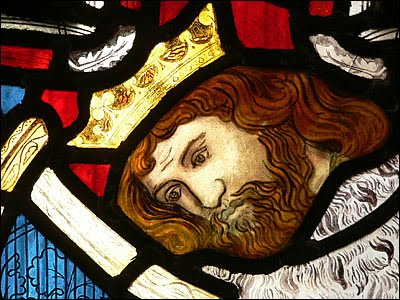
King David, St. Martin’s Church, Yorkshire, England
But even such men and women need to be very careful about how they respond to the challenges and especially the disappointments of life. David committed adultery after his army officers, out of a commendable desire to protect his life, made him stay back in Jerusalem when they went out to war. For a military commander like David, this idleness and apparent uselessness were hard to bear. One may surmise that he tried to find renewed validation by getting a beautiful woman for himself, Bathsheba.
He should have regarded her as strictly off limits because she was another man’s wife—in fact, the wife of one of his trusted “mighty warriors,” Uriah the Hittite. But instead David abused his kingly powers and committed adultery and murder to get her. In a divine judgment, his royal house was torn apart in the next generation. So no divine approval of David’s actions can be found in the earlier description of him as a “man after God’s own heart.”
But here David provides an example in another way. Beware, men and women: even if you are devoted solely to God, you have to flee temptation, recognizing that it will assault you most strongly when you are at your weakest. (For many people, this comes on the “down slope,” when they’ve held an important position but now are facing some new limitations on their role or reductions in their status, as David was here. Be especially vigilant under these circumstances!)
Q. I always felt sorry for Saul. God chose him to lead His people, and he did a good job at it. Saul only made one mistake and God sent David to replace him. I think David did much worse, yet God said, “He’s a man after my own heart.”
Rembrandt, King Saul (detail)
These are excellent questions. In this post I’ll look at why God rejected Saul as king. In my next post I’ll consider how God could call David a “man after my own heart.”
Kingship in Israel was supposed to be different from kingship in the surrounding nations. Israel’s king was not to be considered divine. In the law of Moses, God carefully distinguished the priesthood from the kingship and gave future kings careful instructions that put them under the law.
So it was vital that Israelite kings not usurp any priestly or divine prerogatives. The precedent that Saul set as Israel’s first king would influence all of his successors (like George Washington declining a third term). So he was held to a strict standard.
At one point during Saul’s reign, he was campaigning against the Philistines and waiting for Samuel to come and offer sacrifices to seek God’s favor. When Samuel didn’t arrive as soon as he expected, Saul offered these sacrifices himself, assuming the prerogatives of a priest. When Samuel did arrive, he told Saul, “You have done a foolish thing,” using the Hebrew term for people who act without regard for God. Samuel warned that Saul’s kingdom would not endure, meaning that his family would not establish a dynasty. He’d be succeeded on the throne by someone from a different family.
Some time later, however, God gave Saul a new assignment in his capacity as king. Samuel introduces this assignment by saying, “I am the one the LORD sent to anoint you king over his people Israel.” So perhaps this was intended as a “second chance.”
God commanded Saul to destroy the Amalekites. (This is one of those episodes of total destruction in the Bible that are very difficult for us to understand; I’ve shared some thoughts about them here.) One thing we can recognize in such episodes is that the Israelites were never to take any plunder because weren’t in the war for themselves; they were considered agents of divine judgment.
But Saul and his army spared “the best of the sheep and cattle, the fat calves and lambs—everything that was good.” They only destroyed what they thought was undesirable and worthless. They spared King Agag because in this time captured kings were a prized trophy of war. By conducting this raid as if it were ordinary warfare that he was directing, Saul once again usurped a divine prerogative and misrepresented the character of divine judgment, which doesn’t privilege the powerful and the beautiful.
It seems that God gave Saul a second chance, but this only showed that he still hadn’t learned to respect the limits of his authority as king. And so, to prevent Israelite kingship from being established on the model of the divine kings or priest-kings of surrounding nations, God didn’t allow Saul to establish a dynasty.
Nevertheless, even after Samuel announced this judgment a second time, he granted Saul’s request, “Please honor me [as king] before the elders of my people and before Israel.” Saul reigned for 42 years and throughout that time he was acknowledged as the rightful king. David, even though promised the kingship himself, respected and protected him as the “LORD’s anointed.”
One of the last things we hear about Saul in the Bible is David’s tribute to him after he was killed in battle. Acknowledging how Saul had made Israel secure and prosperous by defeating its enemies, David laments,
Daughters of Israel, weep for Saul,
who clothed you in scarlet and finery,
who adorned your garments with ornaments of gold.
How the mighty have fallen in battle!
So even though Saul wasn’t able to establish an Israelite royal dynasty on the right principles, the Bible acknowledges the benefits Israel received from his long reign.
This is a follow-up to my post about the recent publication entitled A New New Testament. One of the justifications its editors offer for adding books to the New Testament is this:
Both now and for the past 400 years Catholics and Protestants don’t agree on what is in the Bible, and neither do Episcopalians and Lutherans. Internationally the eastern Orthodox, Ethiopian, and Syriac Bibles all contain different books than the western Catholic and Protestant Bibles.
Now it is true that the Bibles of these various communities contain some different books. However, we need to make some important observations about this:
1. None of these Bibles differ when it comes to the New Testament. All Christians communities agree universally about what books belong to the New Testament. So these differences do not provide any justification for changing the New Testament canon.
2. The current differences are rather about certain Old Testament books that were added to the biblical canon at the end of the Fourth Century in the Western church, but not in the Eastern church. No other books have been considered for inclusion since then by any of the communities the editors of A New New Testament mention. So it’s somewhat misleading to cite these communities in support of adding books to the biblical canon, particularly so many centuries later.
3. Since these books were added, and especially since the 1500s, the trend in newly-formed communities in the West—Anglican/Episcopal, Lutheran, and other Protestant—has been towards rejecting these books as canonical. Only the Roman Catholic Church still considers them fully canonical. In other words, the percentage of Christians who consider these books Scriptural, even in the West, has been steadily decreasing in recent centuries. One could posit that the church is actually moving towards a consensus about the canon that would exclude these disputed books. So the appeal to disagreement among various communities about “what is in the Bible” as grounds for adding to the canon is not really valid.
4. All of this said, there is still ample precedent for putting different books in Bibles, as the examples below will show. Nevertheless, this does not provide justification for adding more books to the canon of inspired Scripture. But that is precisely what the committee of scholars behind A New New Testament wants to do. As the publisher’s web site explains, “Hal Taussig called together a council of scholars and spiritual leaders to discuss and reconsider which books belong in the New Testament. . . . They voted on which should be added” to the “previously bound books” (that is, the ones previously bound together in the canon). As I said in my earlier post, it would have been much better to call the publication An Anthology of Early Christian Literature or even An Expanded New Testament, showing that books were being added to a published volume, but not making a claim that they should be accepted as inspired Scripture on a par with the canonical books.
Here are the details about which additional books appear in the Bibles of specific Christian communities. (I am indebted to this article for leads to much of this information.)
The issue is whether followers of Jesus should consider canonical certain books that were written in Greek within the Jewish community in the centuries before Christ. These books, sometimes known as the Apocrypha, are missing from the Hebrew Bible but they were included in the Septuagint, the Greek translation of the Old Testament that was most popular among early Christians.
The Roman Catholic Church, according to the Catholic Encyclopedia, includes the following apocryphal books in its Bible because it considers them fully canonical: Tobias, Judith, Baruch, Ecclesiasticus (Sirach), Wisdom of Solomon, First and Second Maccabees, and the additions to Esther and Daniel found in the Septuagint. These books were affirmed as canonical by regional councils at Hipppo in 393 and Carthage in 397, pending eventual ratification by Rome. Around this same time Jerome included them in the Vulgate, his Latin translation of the Bible.
A manuscript of the Vulgate
However, Catholic theologians describe these books as deuterocanonical, meaning that they belong to a second group of books “whose Scriptural character was contested in some quarters,” as opposed to the protocanonical books, the collection of “sacred writings which have been always received by Christendom without dispute.” To the extent that a Catholic considered the consensus of Christendom significant, this distinction would have some bearing on the authority attached to these books.
Nevertheless, in 1546 the Council of Trent, largely in response to the way Martin Luther had separated out the apocryphal books and placed them between the testaments in his German translation of Bible, decreed that these books were as fully canonical as the others—finally validating the decision of the Council of Carthage over a thousand years later. The Council of Trent also decreed that the Vulgate was the authoritative text of Scripture.
This actually sent something of a mixed message about the Apocrypha, however, because Jerome’s prologues were always included in the Vulgate, and in his prologue to the book of Kings, in which he surveyed the entire Old Testament, Jerome specified that the books that had been translated from Greek, rather than from Hebrew, are “set aside among the apocrypha” (inter apocrifa seponendum) and “are not in the canon” (non sunt in canone). He made similar comments in the prologues to several of the apocryphal books themselves.
So while the Roman Catholic Church’s embrace of these books is explicit, its position on them is not without internal tensions.
Eastern Orthodox Bibles include all the books in the Catholic Apocrypha, plus 2 Esdras, 3 Esdras, 3 Maccabees, the Prayer of Manasseh, and Psalm 151. Greek Orthodox Bibles also contain 4 Maccabees, in an appendix. However, all these apocryphal books are classified as Anagignoskomena (“worthy to be read”), meaning that they are read during services of worship, but that they are not as authoritative as the other books. Orthodox theologians sometimes call the apocryphal books deuterocanonical to indicate their secondary authority, using this term differently from Catholics, for whom it describes how these books were received after first being disputed.
The Coptic (Ethiopian) Church traditionally considered all of the books in the Catholic Apocrypha canonical, along with 3 Maccabees, the Letter of Jeremiah, and Psalm 151. However, according to the Coptic Encyclopedia, “At the beginning of the twentieth century and by order of Cyril V (1874-1927)” all the apocryphal books were “removed from the canon,” although they are still “normally included in the Coptic versions of the Bible.”
Anglican or Episcopal Bibles typically include the Apocrypha, and the Book of Common Prayer prescribes readings from it. However, the Thirty-Nine Articles of the Church of England specify that the canonical books are those “of whose authority was never any doubt in the Church” (that is, only the protocanonical ones, and not the deuterocanonical ones, in the Catholic sense of those terms). As for the apocryphal books, these “the Church doth read for example of life and instruction of manners; but yet doth it not apply them to establish any doctrine.”
Lutheran Bibles also typically include the Apocrypha, but not mixed in among the Old Testament books; rather, as noted above, they are in a separate section between the testaments. Martin Luther wrote in his preface to this section that they were “books which are not held equal to the Holy Scriptures, and yet are profitable and good to read.” (Das sind Bücher so nicht der heiligen Schrift gleichgehalten: und doch nützlich und gut zu lesen sind.)
Other Protestant Bibles contain the same Old Testament books as the Hebrew Bible.
So once again, the only differences between Christian communities when it comes to the biblical canon have to do with books that were added by the Catholic church to the Old Testament in the Fourth Century. The trend in the following centuries has been away from accepting these books. This hardly provides a precedent for adding books to the New Testament today.
Two notes about the New Testament itself:
The publishers of A New New Testament probably refer to the Syriac Church for the following reason. Tatian, a second-century Christian writer and theologian, created a harmony of the four gospels called the Diatessaron. Because Tatian’s influence was felt strongly in Syria, the oldest Syriac Bibles include the Diatessaron in place of the four gospels themselves. But by the middle of the Fifth Century, the separate gospels had been reintroduced in Syriac Bibles, displacing the Diatessaron. There is therefore, as noted above, no difference among contemporary Christians about the New Testament canon. And the very fact that Tatian created a harmony of the four canonical gospels shows that the church accepted these, and no others, as inspired Scripture. This example, therefore, hardly makes a case for adding any new gospels.
The editors of A New New Testament also claim that Martin Luther himself tried to remove some books from the New Testament, and successfully did so from what he called the Old Testament. We’ve just seen that Luther actually removed the Apocrypha, which had always been disputed by the Eastern church, from the Old Testament, and put it in a section between the testaments.
As for the New Testament, in the earliest editions of his German Bible, Luther moved Hebrews, James, Jude, and Revelation, which he said were inferior books, to the back. But he soon reconsidered this opinion, restored these books to their original places, and wrote more appreciative prefaces to them. In addition, as this site explains, “In all the editions of Luther’s Bible translation after 1522, the Reformer dropped the paragraphs at the end of his general Preface to the New Testament which made value judgments among the various biblical books.”
So it’s not really fair to Luther to say that he tried to remove some books from the New Testament when he only entertained this idea briefly, then reconsidered, and even retracted his earlier negative comments about books such as James.
Q. Recently, A New New Testament, published by Hal Taussig, has incorporated 10 new books into the New Testament. Most of these texts are Gnostic. Can you shed some light on the claims of the “Bible scholars” behind the project as to why these texts should be added to the canon?
Your specific question is why a group of scholars wants to add particular books to the New Testament when these books are “Gnostic,” that is, they “come from a different time period than any New Testament document, and they represent a fundamentally different worldview,” as one reviewer has observed. I will answer that question first. But this new publication also raises the issue of whether anyone can add any more books to the New Testament at this point, and if so, how and why might that be done? I’ll respond to that question as well.
I have not seen a copy of A New New Testament, but in my doctoral studies I did read some of the extra books it contains, such as the Gospel of Thomas and the Acts of Paul and Thecla.
The publisher’s web site, in “A Conversation With Hal Taussig,” explains that the committee of scholars behind the edition wanted to include these books precisely because they represent a fundamentally different worldview. Taussig says that the new books will show that “some of the narrow-minded doctrines of orthodox Christianity and the old-fashioned ideas of the traditional New Testament are not the only way that the early Christ movements expressed themselves.” He says that the expanded collection “opens the door to a wider set of expressions, practices, stories, and teachings than [Christians] have previously known.”
In other words, the scholars on the committee behind this publication (a complete list of them can be found in this article) didn’t like traditional Christian beliefs and practices, they wanted to challenge them by adding other kinds books to the Bible, and they’re hoping this will attract people to their own beliefs.
No one can do this. No self-appointed, narrowly-defined committee (this one excluded any scholars who didn’t find orthodox Christianity narrow-minded and the ideas of the New Testament old-fashioned) can decide on its own what books should be in the Bible. The canon of the New Testament was not established by a committee or council of church leaders.
Rather, as I explain in this post, “books that stood the test of time through continuous use in diverse Christian centers were eventually accepted by almost all believers.” The formation of the canon was a process that unfolded over centuries. I believe, by faith, that through this process the Holy Spirit was bearing witness to the church corporately about which books were Scriptural. (For specifics about the virtual consensus among Christians regarding the canon of Scripture, see this post.)
If we were going to add any more books to the canon, the same process would have to unfold in the centuries ahead. For example, suppose we discovered another letter by the apostle Paul—his letter to Laodicea, for instance, mentioned at the end of Colossians but not known now to survive in any copies. This letter would have to stand the test of time and continual use in diverse Christian communities, as the other New Testament documents have, before it was accepted as part of the word of God.
And the individuals who contributed to this ultimate determination would all have to be active community followers of Jesus. The committee behind A New New Testament included a Jewish rabbi and an “expert in yogic and Buddhist traditions.” While such people may have an academic background in biblical studies, by their own admission they are not part of the living Christian community that is animated and directed by the Holy Spirit.
I can, however, think of one good use for the extra books in question. Recognizing that “early Christ movements expressed themselves” in ways different from the ones we know today can help us appreciate the good reasons behind many of the beliefs and practices we have adopted.
For example, in the Acts of Paul and Thecla, Thecla, thinking she is about to be killed in the arena by wild beasts, baptizes herself. Her life is miraculously preserved and when she finds Paul afterwards, she tells him, “I have received the baptism.” Paul does not correct her, from which we understand that in the circles in which this work originated around AD 80-160, self-baptism was considered acceptable. But over time, Jesus’ followers recognized that baptism had to be the community affirming the work of God’s Spirit in an individual’s life, and so the practice of self-baptism was abandoned.
Since there is value in seeing that our beliefs and practices are the result of careful deliberation over time among alternatives, I think it’s helpful for people to know about early books that describe some of these alternatives. But if we’re going to put these books together with the New Testament documents, I would call the whole collection An Anthology of Early Christian Literature. That’s the title that many universities now use for what used to be called courses in “New Testament.” Saying “Early Christian Literature” gives assurances that the enterprise is secular and historical. The title of the new publication, by contrast, is a bid to change what people believe and practice as Christians by changing their Scriptures, and we should rightfully be concerned about this.
Another response to this questioner is offered in this post on Stephen Miller’s blog.
Q. A friend and I recently read out loud through the book of Hebrews using The Books of the Bible. I can definitely recommend this way of experiencing the Bible.
We do have a question, though. Your introduction says that the recipients of this letter “seem to have lived in Italy.” But as we read through Hebrews, it seemed to us that it was addressing instead a pre-70 A.D. Jerusalem audience—people who needed encouragement to stand strong while on the receiving end of persecution from temple-observant Jews. This seemed to us to account better for the letter’s encouragement to persevere and endure persecution.
We thought that the reference in the letter to people “from Italy” sending their greetings was actually describing people who were in Italy at the time, and not, as you say, people who used to live there who were now sending greetings back to their friends in Rome.
We don’t know any Greek and we haven’t looked in any commentaries; this is simply two reasonable laymen looking at each other and reflecting on what we’ve read—both in the text, as well as in the preceding intro.
It strikes me that the questions you’re asking are the kind of broad and comprehensive ones that arise naturally from the consideration of an entire book. You and your friend clearly got the big picture as you read through and listened to the book of Hebrews. All the more reason to present the Bible in a format that encourages that kind of experience!
Questions like yours, about the background to a whole book, won’t necessarily lead you to a “gem of the day” devotional thought that you can carry around with you. But they still matter tremendously. As Gordon Fee and Douglas Stuart write in their book How to Read the Bible For All Its Worth, we can never really recognize what the Bible is saying to “us now” until we appreciate what it was saying to “them then.” All of the biblical documents arise out of real-life experiences of communities of believers. The better we can understand those situations, the more clearly we can hear how the word of God was speaking into them, and so into our situation as well. Anything less does not do justice to the believers whose faith and courage in following Jesus brought us the New Testament in the first place.
You’ve raised an interesting question about the book of Hebrews that other readers and interpreters have also posed. Why couldn’t the audience of this book have been in Jerusalem, where we would expect the strongest opposition from those who wanted to maintain temple observances and sacrifices? Why couldn’t the greetings of “those from Italy” be from people who were actually living in Italy, meaning that the book was sent from there, not to there?
The answers to these questions don’t depend on knowing Greek. The Greek phrase translated as “those from Italy” could mean either people who live in Italy or people who came from Italy. But there are some other things in the epistle that suggest it wasn’t written to people living in Jerusalem:
– The writer says near the beginning, “This salvation, which was first announced by the Lord, was confirmed to us by those who heard him.” So neither the writer nor the audience were eyewitnesses of the ministry of Jesus. If this letter was addressed to believers in Jerusalem before AD 70, it’s almost certain that some of them would have seen and heard Jesus when he was alive on earth.
– From the rest of the New Testament we know that the believers in Jerusalem were very poor. (This is why, for example, Paul took up a collection from wealthier believers elsewhere in the empire to help them.) But the writer to the Hebrews notes, “You suffered along with those in prison and joyfully accepted the confiscation of your property, because you knew that you had better and lasting possessions.” This would fit the wealthy situation in Italy much better.
– The writer also says, “In your struggle against sin, you have not yet resisted to the point of shedding your blood.” This also wouldn’t fit the situation of the Jerusalem believers, who had already seen some of their number killed for their faith. But there was a large and strong Jewish community in Rome, and Hebrews could be reflecting the threat that was beginning to be perceived from them.
– Finally, as I note in the introductory session to Hebrews in my Deuteronomy/Hebrews study guide, “At the end the author calls the whole work a ‘word of exhortation,’ the technical term for a sermon or homily in the Jewish synagogue.” There were, of course, synagogues in Palestine as in other parts of the empire, but if the question is whether the letter arises out of Diaspora Judaism or temple observance in Jerusalem, the synagogue language points more naturally towards the Diaspora.
None of these considerations are, of course, absolutely conclusive, but they are the kind of things that lead me to believe that Hebrews was written to the community of Jesus’ followers in Rome, not in Jerusalem.
Ancient Rome, the likely location of the people addressed in the book of Hebrews.
Why did God tell Balaam he could go with Balak’s men but then get mad at him for going? Was Balaam not supposed to ask a second time after God said no the first time, and God said “fine, go!” but really didn’t want him to?
The story of Balaam in the book of Numbers raises many perplexing questions, and you’ve highlighted one of the main ones. God seems to say no to Balaam at first. But he asks again, and God says yes. But then God opposes him. So can we really appeal a decision from God or not?
Balaam is one of those enigmatic figures in the Old Testament who’s outside the nation of Israel but who seems nevertheless to have a relationship with the true God.
Balak, king of Moab, feels threatened by the Israelites. He knows that Balaam is a diviner and so, in league with the Midianites, he sends messengers to bring him from Mesopotamia to curse the nation of Israel.
Balaam waits on God for guidance overnight and God tells him, “Do not go with them. You must not put a curse on those people, because they are blessed.” So Balaam refuses to go.
Undaunted, Balak sends a more impressive delegation and now, instead of offering the standard fee for divination, he promises, “I will reward you handsomely.” Still, there’s no reason why Balaam should even consider this offer. God has already told him the people of Israel are blessed and not to be cursed. But Balaam once again goes before God for guidance.
So why does God tell him this second time that he can go? The reasons seem not to have to do with Balaam, but with Balak. God says, “Since these men have come to summon you” (that is, the large delegation of Balak’s high officials), “go with them, but do only what I tell you.” My suspicion is that God is seeing an opportunity to declare his purposes and his glory before a large audience, the leaders and people of two nations, Moab and Midian. God is prepared to work through Balaam to do that.
I believe that God sovereignly accomplishes his purposes through the free choices, good and bad, of human moral agents. (This is how I relate divine sovereignty to human moral responsibility.) I think that despite Balaam’s bad motives for wanting to go—he was clearly after the reward and renown—God felt he could work through him in the situation.
But the next day, as Balaam is on his way, God angrily opposes him, in the person of the “angel of the LORD.” Now the reasons don’t have to do with Balak, but with Balaam. God explains (translating literally), “I have come out as an adversary because the way plunges [into destruction] before me.” In other words, I can see that your way is leading right into destruction, and so I’ve come to stop you, even if I have to kill you to do it.”
Rembrandt’s rendition of the scene in which Balaam’s donkey lies down to avoid the angel of the LORD’s drawn sword
Balaam is so chastened by this that he offers to return home, forsaking the hoped-for reward. In view of this, God allows him to continue instead, but after a repeated warning: “Go with the men, but speak only what I tell you.” Hopefully the experience of seeing the angel of the LORD blocking the road with his sword drawn will stay with Balaam and keep him from doing anything foolish.
At first it seems to. Balak gives Balaam three chances to curse Israel, but he blesses them three times instead. Balak then refuses to pay Balaam, who delivers four oracles of judgment against Moab and other enemies of Israel. God’s mission accomplished, right?
Unfortunately not. In the very next scene, women from Moab and Midian seduce the Israelite men into worshipping idols, and in a divine judgment for this, thousands and thousands of Israelites are killed in a plague. It’s as devastating as any defeat they might have suffered in battle against these enemies. And who thought of this strategy? Balaam.
We learn shortly afterwards in the book of Numbers that the Moabites and Midianites “followed Balaam’s advice and enticed the Israelites to be unfaithful to the LORD . . . so that a plague struck the LORD’s people.” The book of Jude, still using Balaam as a negative object lesson many centuries later, notes what his motive was: “for profit.”
But the Israelites fought back against the Midianites, and when they defeated them, “they also killed Balaam son of Beor with the sword.” He hadn’t gone back to Mesopotamia. He was still living with Balak and his allies, enjoying (briefly) the reward he’d received for finding a way to help them oppose Israel, even though God had told him only to bless Israel.
God saw accurately that Balaam’s way was plunging into destruction and tried to warn him. But God didn’t take away Balaam’s freedom to choose. And since Balaam was an available agent, God worked through his choices to ensure that his purposes were publicly proclaimed. Balaam could have and should have taken warning from his near-death experience at the hands of the angel of the LORD. But in the end, his greed overcame him, he opposed God’s purposes, and he was destroyed.
All of this leads me to conclude that while it might be possible to appeal when God says no, it’s a risky proposition, and not a very good idea.





 Your specific question is why a group of scholars wants to add particular books to the New Testament when these books are “Gnostic,” that is, they “come from a different time period than any New Testament document, and they represent a fundamentally different worldview,” as

 Good Question