
How could God bless Abraham when he was deceitful?

Q. When Abram (Abraham) went to live in Egypt, he said deceitfully that Sarai (Sarah) was his sister, not his wife. But as a result, he “acquired sheep and cattle, male and female donkeys, male and female servants, and camels.” In other words, he got very rich. And he got to take all those things with him when he left after his deception was exposed. It’s almost as if God blessed him for being deceitful. That doesn’t seem right to me. I mean, God doesn’t want us to get money through deception, does He?

When I consider this passage about Abram in Egypt, it strikes me that the original Hebrew readers would have readily understood his time there as an “antetype” or preceding example of their own experience in Egypt. Consider the parallels:

• Abraham goes to Egypt because of a famine, as the Israelites did.

• The Egyptians compel Sarah to serve Pharaoh, as they later compelled the Israelites to serve them. (Sarah was intended as a concubine for Pharaoh, though the passage does not say whether she actually became his concubine before he realized her true identity.)

• God strikes the Egyptians with plagues because of how they are treating Abraham and Sarah, just as he struck them with plagues for enslaving the Israelites. (Some translations say something like “the Lord inflicted serious diseases,” but the statement is more general: “afflicted them with great afflictions.” The same term, “affliction,” literally “a striking,” is used for the tenth plague in Exodus.)

• When Abraham leaves Egypt, he takes away much wealth from there, just as the Israelites “plundered” the Egyptians by asking them “for articles of silver and gold and for clothing” and carrying those away with them.

Indeed, the association between Abram’s time in Egypt and the later experience of the Israelites is made explicit just a little later in Genesis, when God tells Abram, “Know for certain that for four hundred years your descendants will be strangers in a country not their own and that they will be enslaved and mistreated there. But I will punish the nation they serve as slaves, and afterward they will come out with great possessions.”

It’s worth noting that this suggests that the “plunder” the Israelites would take from Egypt would be at least partial compensation for the many years they would be forced to work without pay. But what about the riches Abraham acquired? They don’t seem to be anything that the Egyptians “owed” him.

I think the issue really comes down to this: Did the Egyptians only take Sarai as a concubine for Pharaoh because Abram told them she was his sister—they wouldn’t have done so otherwise? Or was Abram correct in believing that the Egyptians were going to take her one way or another, and the only question was whether they would kill him to get her?

If the former is the case, then Abram feared unnecessarily, rather than trusting in the Lord, and he was also unnecessarily deceitful and caused Sarai real or potential dishonor as a result. It would certainly be difficult to understand how God could allow him to acquire such riches under those circumstances.

However, the thematic connections between Abram’s experience in Egypt and the later experience of the Israelites there, along with the explicit connection that is made shortly afterwards, suggest that Abram was  correct to see the Egyptians as people who would oppress foreigners. Indeed, the fact that when “the Egyptians saw that Sarai was a very beautiful woman,” they “took” her as a concubine—there’s nothing about them seeking consent from the “brother,” offering a bride-price, etc., as we typically see elsewhere—indicates that they may well have been as forcefully oppressive as Abram feared.

This brings us to a different question: Was it valid for Abram to use deception to try to ensure that, if Sarai were inevitably going to be taken as a concubine, at least he wouldn’t be killed in the process? In this series of posts, I consider some other biblical characters (such as Rahab and Samuel) who apparently used deception to protect themselves and others from oppressors who held a significant power advantage. It seems that in some cases, God’s purposes may actually have been advanced through this.

It’s a controversial question with no clear answer, but if we assume that people who are at a hopeless power disadvantage can legitimately use deception for protection (for example, by hiding people who would otherwise be captured and mistreated or killed), and if we conclude that Abram was indeed right in believing that the Egyptians would want to take Sarai even if they had to kill him to get her, then his deception is at least understandable. He didn’t deceive the Egyptians in order to get wealth; instead, he got the wealth as the “brother” of a woman who had been “taken into Pharaoh’s palace.” In a sense, accepting these gifts was a means of maintaining the deception, which appears to have been vital to his survival.

However, we also have to consider that Pharaoh responded by returning Sarai to Abram and sending them on their way when the Lord “afflicted the Egyptians with great afflictions.” We do have to wonder what would have happened if Abram, instead of claiming that Sarai was his sister, had cried out to God for protection in this dangerous situation. God could presumably have “afflicted with great afflictions” anyone who tried to harm them, and that would have protected them.

But as so often happens in the Bible, what we are seeing is the action of God in a situation that is already imperfect because of human choices. Still later in Genesis, Abraham and Sarah go to live among the Philistines for a while. Abraham says to himself, “There is surely no fear of God in this place, and they will kill me because of my wife,” so he once again claims that Sarah is his sister, and she is taken into the palace of King Abimelek. But in this case God speaks to Abimelek in a dream and he responds by returning Sarah immediately. (It turns out that there was “fear of God” in that place.) But even though in this case the passage specifies that Sarah had not yet become Abimelek’s concubine, the king still pays Abraham a large quantity of silver “to cover the offense against you,” that is, as compensation for an offense against Abraham and Sarah’s honor, even though it was unintended and based on a deceptive claim, and no actual harm was done.

We might conclude that if such compensation was appropriate in the case of Abimelek, some compensation would also be appropriate in the case of Pharaoh, particularly if he was more oppressive and less God-fearing. Even though the riches Abram acquired in Egypt were not originally intended as compensation, but rather as gifts, and they were due to Abram’s false pretenses, we could still understand them ultimately as being compensation: Pharaoh says, “Take your wife and go,” and he doesn’t ask for the gifts back.

However, as I said, it’s already an imperfect situation due to human choices by the time we get to sorting out what role God’s actions play in it, so I think there’s good reason to continue pondering what happens in this episode.

 

Was Jesus a legal or an illegal refugee?

Q. What do you think of this recent comment by Paula White (spiritual advisor to Donald Trump)? “Many people have taken biblical Scriptures out of context on this [issue of immigration] to say stuff like, ‘Well, Jesus was a refugee.’ Yes, He did live in Egypt for three and a half years. But it was not illegal. If He had broken the law then He would have been sinful and He would not have been our Messiah.”

The concept of legal vs. illegal immigration, when applied to the ancient world, is anachronistic and irrelevant. Ancient countries didn’t forbid foreigners to enter if they didn’t have certain permissions. (As one Christian leader has already observed in response to White’s comment, the concept “hardly applied during Jesus’ time, centuries before the existence of modern nation-states that issue passports and visas to regulate migration.”)

Rather, the issue was how the local population would treat foreigners who came to stay among them. And the biblical Scriptures are very clear about how God’s people should treat them. God told the Israelites, “When a foreigner resides among you in your land, do not mistreat them. The foreigner residing among you must be treated as your native-born. Love them as yourself, for you were foreigners in Egypt. I am the Lord your God.”

Jesus was a very particular kind of refugee: an asylum seeker. That is, he fled for safety to another country because he would have been killed if he had stayed in his own country. The fact that this “was not illegal” is the whole point. Trying to criminalize asylum seeking, whether in law, or through the way government policy is carried out, or in the popular imagination, is a  departure from a time-honored international standard of justice and compassion.

If Jesus had been killed by Herod, he couldn’t have been our Savior, either.

Were any women killed for worshiping the golden calf?

Q. Were any women killed for worshiping the golden calf? If not, why? Didn’t they contribute their gold to make the image and engage in the same behavior as the men?

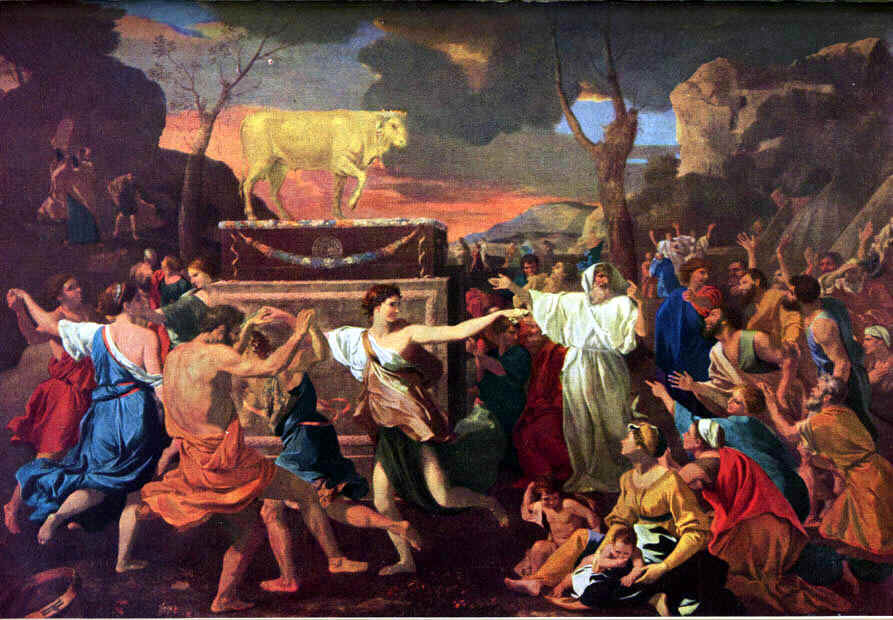
Nicolas Poussin, “The Adoration of the Golden Calf”

The account in the book of Exodus that describes how the Israelites made and worshiped the golden calf does leave us with the impression, at least at first, that only men were killed in punishment. Moses told the Levites, who had remained loyal to the Lord, “Go back and forth through the camp from one end to the other, each killing his brother and friend and neighbor.” All of these terms are masculine, suggesting that only men were  targeted.

However, there are at least three things that suggest women were likely killed in punishment as well. First, the Hebrew language, by convention, uses such terms in the masculine when both men and women are in view. For example, the commandment in Leviticus to “love your neighbor as yourself” clearly applies to both men and women. And while the preceding commandment in Leviticus says literally, “You shall not hate your brother in your heart,” many modern translations, recognizing that this word in Hebrew can apply to any relative, male or female, in such a context, translate the expression as “anyone of your kin” or “a fellow Israelite.”

Also, the account of the golden calf concludes by telling us that “the Lord struck the people with a plague because of what they did with the calf Aaron had made.” So even if no women were killed by the Levites for their part in making and worshiping the idol, it appears that some women did die in this plague.

Finally, in the New Testament, Paul describes to the Corinthians several things the Israelites did that constituted a pattern of disobedience and rebellion, as a result of which “their bodies were scattered in the wilderness.” This was in keeping with the punishment that God announced when the people rebelled definitively at Kadesh and refused to enter the promised land. So any women who were involved in the golden calf episode but who were not killed in punishment at the time nevertheless died in the desert as the result of chronic disobedience that included that episode.

In other words, anyone who contributed to making the calf and participated in its worship was subject to punishment—women as well as men. There was no unfairness in that regard.

Still, the account of the golden calf and of these divine punishments is one that  thoughtful readers of the Bible wrestle with today. We may wonder why people were killed for making and worshiping an idol. But worshiping a different god meant becoming an entirely different kind of culture than the one envisioned in the Law of Moses. In Old Testament times, every society was a theocracy that mirrored the character of the god it worshiped. The Canaanite gods were bloodthirsty, power-hungry, and immoral, while Yahweh was pure, holy, compassionate, and concerned for the poor and weak. Even as the Israelites first started to worship the golden calf, they  began to change the character of their society, engaging in “revelry” (sexual immorality, though described euphemistically as “dancing”) as part of the proceedings. The decay was spreading so fast that it needed to be halted immediately. The overt violence may trouble us, but it seems to have been intended to prevent the subtle, crushing violence of injustice and oppression that would have settled into the society if it had adopted Canaanite-style gods.

Why didn’t God give Esau back the blessing that Jacob stole?

Q. I appreciated your post on “Why couldn’t God defeat Jacob in a wresting match?” but I have another question. This one has been disturbing me for quite a long time. Why did God allow Jacob to steal Esau’s blessing and get away with it? Why did God continue to bless Jacob? I expected that at some point, because we are dealing with an omnipotent being, God was going to reverse the blessings, but that doesn’t happen. Please answer.

Let me respond by offering a series of observations. First, the blessing  that Jacob stole from Esau was specifically the blessing of primogeniture, that is, the blessing Esau would have been given so that he could fulfill his responsibilities as the first-born son of Isaac.

Primogeniture (which simply means “first born”) was one of the existing cultural institutions that God incorporated into the Law of Moses to promote order and provide for those in need. The book of Deuteronomy commands that when a father dies and his inheritance is divided, the firstborn son is to be given a “double portion,” that is, twice as much as the other sons. In this culture women didn’t own property and so they were dependent on male relatives, typically their fathers and then their husbands. But any unmarried sisters, or widowed sisters without children, would have to depend on this oldest brother after the father’s death. That’s why he was given a double portion, so he could care both for his own immediate family and for his extended family in his late father’s stead.

It was customary for a father, on his deathbed, to bless the firstborn son, asking God to give him material abundance so that he could care for the extended family, and to make his brothers come under his authority so that order would be preserved within the clan. Accordingly, when Isaac blesses Jacob (thinking that he’s Esau his firstborn), he says, “May God give you heaven’s dew and earth’s richness—an abundance of grain and new wine,” and, “Be lord over your brothers, and may the sons of your mother bow down to you.”

A further observation I’d like to make is that, paradoxically, God repeatedly did not follow the custom of primogeniture as He carried out His program of redemption. The Old Testament is full of examples of God choosing younger brothers over older ones: Isaac over Ishmael; Jacob over Esau (even before they were born, God told their mother, “the older will serve the younger“); Judah over his three older brothers as the ancestor of the royal line; David over his seven older brothers as king; and so forth. It seems that God simply looks for the person who can best fulfill his purposes, regardless of that person’s social standing. And so the judges, for example, include both men and women (Deborah), even though this was a patriarchal society that privileged men, and they also include an illegitimate son (Jephthah) and a youngest son (Gideon).

My next observation is that God works through the free choices, both good and bad, of human moral agents to accomplish his purposes. We get an indication of this when Joseph tells his brothers, who sold him into slavery, “You intended to harm me, but God intended it for good to accomplish what is now being done, the saving of many lives.” God does not take away our free will; God lets us choose, and God is always able to work with our choices to advance his own positive purposes, although there can also be negative consequences for people who makes bad choices.

Genesis tells us that “Esau despised his birthright,” that is, his responsibilities as the firstborn son weren’t important to him and he was likely to neglect them. Jacob, on the other hand, was hard-working and ambitious—a real hustler. He was much better suited to assume the leadership of the Israelite family as it began growing rapidly into a group of tribes that would become a nation. Ideally, Esau would have recognized Jacob’s abilities, and his own disinclination, and offered Jacob the role of family leader voluntarily. Unfortunately, that’s not what happened.

Jacob was a “hustler” in another sense—a con artist. He took advantage of a weakness in Esau’s character to defraud him. The book of Hebrews describes Esau as “profane,” meaning literally that “nothing was sacred to him.” (Clearly these were two young men who both needed some character development!) One day Esau came home famished at the end of a day of hunting and saw that Jacob had made stew. He pleaded for some, and Jacob “sold” it to him in exchange for his birthright, which he knew meant nothing to Esau.

But Jacob still had to get the blessing that went with the birthright, and so he also deceived his father Isaac, pretending to be Esau once his father’s eyesight had grown so dim that he couldn’t tell the difference. (Though smooth-skinned Jacob also had to put on Esau’s clothes and wrap his arms and neck in goatskins, so that he would smell and feel like his hairy older brother!) As a result of this deception, Jacob received his father’s blessing, in God’s name, of both material abundance and family leadership.

So why did God honor this blessing, when it was obtained under such fraudulent circumstances? As I said earlier, God works through the free choices, both good and bad, of human moral agents to accomplish his purposes. Unfortunately we often don’t give God good choices to work with, and that seems to be what happened in this case. There were plenty of negative consequences for Jacob: He had to flee from his brother’s anger at this deception, leaving with nothing but a staff and spending twenty years in exile. But through the hardships of those years, his character was shaped and he became a man who could lead the tribes of Israel into their future. The same thing could have been accomplished much more positively, but I think that everyone involved (not just Esau and Jacob, but their parents Isaac and Rebekah, who each showed favoritism towards a different son) didn’t give God enough good choices to work with to allow things to happen any better. As I said, God doesn’t take away our free will.

One final observation I’d like to offer is that when Jacob returns from exile a wealthy man, rich in flocks and herds, he does make some restitution to Esau for the material abundance he stole from him when he took his firstborn blessing. Jacob sends Esau hundreds of goats, sheep, camels, and donkeys, and when they meet in person, he says to him, “Accept the gift I have brought you.” This is literally, “Please accept my blessing that has been brought to you.” Jacob is making restitution by providing Esau with a “blessing” in place of the one he stole. Jacob also bows down to Esau and calls him “My lord,” even though Isaac’s blessing to Jacob had been, “Be lord over your brothers, and may the sons of your mother bow down to you.”

These actions on Jacob’s part don’t undo Esau’s surrender of his birthright; that was an permanent transaction between the two of them, even though it wasn’t concluded under the best of circumstances. But it does seem that Jacob, now that he is more mature, at least tries to return some of the benefits of their father’s blessing to Esau.

Sometimes this kind of thing is best we can hope for. It’s a messy world, even with an omnipotent God actively working to bring about its renewal.

Raffaellino Bottalla, “Meeting between Esau and Jacob,” c. 1640. Esau and Jacob ultimately were reconciled later in life.

Why did God give David all of Saul’s wives?

Q. Why did God give David all of Saul’s wives and break his own law that said Israel’s king “must not take many wives“?

I think this should be of concern to us, although not primarily for the reason that you give.

While the law you cite does appear, on the face of it, to prohibit Israel’s kings from marrying multiple wives, the intention of that law is to forbid marriage alliances with the surrounding pagan countries, as the justification for the law makes clear: “or his heart will be led astray.” It was understood that a women who went to a foreign country for a marriage alliance would still be allowed to worship her own gods, and if her husband really wanted to please his father-in-law (who might be a more powerful king), he might join in this worship.

This is precisely what happened to Solomon: “He had seven hundred wives of royal birth [i.e. through marriage alliances] and three hundred concubines, and his wives led him astray. As Solomon grew old, his wives turned his heart after other gods, and his heart was not fully devoted to the Lord his God, as the heart of David his father had been. He followed Ashtoreth the goddess of the Sidonians, and Molek the detestable god of the Ammonites.”

I think we can safely assume that if an Israelite king had married multiple wives who had all been faithful followers of the God of Israel, his heart would not have been “led astray,” and so the spirit, at least, of the commandment in Deuteronomy would not have been broken.

However, as I said, God giving Saul’s wives to David raises other concerns. It would appear that Saul had something of a royal harem (though certainly nowhere near as large as Solomon’s), and that David was allowed to make this harem his own when he became king. (This is the only place in the story of David where this is mentioned, so we have to infer the details.) Ordinarily the harem would never come to belong to the next king because sons succeeded their fathers on the throne and there was a prohibition in the law of Moses against a father and son marrying the same woman. But since David was starting a new dynasty, i.e. he was not the son of Saul, it was legal for him to make these women, who had become widows upon Saul’s death, his wives.

We may nevertheless still be concerned that David may have done this primarily to consolidate his hold on the kingship, rather than because he wanted to love and care for these women as his wives. We see this  illustrated later in the biblical story, when there’s a rivalry between David’s own sons Solomon and Adonijah to succeed him on the throne. Adonijah wants to marry Abishag the Shunamite, a woman who had kept David warm in bed when he was old but who had not had sexual relations with him (so it was legal for Adonijah to marry her). But Solomon recognizes that Adonijah is trying to displace him, even though he’s David’s own choice for his successor, and consolidate a rival claim to the throne by doing the closest thing he can to taking over the royal harem. So Solomon replies to his messenger, “Why do you request Abishag the Shunammite for Adonijah? You might as well request the kingdom for him.”

However, we might observe that even if David’s primary motive was not to love and care for Saul’s widows, because he married them, they were cared for in a way that they probably would not have been otherwise. One of the realities of the story of redemption in the Old Testament is that it unfolds within a cultural context in which women are dependent on men for support, and many arrangements have to be understood in that light. We also see in the biblical story that well after David came to the throne, there was still sentiment in various parts of Israel to restore the house of Saul, and these women might actually have been in danger from partisans of David who wanted to quell that sentiment. Much of this is speculative, but I believe it helps explain why God might have allowed David to take over Saul’s harem.

There’s still one more important concern, though. It’s actually while the prophet Nathan is in the course of rebuking David for his sin against Bathsheba that he reminds David that God let him do this. Nathan’s message is that David had no grounds to want another man’s wife because he already had so many wives of his own: “I gave your master’s house to you, and your master’s wives into your arms. I gave you all Israel and Judah. And if all this had been too little, I would have given you even more. Why did you despise the word of the Lord by doing what is evil in his eyes? You struck down Uriah the Hittite with the sword and took his wife to be your own.”

As a consequence, Nathan says, David will suffer retributive justice: What he did to someone else will be done to him. However, it doesn’t seem that it’s really going to be done to David himself; instead, someone else will suffer for his wrongdoing: “Before your very eyes I will take your wives and give them to one who is close to you, and he will sleep with your wives in broad daylight. You did it in secret, but I will do this thing in broad daylight before all Israel.

In other words, because David tried to get away secretly with sleeping with another man’s wife, someone else will sleep with his wives openly. It seems that it’s actually David’s wives who suffer this punishment, not David himself. The women ultimately affected were ten concubines whom David left behind to “take care of the palace” when he fled for his life from a rebellion launched by his son Absalom. Upon being advised that this would consolidate his claim on the throne, Absalom slept with these women; once he was defeated and killed and David returned, David put them in seclusion. They were provided for and protected, but “they lived as if they were widows,” no longer his wives.

The reader of the Bible is distressed to think that these innocent women suffered such a fate as some kind of divine judgment against somebody else. It is true that as the story of redemption continues to unfold over the course of the Bible, and particularly as the coming new covenant is announced by Jeremiah and Ezekiel, there’s a move away from judgments like these that affect an offender’s family towards individual punishments that target the individual responsibe. Jeremiah, for example, in his new covenant oracle, says that this proverb will no longer be quoted, “The parents have eaten sour grapes, and the children’s teeth are set on edge.”

Speaking through Ezekiel, God similarly objects to the people of Israel quoting this same proverb: “You ask, ‘Why does the son not share the guilt of his father?’ Since the son has done what is just and right and has been careful to keep all my decrees, he will surely live. The one who sins is the one who will die. The child will not share the guilt of the parent, nor will the parent share the guilt of the child. The righteousness of the righteous will be credited to them, and the wickedness of the wicked will be charged against them.”

So we may at least say that there is a development within redemptive history away from corporate or family punishments toward individual punishments, which seem to us to be much more in keeping with the just character of God. Nevertheless we still feel very badly for, and have continuing concerns about, those who lived in the time before this development, such as David’s ten concubines.

Perhaps the most we can say about their situations is to realize that our sins inevitably do affect those around us, and they affect most the people who are closest to us. Whether this is the result of direct divine judgment, or the result of the way God set up the moral universe, the harm we will do to those we love the most if we choose to sin is one more reason for us to turn away from that wrong choice and instead follow a course of action that will bring help and blessing to all those around us.

Was Dietrich Bonhoeffer justified in joining the plot to kill Hitler?

Q. I just finished reading Bonhoeffer: Pastor, Martyr, Prophet, Spy by Eric Metaxas. It is an outstanding book about an inspiring Christian (with fascinating history to boot). The author describes—often in Bonhoeffer’s own words—how he came to believe that, as a Christian, it was his duty to do anything possible to stop Hitler, including killing him. It seems to me that this is a very slippery slope. Bonhoeffer, for instance, also thought that abortion was murder. I wonder, therefore, if he would have approved of killing abortion providers. What biblical basis is there for humans intentionally taking the life of another human (even capital punishment)?

I, too, have read this book by Metaxas, and like you I found it fascinating, informative, and challenging. I had my own questions and concerns about Bonhoeffer’s decision to join the plot to kill Hitler, even after listening to him make the case in his own words.

My first concern was just like yours—this is a very slippery slope. Even if we decide that somehow, under extreme and very extraordinary circumstances, Bonhoeffer was justified, this could open the door for others to conclude that they, too, might be justified in killing someone, in circumstances that are actually nowhere near to being as extraordinary as Bonhoeffer’s.

So it’s very important that we appreciate the context of his decision. The book does a superb job situating it in its historical context; let me try briefly here to review the biblical-theological context, as I understand it (not that this is absent from the book, either).

We need to recognize that Bonhoeffer’s deliberations came within the centuries-old tradition of reflection within Christianity about whether there can be such a thing as a “just war.” (The other longstanding and respected tradition in Christian theology is pacifism.) Among those who believe that there could be a just war, almost all agree that the war to defeat Hitler was one. It was a defensive war of self-protection against an unprovoked aggressor who had attacked peaceful countries and was oppressing their conquered populations, including systematically committing genocide against millions. So Bonhoeffer and his fellow plotters, many of whom were senior German military officers, saw themselves as joining the justified side in a just war.

Given this, the question then arose as to whether assassination was ever an appropriate tactic within a just war. It could be that in most cases of a just war (assuming there is such a thing), assassination would still not be valid. But in this case, Bonhoeffer concluded, it was a means proportionate to the desired end that would not have wider unacceptable consequences. (These are some of the tests that are applied to means within just war theory.) This was true even though the plotters recognized that some of Hitler’s senior staff might be killed along with him; the person who delivered the bomb in a briefcase was prepared to die himself in the process if necessary.

And this leads us into the second part of the biblical-theological context for the decision: Bonhoeffer’s own theory of ethics. Part of this theory held that if you could recognize, “Somebody ought to do such-and-such,” then you ought to do such-and-such, because we are answerable to God not just for our actions, but also for our inaction. This was because God, in Bonhoeffer’s understanding, accomplishes his purposes through the free acts of human moral agents.

He therefore took seriously what the book of James says: “Anyone who knows the right thing to do and fails to do it, commits sin.” He saw too many German Christians effectively giving Hitler a free hand by appeal to “obeying the law” or “submitting to authorities,” when they ought to have been resisting oppression and protecting the weak. According to Bonhoeffer’s ethics, it was better to act on your beliefs and convictions and be prepared to answer to God for your actions than it was not to act out of fear of doing something wrong. I believe this is one reason why he’s such a fascinating and inspiring character.

I think our takeaway needs to be, however, that anyone who’s prepared to act as boldly as he did should also be prepared to reflect as carefully as he did, in community, about ethical actions, both generally and specifically. This was not a simple matter of “I think God is telling me to kill Hitler.” It was a meticulously deliberated decision, made in the context of a close community of committed believers in his own day, in the larger context of Christian moral and ethical reflection over the centuries. The fact that the jury is still out on this decision shows how difficult and complicated it was, and therefore what moral courage it took for him to act upon it and be prepared to answer to God for his actions (not to mention answering to the verdict of history, which I guess we’re working on here).

Your ultimate question is too large for me to address in a single blog post: “What biblical basis is there for one human intentionally taking the life of another?” But I hope I’ve sketched out the beginnings of an approach to that question, at least.

Is Jesus insulting the Canaanite woman by calling her a “dog”?

Q. I read the story of Jesus and the Canaanite woman the other day and I have no idea what Jesus is talking about in the parable when he references crumbs and dogs eating the crumbs. Can you shed some light on this passage?

“The Woman of Canaan” by Michael Angelo Immenraet, 1670s

This story is confusing and sometimes upsetting to readers of the gospels because it appears that Jesus is not only rebuffing someone who comes to him for help, he’s actually insulting her in the process.

A Canaanite woman asks Jesus to deliver her daughter, who’s suffering at the hands of a demon, but he won’t even speak to her. When his disciples urge him to help, he replies, “I was sent only to the lost sheep of the house of Israel.” (The woman is a non-Israelite.) And when she appeals to Jesus personally, he responds, “It is not right to take the children’s bread and throw it to the dogs.”

So Jesus seems to have a very callous and insulting attitude. However, I think something different is actually going on here.

This was an oral culture whose ways were embodied in popular sayings. These were often cited in support of a particular course of action. When two people had different courses in mind, they would pit different sayings against each other until one person had to admit, “Okay, you’ve got me there.”

This kind of thing can happen in our own culture. For example, two friends might visit a new part of town on a weekend, looking for a restaurant where they can have dinner. The first place they consider says it can seat them immediately. One of them might say, “Maybe we should eat here. After all, ‘A bird in the hand is worth two in the bush.'” But if the other thinks there could be a better restaurant down the street that would be worth the wait, he might reply, “Yes, but ‘nothing ventured, nothing gained.'”

Similarly, I think Jesus is actually quoting a popular saying to the woman: “It’s not right to throw the children’s bread to the dogs.” This saying probably had a general application meaning something like, “Don’t use something expensive or valuable for a common purpose.” Jesus is applying it to the mandate he has, during his limited time on earth, to concentrate his efforts on ministry to the people of Israel, as their Messiah. (After his resurrection, his message will spread to all the people of the world from that starting point.)

The woman, however, comes up with what I think is an original saying of her own in response: “Yes, but even the dogs eat the crumbs that fall from their masters’ table.” Jesus responds, in effect, “You’ve got me there,” and he heals her daughter.

But this was not merely a battle of wits that the woman won by her cleverness and quick thinking. Rather, I believe Jesus evaluated every situation he encountered in order to discern how God might be at work in it. In the gospel of John he’s quoted as saying, “The Son can do nothing of his own accord, but only what he sees the Father doing.” So Jesus was always on the lookout for when his Father might be doing something that he could join in with.

I believe, for example, that when his mother Mary came to him at the wedding in Cana and told him that the hosts had run out of wine, while Jesus thought initially that the time hadn’t come yet for him to do “signs” in public, he ultimately recognized that Mary’s persistent and trusting faith was an indication that God was at work in the situation. And so he did his first miracle there, turning water into wine.

I believe that Jesus similarly recognized the Canaanite woman’s bold request and audacious persistence as indications that God was giving her the faith to believe her daughter could be delivered if she sought help from Jesus. It was in response to that recognition, inspired by the woman’s reply to his challenge, that Jesus acted to heal the daughter, giving an advance glimpse of how his influence would soon extend beyond the borders of Israel.


How could God use a man and not save him?

Q. How is it fair to a person born to be put through hell in life because he is used by the devil and God. Is this like the story of Job? How could God use a man and not save him?

I’m not entirely sure what you’re asking about here, but let me reassert, as I’ve said often on this blog, that I believe God gives everyone the opportunity to trust in Him and be saved, and in fact God makes every effort to bring each person to salvation. As the Bible says, God “doesn’t want anyone to be destroyed. Instead, he wants all people to turn away from their sins.” So I don’t believe that God would “use” somebody for His purposes and then just discard that person afterwards. Any purposes God pursues through our lives are subservient to the purpose God pursues for our lives, which is to bring us to know and trust Him and enjoy His presence forever.

In terms of the story of Job specifically, in my study guide to that book I note, “The book of Job has much to say about the ‘problem of evil,’ that is, why there is so much suffering in the world if it’s governed by a good God. But [in the opening story] the Adversary [the name for Satan in the book] begins by raising a different problem, the ‘problem of good.’ If apparent goodness is always rewarded and bad conduct is always punished, how can we ever really be sure that a person is genuinely good, and not just trying to win rewards and avoid punishment? It turns out that the only kind of universe in which genuine good can be known to exist is one in which good people sometimes suffer undeservedly, but still demonstrate continuing loyalty to God.”

This is what God “uses” Job to demonstrate over the course of the book (if we may use that term). And there’s no question that at the end he’s “saved,” that is, fully returned to God’s tangible favor and blessing.

I hope this helps address your concerns.

Did the Israelites really massacre the Canaanites, and if so, was this really at God’s command?

Q. Peter Enns has a book out called The Bible Tells Me So: Why Defending Scripture Has Made Us Unable to Read It. In this book, among other things, he argues that there is a huge lack of archaeological evidence for the exodus and for the Canaanite “genocides.” He says that outside of evangelical scholarship this is essentially an undisputed fact. He argues that these stories likely reflect a sort of “tribal deity” rhetoric/mentality and are full of hyperbole and would have been characteristic of how people in that time and place related to God. He also argues that to the extent that the Israelites did massacre the Canaanites, they were not in fact carrying out God’s will but were instead doing what they erroneously thought God was telling them to do (since they related to him as a tribal warrior god). What do you make of these claims?

I haven’t yet read this particular book by Enns, though I have read some of his other books and I appreciate him as an honest, thoughtful, careful, articulate, and provocative writer. But I do discuss the historicity of the Canaanite genocides and their theological implications in this post, in light of a review of another book that makes similar claims.

I’m not qualified to speak to the archaeological debate, though I can  imagine how it could easily devolve into circular arguments: “Of course there’s no trace left of the campaign against the Canaanites, because the Israelites were told to ‘break down their altars, smash their sacred pillars, burn their Asherah poles, cut down their carved idols, and completely erase the names of their gods.’ You shouldn’t expect to find anything.  It’s just an argument from silence that it didn’t happen because you haven’t found anything.” But basically I will leave the archaeology to others.

Instead, to address the biblical and theological side of things, let me say again that the biblical stories of genocide are so disturbing that it would be a great relief to think that they never really happened. However, I think we have to ask ourselves what the implications would be if they actually had happened, and for that matter what the implications are that the Bible says they happened. As I wrote earlier, I think we need to see these stories as exceptional and even incongruous within the Bible, and on that basis see whether we can account for them somehow.

The best I’ve been able to do with that is still to see the life and teachings of Jesus as normative for the interpretation of all of Scripture, and on that basis to conclude that no one today should emulate the actions or attitudes represented by the genocide stories in the Bible. Instead, we need to hold them in an uncomfortably painful tension with the normative teachings about loving our enemies and seeking forgiveness and reconciliation, pursue those things, and await the day when “we shall know fully, even as we are now fully known,” and hopefully then understand.