Why was only Miriam punished with leprosy when she and Aaron rebelled against Moses?

Q. When Aaron and Miriam rebelled against Moses, why was only Miriam punished with leprosy?

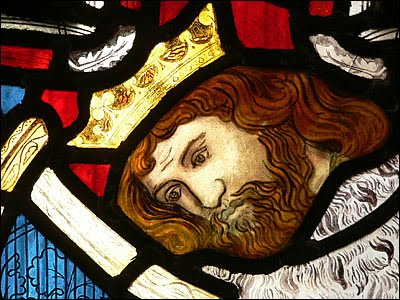
“The Leprosy of Miriam,” woodcut from 1583 Bible.

The main explanation seems to be that Miriam was held more responsible because she instigated the challenge in the first place and then enlisted Aaron to support her.  There are two things in the text that show us this:
• Miriam is named before Aaron at the start of the account.  In every other place in the Bible where they are named together, including later in the same account, Aaron is mentioned first (conventionally, as the eldest brother in the family).
• The verb “speak against” is actually in the feminine singular in Hebrew:  “She spoke, Miriam, and Aaron, against Moses . . .”
Both of these things suggest, as I said, that Miriam originated the challenge and enlisted Aaron to support her, so she is held more responsible and given a greater punishment.  This shows us the fairness of divine justice.

One additional possibility to consider is that God spared Aaron specifically so that he could intercede as Israel’s high priest, approaching Moses with a renewed recognition of him as God’s representative, to ask forgiveness for Miriam’s sin and for his own:  “Please, my lord, I ask you not to hold against us the sin we have so foolishly committed.”  If Aaron had been struck with leprosy, he would not have been able to function as a priest according to the laws in Leviticus.  So God may have spared him in mercy specifically so that he could intercede for sin in this way as a priest. (It’s Moses who actually prays for Miriam’s healing).  We see that God’s very judgments are tempered with mercy, even if this sometimes makes them seem unfair.

Sparing the high priest so he could intercede for sin is a bit like the way God spared King David from direct personal punishment after he sinned by taking a census of his fighting men.  God may have spared David because the people still needed a king to rule their nation and lead their armies. When David saw the plague that was striking down the people, he recognized his own responsibility and prayed, “I have sinned; I, the shepherd, have done wrong.  These are but sheep.  What have they done?  Let your hand fall on me and my family.”  But instead of afflicting David directly at that point, God in mercy ended the plague entirely.

This is a warning to people in vital offices:  You may be spared immediate personal judgment not because you are entirely innocent, but because God still needs someone in your role and you’re not bad enough yet to be removed from it!  Aaron should not have concluded that he was less deserving of some punishment than Miriam for the same revolt, even if not the same punishment. Leaders today who “think they are standing firm” should “be careful that they don’t fall.”
Did Jephthah really sacrifice his daughter?

Q. Did Jephthah really sacrifice his daughter?  Or is the other point of view correct that says that she lived her life as a virgin and in that sense was sacrificed?

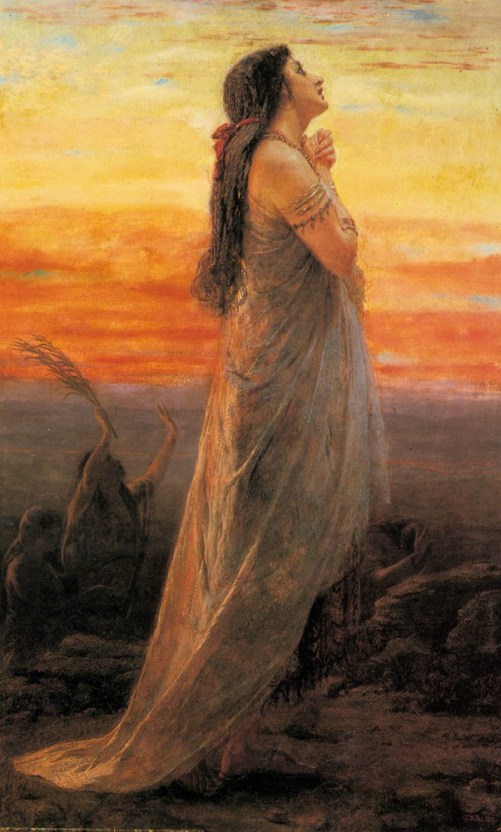
George Elgar Hicks, “The Lament of Jephthah’s Daughter”

Unfortunately Jephthah most likely did sacrifice his daughter after he vowed to make a burnt offering of “whatever comes out of the door of my house to meet me when I return in triumph.”  The author of Judges includes this story as one of several horrific examples of what happened in the days when “Israel had no king” and “everyone did as they saw fit.”  These examples support the overall argument of the book, that the people need a king to help ensure that they will know God’s law and follow it.  As I explain further in my study guide to Joshua, Judges, and Ruth:

* * * * *

It wasn’t unusual for an Israelite who was counting on the LORD to make a vow, as Jephthah does.  This was a promise to acknowledge God publicly when he brought deliverance.  Vows like this are described often in the Psalms, for example, in Psalm 66:  “I will come to your temple with burnt offerings and fulfill my vows to you—vows my lips promised and my mouth spoke when I was in trouble.”

There would have been nothing wrong with Jepthah’s vow if he had only known the law.  Moses allowed the Israelites to offer anyone or anything they wanted to the LORD in payment of a vow, but it specified that if they dedicated a human being, they had to “redeem” that person by offering the value of their labor instead.  (These regulations are found at the end of the book of Leviticus.)  Jephthah should have paid ten shekels of silver into the LORD’s treasury, rather than sacrificing his daughter as a burnt offering.  But by now the Israelites were so used to Baal-worship, which included human sacrifices, that they were actually prepared to offer human sacrifices to the LORD–even though he had expressly forbidden them in the law.  And so Jephthah’s daughter suffers a horrific fate.

* * * * *

After offering this explanation, I then make these further reflections on the story of Jephthah:  “However, apart from his ignorance of the law and these tragic consequences, Jephthah is in other ways an exemplary judge.  He continually acknowledges the LORD as the one who delivered Israel in the past and who should be trusted to do so again.  The narrative says that the ‘Spirit of the LORD’ was on him, and that ‘the LORD gave [the Ammonites] into his hand.’  The book of Hebrews names him as a hero of the faith.”

In light of these observations, I ask these questions in the guide:

• Was Jephthah the best man he could have been, given his nation’s state of spiritual decline?  Or could he have been better?  If so, how?

• What consequences do you see in your own culture of an ignorance of God’s ways?  What activities are accepted, perhaps without question, that God doesn’t want people to practice?

What would you say in response to these questions?

Why didn’t Jesus explain his parables to everyone?

Q. I have a question about something I read today in my quiet time in the gospel of Mark. Why didn’t Jesus explain all of his parables to everyone who was listening?  Instead, it says he explained them to his disciples later, but for the public, everything was in parables. Is it because he knew the crowds were just “fans” who thought the things he said were interesting but not important? Jesus even says,”otherwise they might turn and be forgiven.” That sounds strange to me. Doesn’t he want each and every person on earth to believe, even though he knows there are many who won’t believe?

Vincent van Gogh, “The Sower,” 1888

Jesus says the things you’re wondering about when he’s explaining the Parable of the Sower to his close followers.  As I observe in my Mark study guide, it may appear that he doesn’t want “those on the outside” to understand, since he says that when they listen, they will be “ever seeing but never perceiving” and “ever hearing but never understanding.”  However, Jesus is actually quoting these phrases from the book of Isaiah.  That was how God described what the response of the hard-hearted Israelites would be when he sent Isaiah to speak to them.  These words explain what happens to someone whose heart is hardened, as represented by the first kind of soil in the parable.

(I discuss the passage in Isaiah in this post, in response to a question about whether God actually hardens people’s hearts so they won’t believe.  As I say there, “God really wants people to respond positively to his warnings and invitations and so be rescued. But the language here reflects God’s knowledge of the people’s confidence in their own strategies and his realization that they will choose their own way even more stubbornly when they’re challenged. And so God tells Isaiah, ironically, to go and make the people even more insensible and resistant. Whatever their response, the reality of the situation needs to be proclaimed.”)

Back here in Mark, it’s clear from the Parable of the Sower that other kinds of responses are possible, since the parable eventually describes the seed finding good soil and bearing much fruit, representing those who not only believe, but help others to believe.

It’s even clearer from the next parable that Jesus wants everyone to understand.  He uses a lamp to illustrate that he’s not deliberately concealing the truth about himself; he wants this to be “brought out into the open,” and ultimately it will be.

And so he invites everyone in the crowd, right after telling the Parable of the Sower, “Whoever has ears to hear, let them hear.”  Jesus wants people to hear and understand–if they want to themselves.  In other words, as has often been observed, parables were the perfect vehicle for Jesus’ purposes because they either reveal or conceal the message, depending on the state of a person’s heart.  They reveal the truth to those who are open to it, but conceal it from those who aren’t ready for it yet.

That’s why, after telling the parable about the lamp, Jesus also warns his listeners–most likely the entire crowd once again–“Consider carefully what you hear.”  If people don’t understand, it’s not because God doesn’t want them to understand, it’s because of how they’re listening.  They might be just “fans,” as you put it, listening carelessly to what Jesus says as some kind of novelty or diversion.

I think you actually model the kind of response Jesus is looking for.  You’re not just reading his words in your daily quiet time as some kind of religious duty.  You’re thinking carefully about them, and if something bothers you, you don’t just gloss over it, you try to find out what it means.

Keep doing this!  That’s what it looks like to be someone who truly has “ears to hear.”

What about the law in the Bible about masters beating their slaves?

Q. An atheist has challenged me about a problem in the Bible that I have been trying to resolve.  In Exodus 21:21 it says about a slave who is beaten by his master, “Notwithstanding, if the slave survives for a day or two, the master shall not be punished: for the slave is his money.” How is this consistent with a compassionate God who wants to protect the weak?  Can you help me with this?

Thanks for your question.  This law in Exodus is one that compassionate people of faith really struggle with, as it seems to suggest on first reading that once masters have paid for slaves, they can do anything with them that they want.  But I believe that the proper way to understand this law is by recognizing that it was originally intended to protect slaves from severe beatings.

Someone asked me about that same law on this blog earlier this year, as one of a number of questions about slavery and the Bible. Here’s what I said in response:

* * * * *

The law in Exodus about beating a slave should not be understood in any way as giving permission to masters to beat their slaves severely, so long as they don’t quite kill them.  For one thing, this law specifies that if a slave dies immediately from a beating, the master must suffer the death penalty, just as in the case of a free person being murdered. The Hebrew says literally, “vengeance shall surely be taken.”  The NIV says that the master “must be punished,” but this is not specific enough; the ESV says that the slave “shall be avenged,” and this is clearer.  The first part of this law provides the same protection for slaves as for free persons, an unusual and perhaps unique piece of legislation among ancient cultures.

The second part of this law says that if the slave does not die immediately, but after a day or two, “he is not to be avenged,” that is, the master does not suffer the death penalty.  The reasoning behind this stipulation is that the slave’s survival for a time suggests that the killing was not intentional. The law of Moses carefully distinguishes between the penalties for murder and manslaughter (that is, for intentional and unintentional killings).  The explanation “for the slave is his money” does not mean that the master has bought and paid for the slave and so can do anything with him that he wants.  Rather, the meaning is that the loss of the price of the slave, a significant sum in the ancient world, punishes the master sufficiently for manslaughter.  The master has, in effect, punished himself.

Even though understanding more about the background and intent of this law can help us recognize that it is designed to protect slaves, not the masters who beat them, it is still a very difficult law for compassionate followers of Jesus to read today in the Bible.

* * * * *

I hope this helps answer your question.  If you have more concerns, please comment on this post and I’ll try to respond to them.

Is it fair for Jesus to bless those who believe without seeing when this is so hard for some people?

Q.  “Blessed are those who believe but do not see.” Some people have a very hard time with this.

I can understand why you say that.  People tend to be oriented towards one of the senses as their chief means of acquiring information and making sense of the world.  We speak of people as being “visually oriented,” or as “auditory learners,” etc.

For a visually oriented person, seeing literally is believing.  The best way to get them to understand something is to show them.  The world around them registers vividly in pictures in their minds, and that’s how they grasp things and make coherence of them. So it can be discouraging for such a person to encounter biblical statements such as, “Blessed are those who have not seen and yet have believed.”

However, we need to appreciate that when Jesus said this to Thomas after inviting him to touch the wounds in his hands and side (was Thomas actually a tactile learner?), Jesus was actually observing that Thomas had the privilege of being an eyewitness to his life, ministry, death and especially resurrection.  Everyone afterwards would have to believe in these things based on the testimony of those who had witnessed them.  And so Jesus pronounces a blessing on all who believe in the witness of His chosen messengers.

Jesus isn’t privileging one way of knowing over another.  In fact, in the Bible we often see God “speaking the language” of visually oriented people to help them believe and obey.  He told Abraham, for example, to look up in the sky and count the stars, because that’s how many descendants he would have. Many of Jesus’ parables are actually vivid word pictures, like the ones about a camel going through the eye of a needle or a tiny mustard seed growing into a great tree.  You really need to visualize these to “get” them.  So God is an equal-opportunity communicator!

I was struck by this distinction between the visual and auditory styles when I was working on the Isaiah study guide.  Some people believe the words of a single prophet are found throughout the whole book of Isaiah, while others who are equally committed to the inspiration and authority of the Bible as the word of God believe that a second prophet speaks later in the book.  In the guide I explain the reasons for holding these different understandings.

One reason why many people believe there are two prophets is that in the first part of the book, God communicates with the prophet primarily through visual means, including an amazing vision of heavenly worship that becomes his calling.  For his part, this prophet communicates with the people largely by acting out “signs” and even by putting up placards.

In the second part of the book, however, God communicates with the prophet primarily through speaking.  This prophet is called when he hears and answers a voice.  He later describes how God speaks to him as he awakens each morning.

This illustrated for me how God graciously adapts his communication to each one of us, “speaking our language” to help us understand who he is and how we can follow him.  God knows that for many of us, seeing is believing.  So he shows us things visually and then expects us to trust and obey him in light of those things—that’s where faith comes in.

So I’d encourage you to remember times when God has spoken to you through visual means.  When have you experienced God in the beauty of creation?  What objects has God brought into your life that speak of his love and care?  What things have you observed that have served ever since as mini-parables about some aspect of God and his ways?

I think that if you reflect on experiences like these, you’ll find that you truly have been blessed, through what you’ve seen.

Thomas verifies the reality of Jesus’ resurrection (painting by Caravaggio)

Why does God make people He knows are going to reject Him?

My conception of God is that He is not only all-powerful, but also all-loving and all-knowing.  That’s why my “free will” to accept Him or refuse Him confuses me.

I like to do magic tricks with cards.  I ask someone to “freely” pick a card.  I have ways of either knowing which card they’ll pick, or easily finding out shortly afterwards which card was selected. 

If God knows which option I’ll take, then we really don’t have a free choice that isn’t influenced by our “predetermined destiny.”  In that case, why would an all-loving God allow those He knows won’t choose Him even to be born?

On the other hand, if He doesn’t know whether we will choose to serve and love Him, how can He be all-knowing?

I believe that human beings are created with genuine moral freedom.  Their freedom is not an illusion, as in a card trick.  That being the case, whether they will ultimately accept or reject God cannot be known in advance, by anyone.

In this earlier post I’ve suggested that it’s not a failure in omniscience not to know what cannot be known.  So human moral freedom does not present a problem, as I see it, with God being all-knowing.

But we may still genuinely wonder about God being all-loving if he creates a world full of people knowing in advance that many of them will reject Him–even if it can’t be known which particular ones that will be.

But I think we can helpfully frame the question this way:  Which is better, to deny a person existence on the grounds that they might reject God, or to give a person existence in the hopes that they will embrace God?

Every time two people decide whether to become parents, they’re facing this same choice.  For all they know, their child could grow up to be a serial killer or the next Adolf Hitler.  On the other hand, their child might grow up and literally change the world for the better some day.  There’s no way to know in advance.  But the uncertainty shouldn’t make them shut down the possibilities.  There are great risks, but there could be great rewards.

Perhaps we need to acknowledge one more attribute in God:  He’s all-courageous, willing to take risks that might break His own heart, but which might also heal His broken world.

How could God call David a “man after his own heart” when he committed adultery and murder?

Q. I always felt sorry for Saul.  God chose him to lead His people, and he did a good job at it.  Saul only made one mistake and God sent David to replace him.  I think David did much worse, yet God said, “He’s a man after my own heart.”

In my first post in response to this question, I looked at why God rejected Saul as king.  In this post I’ll consider how God could call David a “man after my own heart.”

I think much of our difficulty in understanding how God could apply this phrase to a man who became an adulterer and murderer comes from the way we use the phrase today.  For us it means “just the kind of guy I like” or “someone who does what I would do in a situation.”  But that’s not what the phrase means when Samuel uses it to describe to Saul the kind of king God is seeking to establish a dynasty in Israel.

The Hebrew phrase is actually “a man according to God’s heart”—one who is in accordance with God’s wishes for the kingship.  Samuel makes this clear by observing, “You have not kept the LORD’s command,” that is, that the kingship should not be treated as divine or as encompassing priestly powers.

David set an example for all subsequent kings by never acting as if he were a divine king or priest-king.  (Uzziah, by contrast, one of his successors, was punished for going into the temple of the LORD to burn incense, effectively claiming to be a priest-king.  The priests challenged him, saying, “It is not right for you, Uzziah, to burn incense to the LORD. That is for the priests.”  Uzziah was smitten with leprosy and had to turn over royal power to his son as regent.  “His pride led to his downfall,” the biblical narrator observes.)

David was always devoted to the LORD as Israel’s supreme ruler and he never turned aside after other gods.  This heart of loyalty became the standard by which all later kings were judged.  The Bible says about Abijah, for example, “His heart was not fully devoted to the LORD his God, as the heart of David his forefather had been.”  We might think of a “man after God’s own heart” as one whose heart is fully devoted to God.

King David, St. Martin’s Church, Yorkshire, England

But even such men and women need to be very careful about how they respond to the challenges and especially the disappointments of life.  David committed adultery after his army officers, out of a commendable desire to protect his life, made him stay back in Jerusalem when they went out to war.  For a military commander like David, this idleness and apparent uselessness were hard to bear. One may surmise that he tried to find renewed validation by getting a beautiful woman for himself, Bathsheba.

He should have regarded her as strictly off limits because she was another man’s wife—in fact, the wife of one of his trusted “mighty warriors,” Uriah the Hittite.  But instead David abused his kingly powers and committed adultery and murder to get her.  In a divine judgment, his royal house was torn apart in the next generation.  So no divine approval of David’s actions can be found in the earlier description of him as a “man after God’s own heart.”

But here David provides an example in another way.  Beware, men and women:  even if you are devoted solely to God, you have to flee temptation, recognizing that it will assault you most strongly when you are at your weakest.  (For many people, this comes on the “down slope,” when they’ve held an important position but now are facing some new limitations on their role or reductions in their status, as David was here.  Be especially vigilant under these circumstances!)

Why did God reject Saul as king for making one small mistake?

Q. I always felt sorry for Saul.  God chose him to lead His people, and he did a good job at it.  Saul only made one mistake and God sent David to replace him.  I think David did much worse, yet God said, “He’s a man after my own heart.”

Rembrandt, King Saul (detail)

These are excellent questions.  In this post I’ll look at why God rejected Saul as king.  In my next post I’ll consider how God could call David a “man after my own heart.”

Kingship in Israel was supposed to be different from kingship in the surrounding nations.  Israel’s king was not to be considered divine.  In the law of Moses, God carefully distinguished the priesthood from the kingship and gave future kings careful instructions that put them under the law.

So it was vital that Israelite kings not usurp any priestly or divine prerogatives.  The precedent that Saul set as Israel’s first king would influence all of his successors (like George Washington declining a third term).  So he was held to a strict standard.

At one point during Saul’s reign, he was campaigning against the Philistines and waiting for Samuel to come and offer sacrifices to seek God’s favor.  When Samuel didn’t arrive as soon as he expected, Saul offered these sacrifices himself, assuming the prerogatives of a priest.  When Samuel did arrive, he told Saul, “You have done a foolish thing,” using the Hebrew term for people who act without regard for God.  Samuel warned that Saul’s kingdom would not endure, meaning that his family would not establish a dynasty.  He’d be succeeded on the throne by someone from a different family.

Some time later, however, God gave Saul a new assignment in his capacity as king.  Samuel introduces this assignment by saying, “I am the one the LORD sent to anoint you king over his people Israel.”  So perhaps this was intended as a “second chance.”

God commanded Saul to destroy the Amalekites.  (This is one of those episodes of total destruction in the Bible that are very difficult for us to understand; I’ve shared some thoughts about them here.) One thing we can recognize in such episodes is that the Israelites were never to take any plunder because weren’t in the war for themselves; they were considered agents of divine judgment.

But Saul and his army spared “the best of the sheep and cattle, the fat calves and lambs—everything that was good.”  They only destroyed what they thought was undesirable and worthless.  They spared King Agag because in this time captured kings were a prized trophy of war.  By conducting this raid as if it were ordinary warfare that he was directing, Saul once again usurped a divine prerogative and misrepresented the character of divine judgment, which doesn’t privilege the powerful and the beautiful.

It seems that God gave Saul a second chance, but this only showed that he still hadn’t learned to respect the limits of his authority as king.  And so, to prevent Israelite kingship from being established on the model of the divine kings or priest-kings of surrounding nations, God didn’t allow Saul to establish a dynasty.

Nevertheless, even after Samuel announced this judgment a second time, he granted Saul’s request, “Please honor me [as king] before the elders of my people and before Israel.”  Saul reigned for 42 years and throughout that time he was acknowledged as the rightful king.  David, even though promised the kingship himself, respected and protected him as the “LORD’s anointed.”

One of the last things we hear about Saul in the Bible is David’s tribute to him after he was killed in battle.  Acknowledging how Saul had made Israel secure and prosperous by defeating its enemies, David laments,

Daughters of Israel, weep for Saul,
who clothed you in scarlet and finery,
who adorned your garments with ornaments of gold.
How the mighty have fallen in battle!

So even though Saul wasn’t able to establish an Israelite royal dynasty on the right principles, the Bible acknowledges the benefits Israel received from his long reign.

Are deathbed conversions really fair?

Q. I’ve been told that if even the worst criminal repents on his deathbed and prays for Jesus to be his Lord and Savior, he can be forgiven and spend eternity as a “good and faithful servant.”  But many, if not all, of his innocent victims might never have understood the need for redemption, such as young children who never got the chance to learn right from wrong.  The criminal goes to heaven while the victims suffer in hell.  How is this a moral system?

I sympathize with your sense that this would be a great injustice.  So we need to ask some important questions about the idea of a deathbed conversion.

It’s often used as a hypothetical example to illustrate how salvation is by grace alone, through faith alone.  We can do nothing to earn or deserve salvation, so even the worst offender who truly repents can be saved.

But it’s an extreme example.  Could this really happen?  Would someone who had pursued a course of evil over a lifetime really abandon it right at the end, out of truly genuine motives?  Wouldn’t their conscience be so hardened that any show of religion would actually be just a desire to escape the consequences?

The actor and comedian W.C. Fields was a lifelong atheist.  Shortly before he died he was seen reading the Bible.  When asked what he was doing, he replied, “Looking for a loophole.”  Whether he was serious or making a joke, his example illustrates what the motive might be for a deathbed conversion.  Divine justice has no obligation to open the gates of heaven to people who think they’ve found a loophole just by praying to receive Christ.

We can reasonably expect that a sincere commitment to Christ will be accompanied by the “fruits of repentance,” as John the Baptist insisted to the crowds who were trying to escape the “coming wrath.”  These fruits, which can only be confirmed over time, must include a newly sensitive conscience, a full admission of guilt and acceptance of responsibility, and a sincere effort to make restitution to victims and their families.  If any any of these things were missing, we couldn’t say confidently that the criminal had genuinely been saved.  “By their fruits you shall know them,” Jesus insisted.

Another important point to make about deathbed conversions is that we shouldn’t equate being saved by grace alone, through faith alone, with simply “praying the prayer.”  I believe that to be saved a person does need to make a definite commitment to Christ in response to God’s gracious overtures, and we often encourage people to do this by praying and asking Jesus into their hearts as Lord and Savior.  But such prayers are only words if they don’t express a genuine, heartfelt intention to follow Christ at any cost.  I’ve heard great emphasis placed on being able to say exactly when and where you “prayed the prayer.”  I’m actually more interested in what this really meant, and what happened next.

With all of this said, we must still acknowledge that a genuine deathbed conversion is a possibility.  When the thief on the cross, a convicted criminal, acknowledged Jesus as the innocent Savior, Jesus promised he would be with him in Paradise.  The approach of death and judgment can lead a person to examine their life in light of eternity and make a commitment to Christ, recognizing a need they hadn’t taken seriously before.  But we should expect this to be the culmination of a process that was already leading the person visibly to a more sincere faith in God and a more generous love for others.  The thief who was promised paradise wasn’t demanding “Save yourself and us!” like the other thief.  He was concerned for Jesus’ reputation, not his own escape from the judgment he admitted he deserved.

I would add, in conclusion, that I believe God looks upon the victims of crimes with mercy and compassion, and that God doesn’t punish people endlessly just because they never got the chance to understand or believe.

I hope these thoughts are helpful.

A conversation about “Why did God create Satan?”

SixDividedByZero

The following exchange with a reader of this post is shared with permission.

I read your post about “Why did God create Satan?” and I like your comparison to the question about whether God can create a rock so big He can’t move it. That part of the post is understandable.  But I still don’t see why omniscience isn’t lessened by a lack of knowledge of the outcome of an event or a decision.  And even if God truly didn’t know that His greatest angel would turn against Him, why wouldn’t he just squash Satan like a bug after he did rebel?  He’s going to be punished in the end, so why let him cause so much trouble on the earth in the meantime?  

The following illustration might help explain what I mean when I say that it’s not a failure of omniscience not to know what cannot be known.

Someone might say, “I know all of my division tables.”  So another person tests them:

“What’s 35 divided by 7?”
“5.”
“Very good.”

“What’s 12 divided by 4?”
“3.”
“Very good.”

“What’s 6 divided by 0?”
“There’s no answer to that question, because division by 0 is impossible.”
“Then you don’t really know your division tables.”

Actually, the person does know their tables.  It’s not a failure for them not to know what can’t be known.

Does that make sense?

Your example about division by zero seems just like the impossibly big rock scenario.  I don’t see how these logical fallacies apply to the concept of omniscience.  These situations could never happen anyway.  They can only be thought up. 

If you mean that God created us, including the angels, with the ability to think and make decisions without His knowledge, and now, because of this, it becomes one of the impossible things for anyone to do, I think I understand your point.  I just think God would have this ability.
 
There is still one more point:  Why doesn’t God destroy Satan now because of his incessant meddling?  Why must God wait until the end of the ages? 

You have understood what I was trying to say:  I do believe that that God created intelligent beings, including humans and angels, with the ability to think and make decisions so freely that He wouldn’t know in advance what they were going to decide, and that, because of this, knowing these outcomes in advance becomes one of the things that are impossible for anyone to do.  Of course someone might believe something else, but because I believe this, I don’t think God knowingly created a being, Satan, who would inevitably cause massive destruction and evil on a planet-wide scale.

As for why Satan hasn’t already been judged, like human individuals and civilizations that have done great evil, I honestly don’t know.  I can’t really come up with a scenario where this is better for us than having Satan dealt with already.  But from what I do know of the character of God, by faith I consider this mystery consistent with an all-knowing, all-powerful, and all-loving God.

OK, I do get your point now.  But I’ll have to work on the all-knowing, but creating “non-readable” creatures concept. 

I’d have no problem with these exchanges being posted on the blog.  Others may have the same questions, and I agree with what you do in your book studies: the brontosaurus-sized elephants in the room need to be acknowledged sooner rather than later.