
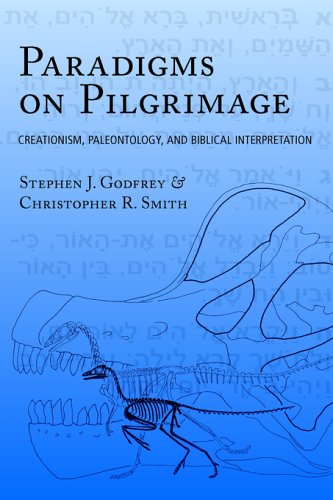
A reader of this blog recently submitted several questions after re-reading my book  Paradigms on Pilgrimage: Creationism, Paleontology, and Biblical Interpretation, which I co-authored with Dr. Stephen J. Godfrey, curator of paleontology at the Calvert Marine Museum in Solomons, Maryland. The book argues that the Genesis creation account should be understood as literally intended and accurate from an observational perspective, meaning that there is no inherent conflict between believing this account and believing that more complex life forms have developed from simpler ones in a process that has extended over a long period of time. I will answer this reader’s questions in a series of posts, starting with this one. The full text of the book is available online at this link.
Q. I recently reread your book Paradigms on Pilgrimage and I can safely say that it is by far the best book I have read on the Creation/Evolution controversy. (And that’s saying a lot, because I’ve probably read upwards of thirty.) I’ve come to the conclusion that the position you advocate is the most reasonable and cogent and makes the most sense in light of the big picture.
I still have some questions, however. First, what are we to make of how other biblical authors understood Genesis? Creationists often argue that they viewed Genesis as literal truth, which would make these supposedly inspired authors wrong if evolution were a valid theory, unless they were affirming Genesis from a purely observational perspective. In the case of Jesus in particular, what’s important for me to resolve is to what degree he gave up his omniscience while he was a man. If he was still fully omniscient, then in affirming the Genesis account of origins he would have been affirming something he knew was empirically wrong.
Thanks very much for your kind words about our book. I’m glad it has been helpful to you.
In answer to your first question, as we show in the book, the other biblical authors express the same observational cosmology that’s in the Genesis creation account. For example, just as Genesis depicts God as creating the sky as a “vault” (literally a “spread-out” object), so Psalm 104 speaks of God “stretching out the heavens like a tent” and Isaiah says that God “stretches out the heavens like a canopy, and spreads them out like a tent.” And just as Genesis says that God made the seas by saying “Let the water under the sky be gathered to one place,” so Psalm 33 says, in speaking of creation, “He gathers the waters of the sea into a heap; he puts the deep into storehouses.”
Perhaps it is not too surprising or unsettling to hear other biblical authors speak like this, if we accept that the Bible is written from an observational perspective. Its human authors are simply describing how things appear to them. But we might expect that Jesus would have spoken from a different, objective perspective (that is, not that of an earth-bound observer) if he really was God and so was omniscient.
However, what we find is that Jesus also describes the created world from the same observational perspective as the other biblical authors. He says in the Sermon on the Mount, for example, that God “causes his sun to rise on the evil and the good, and sends rain on the righteous and the unrighteous.” This is the same perspective expressed by Job when he says that God “speaks to the sun and it does not shine,” explaining days when the sun does not appear in the sky not just from an observational perspective but also from the standpoint that God actively commands weather phenomenon. (Jesus is not speaking in poetry or metaphor here.) And Jesus also appealed to the way things were “from the beginning,” quoting directly from the Genesis account of the creation of man and woman, when he answered a question about divorce.
So it seems reasonable to conclude that Jesus had the same earth-bound perspective as the other biblical authors. If that was indeed the case, then he couldn’t have been omniscient in his incarnation. Is that a problem?
Not really. As I explained in response to a recent comment on this post, “Christians believe that when Jesus, the Son of God, came to earth, he ’emptied’ himself of certain divine attributes, the ones known as ‘non-communicable’ (in other words, the ones that humans cannot share), which include omniscience, omnipotence, and omnipresence. Jesus fulfilled his mission on earth by complete obedience to God, rather than by drawing on powers not available to other humans.” It may take us a while to wrap our minds around the idea that we today might understand natural phenomena and natural history better than Jesus did when he was on earth, but those seem to be the implications of the Christian doctrine of the Incarnation.




 Good Question