Q. I’m wondering why Jesus hasn’t returned yet. I realize it’s not our lot in life to know the exact time, but it sure seems like this would be a good time. Throughout the ages folks have made predictions but of course we are still here. I don’t want to second-guess God, but I gotta say in my opinion I would love to see Jesus return tomorrow.
The question of why Jesus hasn’t returned yet was being asked even in New Testament times, just one generation after Jesus lived on earth. In his second letter, Peter speaks of “scoffers” who were asking, “Where is this ‘coming’ he promised?” These were people who were arguing that if Jesus hadn’t come back yet, he wasn’t coming at all, and they were using as an excuse to “follow their own evil desires.”
But Peter also speaks to those who, like you, are genuinely longing for Jesus’ return, in distress over the condition of the world, explaining, “The Lord is not slow in keeping his promise, as some understand slowness. Instead he is patient with you, not wanting anyone to perish, but everyone to come to repentance.” For me, that’s the essential reason why Jesus hasn’t returned yet: God wants as many people as possible to have the opportunity to hear the good news and respond. When we consider that, because of the exponential growth of the human population, half of the people who’ve ever lived on earth are alive today, we realize that if Christ had returned a generation ago, only half as many people would have had the chance of knowing him as the Lord and Savior. So this is reason both to wait patiently and to give a good testimony for Christ in the way we live, how we treat others, and what we say.
It’s also a mandate to live charitably and constructively as we await his return, doing all we can about the conditions around us as a way of expressing our faith in the kind of world Jesus will bring about when he does return. He himself cautioned his followers that he might not return as soon as they expected, but that they were entrusted with a positive duty in the meantime. He told this parable: “Who then is the faithful and wise manager, whom the master puts in charge of his servants to give them their food allowance at the proper time?It will be good for that servant whom the master finds doing so when he returns.Truly I tell you, he will put him in charge of all his possessions.But suppose the servant says to himself, ‘My master is taking a long time in coming,’ and he then begins to beat the other servants, both men and women, and to eat and drink and get drunk.The master of that servant will come on a day when he does not expect him and at an hour he is not aware of. He will cut him to pieces and assign him a place with the unbelievers.” (Ouch!)
So we should “make the most of every opportunity in these evil days,” as Paul wrote to the Ephesians, even as what we see around us makes us long and pray for Jesus to return. And all the while we can remember, in the words of the hymn “The Church’s One Foundation”:
Yet saints their watch are keeping,
Their cry goes up, “How long?”
And soon the night of weeping
Shall be the morn of song!
A depiction of Christ as triumphal conqueror by Gustave Dore, c. 1868
It remains only for Mobley to consider apocalyptic in the Bible and reveal who—not what—he actually considers chaos to be. At the start of his book he says that “the chaos monsters return in apocalyptic, only now they are members of a universal, invisible conspiracy dedicated to bedeviling the saints at every turn” (p. 15). Here at the end of the book we discover that “bedeviling” is meant quite literally: the chaos monsters are actually “the devil and his demons” (p. 135). And Mobley adds that “in the apocalyptic hall of mirrors, where nothing is as it appears, it is tempting to read an even deeper conspiracy behind the conspiracy.” This would actually be a conspiracy between God and the devil.
Mobley asserts that “the devil has taken on so many unpleasant chores of the divine administration,” such as “authoring the repertoire of disasters that thin the herds and forests” (not to mention “thinning” the human population as well?) and “injecting periodic doses of chaos that inspire innovation and new growth.” Mobley concludes that “Satan is the necessary evil,” and finally describes him in heroic terms, using language that is usually reserved for Christ himself: “Did the Angel of Light empty himself, bedimming his brilliance, in order to do the dirty work that Michael and Gabriel did not have the dramatic range or courage to handle?” Mobley’s implied answer is yes, because he suggests that “on the last day,” the “Ancient of Days will call Satan to the dais and say . . . ‘Well done, good and faithful servant’” (pp. 137-138). (And, presumably, “Enter into the joy of your Lord”?)
At the end of the real story of the Bible, Satan is thrown into the lake of fire, to be “tormented day and night forever and ever.” So how did Mobley lead us along the supposed “backstory” of the Bible to such a different outcome?
Gustave Doré’s depiction of Satan’s defeat
My first response would be, “bad interpretation,” that is, faulty approaches to and uses of biblical passages and books, as I’ve tried to show throughout this series of posts. Certainly Mobley’s deliberate choice not to appreciate the value and conventions of literary genres other than narrative contributes to his missteps through the Bible, which contains many works in these other genres.
But I think there’s an equally important problem: bad math. Simply stated, you can subtract from infinity as many finite numbers as you wish—billions of them, in Mobley’s terms—of whatever size, and it still remains infinity. If God’s “love-energy” is infinite to begin with, then creating finiteness from it will not leave it lacking anything. Quite the contrary. Creation is more commonly understood within Christian theology as an expression of God’s creativity that is effectively an expansion of God, not a diminishment.
There’s one more reason why I think Mobley wanders off into “sympathy for the devil” (as the Rolling Stones would say) when he tries to tell the story of the Bible: he mistakes freedom for chaos. Freedom is what is actually needed for “change, novelty, drama.” But this freedom must be exercised within a framework of structure, or nothing will come from it. No oyster shell, no pearl.
For example, a writer must work within an established genre—even if he or she uses it creatively, meeting some expectations while significantly disappointing others, and even transforming the genre itself in the process—or there can be no meaningful communication with readers, who are working to try to identify what kind of writing they have before them so they can approach it with appropriate expectations. Creativity (creation) occurs through the dynamic interplay of structure and freedom, not “the dynamic interplay of order and chaos,” as Mobley puts it (p. 9).
Chaos is structurelessness, within which nothing can happen. It’s the string on your violin snapping just as you’re supposed to start your solo in the concerto. Chaos is not constructive, it is destructive. It’s not synonymous with “random” or “free,” terms that only have meaning within the context of structure. It’s the absence of any kind of meaning-giving structure.
For me this is perhaps the greatest irony in Mobley’s book, since he begins it with a very articulate prologue about storytelling as meaning-making, and what characteristics it must have for that to happen. “Narratives,” he says, “create chains of events bound by cause and effect along a timeline . . . This led to that which led to this which led to that. . . . Once we have a story, we have direction, shape, motive, and episodes. We no longer have chaos; we have meaning and order” (p. 6). But what would happen if we tried instead to tell a story through the “dynamic interplay of order and chaos,” that is, if we repeatedly broke the chain of events by introducing things that nothing had led to, and which led to nothing? I doubt this would be seen as a “necessary evil” within a good story. Rather, the whole thing would be regarded as a bad story.
So let’s not welcome the chaos monsters back into the Bible. It’s far too good a story to ruin that way.
Mobley presses his case for divine dependence on human assistance further in his next chapter, about the Psalms, which he entitles, “God Needs Us.” He says, “Humans possess some measure of love-energy drawn from . . . the gracious endowment created in the world-making big bang . . . that contraction of the Infinite that gave space for the plenitude of finites. When we ‘bless’ the Lord, we release our vital powers back to their source” (p. 107). Or, stated more simply, “Praise releases the love-energy inside us that belongs to God. That is the backstory of the Psalms.” This praise, Mobley suggests, is “food” for God, just as animal sacrifices, according to the way “many . . . biblical passages could be read,” were once “sustenance for the Lord” (p. 102).
In support of this argument, Mobley cites texts from the Psalms where “the speaker threatens the Deity with loss of worship” (p. 97) if a petition for deliverance is not granted. For example, in Psalm 6, “In Death, there is no mention of you. In Sheol who praises you?” Presumably God cannot live without the “food” of praise and will be motivated to act.
But this is the kind of misunderstanding that occurs when one reads a collection of poems as if they were a story. (“There is a story in the Psalms,” Mobley argues: laments predominate in the earlier part of the collection as it is now arranged, and “praise songs” dominate more towards the end, so that it is “a journey . . . from lament to praise,” p. 99). I would argue that the psalmist is not so much saying, as in Mobley’s summary, “if you rescue me, then I will praise you” (p. 105)—a future narrative sketched out—as “when you rescue me, I will acknowledge your deliverance publicly.” The flow of worship is being described.
The vow of praise within which these supposed threats occur is actually a standard liturgical element within the psalm of supplication or lament genre, along with things like a cry for help, description of troubles, statement of trust, and petition. It has a counterpart element in psalms of thanksgiving, in the similarly conventional places where the psalmist recalls an earlier cry for help and states that he is now paying the vow he made on that occasion. For example, in Psalm 66: “I will come to your temple with burnt offerings and fulfill my vows to you—vows my lips promised and my mouth spoke when I was in trouble.” The very kind of statement about potential “loss of worship” that Mobley terms “rhetorically manipulative” is found within such a recollection in Psalm 30:
To you, Lord, I called;
to the Lord I cried for mercy:
“What is gained if I am silenced,
if I go down to the pit?
Will the dust praise you?
Will it proclaim your faithfulness?
Hear, Lord, and be merciful to me;
Lord, be my help.”
It would actually tactless, not to mention pointless, to recall and repeat these words if they had originally been used to threaten God to get Him to grant a request, on an occasion that is supposed to be devoted to thanking God for doing this. But within the context of the flow of worship captured in the poetry of the Psalms, it’s clear why it is appropriate to recall the words: This recollection brings glory to God by acknowledging that He was the one who delivered, in response to a cry to Him for help.
Mobley next considers the wisdom books of Proverbs, Ecclesiastes, and Job, suggesting that they offer “glimpses of the divine design for chaos management” (p. 110). He believes he detects a progression in their insights. Proverbs, he says, offers “terse parallel sayings,” each of which “fits snugly . . . into a single small square on the graph paper of the blueprint” (p. 115). Ecclesiastes, for its part, also presents “the blueprint with lots of its squares filled in,” but it warns additionally that while “the squares are there, we lack the perspective to see the patterns they form” (p. 117). “We can experience . . . fleeting puffs of insight about and engagement with the Real, but we can neither possess nor control them” (p. 118).
Now I appreciate Mobley’s translation of hebel, perhaps the most key term in Ecclesiastes, as “fleeting” rather than “meaningless” or “vanity.” But I would argue that what the book actually says is “fleeting” is not our insight into life, but the things we typically think will make our lives worthwhile, such as riches and status. I believe the book is actually teaching us positively to invest in what really does last—relationships, and work that is meaningful and enjoyable while we are doing it—rather than discouraging us negatively from thinking we can know how we should live. But that is what Mobley believes the book is doing. He says that the “brilliantly ambivalent affirmation” of Ecclesiastes is, “There is a plan, but good luck, pal. We cannot know it.”
Not surprisingly, when he gets to the book of Job, Mobley is most interested in the figure of Leviathan, which (as noted earlier) he considers to be a chaos monster, even though Yahweh says specifically in his second speech that both Behemoth and Leviathan are creatures that He has “made” (likely correcting Job’s belief that he can appeal to Leviathan to undo part of creation, the day of his birth). I would argue that Yahweh uses the strength and power of His creature Leviathan to help Job realize what a small part of creation he is himself, and so Yahweh stresses that Leviathan is completely untamable:
“Can you draw out Leviathan with a fishhook
or press down his tongue with a cord?
Can you put a rope in his nose
or pierce his jaw with a hook?
Will he make many pleas to you?
Will he speak to you soft words?
Will he make a covenant with you
to take him for your servant forever?
Will you play with him as with a bird,
or will you put him on a leash for your girls?”
Mobley, however, takes one of these statements in a different way, as if it meant, “Will Leviathan make a covenant with you, as it has made with me?” Then he argues that according to this reading, “In effect, God says, ‘I have a covenant with chaos. Chaos is part of the plan. . . . In order for reality to function . . . there has to be space for the random, chaotic, and wild’” (p. 124). This is a theme Mobley has struck earlier in the book: “Chaos cannot be erased because to do so would eliminate change, novelty, drama, or conflict. No sand, no pearl” (p. 19).
I’ll discuss in my final post where this embrace of chaos, which we were originally encouraged to see as God’s primordial enemy, ultimately takes Mobley.
Mobley also appeals to Dr. Seuss to explain how “in prayer the community emits its love-energies back towards God.” Citing Horton Hears a Who, he sees an analogy in the way that “the fate of all Who-ville depends on the volume of the alarm its inhabitants could raise,” down to the littlest Who.
Making a barely subdued chaos his first premise, Mobley next takes up the Torah or “Pentateuchal narratives and teachings” and argues that their backstory is that humans must “act as co-creators of order and co-managers of chaos, with God,” by “living in accordance with the divine instructions” in the Torah.
However, in Mobley’s view, the creation is not at risk of coming undone if we don’t all follow the Law of Moses as originally given. He suggests that its commandments are “not written in stone, even though that is how the story of the Ten Commandments tells it” (p. 37); they’re adaptable to new situations. So adaptable, in fact, that following them comes down basically to “every free soul’s expression of the beneficence that animates it” (p. 46). To find biblical support for the notion that “Torah was always capable of reinterpretation,” Mobley argues that “the very words of the Ten Commandments are different in Deuteronomy than in Exodus . . . Forty years elapse in story time and the divine instructions already have new dimensions” (p. 37).
I agree with his conclusion about God’s people no longer being bound to keep the law literally, but I think the proper way to get there is through the “front story” of the Bible, of a covenant community in relationship with God that is transformed from being national to multinational. I feel that Mobley’s attempt to get there through a backstory doesn’t really work.
The commandments themselves match in Exodus and Deuteronomy, verbatim. The only differences are that the phrase “as the Lord your God has commanded you” is added to the commandment about honoring father and mother, and the rationale for the sabbath becomes, “Remember that you were slaves in Egypt and that the Lord your God brought you out of there with a mighty hand and an outstretched arm,” rather than, “For in six days the Lord made the heavens and the earth, the sea, and all that is in them, but he rested on the seventh day.” In this one instance, one commandment is recontextualized, but the commandment itself is still not worded differently. Only in this quite limited sense is it true that “the very words of the Ten Commandments are different.”
Much more significantly, nowhere does the Torah describe its own purpose as empowering humans for chaos management. Rather, its stated purpose is to show the people of Israel how to walk in the same “ways” as the God with whom they are in covenant relationship, and how consequently to create a model community that will attract other nations, ultimately fulfilling the promise to their ancestor Abraham that through him all peoples on earth will be blessed.
But once again, let’s follow Mobley’s move, to see where it leads. He turns next to the “Former Prophets” (Joshua, Judges, and Samuel-Kings), which he describes as the Hebrew Bible’s “treasury of tales” (p. 49). The characterization doesn’t quite fit; Mobley acknowledges that Joshua, for example, “contains more than narrative—there are descriptions of rituals, geographic lists . . . and much speechifying.” But,” he says, “we will ignore all that to float in the stream of stories” (p. 56). I would argue once again that choosing to “ignore all that” is the surest way to miss the point of a book like Joshua. Disparaging the paired covenant ceremonies at Ebal and Shechem as “rituals,” for example, overlooks their essential role in both the structure and purpose of the book. And Joshua’s stirring farewell to the Israelites (“choose for yourselves this day whom you will serve . . . but as for me and my household, we will serve the Lord”) is a rhetorical masterpiece that should hardly be dismissed as “speechifying.”
But I will say that Mobley’s reading of the tales themselves is insightful. He demonstrates how, over and over again, characters receive their “just deserts” in ironically appropriate ways. Abimelech, for example, slays his brothers on a stone to claim the kingship, but he is killed when a woman drops a stone on his head from a tower. Gehazi sneaks out to get a reward from the Syrian general Naaman, whom Elisha has healed of leprosy, and for his punishment is struck by leprosy himself. Mobley calls this “poetic justice” and says it illustrates how “God has enacted the tough love of moral cause and effect” to encourage fidelity to the Torah, which will “support management of the chaos” (p. 47).
Within this section devoted to the Former Prophets, however, Mobley dashes briefly over to the book of Isaiah to note similar poetic justice in the case of Lucifer, who was previously a heavenly being, but who said in his heart, “I will ascend to the heavens; I will raise my throne above the stars of God” and was ironically “brought down” to the underworld instead. There’s a reason for this excursus. Readers of the book need to keep a careful eye on this theme; they may be surprised where it leads.
Mobley turns next to consider the Latter Prophets (Isaiah, Jeremiah, Ezekiel, and the minor prophets) in a chapter entitled “Anger Management.” Though “diminished” by the “creation of the many,” he says, God still has “reserves of love-energy,” but while these are “vast,” they are “no longer quite enough” (p. 83). And so God gets angry and creates in human lives “effects that go beyond causality, retribution, and consequence” (p. 75).
It would seem that Mobley is saying that God was not able to maintain the “tough love of moral cause and effect” consistently because of his deficiency in love, and so there were times when “the divine anger threatened to burn hot and out of control.” The prophets were needed to perform “a mediating function between God and creation”: they “massaged and cajoled and shamed and used every rhetorical trick they had at their disposal to move God from the light and heat of day [anger] to the benedictionary calm of God’s evening-vespers-time stroll through the Garden” (p. 96).
However, Mobley says, while “this theme of anger management can be traced between the lines of the Latter Prophets . . . it is best seen in narratives . . . in which the two greatest figures from Israel’s past, Abraham and Moses, are recast as prophetic intercessors” (p. 77). As in the case of the story he said was back of the creation accounts, which he illustrated from Psalms, Isaiah, and Job, Mobley finds that his backstory of the prophets is most evident in the Pentateuchal narratives, where Abraham intercedes (though ultimately unsuccessfully) for Sodom and Gomorrah to be spared from destruction, and where Moses convinces God not to destroy Israel after the golden calf incident.
However, Mobley does cite some examples of the need for, and practice of, divine anger management within the Latter Prophets themselves. After each of two visions of destruction, for instance, Amos pleads for Israel and the Lord “relents.” (However, Iafter the third and immediately following vision, the Lord declares, “I will spare them no more.” This may be the literary device in which an intended action is taken “the third time around” after two tentative ventures.) The book of Ezekiel, for its part, Mobley says, shows what happens without the “dynamic of prophetic intercession”: “I searched among them for a man to . . . stand in the breach before me on behalf of the land, so I would not destroy it. But I couldn’t find one. So I poured out on them my curse, with the fire of my rage, I consumed them” (p. 90).
Paradoxically, however, Mobley also suggests that “if the prophet does not intercede, God may have to act out all the parts.” He quotes Muffs to this effect: “If an intercessor does not arise . . . the Holy One . . . rises from His chair of strict justice and goes to sit upon His chair of mercy. . . . The Holy One . . . appropriates to Himself . . . the role of intercessor, and pleads for Israel in His very own court” (p. 90). Mobley finds this kind of “self-produced intercession” in the divine soliloquies in the book of Hosea, for example. How this is consistent with God lacking sufficient reserves of love-energy to turn away from anger without the mediation of prophets is not clear to me.
Mobley uses The Cat in the Hat to illustrate that by keeping God’s commandments, humans help manage chaos. He says, “A mother goes out shopping and leaves her two children . . . with explicit instructions not to let anyone enter.” They “disobey her instructions” and “open the door to the Cat in the Hat.” “The violation leads to the emergence of the chaos monsters, Thing 1 and Thing 2.” (Fans of the book may recall that the mother actually gives no such explicit instruction; she does not appear until the end. But the fish does say of the Cat, “He should not be here when your mother is out!”)
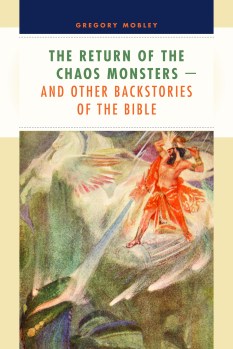
From time to time on this blog I offer reviews of books about the Bible, even though most posts are devoted to answering questions about the Bible itself. In the next several posts I’d like to review Gregory Mobley’s book The Return of the Chaos Monsters.
I’m going to give so much space to this book because I find it to be a very significant one. It suggests an approach to the Bible that many readers, tired of the typical method of trying to extract personal divine daily messages from isolated snippets, are likely to find appealing and refreshing. But as I’ll argue in this series, I don’t believe Mobley ultimately presents an accurate picture of what the Bible is and what we are supposed to do with it, or of God, or of the place of suffering and evil in creation. His book is written in a delightful style that carries the reader along in glad assent, and I’m concerned that some readers may not appreciate exactly where they’ve been carried by the time they get to the end. So let me share some thoughts about where this book goes and how it gets there.
In the middle of the book, Mobley lays all of his cards on the table. He summarizes his understanding of the relationship between God, creation, and humanity this way: “Before time, the blinding Infinite Light exploded into a billion sparks, a happy accident for us since our very lives are merely infinitesimal reflections of this primeval divine effulgence. But this creation of the many left the One diminished. It is the sacred duty of every person to let his or her little light shine . . . and thus restore the full brilliance of the Light of Lights” (p. 82).
Mobley explains that the source of this understanding, in which God needs humans as much for His own restoration as they need God for theirs, is “medieval Jewish mystical theology, Kabbalah.” But he also maintains that the Bible itself, read in a certain way, says the same thing. Let’s explore how he makes his case.
Mobley’s first step, at the beginning of the book, is to turn all of the varied types of writing in the Bible into narrative. Citing phenomena such as the traditional headings that “associate given psalms with events in the life of David,” he claims that “a narrative alchemy is at work in the process of the Bible that endlessly, inevitably seeks to transform every genre into story” (p. 4).
I would argue, however, that this is precisely the way to misunderstand the biblical books. One of the first and most essential steps to understanding them on their own terms is to recognize their true genres and not approach them with expectations appropriate to different ones. They are not all stories. (I find that this presupposition causes problems for Mobley’s interpretations of many biblical books, as evidenced, for example, in his complaint that the “plot” of the book of Job “has been obscured by the poetic format.” Job contains some of the most elegant poetry ever written, and to see this as an “obscuring” factor is surely to miss what that book is all about.) Mobley’s approach is also precisely the way to misunderstand how the varying works collected in the Bible combine to become a grand story. They don’t do this by all turning into narrative. They instead together sketch out a story of God that is beyond themselves, and then they each find their own place within that story.
Nevertheless, let’s see where this leads. Mobley then observes that every story has a backstory or prequel. “No story starts ‘in the beginning.’ Every infant story is born into a narrative world that already exists” (p. 9). Some backstories actually do get written up, like The Hobbit as a prequel to The Lord of the Rings. But Mobley says that a true backstory is an “implied narrative” that has “not yet been composed, but looms, all latency, just before the horizon of a given narrative’s daybreak” (p. 9). He says he will give us “a thematic overview of the entire Hebrew Bible” by sharing the backstories that guide the “meaning-making most characteristic of” each of its sections (p. 13).
Mobley begins with the first section, “the creation stories,” and suggests that even Genesis itself doesn’t begin “in the beginning.” “Observant readers,” he says, “note that . . . there is something there: the primeval cosmic soup with its formless abyss.” The backstory in circulation at the time when Genesis was composed told how one god or another had slain this “chaos monster” and built the creation out of its dismembered carcass. But Genesis, Mobley acknowledges, is an example of how an author can “defy the conventional pattern and change the plot. . . . The chaos monsters . . . are not God’s mythological opponents; they are merely one more phylum of creation,” the “great dragons” (p. 10, “great sea creatures” in most English translations.
However, Mobley says, while this is the “official story,” there is an “alternate creation story” found elsewhere in the Bible. While the “front story” (my term) does indeed take things in a new direction, Mobley would prefer to keep them where the backstory had them. And so he cites two references in the Psalms and one in Isaiah about God slaying a chaos monster called Rahab or Leviathan. We should understand this “slaying,” he says, as only an incomplete victory over chaos; quoting Timothy Beal, he insists, “It is difficult to keep a good monster down. They have a tendency to reawaken, reassemble their dismembered parts, and return for a sequel.” And so in Mobley’s understanding, “God has subdued chaos, just barely” (pp. 16-17).
As evidence that chaos monsters are actually “lurking in the background” in the rest of the Bible, despite the placid and orderly creation account in Genesis, Mobley cites Job’s wish for someone to “awaken Leviathan” so that his day of birth, which he is cursing, will cease to exist: “The clear implication is that once the dragon Leviathan is aroused from her slumbers . . . all hell will break loose and creation will start to come undone” (pp. 22-23). I would argue, however, that the book of Job, by its end, also “changes the plot” and recasts Leviathan as one of God’s creatures, “one more phylum of creation,” not God’s mythical opponent. This is one of the many ways in which Yahweh’s speeches to Job at the end of the book address and resolve concerns raised at the beginning.
Similarly, I would argue that Isaiah’s point in asking Yahweh, “Was it not you who cut Rahab to pieces?” is, “Was it not you, and not Marduk, who cut Rahab to pieces?” In other words, Isaiah is appropriating the Babylonian propaganda and repurposing it as part of his sustained argument that “apart from Yahweh there is no other god.” Beyond this, it is hardly suitable to cite this part of the book of Isaiah, which lyrically celebrates Yahweh as effortlessly creating “the ends of the earth” by his “great power and mighty strength,” as a source for the idea that God has “just barely” restrained chaos. Nor is it really fair to cite the references to the mythological version of Leviathan in Psalm 74 and Rahab in Psalm 89 without noting the reference to the natural, creaturely version of Leviathan in Psalm 104, “which,” the psalmist says to God, “you formed to frolic” in the sea. Apparently the psalmists knew the backstory myth and could appropriate it for their own purposes, but they also told the “official story” with delight, picturing Leviathan frolicking in the waves, rather than awakening to undo the rest of creation.
But however we understand such passages, if this backstory is only found in other parts of the Bible, it doesn’t seem legitimate to treat it as the backstory to the Genesis creation accounts (particularly since Mobley himself says it is “suppressed” there, p. 23), as if it provided a foundation for understanding the rest of the Bible. But that’s precisely how he treats it, making it the basis for all the further steps in his argument.
I’ll explore those further steps in my next posts.
Q. My question has to do with suffering and the fairness of God. Why do some people suffer, even terribly, while others do not? Judging from the stories of Job and Peter, Satan was given permission to cause suffering in their lives. It seems even worse that God would allow some people to suffer by this means.
I’ll do my best to answer your question, although it’s one that people of faith have struggled with for all of human history without definitively resolving.
Without freedom there can be no love. But freedom creates the possibility, perhaps even the likelihood, of suffering, as freedom can be, and is, misused. I believe that God knows, in a way that we cannot know, that a world with both love and suffering is infinitely better than a world with neither love nor suffering, and that those are the only two possibilities. Love is worth what has to be for it to be.
But I don’t think this means that certain individuals are singled out for suffering. Every individual is liable to the possibility of suffering. But precisely because suffering is the result of freedom (misused), the “free” (undetermined) nature of the world means that some will likely suffer more than others. While the Bible does say that Satan specifically asked for and received permission to torment Job, and that Jesus warned Peter, “Satan demanded to have you, that he might sift you like wheat,” this is actually what Satan wants to do to everybody, with or without permission. If God granted permission in those two cases, it was because God knew He could bring a result out of the suffering that would advance His own purposes and defeat Satan’s—turning Satan’s own weapons against him.
But this means that all of us must be willing to suffer if that will advance God’s purposes through our own lives. The difficulty is that we see such a small part of the big picture that usually we can’t understand why we are suffering. It feels pointless and useless. But God is trusting us to trust Him, that He indeed is at work in the situation (that He has chosen to work in it, given the nature of the world He created, not that He directly caused the suffering) to bring about a purpose that is so positive and redemptive, that in the end, when we do understand, we will rejoice in this work of God.
Not that any of us should seek out situations of suffering. But we should know that, as Amy Carmichael often said, “The love of God is very courageous,” and that God will therefore trust us to accept difficult situations as a part of His plan that we will only understand in the end, when we can see everything clearly.
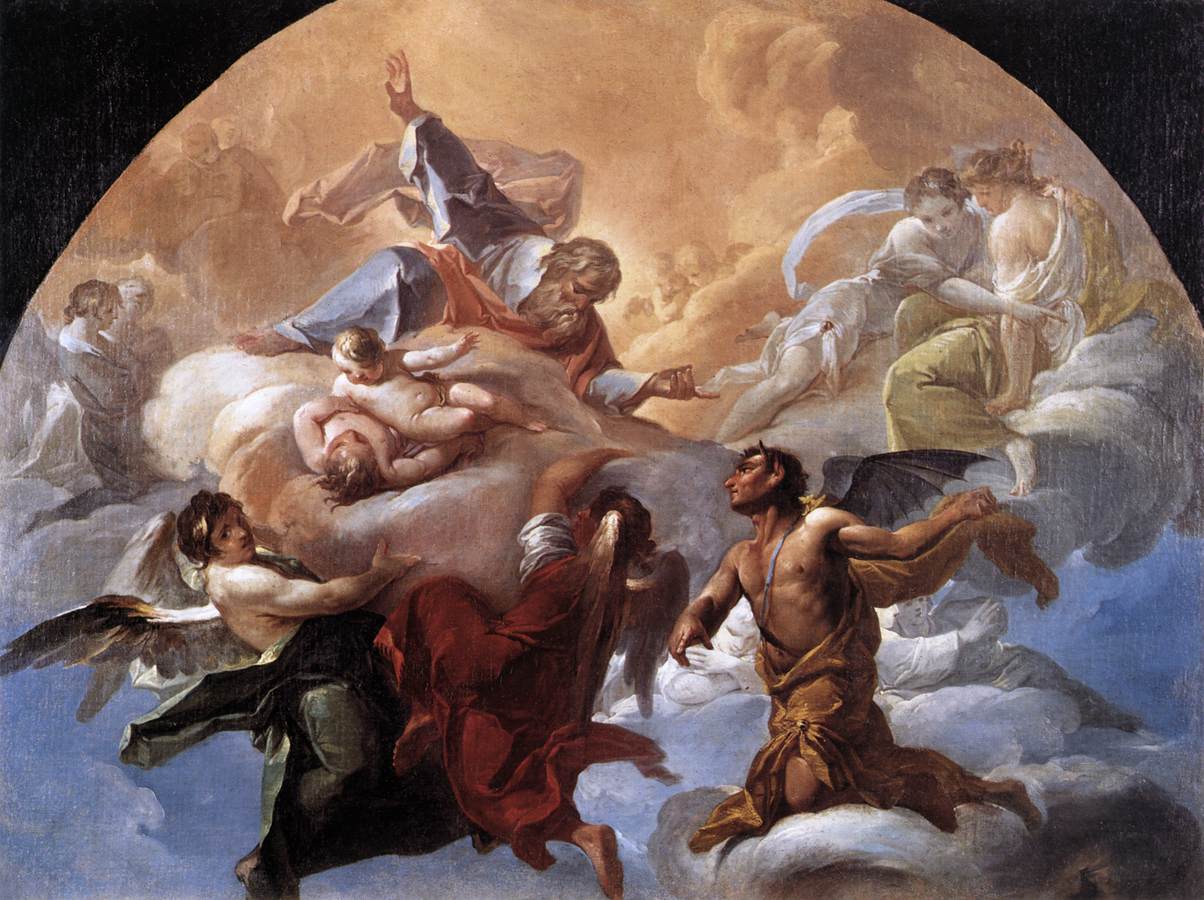
Giaquinto, “Satan Before the Lord” c. 1750, Vatican Museum. The painting depicts the scene from the book of Job in which Satan requests, and receives, permission to torment Job.
Q. Please explain in detail the passage in Genesis that says, “The sons of God saw that the daughters of humans were beautiful, and they married any of them they chose.”
Q. How do you resolve a certain resurrection discrepancy? Did Mary Magdalene and Mary the mother of James find angels at the tomb, who told them that Jesus was alive and that they should go tell the disciples to meet him in Galilee? Or did Mary Magdalene go by herself (as John indicates), find nothing, and go tell the disciples someone had stolen the dead body? The accounts seem to be contradicting each other.
I would answer your question along the same lines as I answered an earlier one in this post:
The person who asked that earlier question wanted to know about the episodes in the gospels in which a woman pours perfume on Jesus, Jesus walks on water, and Judas betrays him in the garden. There seem to be discrepancies in detail between the different accounts of these episodes, and as you observe, the same thing can be said about the accounts of Jesus’ resurrection. But as I write in my other post:
I don’t personally see irreconcilable details such as these as diminishing the truth or authority of the Bible in any way. Rather, as many have observed, these differences actually show that the gospel writers weren’t all trying deliberately to tell the same story as the others. This should give us even greater confidence in the independence and authenticity of their reports. If some minor details differ, the main points are always confirmed. And so we can be confident, based on multiple independent reports, that Jesus did walk on the water–the gospel writers agree about this miracle that testified to who he was. Judas did betray Jesus by bringing the soldiers to the garden. And a woman did anoint Jesus with perfume, and he acknowledged this as an appropriate, if extravagant, act of worship.
We may say similarly that we can be confident, based on multiple independent reports, that Mary Magdalene went to the tomb with some other women (thought John tells the story through her eyes alone), found it empty, and had an encounter with someone (an angel, a man in a white robe or men in “gleaming clothes,” or Jesus himself) that convinced them Jesus was alive. The main line of the story is the same in each account. (If one of the gospels said that the women found Jesus’ body in the tomb, then we’d really have a problem!)
Let me offer here the same conclusion as in my earlier post:
We only have problems with the differences in minor details if we embrace the idea that if the Bible is to be the word of God, it has to present only exactly what happened, without dispute or variation, down to the last detail every time. That’s simply not the kind of Bible God has given us. We should recognize that we have instead a Bible whose human character, including such variation in minor details, only helps it to be an even better authoritative witness to divine truth.
From time to time on this blog I review books that have to do with the Bible. Full disclosure: I’ve been working closely with this author for over a dozen years on various projects, beginning with The Books of the Bible.
There’s a new book out that will help you understand what’s wrong with your Bible—why it’s not working the way you expect. The book, Saving the Bible from Ourselves, is by Glenn Paauw, vice president for global Bible engagement at Biblica and a director of the Institute for Bible Reading.
When you open your Bible, Paauw says, chances are you’re getting lost in the clutter—cross-references, study notes, topical headings, call-outs, etc.—and barely making it to the text. What you need is an Elegant Bible, one that’s clean and clutter-free, featuring “unencumbered words on a page, pleasingly set, easy to read.”
Is your Bible just offering you “snacks”—little tidbits that never really satisfy your appetite? Then you need a Feasting Bible, one in which you enjoy full meals— whole biblical books—at length and at leisure.
Have you been encouraged to see the Bible as something that dropped fully formed out of heaven? And aren’t you wondering why it doesn’t read as if it did? You need a Historical Bible, one that you can tell emerged from the covenant community’s interactions with God over centuries.
Do there seem to be no connection between the things you’re reading about in the Bible? Is it just a law here, a proverb there, and some stuff that doesn’t really seem to fit anywhere? You need a “Storiented” Bible, in which everything is clearly tied together into a compelling story.
When it’s just you and your Bible, don’t you feel lonely? That’s because reading and studying the Bible were meant to be shared experiences. You need a Synagogue Bible that will enable and empower you to read and study God’s word in community.
If, when you read the Bible, all you see are free-floating phrases from some ethereal realm, then you need a Earthly Bible, in which it’s clear that God’s word has everything to do with life here on this earth.
And not to put too fine a point on it, but is your Bible just plain ugly? Type bleeding through from the back of thin pages, crowded printing, Industrial Revolution overtones? What you need is a Beautiful Bible, like the ones the church produced in ages past, and which it is showing signs of producing again.
How can you get a Bible that’s all of these things? Some of it has to do with the actual physical form. If you wouldn’t describe any of the Bibles on your shelf right now as elegant and beautiful, then you actually do need one more copy. But the rest of these things have to do more specifically with thought patterns: what you understand the Bible to be, and what you believe you’re supposed to do with it. And if you want a clear, comprehensive explanation of that, then read Saving the Bible from Ourselves. It will give you a new Bible in your mind.
Q. Many present-day follows of Jesus, including myself, believe that God is with us once we invite Him into our hearts. That said, I wonder at times how much He is directly involved in our day-to-day lives. Does He plan my every move if I invite that? The thought that God can be in complete “control” of our lives as we “tune out” seems to be a modern concept developed over the last hundred years. A verse often quoted to support His complete direction in our lives is “‘I know the plans I have for you,’ declares the Lord, ‘plans to prosper you and not to harm you, plans to give you hope and a future.'” But it seems to me if we just rely on this as our basis for this argument we may have applied its message too literally. The passage was written to the exiles but it is often quoted out of context as if it applied to every one of us today. I am thankful God gave us His word, the Bible, the Holy Spirit, and a thinking brain. Would love your thoughts.
I haven’t actually encountered myself the teaching that we can and should “tune out” ourselves and allow God to control our day-to-day lives directly, but let me share some thoughts about this teaching as you describe it.
First, I agree with you that that often-quoted statement from Jeremiah’s letter to the exiles does not really support such an approach. In context, that statement actually means something like this: “You might not think that I have good plans for you based on your present circumstances, but long-term, big-picture, I really do.” The Judeans of Jeremiah’s time thought that those who had been carried off to Babylon were lost from the community and doomed to a dismal future, while those who remained in Judea had excellent prospects. Jeremiah wrote his letter to the exiles to assure them that just the opposite was true: that they had a “hope and a future” as remnant that would eventually restore the nation, while those left in Judea were doomed to destruction.
So this statement can appropriately be cited to people today who are in difficult and troubling circumstances, to assure them that long-term, big-picture, God will work things out for His glory in their lives. But it should not be quoted to support the idea that “God knows the plans He has for us” if we will just “let go” and let Him run every detail of our lives.
I wonder how that would actually work, in fact. How are we supposed to know where to go and what to do to fulfill these “plans” of God? Are we supposed to be simply passive and trust that anything that happens to us reflects God’s plans?
I’m much more inclined to agree with you that “God gave us His word, the Holy Spirit, and a thinking brain,” and God expects us to develop wisdom and mature character so that we can make good decisions that reflect His values and purposes–not try to chase down His supposed “plans” for the tiniest details of our lives.
I talk about this more in my post entitled, “Should I be looking for ‘God’s will for my life’ in every decision?” There I encourage us to pursue an approach of “co-operation” with God, which I believe Jesus modeled for us, and which I describe this way: “Within the context of his overall life mission as he understood it, Jesus discerned where God was already at work and considered how he could join in.” As I see it, this honors God, as we take responsibility for using the gifts and opportunities God has given us, guided by our sanctified sense of His own working in and around us.