Why do some premillennialists give special status to the nation of Israel?

Q.  I’d be thankful if you could expand a little on the following schools of belief:  Premillennialism, Postmillennialism, and Amillennialism.  Which one are you inclined to believe, and why? Also, why do some of the people who believe in Premillennialism tend to treat Jews with special significance and Israel as a separate state (and not as the whole body of believers) even today? Doesn’t this go against what Paul said in Galatians 3:28-29?

In my first and second posts in response to this question, I’ve explained that the three terms premillennialsm, postmillennialism, and amillennialism refer to different beliefs about when Christ will return relative to the millennium (the thousand-year era of worldwide peace and justice described at the end of the book of Revelation) and by what means the kingdom of God might find its ultimate earthly expression in such an era.

Let me now answer the last part of your question and explain why some premillennialists believe that the nation of Israel has a special status within God’s unfolding plans for the culmination of human history.

As I’ve already noted, all three of these millennial views have been represented in just about every period of church history, and until relatively recently they all agreed, despite their other differences, that God’s plan for the Israelites was to draw them into the multinational community of Jesus’ followers that now constitutes the people of God on earth, according to the Christian understanding.

However, in the 1830s a man named John Nelson Darby developed a theological system, known as dispensationalism, that taught instead that the age of the church was a “parenthesis” between two periods, one past and one future, in which the Jews constituted the people of God on earth.

The starting point for Darby’s system was his doctrine of the “ruin of the church,” the belief that the earthly institution claiming to embody the community of Jesus’ followers had become so hopelessly corrupt that it was of no possible future use to God.  Darby expected the few remaining true followers of Jesus to be “raptured” (taken to heaven) imminently, after which all of the promises God made to the Jews in the First Testament would be fulfilled for them literally on earth.

This meant, for our present purposes specifically, that Darby expected a Jewish millennium:  Christ would return to earth to reign for a thousand years as the king of the Jews, who had once rejected him as their ruler but who would now accept him.  This view differed from all previous millennial expectations, which were of a Christian millennium, in which Christ’s reign over the multinational community of his followers (already a present spiritual reality) would be extended over the whole world.

Dispensational premillennialists today follow Darby’s theological system generally, and that is why they accord special status to the modern nation-state of Israel: They believe it embodies a group that will soon become the people of God on earth once again.  In this they differ distinctly from traditional premillennialists, who like postmillennialists and amillennialists have always expected a Christian millennium, in which the Jews are drawn into the multinational community of Jesus’ followers.  My personal belief is that the New Testament supports this expectation.

You cited Paul’s statement in Galatians that in Christ “there is neither Jew nor Gentile . . . if you belong to Christ, then you are Abraham’s seed, and heirs according to the promise.”  It’s hard to imagine a clearer statement of the case.  But there are others as well.  Paul writes in Romans, “A person is not a Jew who is one only outwardly, nor is circumcision merely outward and physical. No, a person is a Jew who is one inwardly; and circumcision is circumcision of the heart, by the Spirit, not by the written code.”  And he tells the Philippians, “It is we who are the circumcision, we who serve God by his Spirit, who boast in Christ Jesus, and who put no confidence in the flesh.”

Statements such as these make me confident that today the true “Israel of God,” which Paul speaks of later in Galatians, is made up of “all who follow this rule”: that “neither circumcision nor uncircumcision means anything; what counts is the new creation.”

One important implication of this conclusion is that the modern nation-state of Israel shouldn’t be held only to a privileged, more lenient standard when it comes to human rights and foreign relations.  That nation does not have a “free pass” from God to behave any way it wishes.  It must adhere to international norms.
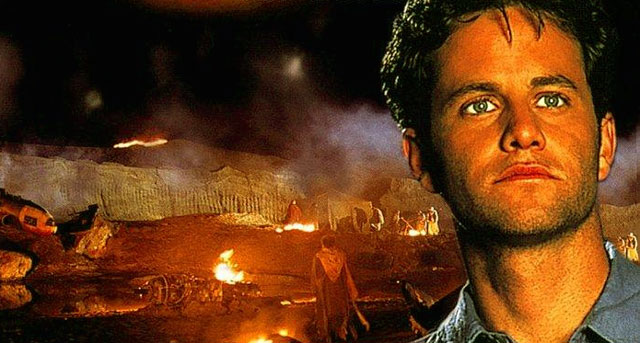
A poster promoting one of the “Left Behind” movies. The books and films in the series reflect a popularized apocalyptic version of Darby’s nineteenth-century dispensationalism whose expectations about the future are much more pessimistic than those of traditional forms of millennialism.

What’s the difference between premillennialism, postmillennialism, and amillennialism? (Part 2)

Q.  I’d be thankful if you could expand a little on the following schools of belief:  Premillennialism, Postmillennialism, and Amillennialism.  Which one are you inclined to believe, and why? Also, why do some of the people who believe in Premillennialism tend to treat Jews with special significance and Israel as a separate state (and not as the whole body of believers) even today? Doesn’t this go against what Paul said in Galatians 3:28-29?

In the first part of my response to this question, I explained that these terms refer to varying beliefs about the timing of Christ’s Second Coming.   Premillennialism is the belief that his return will be pre-millennial, that is, it will precede the millennium, the thousand-year era of worldwide peace and justice described at the end of the book of Revelation. Postmillennialism is the belief that Christ’s coming will be post-millennial, that is, it will follow this millennium.  And amillennialism is the the belief that Christ’s coming will be without a millennium, that is, that there be no world-wide era of peace and justice at the end of history.

But I also explained that these expectations of when the millennium will occur reflect far more important beliefs within each system about how the millennium will occur–that is, about what, if anything, will create such an era.

Premillennialism is more accurately the belief that Christ’s return will be required to bring about the millennium, because nothing short of this will be sufficient.  In this view, the kingdom of God is an eschatological reality that comes over against history.

Postmillennialism, by contrast, is the belief that Christ’s return will come as the culmination of the millennium, because it will have been brought about previously by inner-historical forces such as the progress of literacy, education, charity, etc.; the advancement of the influence of the gospel on culture; or similar things.  In this view, the kingdom of God is a historical reality that comes within history.

Amillennialism, for its part, is the belief that Christ’s return will take place without a millennium, since from this perspective God does not intend to bring about a worldwide era of peace and justice on earth.  In this view, the kingdom of God is a spiritual reality that comes apart from history.

So which one is right?  My conclusion, after years of research and reflection, is that they are all right.  The kingdom of God is a complex entity that has historical, eschatological, and spiritual aspects.  Each school of millennial thought is looking at one of these aspects.

I was interested to discover in my doctoral research that each view has had its proponents in each major era of church history.  In fact, when one view comes to dominate, it’s not too long (within the grand sweep of history, at least) before the others reassert themselves in a counterbalancing way, often prompted by developments within the life of the church.

For example, the eschatological view dominated during the Roman persecutions, but the historical view largely displaced it when Constantine proclaimed himself a Christian emperor.  Then when Rome fell to barbarian invasions, the spiritual view came to the fore, exemplified by Augustine’s great work The City of God.  This cycle has repeated itself many times throughout church history.

This discussion of the various millennial beliefs has definite practical implications because their adherents tend to see in them “marching orders” for the church.  Premillennialism, an eschatological understanding of the kingdom, tends to emphasize witness.  Postmillennialism, a historical understanding of the kingdom, tends to emphasize service.  And amillennialism, a spiritual understanding of the kingdom, tends to emphasize worship.

All three of these things, of course, are vital to the church’s health and influence.  Whichever one we would most promote, we would do well to recognize and affirm the importance of the other emphases, and the valid insight into one aspect of the kingdom of God that underlies each one.

As for me personally, while I acknowledge the truth in each view, I find that the historical expression of the kingdom of God is the one we need to attend to most intentionally.  I proclaim in full faith, “Christ has died, Christ is risen, Christ is coming again!”  But I am clearly not in a position to accomplish anything that only his return can accomplish.  And while I treasure the worship life of the church, its ministry of word and sacrament, I sometimes feel that the church would always carry on this life simply as an expression of its own being.  But the historical side of things requires intentionality, to get out of ourselves and into the world to see where we can make a difference.

So if I had to choose one view to emphasize, it would be postmillennialism, to help all of us recognize that the kingdom of God does come, in one sense, within history, and that we can express our faith in what we believe Jesus wants to do when he returns by working for those same things now, even if ultimate success must await his Second Coming.

Along these lines, the particular version of postmillennialism that I find most attractive is what I have come to call “vocational postmillennialism.”  This is the belief that as godly and sincere followers of Christ pursue their divine callings with integrity into a variety of fields of human endeavor, with God’s help they will rise to positions of influence that will allow them to shape the society and culture around them.  This was Jonathan Edwards’ expectation of how the millennium would be brought about, and I think it is a wise and biblical expectation. (It is certainly less fraught with risk than relying on technology and science, or on an emperor such as Constantine or Charlemagne or on any modern nation, to bring about the kingdom of God on earth.)

In my final post in this series I’ll respond to the part of your question in which you ask why some premillennialists accord special status to the nation of Israel.

What’s the difference between premillennialism, postmillennialism, and amillennialism? (Part 1)

Q.  I’d be thankful if you could expand a little on the following schools of belief:  Premillennialism, Postmillennialism, and Amillennialism.  Which one are you inclined to believe, and why? Also, why do some of the people who believe in Premillennialism tend to treat Jews with special significance and Israel as a separate state (and not as the whole body of believers) even today? Doesn’t this go against what Paul said in Galatians 3:28-29?

I really appreciate this question, because the Christian doctrine of the millennium was my main focus of investigation during my doctoral program.  While I did my dissertation on Jonathan Edwards’ theology of history, I researched and wrote my comprehensive exams, by way of background and preparation, on the various millennial views as they have found expression in each era of church history.  So I’m glad to have this opportunity to recall this research and explain in this series of posts what is meant by the terms premillennialism, postmillennialism, and amillennialism.  (In the course of the series I’ll also answer your questions about my own personal beliefs and about why some premillennialists give special significance to Israel.)

In terms of their derivation, these terms refer to varying beliefs about the timing of Christ’s Second Coming.  Specifically, they answer the question of when this will take place relative to the millennium, the thousand-year era of worldwide peace and justice described at the end of the book of Revelation.

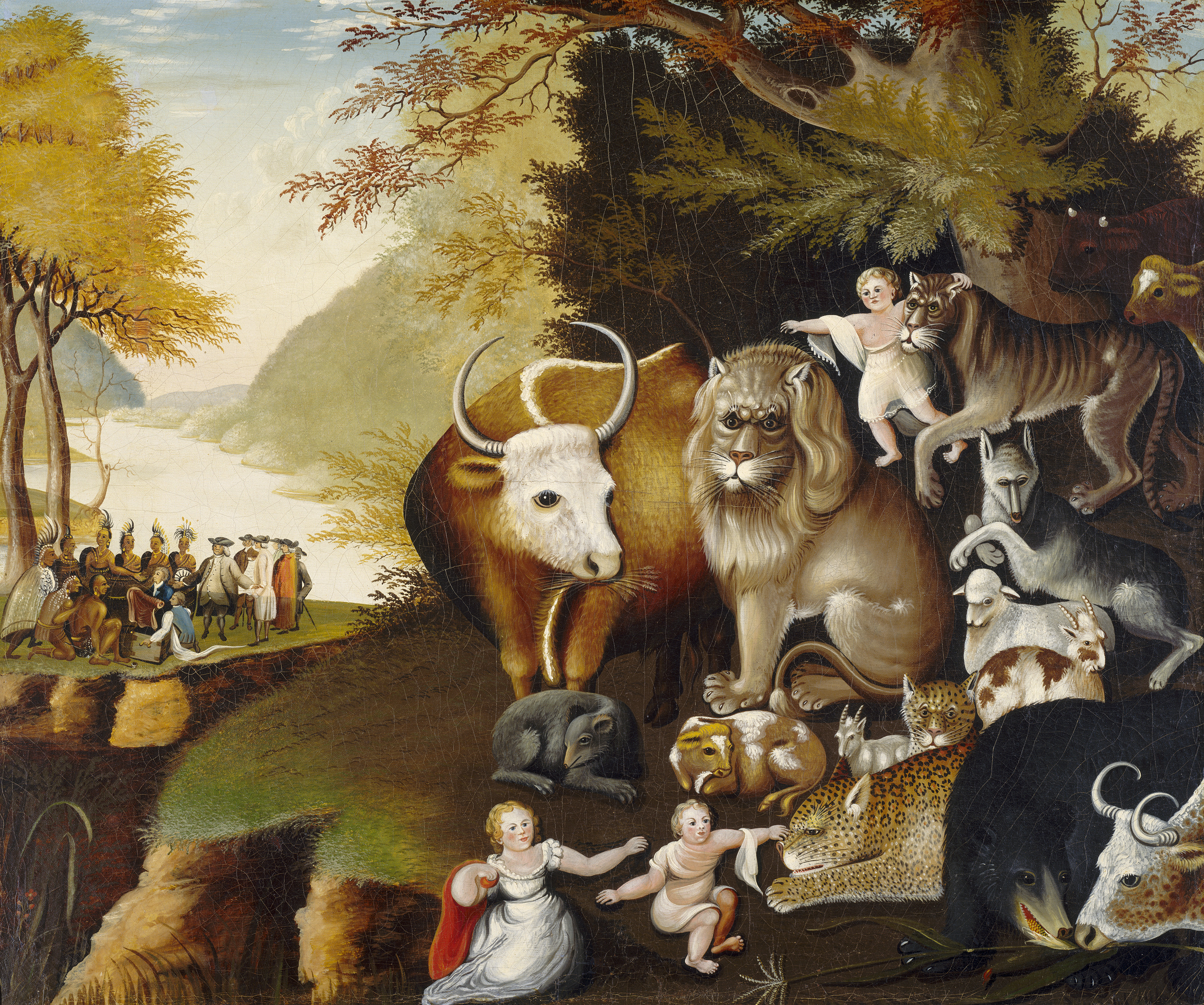
Edward Hicks, The Peaceable Kingdom (1826), a depiction of the millennium coming through developments in history and culture. This view would be known as “postmillennial” today.

From the 1600s to the early 1900s, the prevailing view among Protestants in Britain and America who considered the Bible to be the inspired word of God was that Christ would return after the millennium.  The expectation was that he would come back as king, but if the world had not yet been transformed according to his wishes, it was argued, he would have no kingdom to rule over, so the millennium had to come first.  As the English Puritan theologian John Owen insisted in a 1652 sermon to the British parliament (which was then controlled by his fellow Puritans), “Antichrist not destroyed, the nations of the world generally wrapped up in idolatry . . . will the Lord Christ leave the world in this state, and set up his kingdom here on a molehill?”

By the middle of the 1800s, however, another view had developed, that Christ’s return would actually be required to bring about the millennium, and so it had to take place before. This view was articulated in David Brown’s 1858 book Christ’s Second Coming: Will It Be Premillennial?  This is where the term “premillennial” originated.  The term “postmillennial” was coined in response, to describe the view that had formerly dominated eschatological thought so completely that it didn’t need a separate name.

So in terms of derivation, premillennialism is the belief that Christ’s coming will be pre-millennial, that is, it will precede the millennium.  Postmillennialism is the belief that Christ’s coming will be post-millennial, that is, it will follow the millennium.  And amillennialism, for its part, is the the belief that Christ’s coming will be without a millennium, that is, that there be no world-wide era of peace and justice at the end of history.  (This view interprets the description of the millennium at the end of Revelation symbolically.)

But these expectations of when (if at all) the millennium will occur relative to the return of Christ are really only the tip of the iceberg when it comes to these systems of thought.  Far more important are their beliefs about how the millennium will occur–indeed, about what the millennium will be.  (We’ve already had a hint of this in the explanation that premillennialism arose from a belief that Christ’s return would be required to bring about the millennium.)  I’ll explore this aspect of these systems, which is really their much more important dynamic, in my next post.

Who are the 144,000 in the book of Revelation?

“Sealing the 144,000” Ottheinrich Bibel, c. 1430

The identity of the 144,000 who have their “Father’s name written on their foreheads” is one of the great puzzles in the book of Revelation.  Because these people are said to be “from all the tribes of Israel,” they are often understood to be Israelites of some kind.  But there’s a very good reason to believe that they are not exclusively Israelites, but rather a different group that includes some Israelites.

The list of the tribes of Israel in the description of the 144,000 in Revelation is different from any other such list in the Bible in two significant ways:
(1) the names are different and
(2) the order is different.

Elsewhere in the Bible, these names are typically listed in one of two ways.  When they are being presented as the sons of Jacob, they are listed by birthright, according to the seniority of his wives and concubines and the birth order of their sons:

Sons of Leah
Reuben, Simeon, Levi, Judah, Issachar, Zebulun.
Sons of Rachel
Joseph, Benjamin
Sons of Bilhah
Dan, Naphtali
Sons of Zilpah
Gad, Asher

On the other hand, when the names represent the tribes of Israel, that is, territorial and civic entities, Levi is not listed because his descendants became temple servants and were not assigned any territory.  To get back to a total of twelve, Ephraim and Manasseh are listed in place of their father Joseph.  When the names represent the tribes, they are often listed in geographic order, roughly from south to north.

In Revelation, Levi and Joseph are both on the list, suggesting that the sons of Jacob are in view.  However, Manasseh also appears on the list, even though all of his descendants are already included in Joseph—this is a redundancy.  And Dan, for some reason, is missing.  So we have one tribe too many and one tribe too few.  And the order isn’t even close to being correct either by birthright or geography.

So what’s going on here?  As I’ve argued in this article, I believe that here in Revelation we have a “portrayal of the church as the new Israel in the names and order of the tribes.”  That is, the names are presented in such a way as to show that the community of Jesus’ followers is the continuation of the people of God flowing out of the community of ancient Israel.

Specifically, in the portrayal of the 144,000:
• Judah comes first because Jesus was from that tribe as the Messianic heir to David’s throne.  He is the “lion of the tribe of Judah.”
• Reuben comes next representing believing Israelites, the “firstborn” who belong to God.
• Then come four names representing the tribes descended from Jacob’s concubines, who come last by birth order, but in the community of Jesus’ followers, “the last shall be first.”  These names represent the Gentiles, who at the time of the book’s writing are actually coming to faith ahead of the Israelites.
• However, one of the four names, Manasseh, is a replacement for Dan.   The tribe of Dan was the first to fall into idolatry and the first to be carried off into exile.  This represents the danger of apostasy in general (one of the main concerns of Revelation), and perhaps also how Judas Iscariot fell away and was replaced by Matthias.
•  The remaining sons of Jacob’s full wives make up the last six names on the list, expressing the expectation that ultimately “all Israel will be saved.”

The 144,000, in other words, represent the community of all who believe in Jesus, whether Jew or Gentile.  They are a symbolic representation of the reality that is described more literally immediately afterwards, the “great multitude that no one could count, from every nation, tribe, people and language.”

This is another of the places where the book of Revelation is creatively adapting an image from the First Testament to speak to New Testament realities, in this case the continuity between the covenant communities of both testaments; they are one people of God.  This same theme is encountered in other places in Revelation as well, such as when the new Jerusalem is seen to have “the names of the twelve tribes of Israel” on its gates and “the names of the twelve apostles of the Lamb” on its foundations, or when the human community around the throne of God is represented as 24 elders, depicting the first and new covenant communities, 12 being the covenant number in the book.  But in this case the continuity of the covenants is symbolized by 12 x 12 (144) rather than 12 + 12 (24).  The symbol is intensified by multiplication by 10 x 10 x 10 (1,000), representing the totality of those who belong to the community.

Is there any historical evidence that early Christians understood 666 to mean Nero Caesar?

There certainly are many different explanations of what the number 666 means in the book of Revelation.  So why should anyone believe that it means Nero Caesar, as I argue in this post, rather than something else?  There’s actually an intriguing bit of historical evidence that the earliest readers of the book understood it the way I’ve suggested.

The question of the meaning of the number 666 arose from a comment on a post I wrote about secret codes in the Bible.  This number represents a name and it comes from gematria, the practice in languages that use letters for numbers of adding up the total value of the letters in a word.  Gematria is something like a code, but there’s an important difference.

As a rule, if you know how a code works, you can decipher anything written in that code.  But in gematria, you need to know the likely subject of the code in order to imagine possible solutions and test their numerical totals.

It appears that early followers of Jesus understood the number of the beast in Revelation to indicate Nero Caesar (that is, to point to the imminent resumption of imperial persecution) because at least one early copyist seems to have known that this was the solution to the code, but couldn’t get the numbers to add up, and so wrote 616 instead, a number the copyist thought did work!

Here’s what likely happened.  As Bruce Metzger suggests in his Textual Commentary on the New Testament, “Perhaps the change was intentional, seeing that the Greek form Neron Caesar written in Hebrew characters is equivalent to 666, while the Latin form Nero Caesar is equivalent to 616.”  (The difference is the Hebrew letter Nun, which has a value of 50.)  Whatever copyist first introduced the change was thinking of Nero’s name in Latin rather than Greek, and so wrote in 616.

We don’t know when this variant reading first appeared, but it was quite early, since Irenaeus discusses it in Against Heresies, which he wrote around AD 180.  He notes that 666, not 616, is the number “found in all the most approved and ancient copies” of the book of Revelation, and that “those men who saw John face to face” attest to it.  So 616 was recognized early on as a change.  But that’s the whole point: it’s a change that was made so early it was likely introduced by someone who knew what Revelation wanted to say and who was trying to get the numbers to add up.

A fragment from p115, the earliest written attestation of the reading 616, indicated by arrow (courtesy Wikipedia)

The change in the text was copied into later manuscripts. The first written evidence we have of this reading is in an Egyptian papyrus fragment that dates to about AD 225-275.  The reading 616 also appears in Codex Ephraemi Rescriptus, compiled about 200 years later, which is one of the four major uncial manuscripts that are key resources for New Testament textual criticism.

This variant reading provides a vital clue that the interpretation of 666 as gematria for Nero(n) Caesar is correct. The implications are, as I say in my Daniel-Revelation study guide, that the meaning of this number “has a unique solution based on the conventions of apocalypses and the facts of history.  Its main purpose is to delegitimize Domitian’s claims to divinity and to strengthen followers of Jesus who are being pressured by the emperor cult.”  The take-home message for us today is that we should be equally faithful in resisting anything that rivals our loyalty to Jesus.  But “the number 666 isn’t a coded biblical prediction of some invisible, demonic means of social control in the end times.”

What is the meaning of 666, the number of the beast in the book of Revelation?

In response to my last post about secret codes in the Bible, a reader commented that the number 666 in the book of Revelation is also an encrypted word.  That’s quite true. Let me summarize here what I say about this in my Daniel-Revelation study guide.

In many ancient languages, letters were used to represent numbers. (One example of this is the “Roman numerals” we know today: Super Bowl XLVI means Super Bowl 46.) Words and names in such languages had a total value, the sum of the values of their individual letters.  This total value could be used as a kind of  symbolic code in place of the word.  (This practice is known as gematria.) For example, as I discuss in an earlier post, the value of the Hebrew letters in Hezekiah’s name adds up to 130, and in tribute to him, 130 proverbs were placed in the collection that was created under his patronage.

As I’ve show in another post, apocalypses like Revelation evoke the symbolic significance numbers. 666 suggests having pretensions to divinity or perfection, but falling short of it, since it’s symbolized in the book by the number 7.  But whose name adds up to this total, revealing the hollowness of his pretensions to divinity?

To answer this question, we need to understand the book of Revelation in light of the first-century events that occasioned its writing.  The book was written to warn followers of Jesus, who had experienced persecution under Nero, that persecution would resume under the current emperor, Domitian. So they needed to be faithful unto death in order to win the crown of life. When the book is understood this way, its figure of a “beast” is recognized to be a depiction of Domitian as if he were Nero come back to life.

The number 666 is part of this depiction. John writes that understanding this code “calls for wisdom,” meaning that the puzzle has a trick to it. The secret is, even though John is writing his book in Greek, the numerical values will be those of Hebrew letters. As many scholars have recognized, the consonants of “Neron Caesar” in Hebrew add up to 666. Tagging Domitian with the name (or in this case, the number) of Nero is like drawing a Hitler mustache on a leader’s picture today.  Domitian thinks he’s “lord and God” (as he proclaims on his coins), but he’s really just another evil emperor.

So the meaning of the “number of the beast,” 666, has a unique solution based on the conventions of apocalypses and the facts of history. Its main purpose is to delegitimize Domitian’s claims to divinity and to strengthen followers of Jesus who are being pressured by the emperor cult. But evil rulers in other places and times may also revive the tyrannical spirit of Nero, and they’ll have to be resisted with suffering and endurance. That is the significance of the number 666 for all who live after the time of the book of Revelation.

For some historical evidence that the earliest Christians understood 666 to mean “Nero Caesar,” see this post.

For the significance of the number 144,000, see this post.

Nero 666

If someone’s prediction doesn’t come true, are they a false prophet?

Our church believes that the gift of prophecy is still available today. There’s one man in the church who recently predicted something that didn’t happen.  The Bible says in Deuteronomy that if a prophet’s words don’t come true, they’re not genuine.  I mean, we’re not going to kill this guy or anything (as it also says to do in Deuteronomy), but is he a false prophet?

I wouldn’t apply a “one strike and you’re out” rule to the question of whether someone who speaks prophetically is genuine.  The book of Deuteronomy offers us more than one test of a false prophet.  One is that their predictions don’t come true.  But another is that even if their predictions do come true, if they then say “let us go after other gods,” they are false prophets and are not to be trusted. The fulfilled prediction is a test of faith for believers.  So we aren’t supposed to go exclusively by outcomes, but by whether a prophet’s words and actions point us to the true God.

Since prophecy is a spiritual gift, we should expect that for budding prophets, there will be a “learning curve.”  As they learn to use their gift, they will become sharper and more accurate in their prophecies.  The corollary is that those who feel called to develop a prophetic gift and calling should be more restrained at the outset, until they develop confidence in their gifting.  That’s why I wouldn’t apply a “one strike and you’re out” rule in every case.  To me the main test is whether the prophet is calling people faithfully to obedience.

That much said, I have to admit that I lost confidence in a man I had considered a prophet, who made much of the fact that “God had told him” everything he was predicting, when several of his predictions in a row didn’t come true.  So there is still something to this test of accuracy.

Another thing to consider is that only a small percentage of prophecy in the Bible is predictive, or “fore-telling.” The rest is exhortation or “forth-telling,” a description of God’s perspective on how the community is conducting itself, rather than a prediction of what God plans to do, whether in mercy or judgment.  I would therefore add that a (mature) true prophet will probably come close to these proportions in his or her words to the community.
DeuteronomyHebrews
(A guide to Deuteronomy and Hebrews is available in the Understanding the Books of the Bible series.)

Does Isaiah’s prophecy about a remnant returning predict the formation of the state of Israel?

I’m reading through the Bible and have gotten as far as Isaiah, where I’ve just read, “The Root of Jesse will stand as a banner for the peoples; the nations will rally to him, and his resting place will be glorious.  In that day the Lord will reach out his hand a second time to reclaim the surviving remnant of his people” from nations all over the world.  Is this a prophecy of the formation of the state of Israel in 1948?

My study guide to the book of Isaiah in the Understanding the Books of the Bible series takes readers through the entire book, situating each passage in its historical context and explaining how Isaiah’s words apply both to his own day and to future events.  The guide explores the Messianic significance of this specific prophecy about the Root of Jesse.  Let me tell you a bit of what it says here.

With biblical prophecy, it’s important always to determine first what the original message was for the original audience.  Only then can you understand any further Messianic or end-times implications.

The “shoot from the stump of Jesse” in this passage is originally a new king in the line of David, Hezekiah, who will be faithful to Yahweh and reverse the policy of his father Ahaz.  Ahaz appeased Assyria and even put up altars modeled after Assyrian ones.  But Hezekiah will trust Yahweh, refuse to serve Assyria as a vassal, and see Yahweh’s deliverance.  Then there will be peace, and just as God reached out his hand to bring the Israelites out of slavery in Egypt, he will reach out “a second time” to bring home the “remnant,” Israelites who were carried off into Assyria as exiles or who fled to other countries to escape the Assyrians.  That’s the message for the original audience.

But Hezekiah is also a type of Christ, and what is said about him has Messianic overtones.  When Jesus comes to reign, there will be a similar gathering of the “remnant.”  But who will they be?  My understanding is that they are gathered from all the nations because they’re people from all the nations. This gathering brings together the “great multitude” described in Revelation, which comes “from every nation, tribe, people and language.”  In other words, under the New Covenant the “chosen people” become a multinational community.  As Paul writes in Galatians, “If you are in Christ, then you are Abraham’s seed, heirs according to the promise.”  (See the study guide to Paul’s Journey Letters, session 19.)

The implications of this are that the 1948 formation of the state of Israel is most likely not what is envisioned and predicted in Isaiah’s oracle about the “Root of Jesse.”  So modern Israel does not enjoy any special privileges in the world. Rather, it is a nation-state that is responsible before God for conducting itself with justice and prudence like any other nation.

I’m glad you’re reading through the whole Bible!  That’s the best way to come to understand each individual part: by seeing where it fits within the whole.  Keep on reading!

If the “mark of the beast” meant Domitian’s coins, how can there also be a future fulfillment?

Q. In your Daniel-Revelation guide, you say that taking the “mark of the beast” in Revelation could have originally meant using or wearing Roman coins that gave the emperor Domitian the titles “lord and god.”  But you also say that this historical background is “only a starting point for understanding the symbol,” and that it “shouldn’t limit its meaning” (p. 107). Doesn’t this leave the door open for the speculation and foolish debate that often arise over this topic?

I agree that it’s unfortunate when a lot of time, energy, and emotion are spent trying to figure out what one thing the “mark of the beast” must correspond to. We don’t need to do this.

The symbol did mean something specific and definite at the time when the book of Revelation was written. I’ve suggested one likely possibility in the study guide, Domitian’s coins, which “would be held in the right hand for transactions” and which “were sometimes also worn in a band on the forehead.”  This would explain John’s statement that everyone was forced “to receive a mark on their right hands or on their foreheads, so that they could not buy or sell unless they had the mark.”

The Jews were already sensitive enough to the blasphemous and idolatrous depictions of emperors on Roman coins that these coins were not allowed in the Jerusalem temple.  That’s why there were money-changers there.  (Unfortunately they cheated the people who needed to convert their Roman currency; that’s why Jesus overturned their tables, for making his Father’s house a “den of thieves.”)  And so it’s quite reasonable that John in Revelation would express a similar sensitivity to the way emperor worship was being advanced insidiously through the necessities of economic life. This is a respected interpretation among New Testament scholars.

But I also say in the guide that in the books of Daniel and Revelation, events in the near future and the far distant future may be simultaneously envisioned, “as a definitive crisis in the life of God’s people evokes the ultimate crisis at the end of this age” (p. 122).  So there may well be something in the final conflict between good and evil at the end of history that closely approximates the “mark of the beast” as it was experienced in John’s time—some form of coercion to participate in a godless system, upon threat of being excluded from buying and selling.

But the best way to be prepared for such a challenge, if we ever have to face it, is to recognize even now that fallen cultures will always try to get their people’s allegiance at the expense of their allegiance to God.  Followers of Jesus need to be perpetually aware of this danger and resist it.

Ultimately, what represents a present-day manifestation of the “mark of the beast” (coercion to join a godless system) will vary in different places and times. And so rather than engaging in speculation and debate about a unique meaning for the symbol, believers need to be spiritually alert and uncompromising in every situation.

Was Jesus really forsaken on the cross?

Q. I often hear people say that when Jesus cried out on the cross “My God, my God, why have you forsaken me?” this was a poignant expression of his suffering and abandonment. But given how well Jesus knew the Scriptures, and how strongly the whole of Psalm 22 describes him and his situation, didn’t he likely have the whole psalm in mind? If so, you could equally see his cry as conveying triumph through suffering. When I thought of this it changed my whole view of the crucifixion.

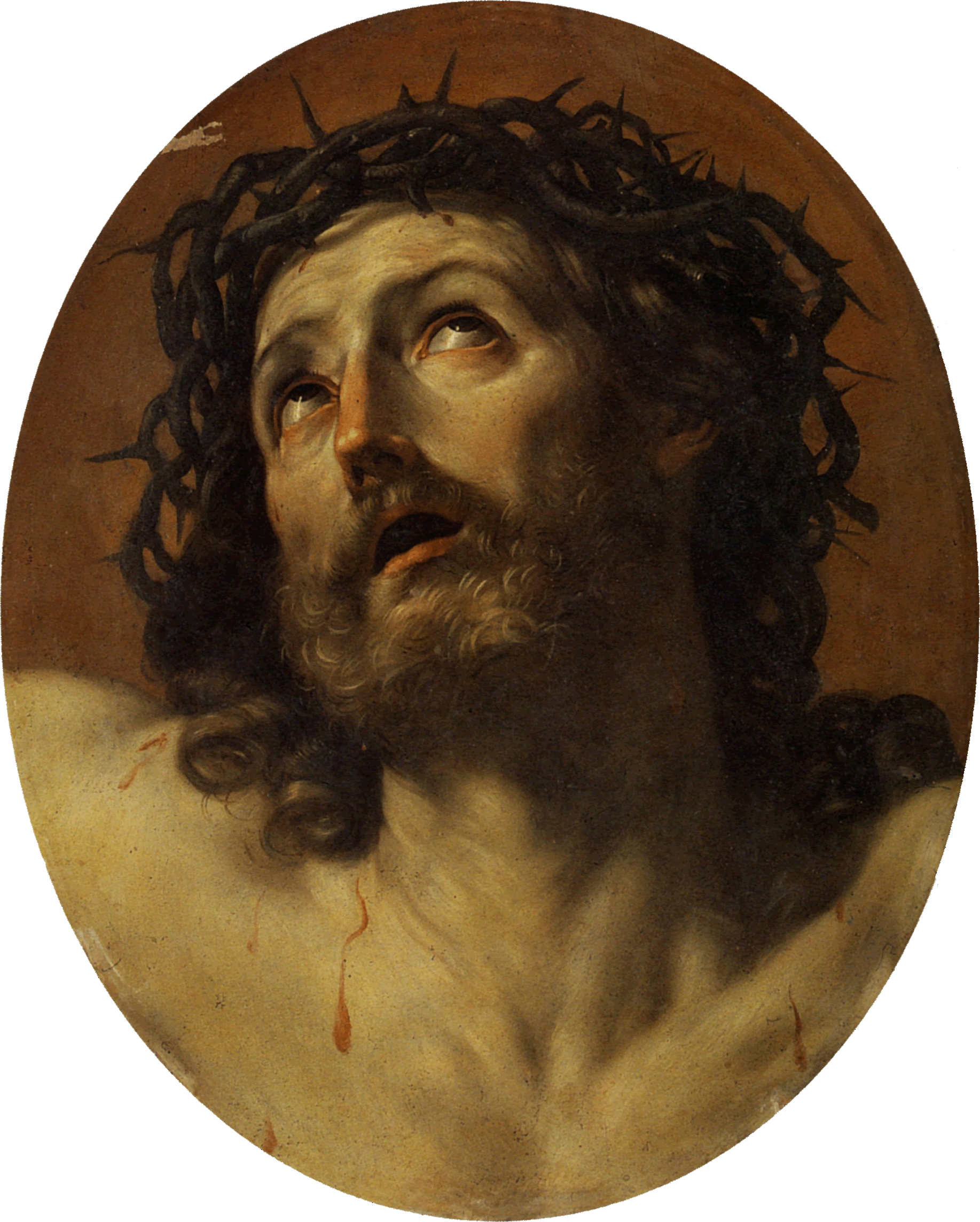
Guido Reni, Christ Crowned With Thorns

There’s an extensive discussion in Session 8 of the Psalms study guide (pages 52-53) of how Jesus appealed on the cross to Psalm 22.

In my view, the best understanding of what was happening when Jesus cried out “My God, my God, why have you forsaken me?” recognizes both the sense of abandonment he was expressing immediately through these words and the sense of faith and trust that’s articulated over the course of Psalm 22, to which he was indeed alluding in its entirety.

In other words, in our interpretations we need to honor what Jesus was experiencing in the moment, but we also need to recognize that he was giving voice to that experience through the words of an ancient inspired song of faith. Jesus was taking his place in the long line of Israelites who used the psalms, written centuries earlier for other occasions, to express what was happening in his own relationship with God.  The Psalms were gathered into a collection and made part of the Bible precisely because people had been using them in this way for so long.

Psalm 22 was probably originally written by someone who had a deadly illness.  However, the uncanny resemblance between what the psalmist describes and the experience of crucifixion, unknown at the time the psalm was written, has convinced many that the inspired writer was given an advance glimpse of Jesus’ sufferings on the cross. In that case this would be a Messianic psalm that speaks as much about the coming Messiah as about the original circumstances of the author.

What we can say for certain is that just as the people of Israel looked back to earlier songs (the psalms) to express their own spiritual experiences, the psalmists themselves also looked forward, as authors like this one express the hope that their words will be used by later generations.  Psalm 22 is a classic psalm of supplication that moves from a cry for help to a statement of trust, and after a description of troubles and petition makes a vow of praise that envisions people in the future all over the world hearing about God and worshiping him.  Jesus fulfilled this vision by creating a worldwide community of followers through his life and ministry, his death on the cross, and his resurrection and ascension.  So the psalmist gave Jesus some words through which to express his most vital spiritual experience, and Jesus in turn gave those words the most marvelous fulfillment that could be imagined.