Was the apostle Paul married or single?

Q. Was the apostle Paul married or single?

In his first letter to the Corinthians, Paul makes it very clear that he is single. He writes, “Now to the unmarried and the widows I say: It is good for them to stay unmarried, as I do.” (Paul’s specific point is that being single provides the advantages of freedom and flexibility for Christian service. However, he recognizes that whether to stay single or get married is a matter of following God’s calling: “Each of you has your own gift from God; one has this gift, another has that.” So while Paul praises the advantages of singleness for his type of ministry, he also sees marriage as a gift from God.)

So why do people sometimes say that Paul was married? For one thing, it’s held that Paul was a member of the Sanhedrin, the Jewish ruling council, and (the argument goes) a man had to be married in order to be on the Sanhedrin. William Barclay writes in his commentary on the Corinthian letters, for example, “It was a requirement that members of the Sanhedrin must be married men, because it was held that married men were more merciful.”

I find the first half of this argument convincing, that is, that Paul belonged to the Sanhedrin. During one of his trials in Acts, Paul recounts, “On the authority of the chief priests I put many of the Lord’s people in prison, and when they were put to death, I cast my vote against them.” So Paul was part of some decision-making body, and since it was one that had the power to enforce a death penalty, it was most likely the Sanhedrin.

However, I find the second half of the argument unconvincing. The statement that Sanhedrin members should be married men, because they are more merciful, comes from the Gemara, the commentary on the Mishnah that makes up the second half of the Talmud. It comes from many centuries after Paul lived. The Mishnah itself dates in its written form to about A.D. 200. It is a collection of teachings about the Torah passed down orally from rabbis who lived in the Second Temple period (through A.D. 70), and it makes no reference to a marriage requirement for Sanhedrin membership. It makes more sense to accept Paul’s first-person testimony, in his own letter to the Corinthians, that he was single than it does to assume that he had to be married if he belonged to the Sanhedrin based on requirements that seem only to have been adopted many centuries later.

Another argument that’s sometimes made for Paul being married is his question, also found in 1 Corinthians, “Don’t we have the right to take a believing wife along with us, as do the other apostles and the Lord’s brothers and Cephas?” The argument goes like this: Why would Paul insist that he had the right to bring a believing wife along with him if he didn’t even have a wife?

However, since Paul has just said, only a little earlier in this same letter, that he is single, it makes sense to understand him to mean that this is one of the many rights that apostles have (he lists several more); he is actually on his way to saying that he hasn’t used any such rights so that he can bring the gospel to the Corinthians free of charge. In other words, he’s most likely saying, “As an apostle, not only do I have the right to depend on you for my food and drink and for my support, if I had a wife, I’d have the right to bring her along—also at your expense. But I have not made use of any of the rights of an apostle.”

So I feel that we can conclude quite confidently that Paul was not married. He saw his singleness as something that permitted him to have a ministry that required much travel and involved much personal risk. Just as he recognized marriage to be a gift from God, he also saw singleness as a gift. “One has this gift, another has that.

Shouldn’t the Bible be easy to understand?

Q. Peace be with you. I read your response to the question, “Why did Jesus say he wasn’t going to the Festival of Tabernacles and then go?” Your justification didn’t satisfy me. Why should Jesus’ talk be so unclear that people like you need to explain to us? The word of God should be so easy that everybody can understand.

Peace be with you as well. Actually, people who consider the Bible to be the word of God have always believed and understood that it has more than one level of meaning. On the surface, it presents stories, songs, dreams, etc. that are interesting and instructive about life on earth in their own right. That’s why even children can enjoy the Bible starting from a young age. But as we grow and mature mentally, emotionally, and spiritually, we come to recognize that beneath the surface there’s another level of meaning that teaches us about God, especially in his relationship to people.

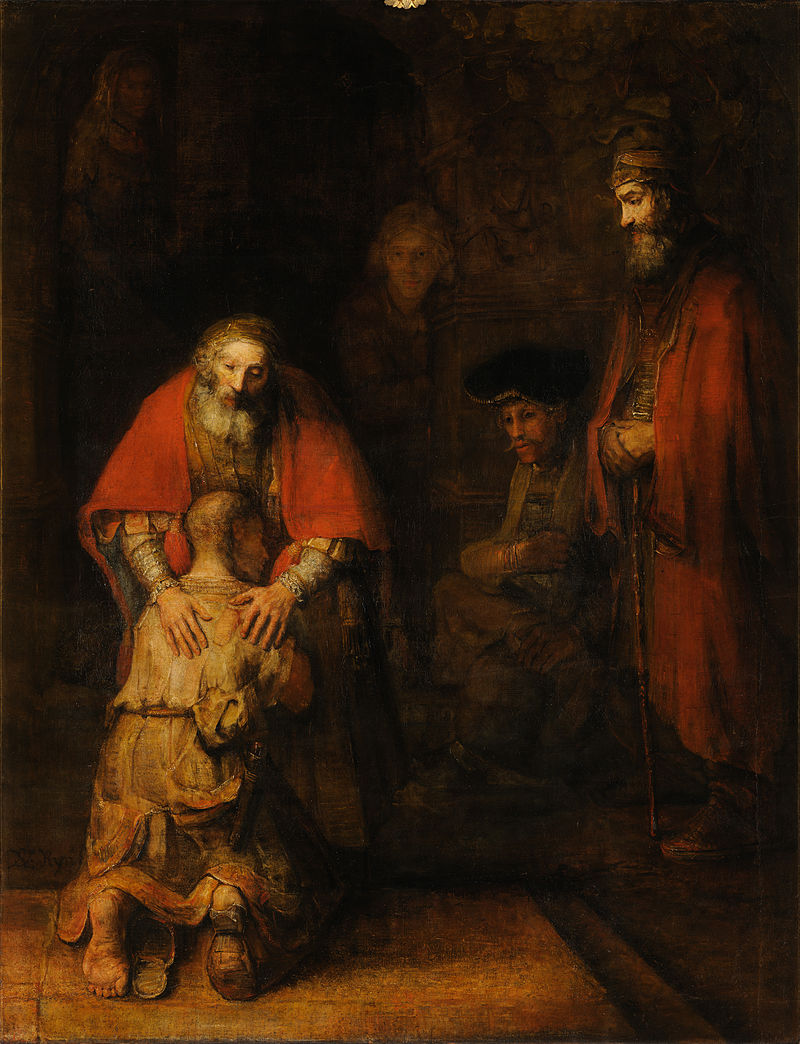
The parables that Jesus told are an excellent example of this. The Parable of the Prodigal Son, for example, is on its surface a memorable story about character development and family relationships. We are moved when we hear about how the younger son grew from being a reckless and ungrateful youth who grieved his father to become a mature adult who took responsibility for his actions and came to appreciate all he had in his family. We admire and want to emulate the example of the father who generously forgave and restored his penitent son. And we take warning from the older brother’s failure to forgive. All of this teaches us important lessons about life on earth.

But when we also discern the deeper spiritual meaning of this story, we are even more moved to realize that God is like the father in the story, who kept watching for his wayward son and ran to meet him “while he was still a long way off.” We understand that God is eager to forgive and restore us and that God is just waiting for us to begin to turn around before he rushes to greet us. We realize that in terms of our own relationship with God, we need to be like the younger son, who confessed, “Father, I have sinned against heaven and against you.” We should not be like the older brother who refused to forgive and so remained estranged.

Perhaps it is easier to see how Jesus’ parables, as teaching vehicles, likely have such deeper meanings. It’s harder to recognize that the narratives of Jesus’ actual words and actions also have such meanings. But they do, and we should look for a deeper significance whenever we come across something that’s puzzling or distressing. That’s a sign that something more is happening than meets the eye.

So—to return to the example you asked about—when Jesus’ brothers encourage him to go to the Feast of Tabernacles, and he replies, “I am not going up to this festival, because my time has not yet fully come,” but then he goes up to the festival anyway, we shouldn’t simply conclude, “Jesus must have lied.” Instead, we should ask, “Did Jesus mean something different from what we first understood?” If we read the whole gospel thoughtfully and reflect on it, we should recognize the significance of the phrases “go up” and “my time” throughout the work. We will then realize that, as John tells us on another occasion when Jesus also talked about being “lifted up,” he gave this response to his brothers “to show the kind of death he was going to die.” There was a deeper meaning behind his words.

The multiple layers of meaning in the Bible make it a book that we can read and study throughout our lives and continue to get new insights from. It is truly so simple that a child can read it and hear God’s invitation to salvation. But it is also so profound that even after a lifetime of study the most learned scholar must confess, as the psalmist says of God’s awareness of everything about him, “Such knowledge is too wonderful for me, it is too lofty for me to attain.” This shouldn’t discourage us from reading and studying the Bible; it should only make us more eager to discover more of its hidden treasures.

Rembrandt, “The Return of the Prodigal Son.” On its surface, the Parable of the Prodigal Son is a moving and instructive story about family relationships and character development. But on a deeper level, it teaches us about the love of God our Heavenly Father.

Our money, words, relationships, and reputation show what’s in our heart

Q. What verses in the Bible discuss the power of the tongue?

My study of the Bible over a lifetime has concentrated on the Scriptures as a collection of literary compositions—stories, songs, letters, laws, oracles, etc.—rather than as a collection of individual sayings or Bible verses. In  light of my studies, however, I can commend the entire book of Proverbs to you. It discusses the power of the tongue—that is, the effects of our speech on ourselves and those around us—within the context of a comprehensive understanding of how our speech, our use of money, our relationships, and our reputation combine to reveal the content of our heart and constitute an outward extension of ourselves. In the rest of this post, I’ll quote from a couple of the sessions in my study guide to Proverbs that explain this understanding. (The premise of the guide is that the groups or individuals using it are reading through Proverbs session by session, about 50 sayings at a time. The questions are provided for either individual reflection or group discussion. You can see or download the entire study guide here.) I hope this is helpful to you.


  1. According to Proverbs, each person has a core-of-being, or “heart,” that’s difficult to know because it lies so deep within them. However, because everything anyone says or does flows from their heart, its character and quality can be seen in certain personal spheres that give direct and effective expression to what’s in the heart.

The first of these spheres is a person’s use of money. Money is a prime area where the heart overflows because it gives us the capability to fulfill our desires. So long as we can afford it, we can pretty much get anything we want.

But money also reveals what’s in a person’s heart another way. Not how much money they have, but what kind of money they have, shows how they’ve gone about living their life. Those who are wise, who live in the fear of the LORD, will accumulate “good money.” It will last a long time and bring joy and satisfaction with it. Those who live without regard to God will acquire “bad money”: even if they make lots of it, it will come with trouble, and soon disappear. So Proverbs often cautions that we shouldn’t pursue money as an end in itself. But if we pursue wisdom, a steadily increasing supply of “good money” will ordinarily be a by-product.

~ Do you know anyone who suddenly came into a lot of money (such as by winning the lottery, receiving an inheritance, or getting an insurance settlement) and was able to buy pretty much anything they wanted? What did they do with this money? How long did it last? What did their use of the money say about what was in their hearts?

~ Read each of the following proverbs aloud and decide whether it’s describing “good money” or “bad money” or drawing a contrast between the two:

– “A fortune made by a lying tongue is a fleeting vapor and a deadly snare.”

– “The blessing of the LORD brings wealth, without painful toil for it.” (Or, “no trouble comes with it.”)

– “Dishonest money dwindles away, but whoever gathers money little by little makes it grow.”

– “Whoever increases wealth by taking interest or profit from the poor amasses it for another, who will be kind to the poor.”

– “Good people leave an inheritance for their children’s children, but a sinner’s wealth is stored up for the righteous.”

– “The house of the righteous contains great treasure, but the income of the wicked brings ruin.”

~ Do you know a person or family that has “bad money”? Why would you describe their money this way? Do you know a person or family that has “good money”? What makes it good?

~ If someone could see all of your expenses for the past year, how would they describe your priorities in life?

  1. What a person says, particularly when they’re free to say whatever they want, is a second area of life where their heart is directly expressed. To put it simply, what’s in your heart will come out of your mouth. “The hearts of the wise make their mouths prudent, and their lips promote instruction.” “Stay away from the foolish, for you will not find knowledge on their lips.”

In this area as well, what matters is quality, not quantity. Just because a person is a “real talker,” never at a loss for words, this doesn’t make them wise. Indeed, the more a person talks, the more they may be trying to hide, excuse or rationalize. “Sin is not ended by multiplying words, but the prudent hold their tongues.” (Or, to paraphrase, “whenever there are many words, something wrong is probably going on.”) Proverbs encourages us to speak valuable words, in prudent quantities, that will be a blessing to others, and not to speak a constant stream of worthless or deceptive words. “The tongue of the righteous is choice silver, but the heart of the wicked is of little value.” “The mouth of the righteous is a fountain of life, but the mouth of the wicked conceals violence.”

~ Often we excuse something we’ve said by insisting, “Oh, I didn’t really mean that.” If words inevitably express what’s in the heart, can a person ever actually say something they don’t mean?

~ Think of a person who’s been helpful and influential in your life. Are there particular sayings of theirs that you remember and repeat, treasuring them like “choice silver”? Share one or more of these sayings with the group.

(If the topics of money and speech are of particular interest to you, keep an eye out for the many other sayings in the book of Proverbs that talk about them.)

  1. Our relationships are a third area of life where what’s in our heart gets expressed directly. It’s revealed, first of all, in what kind of friends we have. Like attracts like. The more our hearts have been shaped by the “fear of the LORD,” the more we will strike up friendships with wise, godly people. The more we live without regard for God, the more we will fall in with people who don’t care about God, and who won’t care about us, either. “The righteous choose their friends carefully, but the way of the wicked leads them astray.” “One who has unreliable friends soon comes to ruin, but there is a friend who sticks closer than a brother.”

Our relationships reveal what’s in our hearts in another way as well. The effect we have on the people we’re close to shows what kind of people we really are. “As iron sharpens iron, so one person sharpens another.” “Walk with the wise and become wise, for a companion of fools suffers harm.” When you’re in a close relationship with another person, they begin to take on your character, and you take on theirs.

Just as the blessing of God is seen not in having a lot of money, but in having good money; and not in having a lot to say, but in having good things to say; so it’s seen in not necessarily having a lot of friends (being “popular”), but in having good friends. It’s a matter of quality, not quantity. Fake friends, who are only around for what they can get out of you, are a dime a dozen. “The poor are shunned even by their neighbors, but the rich have many ‘friends.'”

~ If we want to be wise and “choose our friends carefully,” how should we go about doing this? What qualities should we look for in a friend? What are the signs that someone would be a bad friend to have?

~ Think of someone who’s been a good influence on you over the course of a close relationship. By what means has their character “rubbed off on you”? In what ways are you a better person because of their influence in your life? Where are you beginning to have the same effect on other people yourself?

~ If you know someone who’s been betrayed by “fake friends,” tell what happened (without naming any names or revealing any identities). Once everyone in the group who has a story to share has told it, see what general lessons you can draw from all of the stories together.

  1. A fourth area of life where our heart is revealed is in our reputation. This doesn’t mean fame or celebrity. People can quickly achieve short-term notoriety for all kinds of things that have little to do with character. Rather, reputation is the way a person is regarded by the community of people who interact with them over a long period of time. Character comes to have a social footprint: “The crucible for silver and the furnace for gold, but people are tested by their praise.”

In a society that judges by superficial, inborn characteristics such as appearance and talent, a person who isn’t living in the fear of the LORD may initially achieve a very high “positive recognition factor,” while a godly person may languish in obscurity. But sooner or later, what’s really in a person’s heart will be expressed in their actions. If these actions are unjust and destructive to other people, the person will get a bad reputation. By contrast, those who quietly but consistently do good may eventually be recognized and celebrated. “When wickedness comes, so does contempt, and with shame comes reproach.” “When the righteous prosper, the city rejoices; when the wicked perish, there are shouts of joy.”

Reputation, too, is a matter of quality, not quantity. What matters is not how many people have heard of you, but what the people who have heard of you think of you.

~ “A good name is more desirable than great riches; to be esteemed is better than silver or gold.” Are there sometimes circumstances in life where we have to choose between “a good name” and “great riches”? Do you know someone who has a “good name” because they pursued honor and integrity even though it cost them money? Tell the group about them if you can. Can you give examples of people who’ve lost their “good name” because they went after “great riches” instead?

~ Think of someone whose public reputation has suddenly changed from good to bad. Where did they go wrong?

~ Do you know someone in a service or sales position (car dealer, auto mechanic, dry cleaner, etc.) who you’d recommend to a friend without hesitation? What qualities do they have that make you vouch for their reputation?

Do children lose their guardian angels if they reject Christ?

Q. I’ve heard it suggested that children lose their guardian angels if they reject Christ once they reach the “age of accountability.” I would be interested to know what you think.

The Bible doesn’t say explicitly that children have guardian angels. I’ll discuss in a moment where that idea comes from. But let’s suppose that they do. What would be the purpose of that?

For one thing, angels would be assigned to guard children from danger, because children are inexperienced, they lack information, they don’t always reason well, and so left to themselves they can make unsafe choices. However, I think that beyond that, angels would be assigned to children to help steer them towards faith, using their mysterious invisible influence towards that end. This would be consistent with what the book of Hebrews says about angels, that they are “ministering spirits sent out to serve for the sake of those who are to inherit salvation.”

If that is the case, then I can’t imagine an angel abandoning a child, or for that matter God taking an angel away from a child, because they didn’t make use of an opportunity to accept Christ. This would only make the child less likely to make use of the next opportunity that came along. I’ve just suggested that the very reason for assigning an angel in the first place is that children typically don’t make the best choices because they are immature and not fully informed. So I don’t see why God or an angel would regard a choice that a child made when they barely knew right from wrong (i.e. they’d just reached the “age of accountability”) as so fully informed, mature, and therefore definitive that influences that might help lead them to salvation should be withdrawn, as if of no further use. If anything, I can imagine God sending more influences into a child’s life to help them understand their loving Savior better so that they would embrace him at a future opportunity.

The idea that children do have guardian angels comes from something that Jesus says to his disciples in response to their question about who is the greatest in the kingdom of heaven. The Gospel of Matthew records that he called a little child over to sit among them and then said, “Those who humble themselves like this little child will be the greatest in the kingdom of heaven.” Jesus then went on to tell them,  “Be careful that you don’t look down on one of these little ones. I say to you that their angels in heaven are always looking into the face of my Father who is in heaven.” (This means that the angels “always have access” to the Father in heaven, as some translations put it.)

If these are guardian angels, then presumably this would mean not only that the angels pray for the children, but also that they protest any mistreatment and ask God to punish it. It’s possible, however, that by this point in Jesus’ teaching, “little ones” means not “children” but “young believers” or “simple believers.” Even if it does mean “children,” it’s not necessarily the case that there is one angel assigned to each child. Instead, there could be a group of angels whose role was to pray for the salvation and protection of children.

We simply don’t have enough to go on to make a definitive case from the Bible that there are or are not guardian angels. But as I’ve said, if there are, I can’t imagine God pulling a guardian angel away just when one was needed most—when a child failed to recognize and answer the loving call of their Savior. It seems to me that instead the guardian angel would roll up its sleeves, rub its hands together, and say, “Let’s see if we can’t help some more here.”

The traditional role of guardian angels, to protect children from danger, is illustrated in this 1920s print by the German artist Lindberg. Such pictures were often hung above children’s beds.

How can a woman who’s a natural fighter become a “woman of peace”?

Q. I have a question about something I was reading in Proverbs this morning:

She is more precious than rubies;
    nothing you desire can compare with her.
Long life is in her right hand;
    in her left hand are riches and honor.
Her ways are pleasant ways,
    and all her paths are peace.
She is a tree of life to those who take hold of her;
    those who hold her fast will be blessed.

It is a common theme in Scripture that women of peace are to be praised.

How should a woman who desires to serve the Lord respond when we are natural fighters? I believe the Lord blessed me with a passion for defending others and standing for what is right, but how do I balance “her ways are of pleasantness, and all her paths are of peace” with the tenacity I have for fighting for what is right? Thank you!!

I believe that the much of the answer to your question is actually in the passage you were reading. It’s actually not a description of a “woman of peace,” but of wisdom. It begins:

Blessed are those who find wisdom,
those who gain understanding,
for she is more profitable than silver
and yields better returns than gold.
She is more precious than rubies;
nothing you desire can compare with her . . .

However, I can understand perfectly why you applied it to yourself. First, wisdom is personified here as a woman. Second, at the end of the book of Proverbs there’s a memorable passage that begins:

A wife of noble character who can find?
    She is worth far more than rubies.

So it’s completely understandable that reading and meditating on this passage about wisdom got you thinking about how you could become more and more  a “woman of peace.” And as I said, the answer to that is in the passage itself. It’s part of the long opening address at the beginning of Proverbs that commends wisdom, which is defined as “the fear of the Lord.” And that is defined further as having so much respect for God, so much appreciation for his justice and power, so much devotion to God, that you don’t dare do anything that would be displeasing to him. As it says later in Proverbs, “Do not let your heart envy sinners, but always be zealous for the fear of the Lord.” And as it says in Job, another wisdom book, “The fear of the Lord—that is wisdom, and to shun evil is understanding.”

On the one hand, losing your temper and giving in to destructive anger would certainly be something that was displeasing to God. Another proverb points out, “An angry person stirs up conflict, and a hot-tempered person commits many sins.” Proverbs contrasts giving in to anger with the fruits of the wisdom it is trying to teach: “The one who has knowledge uses words with restraint, and whoever has understanding is even-tempered.” There are many other passages, both in Proverbs and throughout the rest of the Scriptures, that warn of the destruction caused by giving in to anger.

On the other hand, allowing injustice to go unchallenged is also something that is very displeasing to God. In the book of Proverbs, here’s the very last thing we hear just before that description of the woman of noble character who’s more precious than rubies:

Speak up for those who cannot speak for themselves;
    ensure justice for those being crushed.
Yes, speak up for the poor and helpless,
    and see that they get justice.

So in the very same book of the Bible, we hear mandates both to be an even-tempered person who does not create conflict and to speak up to ensure justice. Indeed, the Scriptures equate opposing injustice with the “fear of the Lord.” When one of the Judean kings restored the worship of the true God, he appointed judges and told them, “Now let the fear of the Lord be on you. Judge carefully, for with the Lord our God there is no injustice or partiality or bribery.

So how can a person balance these two things? I think the right approach is expressed very well in Ephesians: “Be angry, but do not sin.” Anger does not have to be sinful. That is, it doesn’t have to be out-of-control and destructive. It can be controlled, focused, positive, and constructive.

We actually need to get angry in order to become motivated enough to do something about injustice. Injustice is usually entrenched in social arrangements and relationships. You can’t address it without “upsetting the apple cart” and threatening the privileges that some people are maintaining at the expense of others. It’s all too tempting to say, “I just won’t rock the boat, I don’t want to make anybody upset.”

So I’m quite delighted to hear that God has given you “a passion for defending others and standing for what is right.” It’s wonderful to hear of your tenacity. We need many more people like that in our world. If you get so upset by injustice that you become angry, that’s not a sin, that’s an emotion. And it’s an appropriate one. Just don’t lose your temper so that your anger is released in destructive ways rather than constructive ones.

Instead, recognize your anger as motivation. Let it be a positive force that gives you the power and the willingness to speak up and address entrenched situations of injustice and unfairness. Ephesians also tells us to “speak the truth in love” and so “grow to be like Christ in every way.” In other words, mature Christian character—”wisdom,” if you will—is exhibited in the capacity to speak necessary truths in a way that brings benefit and blessing to those around us, rather than destructively breaking relationships and tearing people down.

So that’s the challenge. Stay passionate for justice. Don’t lose a bit of that passion. But cultivate patience, graciousness, and kindness in your speech and actions. There is no contradiction between the two.

Since you’re reading Proverbs already, if I could give you a challenge, it would be to notice all the places in the book that talk about restraining your speech and your temper, record them somewhere, and think about how to put them into practice. (“Practice” means that you might not get it perfectly the first time! But every time you try, you’ll get experience that will bring you closer to where you want to be.) But also notice the places that talk about doing what’s right and maintaining justice between people, and meditate on those as well. Pray that God will build the qualities of patience and graciousness into your life even as you expand and pursue your passion for justice and fairness.

The very fact that you’re asking about this says to me that God is already at work in you to bring about a balance between passion for justice and gracious speech that will make you even more effective in your walk with him and service to him. So may God bless you as you seek to cooperate with the work he has already begun in you!

My study guides are now available for free reading and download through this blog

From 2010–2013, I published a series of 14 study guides on individual biblical books and small groups of related books. The series was called Understanding the Books of the Bible. The rights to these guides have now reverted to me, and I am making them available free of charge through this blog for online reading and electronic download. Just use the “Free Study Guides” link that appears at the top of each page on the blog.

I originally started this blog to support groups that were using these guides. The publisher, InterVarsity Press, felt that because people usually approach the Bible as a single reference volume divided into chapters and verses, they could probably use some real-time help approaching it instead as a collection of individual creative works, as my series would lead them to do. So if you start using one of the guides yourself and find that you have a question about it, feel free to ask it. (You can use the “Ask a Question” link at the top of each page.) That was, after all, how this blog got started!

The cover of the John study guide, the first in the series.

How does New Testament teaching progress from Jesus to Paul? (Part 4)

Q. I’m teaching a Bible overview course on the Old and New Testaments. Please help me understand the progression of the teachings from Jesus and the apostles to Paul. How do they complement each other, and how do they differ? Thank you.

In my first two posts in answer to this question, I suggested that Jesus, and the apostles after him, transformed the dualistic idea of the “kingdom”—you were either in or out—to mean a community that was open to everyone, that was based on faith, and that was a present as well as a future reality. In my third post, I suggested that Paul similarly transformed another dualism. He redefined “flesh” and “spirit” as ways of life rather than parts of the human person; he taught that the human body did not have to drag down the spirit but could become an instrument of “spiritual worship”; and he cautioned that life in the Spirit was not entirely a present reality and so people should continue to respect propriety in their bodies. In this final post, I’d like to show how three New Testament books that seem to come from divergent theological streams—the Gospel of John and the books of Hebrews and Revelation—actually express a vision that’s harmonious with the one Jesus and Paul convey by transforming these two different dualisms.

The Gospel of John, even though it’s a life of Jesus, actually transforms the same spirit-matter dualism that Paul does in his letters, rather than the dualism based on being in or out of the kingdom of God that Jesus transforms in his teaching as presented in the Synoptic Gospels. Jesus, as portrayed by John, repeatedly contrasts what is heavenly, spiritual, and from “above” with what is earthly, material, and here “below.”

This dynamic is seen most clearly in the repeated instances where something Jesus says is misunderstood as a reference to what is “below” and he has to explain that he’s actually describing what is “above.” Perhaps the best-known example is when Jesus tells Nicodemus that he must be “born again.” Nicodemus responds, “How can someone be born when they are old? Surely they cannot enter a second time into their mother’s womb to be born!” Jesus has to clarify that he is speaking of a spiritual rebirth. (The phrase “born again” uses a resonant term that can actually mean both “again” and “from above.” Nicodemus takes it the first way and Jesus explains that he should have understood it the second way.)

Interestingly, Jesus’ dialogue with Nicodemus is the one place in the Gospel of John where the phrase “kingdom of God” appears. But as Xavier Léon-Dufour observes in To Act According to the Gospel, “In this passage, the term signifies not the ‘reign [that is] coming,’ but the ‘kingdom’ into which one enters, that is, ‘eternal life'” (brackets original). Dufour therefore asks, “What, then, is the Johannine equivalent of basilea tou theou in the sense of the ‘reign of God’?” He notes that some have seen the concepts of “life” and “light” as the equivalents, but he suggests that “while the coming of the reign of God constitutes the central message of the Synoptics, the Johannine text is organized around the idea of the ‘one sent from the Father'” (p. 31). So the equivalent of the kingdom of God breaking into the present is the Son of God coming from above to here below.

This represents a transformation of how the above/below dualism was conceived by others at the time, particularly those in the stream of thought that would coalesce into Gnosticism. An epigram attributed to Hermes Trismegistus, a foundational figure within that stream, says, “As it is above, so it is below.” What this means may be illustrated by a saying attributed to Jesus in the Gospel of Thomas (which certainly displays proto-Gnostic influences): “I am the light that is over all. I am the All. The All came forth out of me, and to me the All has come. Split a piece of wood—I am there. Lift the stone, and you will find me there.” In other words, there’s actually no distinction between the “above” and the “below”; if we could just see through physical objects, we would recognize that the spiritual is immanent in them.

From this perspective, it would actually be impossible for someone to come from above to below, since the above is already in the below. But the Gospel of John transforms this perspective to the point where Jesus can say, in a key thematic statement, “I have come down from heaven not to do my will but to do the will of him who sent me.” In other places Jesus equates this “will” with the “work” his Father has given him to finish. There would be no place for the language of coming to “finish a work,” either, in the other perspective, because no real change can be effected in a world where the spiritual dwells eternally within the material. But the idea in John that Jesus came to accomplish a “work” connects with the idea in the Synoptic Gospels that Jesus came to inaugurate a “kingdom.”

As for the book of Hebrews, it too presents an above/below dualism, but from the perspective of Platonic thought rather than from that of nascent Gnosticism. This perspective is seen most clearly in places such as those where the author says that the Jewish priests on earth “serve at a sanctuary that is a copy and shadow of what is in heaven.” The implication, in keeping with Platonic thought, is that true or ideal entities exist in a spiritual realm, while anything physical on earth is only a copy or expression of such an ideal. Throughout the book, many other aspects of the old covenant are said to have true or ideal counterparts in spiritual realities. For example, we’re told that when Joshua led the people into the land of Canaan, that wasn’t really the fulfillment of God’s promise to give them “rest.” That promise is still open to anyone who will “rest from their works just as God did from his.” (And God did that outside of the just-finished creation.)

However, this dualism between the true heavenly ideal and the earthly copy or shadow is transformed in much the same way that the Gospel of John transforms the above/below distinction—except that the motion is in the opposite direction. Hebrews emphasizes how Jesus went from below to above: “Christ did not enter a sanctuary made with human hands that was only a copy of the true one; he entered heaven itself, now to appear for us in God’s presence.” And because Christ has gone before us to show the way, we can aspire to follow after him. The author says that the heroes of the faith were “longing for a better country—a heavenly one. Therefore God is not ashamed to be called their God, for he has prepared a city for them.” So once again it becomes possible, as a result of the transformation, to move in actuality between the “below” and the “above,” not just in philosophical contemplation or esoteric learning.

Interestingly, the heavenly city of Hebrews is both present and future, both here and there. On the one hand, the author says, “Here we do not have an enduring city, but we are looking for the city that is to come.” On the other hand, the author says, “You have come to Mount Zion, to the city of the living God, the heavenly Jerusalem.” This captures the “already” and “not yet” aspect of the kingdom of God as Jesus proclaimed it.

The book of Revelation shares much of this same perspective. It envisions God’s temple as ultimately a heavenly reality (for example, “Then God’s temple in heaven was opened, and within his temple was seen the ark of his covenant”). However, once again reversing the direction, Revelation anticipates that “the Holy City, Jerusalem,” will “come down out of heaven from God”  after “the kingdom of the world has become the kingdom of our Lord and of his Messiah.” The conception here, therefore, is also of an already/not yet kingdom. In some passages in Revelation (like this one), the kingdom is expected as a future reality, while in others believers are said to be already living in the kingdom. For example, early in the book John describes himself to the recipients as their “brother and companion in the suffering and kingdom and patient endurance that are ours in Jesus.”

An important difference between Revelation and Hebrews is that in Revelation, the opposite of “true” is “false” rather than “copy.” At the beginning and end of the book, Jesus is identified as “Faithful and True.” By contrast, we hear in between about false apostles and a false prophet who deceive people who aren’t faithful to Jesus, and before we glimpse the heavenly city of Jerusalem, we see a grotesque vision of the earthly city of Babylon, which “led all the nations astray by her magic spells.” The challenge for readers of Revelation is not to distinguish earthly copies from heavenly originals, but to distinguish false influences and illegitimate rulers from true ones here on earth.

This actually brings us full circle, back to the Johannine writings, and specifically to the letters of John. In the first letter, the reality (and even possibility) of Jesus coming to earth—from above to below—becomes the test of true belief as opposed to false. This is expressed in the vivid terminology of “realized eschatology” (that is, the “already” aspect of the kingdom): “Dear friends, do not believe every spirit, but test the spirits to see whether they are from God, because many false prophets have gone out into the world. This is how you can recognize the Spirit of God: Every spirit that acknowledges that Jesus Christ has come in the flesh is from God, but every spirit that does not acknowledge Jesus is not from God. This is the spirit of the antichrist, which you have heard is coming and even now is already in the world.”

I hope these reflections have been helpful to you. I recognize that they are not comprehensive or systematic, but I hope they may nevertheless point you in some directions that will be fruitful for your own thinking and teaching. Thanks again for your question.

Why does Paul say he signs all his letters when he doesn’t?

Q. At the end of 2 Thessalonians, Paul writes, “With my own hand I write this greeting. This is the way I sign every letter; this is how I write.” Paul does do something similar at the end of Galatians. He writes, “See what large letters I use as I write to you with my own hand!” But there is nothing like this in his other letters. So why does Paul say that he signs all of his letters when he doesn’t?

We should probably translate the statement in 2 Thessalonians that you’re asking about more like this: “The greeting of Paul, by my own hand. This is the distinguishing mark in all epistles—thus I write.” It’s important to realize that the “distinguishing mark in all epistles” is not an explicit “greeting of Paul,” but rather something he would write “by his own hand.”

In other words, I think that if we had the originals of Paul’s epistles, we would find that he actually did “sign” his letters, in a sense, by hand-writing a short passage at the end of each one for authentication.

How does New Testament teaching progress from Jesus to Paul? (Part 3)

Q. I’m teaching a Bible overview course on the Old and New Testaments. Please help me understand the progression of the teachings from Jesus and the apostles to Paul. How do they complement each other, and how do they differ? Thank you.

In my first post in response to this question, I suggested that Jesus’ teaching represented a “transformed dualism.” His Jewish contemporaries envisioned a world in which people were either in or out of a kingdom that was the possession of a particular ethnic group, that was based on law-keeping, and that was expected in the future. Jesus replaced that vision with one in which people were either in or out of a kingdom that was open to everyone on earth, that was based on faith, and that was already present, in addition to being expected in the future. In my second post, I showed how the apostles came to share and confirm the understanding of the “kingdom” that Jesus had presented.

In this post I’d like to show that the teaching of Paul constitutes the transformation of a different dualism, but that it ends up articulating the very same vision of what God is doing in the world with the coming of Jesus.

I should note that in his letters preserved in the New Testament, Paul, since he was Jewish himself, actually did address many of the same issues that Jesus did. He insists, for example, that righteousness (understood as right standing with God, more relational than legal) cannot be based on keeping the law; it must be based on faith (implicit trust in God). He says in Romans, “No one will be declared righteous in God’s sight by the works of the law . . . but now apart from the law the righteousness of God has been made known . . . This righteousness is given through faith in Jesus Christ to all who believe.” This assertion leads Paul directly to affirm another key teaching of Jesus, that the kingdom of God is not exclusively hereditary, but rather open to anyone, Jew or Gentile: “Is God the God of Jews only? Is he not the God of Gentiles too? Yes, of Gentiles too, since there is only one God, who will justify the circumcised by faith and the uncircumcised through that same faith.”

However, because Paul also moved in Greek circles—he was uniquely equipped to be the “apostle to the Gentiles” because he was trained in Greek language, culture, and philosophy in addition to being educated as a rabbi—he expanded the discussion to address a further dualism. Greeks thought in terms of a distinction between spirit and matter. They envisioned people as spirits that had trapped in physical bodies. These spirits would ultimately be released at the time of death, but in the meantime people needed to do everything they could to overcome being dragged down from the heights of spiritual experience by their bodies. For example, they might attempt, through ascetic practices, to mortify their bodies to weaken their influence, or they might try to empower their minds and spirits through knowledge and philosophy or through visionary experiences.

Paul offers a different perspective on the dualism between “spirit” and “flesh.” He conceives and explains both of those things not as parts of the human being but as ways of living. The “flesh” is a way of life that is self-assertive, self-indulgent, and rebellious against God. The “spirit” is a way of life that is completely submitted to God’s influence and direction. (Accordingly some versions of the Bible say “Spirit” in various places, meaning the Holy Spirit. Translators and interpreters of the Bible have a difficult time knowing whether, in any given place, Paul is referring to a person’s spirit or to God’s Spirit influencing that person.)

Paul’s teaching that the “flesh” and the “Spirit” are two ways of life, while dependent on Greek conceptions, actually enabled him to answer a question that arose from the discussion within Judaism about faith and the law: If people are not required to keep the law, but simply to have faith, what’s to keep them from running wild? Paul explains, once again in Romans, that the “righteous requirement of the law” can be “fully met in us, who do not live according to the flesh but according to the Spirit.” “The mind governed by the flesh is hostile to God,” he says; “it does not submit to God’s law, nor can it do so.” But “those who live in accordance with the Spirit have their minds set on what the Spirit desires,” and so they spontaneously do what the law requires—not just avoiding what it says to avoid, but doing positively the good things it is designed to promote.

Just as Jesus transformed the understanding of the kingdom by explaining that it was something that was in one sense already present, not something that would arrive exclusively in the future, so Paul transformed the understanding of living in the realm of the “Spirit” by explaining that it was something that was not entirely present yet, but whose ultimate realization was still in the future. Paul devoted much attention in letters such as 1 Corinthians to correcting misinformed practices that were based on a belief that people can already live in the realm of the Spirit to such an extent that what they do in our bodies doesn’t matter—indeed, that they should flaunt their freedom from their bodies’ downward drag by engaging in all sorts of activities that would otherwise be immoral or idolatrous. In theological terms, this was “over-realized eschatology.” That is, it was too much “already” and not enough “not yet.” Paul corrects this presumption of an already-realized kingdom by saying ironically to the Corinthians, “Already you have all you want! Already you have become rich! You have begun to reign—and that without us! How I wish that you really had begun to reign so that we also might reign with you!”

But Paul also had to correct others, in letters such as Colossians, who were still trying to mortify their bodies through ascetic practices. “Since you have been raised with Christ,” he told the Colossians, “set your hearts on things above, where Christ is, seated at the right hand of God. Set your minds on things above, not on earthly things.” In this case it was too much “not yet” and not enough “already.”

Either way, however, Paul made clear that the way of life that he called “the Spirit” had begun with the coming of Jesus. “When the set time had fully come,” Paul wrote to the Galatians, “God sent his Son, born of a woman, born under the law, to redeem those under the law, that we might receive adoption to sonship. Because you are his sons, God sent the Spirit of his Son into our hearts.” In this sense, the “flesh” and the “Spirit” are also two periods of time. The “flesh,” the time of rebellion against God, began with humanity’s first disobedience. The “Spirit,” the time of return to living under God’s authority and guiding influence, began with Jesus’ incarnation. When God’s purposes are fulfilled, ultimately life in the Spirit will completely displace life in the flesh. Gordon Fee brilliantly captures how these two ways of life can also be periods of time in a statement he makes about followers of Jesus: “Marked by Christ’s death and resurrection and identified as God’s people by the gift of the Spirit, they live the life of the future in the present.”

So Paul engaged a dualism between spirit and matter that believed both were parts of the human being; that saw freeing the spirit from the body as the means of salvation; and that believed this deliverance could be accomplished comprehensively in the present. Paul transformed this dualism by teaching a new understanding of the “spirit” and the “flesh” as two different ways of life; by holding that “spiritual worship” consisted of offering one’s body to God as a “living sacrifice” (this must have made some Greeks’ heads spin); and by cautioning that the life of the Spirit had not yet fully arrived: “We ourselves, who have the firstfruits of the Spirit, groan inwardly as we wait eagerly for our adoption to sonship, the redemption of our bodies.”

In my final post in this series, I’ll discuss how the gospel and letters of John and the books of Hebrews and Revelation, though they seem to reflect divergent theological streams, nevertheless contribute to a harmonious New Testament understanding of these issues.

How does New Testament teaching progress from Jesus to Paul? (Part 2)

Q. I’m teaching a Bible overview course on the Old and New Testaments. Please help me understand the progression of the teachings from Jesus and the apostles to Paul. How do they complement each other, and how do they differ? Thank you.

In my first post in response to this question, I suggested that Jesus’ teaching represented a “transformed dualism.” He redefined the “kingdom” as something that included people of all backgrounds, that was based on faith rather than law-keeping, and that was a present reality as well as a future one.

In this post I’d like to show that the apostles are portrayed in the book of Acts as affirming the understanding that Jesus taught of the “kingdom.” I will include Paul among the apostles here, since Acts shows how he worked alongside the ones whom Jesus chose and appointed during his earthly ministry. But I’ll discuss Paul’s writings separately, in my next post, and show how he transformed a further dualism. At the end of this post I’ll also look briefly at the general epistles and show how the letters of some of the other apostles confirm the impression we get from the book of Acts. (I’ll treat the letters of John, however, in my discussion of the Gospel of John in my final post.)

Acts suggests that even after Jesus’ resurrection, his disciples were still expecting a kingdom that would belong to the Jewish people. They asked him just before he ascended to heaven, “Is this the time when you are going to restore the kingdom to Israel?” Jesus responded that it wasn’t for them to know such dates or times, but that instead they should be his witnesses “in Jerusalem, and in all Judea and Samaria, and to the ends of the earth.

Already that discouraged a Jewish-only understanding of the kingdom. And as the disciples fanned out to be witnesses as Jesus commanded, they found that first Greek-speaking Jews, and then Samaritans, and then even Gentiles were receptive to the faith they were proclaiming. Peter, to whom Jesus had given a leading position among the apostles, expressed the discovery this way: “Now I truly understand that God doesn’t show favoritism, but in every nation the person who fears him and does what is right is acceptable to him.

But even after the apostles and the whole Christian community accepted that non-Jews could be part of the “kingdom,” many still thought that everyone’s participation needed to be based on the law. This issue created such a controversy that a great meeting was ultimately held in Jerusalem to settle the matter. At this meeting there was much debate, in which many argued that the Gentiles did need to keep the law. But Peter finally stood up and insisted, “God, who knows the heart, showed that he accepted them by giving the Holy Spirit to them, just as he did to us. He did not discriminate between us and them, for he purified their hearts by faith. Now then, why do you try to test God by putting on the necks of Gentiles a yoke that neither we nor our ancestors have been able to bear? No! We believe it is through the grace of our Lord Jesus that we are saved, just as they are.”

By the time of this meeting, Paul, who had previously opposed the church violently, had been converted and sent out to bring the good news to the Gentiles. He came with his co-worker Barnabas, and the whole meeting listened in rapt attention as they told about “the signs and wonders God had done among the Gentiles through them.” Finally James, the brother of Jesus and a respected elder of the church in Jerusalem, suggested that the Gentiles be welcomed into the community on the basis of faith, but that they also be asked to observe a few specific provisions of the law. His reason was that “the law of Moses has been preached in every city from the earliest times and is read in the synagogues on every Sabbath.” In other words, the Gentiles were being asked this in order not to scandalize people who knew about the law and would have expected followers of Jesus, who was still seen then as a Jewish teacher, not to do things like eating blood or eating food that had been offered to idols.

So the apostles ultimately upheld the ideas of a kingdom that was open to everyone on earth and that was based on faith. They also proclaimed the kingdom as a present reality, not just a future one. For example, at the end of his first missionary journey (into the Roman province of Asia), after nearly being killed himself by a hostile mob, Paul told the new believers in Jesus, “We must go through many hardships to enter the kingdom of God.” Paul didn’t mean they had to suffer hardships now in order to enter the kingdom in the future; he meant that they were entering the kingdom now, and suffering for it.

We see this same understanding of a present kingdom in the general epistles, even though they also envision a future kingdom. James, for example, says that the commandment to “love your neighbor as you love yourself” is a “royal law.” That is, it’s the law of a kingdom, or a law made by a king, or perhaps even the law on which this kingdom is based. So life in this present community is actually life in a kingdom—and it’s a kingdom of mutual love, not one governed by a code of laws that must be meticulously observed.

For his part, when Peter writes his first letter to believers throughout the western part of the Roman Empire, he tells them that they are “a chosen people, a royal priesthood, a holy nation, God’s special possession.” This is language that was applied specifically to the Israelites in the Old Testament. Here Peter applies it to a community that consists of both Jews and Gentiles, and like James he invokes the “kingdom” concept inherent in the term “royal.” But Peter also tells these same believers, in his second letter, “Make every effort to confirm your calling and election. For if you do these things, you will never stumble, and you will receive a rich welcome into the eternal kingdom of our Lord and Savior Jesus Christ.” So the kingdom is future as well as present.

The apostles, therefore, came to share and proclaim Jesus’ own transformed vision of the kingdom. As I said in my first post, your question deserves a much more extensive treatment; I’ve offered only a very brief sketch here. But I hope I’m tracing out an outline for you, and that you’ll be able to see where you can plug in your own insights and those of others.

In my next post I’ll show how Paul transformed a further dualism to arrive at an identical vision of what God was doing in the world.