How does New Testament teaching progress from Jesus to Paul? (Part 1)

Q. I’m teaching a Bible overview course on the Old and New Testaments. Please help me understand the progression of the teachings from Jesus and the apostles to Paul. How do they complement each other, and how do they differ? Thank you.

You’re asking a gigantic question about New Testament theology, and it really deserves to be treated by an entire volume in that field, rather than in a blog post or series of posts. However, your question is so delightfully inviting that I can’t resist sharing some of my own personal reflections in response to it, simply as a reader and student of the Bible. I would refer you to longer works on New Testament theology by writers such as Thomas R. Schreiner, George Eldon Ladd, I. Howard Marshall, and especially N.T. Wright for a more detailed answer to your question.

To summarize my whole response in advance, I would say that the teaching of Jesus represents a transformed dualism. (I’ll explain shortly what I mean by that.) The teaching of the apostles confirms Jesus’ teaching in that regard. Paul is among these apostles, and his teaching, since he addressed Greeks as well as Jews, also constitutes the transformation of a further dualism. There are some other New Testament books that seem to represent slightly divergent theological streams, but they ultimately contribute to a harmonious overall teaching.

In the rest of this first post, I’ll discuss the teaching of Jesus as presented in the synoptic gospels. In my next post, I’ll discuss the teaching of the apostles as presented in the book of Acts and, briefly, the general epistles.In the post after that, I’ll talk about Paul’s teaching. In a fourth and final post, I’ll look at the gospel and letters of John, Hebrews, and Revelation.


The synoptic evangelists (Matthew, Mark, and Luke) agree that the concept of the “kingdom of God” (often called the “kingdom of heaven” in Matthew) is the central element in the teaching of Jesus. Matthew and Mark summarize Jesus’ teaching by quoting his statement, “The kingdom of God has come near.” Luke reports that Jesus went about “proclaiming the good news of the kingdom of God.”

However, Jesus used the term “kingdom” to mean something different than it had previously meant to the Jewish people of his time. It was therefore a term that he transformed. It was also a term that described a dualism. Jesus’ listeners understood the world in dualistic terms. As they saw it, there were only two kinds of people: those who were in the kingdom, and those who weren’t. The essence of the teaching of Jesus was to convey a new understanding of who was in and who was out by presenting a new vision of what the kingdom was.

The Jewish people understood the kingdom to be the kingdom of David. That is, it was a hereditary monarchy that would be re-established when a new ruler came from the line of David and restored their fortunes—their independence, prosperity, and influence. The crowds on Palm Sunday thought this was happening as Jesus entered Jerusalem in triumph, and so they shouted, “Blessed is the kingdom of our father David that is coming!” (That is, that is coming now, with this event.)

The people did express this same dualism with some other terms. Since the kingdom itself was hereditary, that is, it belonged to those who were descended from twelve tribes, they also spoke of a distinction between “Israel” and “the nations,” or between “Jew” and “Gentile,” when they were describing who was in and who was out. They also expressed a distinction between those who had the law (and were at least supposed to follow it) and people who were “sinners” and didn’t follow the law because they didn’t have it. Jesus used this kind of language himself in the Garden of Gethsemane when he said, “The Son of Man is betrayed into the hands of sinners.” He meant “Gentiles”—he was being turned over to the Romans for trial and execution. Paul reports in Galatians that he used the expression “Gentile sinners” when speaking to Peter, who was a fellow Jew (although Paul’s theology deals largely with a different dualism, as we’ll see in a later post).

However, even though there were these other ways of expressing the distinction between those who were “in” and “out,” the kingdom remains the primary term in the teaching of Jesus. And it’s the term he specifically employed to transform the dualism that he encountered.

For one thing, Jesus presented a vision of the kingdom of God as not exclusively hereditary, but rather open to anyone, Jew or Gentile. He said, for example, that “many will come from east and west and recline at table with Abraham, Isaac, and Jacob in the kingdom of heaven, while the sons of the kingdom [i.e. people of Jewish descent] will be thrown into the outer darkness.” Jesus said this right after commending the faith of a Roman centurion who asked him to heal his servant (“I have not found anyone in Israel with such great faith“). So the implication is that the kingdom belongs to all those who have faith in God, not just to those who can claim a certain ethnic pedigree. Faith means not so much belief about God as an implicit trust in God. Jesus encouraged people to have this same kind of implicit trust in himself.

Another transformation Jesus introduced was to envision the kingdom as something that was already present, not something that would only arrive in the future when the monarchy was re-established. That’s part of the tantalizing ambiguity of Jesus’ thematic statement, “The kingdom of God has come near.” It can mean either that the kingdom is nearby (in place), or that the time of the kingdom is just about to begin or has already begun. In Mark, the statement is prefaced with, “The time is fulfilled,” emphasizing the temporal aspect. According to Luke, Jesus stated even more explicitly that the kingdom was not a future reality but a present one: “Once, on being asked by the Pharisees when the kingdom of God would come, Jesus replied, The coming of the kingdom of God is not something that can be observed, nor will people say, “Here it is,” or “There it is,” because the kingdom of God is in your midst.'” That is, “It’s already here, in my person and in the community that I’m creating.”

To expand on that a bit, let me say that I personally believe that Jesus gave his most concise definition of the kingdom of God in the Lord’s Prayer. He taught his disciples to pray, “Your kingdom come, your will be done on earth as it is in heaven.” I don’t think that’s two separate requests; it’s saying the same thing in two different ways. The implication is that the kingdom of God is present on earth wherever and whenever God’s will is done on earth as it is in heaven, that is, without resistance. This holds true most of all in the area of relationships. When people relate to one another unconditionally in the way God wants them to, then God’s kingdom appears among them on earth in its “already” form. (Jesus didn’t teach that the kingdom was exclusively present; he also spoke often of when he would return in power to establish his kingdom. That’s the “not yet” form, which we are still anticipating.)

So the dualism that Jesus was engaging envisioned a world in which people were either in or out of a kingdom that was the possession of a particular ethnic group, that was based on law-keeping, and that was expected in the future. He replaced that vision with one in which people were either in or out of a kingdom that was open to everyone on earth, that was based on faith, and that was already present, in addition to being expected in the future.

I’ll discuss in my next post how the apostles confirmed the understanding of the kingdom that’s found in the teaching of Jesus.

Rembrandt, “Christ Preaching.” The synoptic gospels say that the core of Jesus’ preaching was his message about the kingdom of God.

That was a big temple! (And other realizations from a graphic-novel version of Mark)

Update: The artist behind the Word-for-Word series has successfully completed a Kickstarter campaign to fund the next volume, the Book of Esther. Follow that link to see several pages from the new work already taking shape.

One of my professors in seminary compared reading Paul’s letters in the New Testament to listening to only one side of a telephone conversation. The two people in the conversation have a shared understanding of the situation they’re discussing, and they’re talking to each other in light of that understanding. But if a listener doesn’t have the same background, things will make a lot less sense to them.

I think the observation actually applies to the Bible as a whole. The biblical writers were addressing an audience that shared an understanding with them of the historical and cultural background they were speaking into. We today typically don’t have that same understanding, and so we either find that some things in the Bible don’t make sense to us, or else we think we understand them when we really don’t.

That’s why I believe so much in the project known as the Word for Word Bible Comic. As I’ve described in some previous posts, it’s a series of graphic novels being designed by Simon Amadeus Pillario. (I serve as an unpaid biblical consultant to the project.) Each volume depicts an entire book of the Bible. The artwork is based on painstaking cultural, historical, and archaeological research, so that readers (viewers) can experience the biblical story with a much greater understanding of its background. This gives much deeper insights into the story itself.

And so I’m very excited that The Gospel of Mark has just been released as the latest volume in the series. (You can order a copy here.) Let me share a few ways in which seeing a graphic depiction of this version of the story of Jesus’ life has helped me understand it better.

One thing that always puzzled me a bit was how Jesus could teach in the Jerusalem temple, often challenging the Pharisees and other religious teachers and speaking to them quite harshly, but then slip away and escape capture when they tried to arrest him. I mean, he was in the building, right? How hard would it have been for them to find him? But when I saw some of the panels depicting the temple in the graphic-novel version of Mark, I said to myself, “That was a big temple!” And it was filled with huge crowds. I saw how Jesus could have slipped into the crowd or down a staircase and out of sight. Below are a couple of panels that show this. (There’s also a full-page panel in the graphic novel that shows the whole temple layout and the huge crowds it could accommodate. It’s just one of many full-page panels that capture key elements of the story of Jesus’ life in one sweeping glance.)

Another thing I’ve often wondered about was how people could walk in on Jesus and ask him questions, beg for favors, or even pour perfume on him when he was eating in someone else’s home. And what exactly do the gospels mean when they say he was “reclining at the table”? How could you eat when you’re lying down? The Gospel of Mark in the Word for Word series has several depictions of such meals, including the one below, that answer these questions. This particular panel is based on illustrations that come directly from the first-century Mediterranean world. It shows how people were actually allowed to enter the room and stand by the walls and listen when someone was entertaining a teacher.

Another incident I’ve wondered about in the gospels is the one in which the people of Nazareth try to throw Jesus off the cliff at the edge of the hill  their city was built on. This episode isn’t related in the Gospel of Mark, it’s in Luke, but the graphic novel version of Mark answers the question just the same. One panel shows Jesus and his disciples approaching Nazareth:

This is an accurate rendition of the layout and location of the city in the time of Jesus. Already we get the idea that we’re in mountainous country. We can see how there might be a cliff at the far edge of the city. But a later panel shows even more specifically how a settlement in first-century Palestine, though it’s not Nazareth specifically, might have been built in such a precarious location.

These are just a handful of the insights I got personally from reading through Mark as a graphic novel (even though I’m supposed to be a biblical consultant to the project!). I’m sure it will give you as well a greater appreciation for the historic and cultural background to the story of Jesus, and thus for the story itself.

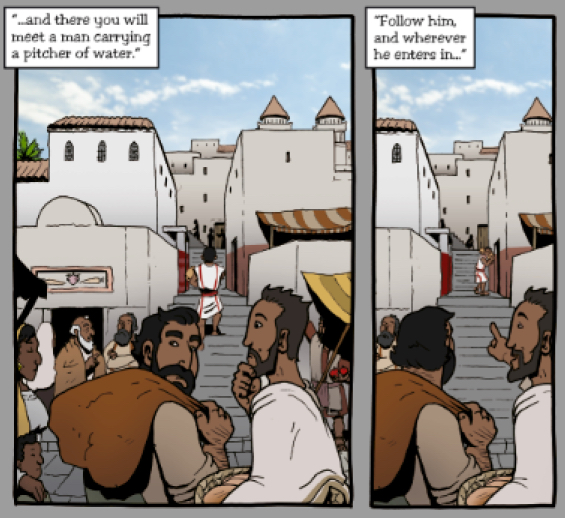
I also can’t resist mentioning how delightful I continue to find the imaginative ways in which the artist envisions the story. It has been said that reading is a creative act, and I find Pillario reading the story of Jesus, and re-telling it visually, in consistently creative ways. For example, here’s how he envisions the cloak-and-dagger episode in which Jesus’ disciples find their way stealthily to the upper room where they’re supposed to prepare the Passover supper:

Another of my favorite panels is the one that shows Jesus answering the question about paying taxes to Caesar. He asks to see a coin and he uses it to give the perfect answer, and as he does, he tosses the coin back to the person who brought it! A wonderfully imaginative way to envision that episode.

But finally, I’d also like to stress that for the artist, this isn’t just a commercial or even a creative project. It’s an act of devotion. While the graphic novel presents the text of Mark, it visually includes episodes from all the gospels. In that way, it’s a “life of Christ.” And writing (or in this case drawing) a life of Christ is a time-honored devotional endeavor. I find many places in the novel where the artist’s faith in Jesus and appreciation for his sacrifice come through clearly. Jesus is featured on the cover of the novel bound and bloodied, not calming the storm at sea or taking the little children in his arms. Jesus’ physical sufferings for us are portrayed realistically but also reverentially, not gratuitiously. Many times, as I reviewed such panels in development, I said out loud, “Hallelujah, what a Savior!” I know that’s the response the artist wants to draw forth from us.

Along those lines, one of the most moving and meaningful panels for me, which captures the artist’s faith, skill, and imaginative power all at the same time, is the one that shows Jesus willingly surrendering  to his would-be captors in the Garden of Gethsemane.

Hallelujah indeed.

Why does God allow his people to suffer while worldly people prosper?

Q. Why does God allow his people to suffer while worldly people prosper?

Your question is exactly the same one that’s asked in Psalm 73:

I envied the arrogant
    when I saw the prosperity of the wicked.
They have no struggles;
    their bodies are healthy and strong.
They are free from common human burdens;
    they are not plagued by human ills.

Surely in vain I have kept my heart pure
    and have washed my hands in innocence.
All day long I have been afflicted,
    and every morning brings new punishments.

The psalmist eventually gets an answer to this difficulty, and I’ll discuss it in a moment. But first I’d like to observe that the perception that God’s people suffer while worldly people prosper actually represents a snapshot from a particular moment in life. If we think back over our whole lives, and if we look at the people all around us, we realize that God’s people actually go through seasons of prosperity and seasons of suffering over the course of their whole lives, and so do people who live without any particular devotion for God. If we took the snapshot at a different time, it might show the godly people we know prospering and the worldly people we know suffering.

But I think the perception nevertheless points to an important issue. We would expect, everything else being equal, that God would bless those who live in devotion to him, that God would protect them from misfortunes, and for that matter that they wouldn’t create so much suffering for themselves as those who live without regard to God. In other words, we would expect a positive correlation between godliness and prosperity, and a positive correlation between ungodliness and suffering. But we don’t see this in our world. I think that’s the real concern, and it is indeed borne out by experience.

So what’s the explanation? The author of Psalm 73 finds one part of it by taking a longer-term view. He sees that in the end, the wicked will not prosper. “How suddenly are they destroyed, completely swept away by terrors!” People who pursue a path of ruthless selfishness in this life are sowing the seeds of their own destruction. God has set up the moral universe that way. And even if these consequences are not experienced in this life, they will be experienced ultimately, when God finally judges the world. As Paul wrote to Timothy, “The sins of some are obvious, reaching the place of judgment ahead of them; the sins of others trail behind them. In the same way, good deeds are obvious, and even those that are not obvious cannot remain hidden forever.

However, even this assurance may be small consolation to a person who’s faithfully trying to serve God in this life but who is struggling with suffering, persecution, and failure. The psalmist has a further insight that addresses this concern. He describes going into the temple, encountering God there, receiving reassuring insights, and finally saying to God,

Whom have I in heaven but you?
    And there is nothing I desire on earth besides you.
My flesh and my heart may fail,
    but God is the strength of my heart
    and my portion forever.

The psalmist realizes that what matters most, in this life and the next, is knowing God and loving God. In a mysterious way that we cannot understand, God works through all of the events and circumstances of our lives to help us know and love Him better. This includes allowing suffering at times. In those times, we need to trust God and cling to him all the more.

I’ve written another post that you might find helpful. It’s entitled, “Why do some people seem to suffer more than others?” In that post I observe that Amy Carmichael often said, “The love of God is very courageous.” She meant that God will courageously trust us to accept difficult situations as a part of His plan that we will only understand in the end, when we can see everything clearly. I think we have a hint of this in the middle of Psalm 73:

When I tried to understand all this,
    it troubled me deeply
till I entered the sanctuary of God;
    then I understood their final destiny.

It may not be until we enter the heavenly sanctuary of God that we are no longer troubled deeply by the problem of human suffering and the fact that it seems to affect godly people as well as ungodly ones. But when we do come into that sanctuary, we will understand not only the final destiny of the wicked, but the glorious destiny that God has been preparing us for all along, even through suffering.

“This,” as the book of Revelation says, “calls for patient endurance and faithfulness on the part of God’s people.”

Why would the Magi have wanted to worship the king of the Jews?

Q. Were the Magi Jewish? I’m thinking they must at least have been students of the Jewish Scriptures (in particular, Daniel and Micah). Otherwise, they wouldn’t have known or cared that a king of the Jews would have been born around that time. They certainly wouldn’t have cared about it enough to have made the trip to see him and had a desire to worship him. I can’t see how they could have derived all of this information from some kind of astrology.

You’re right that there was likely a Jewish influence on the Magi while they were still in “the east” (whether that means Babylon or Persia or somewhere in that area). Not all of the Jews who were taken to exile by the Babylonians returned under the Persians. For many centuries afterwards there was a flourishing Jewish community in Mesopotamia. For example, that’s where the so-called Babylonian Talmud originated in Late Antiquity (though the term “Babylon” was archaic by then). There were also distinct scribal and devotional practices that developed in this community that eventually had to be reconciled with the different ones that developed in Palestine. So the continuing Jewish community in Mesopotamia left us much evidence of its existence and activity.

Indeed, we may see the visit of the Magi as another such evidence. They were not Jews themselves; their name indicates that, at least initially and by profession, they were “magicians” and followers of Zoroastrianism. However, the term “magic” at the time included alchemy and astrology, the forerunners of chemistry and astronomy, so we should see these men as scholars of both religion and science. It’s not hard to imagine that they would have taken an interest in the religious thought and traditions of the Jews, who, like them, were monotheists. As you say, they would likely have read the Jewish Scriptures, and they could indeed have developed a Messianic expectation by reading the prophets.

We don’t know exactly what the “star” was that they saw “in the east” (i.e., while they were still in the east) or “when it rose.” (Either translation is acceptable.) A little later in Matthew’s account of their visit, after the Magi have stopped at Herod’s court and been directed to Bethlehem, there’s the puzzling statement that “the star they had seen when it rose went ahead of them until it stopped over the place where the child was.” So this wasn’t just a star that appeared in the sky in a new position, or was first recognized there, with some astrological significance. This is some kind of active agent of divine guidance. But we aren’t able to say much more about it than that.

What we can say, however, is that Matthew has a great interest in these Magi as Gentiles who have come to worship the Messiah. In the episode just before this one, an angel tells Joseph that Mary “will give birth to a son, and you are to give him the name Jesus, because he will save his people from their sins.” But ironically, the very next thing that happens is that Babylonians or Persians come and worship Jesus, while “his people”—and specifically Herod, who considers himself the “king of the Jews”—try to kill Jesus, and he has to flee to Egypt. (Where, by the way, there was another longstanding Jewish community. So there are two allusions to the Diaspora, and thus to Jewish influence on the surrounding nations, in this one episode.) This is in keeping with one of Matthew’s large themes, the inclusion of the Gentiles in the community of the Messiah’s followers. For example: “Many will come from the east and the west and take their places at the feast with Abraham, Isaac and Jacob in the kingdom of heaven.”

So the Magi were not Jews, but under Jewish influences they did come to expect the Messiah. And then they came to worship the Messiah.

Women in positions of leadership

Q. What do you think is women’s role in society in terms of positions of leadership?

I’ve devoted a series of four posts on this blog to the question of what the Bible teaches about women in leadership roles in the church. That series starts here.

Those posts are actually a summary of a longer series (17 posts, 10,000 words) that I did on the same subject for a separate blog. You can find that series here.

The bottom line for me is that there should be no restrictions within the church on what women can do, simply because they are women. And since I believe that the church is called to “live the life of the future in the present” (as Gordon Fee puts it), that is, to model the values of God’s coming kingdom even now, then I also feel that the church should help the surrounding society recognize and empower the gifts of women as well as men. This means encouraging them to fill whatever roles they can be most effective in and make the greatest contribution to the society, including leadership roles.


How to get these blog posts by email

Q. Do you email a newsletter?

What I believe you’re asking is how to get these blog posts by email. When you’re looking at any post or page from the blog, there should be a link at the bottom right that says “Follow.” If you click on that link, you’ll be given the chance to provide an email address. WordPress will send you an email at the address you provide asking you to confirm that you wish to subscribe to this blog. If you confirm, from then on you’ll get each post by email. I hope that’s helpful, and thanks for your interest.

Did the command in Romans to obey the government justify separating families?

Q. Attorney General Jeff Sessions got the whole country discussing the Bible when he quoted from Romans, “Let everyone be subject to the governing authorities, for there is no authority except that which God has established,” to defend the Trump administration’s policy (now discontinued) of separating the children of migrants from their parents. Was that a valid argument?

Attorney General Jeff Sessions addresses law enforcement officers in Fort Wayne, Indiana, on June 14, 2018. (Photo by the Fort Wayne News-Sentinel.)

I’ll address the interpretation of that passage in Romans shortly. But let me make a preliminary observation first.

Sessions quoted the Scripture about obeying government authority not in support of a law, but in support of a punishment. Here’s what he said in his speech on June 14, 2018 to law enforcement officers in Fort Wayne, Indiana (text from the Justice Department website):

“Let me take an aside to discuss concerns raised by our church friends about separating families. Many of the criticisms raised in recent days are not fair or logical and some are contrary to law. First- illegal entry into the United States is a crime—as it should be. Persons who violate the law of our nation are subject to prosecution. I would cite you to the Apostle Paul and his clear and wise command in Romans 13, to obey the laws of the government because God has ordained them for the purpose of order.”

We can see that Sessions was trying to counter criticisms of the government “separating families” on the grounds that by doing this, it was prosecuting those who “violate the law.” As an aside of my own, I would observe that it’s an open question whether a person who enters a country without prior authorization specifically to request amnesty is breaking the law. But for the purposes of argument, let’s assume that it is. A government’s responsibility to enforce the law doesn’t give it the right to use any punishment it wants. The U.S. Constitution itself forbids “cruel and unusual punishments.” The question then becomes, what does the Bible say about the punishment that Sessions was defending for such cases?

One of the most poignant passages in the Bible is Jeremiah’s description of the people of Judah mourning over the children they were separated from when the Babylonians carried their younger generation off into exile:

“A voice is heard in Ramah,
    mourning and great weeping,
Rachel weeping for her children
    and refusing to be comforted,
    because they are no more.”

The New Testament says that these words were “fulfilled” (that is, they took on a further meaning in light of later events) when Herod executed all the baby boys in Bethlehem in an attempt to kill Jesus. So in terms of family separation as a sanction, the Bible identifies Jesus with those who have suffered this punishment, not with those who would inflict it. It portrays the anguish that it causes, rather than celebrating those who use it to control populations. So I would say, to begin with, that it was not valid for Sessions to appeal to the Bible to support the punishment he was defending.

As for the passage in Romans itself, while Sessions stated that it taught that God has ordained the laws of government “for the purpose of order,” it actually says that “the one in authority is God’s servant for your good.” The Greek term is agathos; it’s also translated “welfare” or “benefit,” or “to help you.” In other words, the government is given power under God not to keep everyone in line with the way it wants things (to maintain “order”), but to promote the welfare of everyone under its control. Everything begins with God wanting good for people; God then creates governments as His agents to promote that good.

While not stated explicitly in Romans, the implication is that when governments fail in that responsibility, and particularly when they oppose what is good and become destructive of it, then God’s people no longer have an obligation to obey. Instead, they have a responsibility to disobey as a loyal protest, in order to call the government back to fulfilling its rightful role and original mandate.

(Incidentally, the American Declaration of Independence says essentially the same thing: “Whenever any Form of Government becomes destructive of these ends”—Life, Liberty, and the pursuit of Happiness—”it is the Right of the People to alter or to abolish it, and to institute new Government, laying its foundation on such principles and organizing its powers in such form, as to them shall seem most likely to effect their Safety and Happiness.” And so if Sessions was instead promoting an unconditional obedience to government, whatever its actions, he was undermining the original foundation of the American government itself.)

A single verse of Scripture never contains the whole counsel of God. We must consider the teaching of the entire Bible on a given question in order to understand the answer to that question in a full and balanced way. And the Scriptures provide numerous examples of people who resisted and disobeyed their governments in order to be faithful to God’s purposes. These examples are informative, and they fill out the picture provided in Romans.

Moses’ parents hid him rather than obey Pharaoh’s order to kill him by drowning him into the Nile. Shadrach, Meschach, and Abednego refused the command to bow down to Nebuchadnezzar’s idol, and they were thrown into a fiery furnace. Daniel broke the law that Darius passed that no one could pray to anyone but himself; Daniel continued to pray to God, and he was thrown into a den of lions. (In all of these cases, God miraculously or providentially preserved the lives of those who disobeyed for the sake of faith and conscience. We must recognize that this may not always be the case, and we must be prepared to suffer if necessary.)

Jesus himself was accused on many occasions of breaking the law, for example, when he healed on the Sabbath. His response was that it was lawful on the Sabbath to do “good.” In Mark and Luke, this is the exact Greek term that Paul uses in Romans (agathos); in Matthew, it’s a synonym (kalōs). Either way, the argument is the same: God’s desire to do good for people comes first; laws come second, to support that.

When the Jewish government authorities forbade the apostles from speaking about Jesus, they continued to do so anyway. When the authorities arrested them and demanded to know why they’d done this, the apostles responded, “We must obey God rather than any human authority.” So according to the Bible, obedience to government is not an absolute, unconditional obligation. Instead, God’s people have a responsibility to hold the government accountable for fulfilling the purpose for which it has been constituted, which is to promote the welfare of everyone under its control. By this test, the policy of family separation was not a biblically valid exercise of government authority.

We may note, finally, that the apostle Paul, who wrote in Scripture that everyone should be subject to the governing authorities, was himself executed by the Romans as a lawbreaker. The charge was that he was promoting loyalty to Jesus rather than to Caesar.


Was Jesus a legal or an illegal refugee?

Q. What do you think of this recent comment by Paula White (spiritual advisor to Donald Trump)? “Many people have taken biblical Scriptures out of context on this [issue of immigration] to say stuff like, ‘Well, Jesus was a refugee.’ Yes, He did live in Egypt for three and a half years. But it was not illegal. If He had broken the law then He would have been sinful and He would not have been our Messiah.”

The concept of legal vs. illegal immigration, when applied to the ancient world, is anachronistic and irrelevant. Ancient countries didn’t forbid foreigners to enter if they didn’t have certain permissions. (As one Christian leader has already observed in response to White’s comment, the concept “hardly applied during Jesus’ time, centuries before the existence of modern nation-states that issue passports and visas to regulate migration.”)

Rather, the issue was how the local population would treat foreigners who came to stay among them. And the biblical Scriptures are very clear about how God’s people should treat them. God told the Israelites, “When a foreigner resides among you in your land, do not mistreat them. The foreigner residing among you must be treated as your native-born. Love them as yourself, for you were foreigners in Egypt. I am the Lord your God.”

Jesus was a very particular kind of refugee: an asylum seeker. That is, he fled for safety to another country because he would have been killed if he had stayed in his own country. The fact that this “was not illegal” is the whole point. Trying to criminalize asylum seeking, whether in law, or through the way government policy is carried out, or in the popular imagination, is a  departure from a time-honored international standard of justice and compassion.

If Jesus had been killed by Herod, he couldn’t have been our Savior, either.

What is a wounded spirit?

Q. My question is about the proverb, “The spirit of a man will sustain his infirmity; but a wounded spirit who can bear?” What is a wounded spirit? I cannot find any other reference in Scripture to a “wounded spirit,” but it seems as though it would be important. Generally, the word “wounded” means an injury coming from a source outside the self. I have read commentaries that claim this wound comes from God—which, if true, is a wound to my own spirit. I need enlightenment and hope you can help. Thank you.

Given your concerns, I think it’s important to clarify right up front that this proverb isn’t saying anything about God. It’s an observation about the human condition. It’s saying in essence that emotional suffering is much harder to endure than physical suffering.

The proverb actually gives the reason for that. When we’re sick—the most likely meaning of “infirmity” here—our “spirit” allows us to “manage.” (That’s how I’d translate the term that the King James Version renders as “sustain.” The same term is used in Psalm 112 to describe those who “manage their affairs with justice.”) That is, if we have hope, courage, and determination, we can make it through an illness with grace and dignity. But if our spirit, the very faculty we depend on to make it through tough times, is damaged itself, this proverb asks, how will we ever manage?

The word translated “wounded” in the KJV refers to the condition a person is in after being struck or beaten. Other translations render it as “broken” or “crushed.” But since it’s referring to something that happens to our “spirit,” it should be taken figuratively rather than literally. It’s describing how the events of life can come along and “beat us down,” and then we are so discouraged and despairing that we feel as if we just can’t make it.

And so I think we do well to ponder the question this proverb poses: How will we ever manage? The implied answer seems to be that we need others to come alongside us and strengthen us from the outside, because we can no longer do that for ourselves from the inside. And while there’s a clear mandate throughout Scripture for us as people to help our fellow humans in this way, and to expect and accept their help ourselves, the Bible also portrays God as actively helping those who are in this situation.

I’m not sure, either, if there’s another reference to a “broken spirit” in the Bible, but there certainly are other expressions that seem synonymous. Psalm 147, for example, says that the Lord “heals the brokenhearted and binds up their wounds.” The word translated “broken” here means “shattered,” and “heart” is roughly a synonym for “spirit.” So the Lord does not wound our spirits or break our hearts; just the opposite. He heals them.

Significantly, the “servant of the Lord” figure in Isaiah says that the Lord has anointed him, among other things, to “bind up the brokenhearted” and “comfort all who mourn.” Jesus applied this Scripture directly to himself at the beginning of his ministry when he read from the scroll of Isaiah in the Nazareth synagogue. (The selection he’s portrayed as reading doesn’t specifically include the parts about binding up the brokenhearted and comforting those who mourn, but it was characteristic of the time to cite part of a passage as a way of referring to it all.)

So the mission of Jesus is intrinsically involved in ministering to a wounded spirit or broken heart. In his own teaching, Jesus promised that those who mourned would be comforted. He also said, “Come to me, all who labor and are heavy laden, and I will give you rest. Take my yoke upon you, and learn from me, for I am gentle and lowly in heart, and you will find rest for your souls.” The proverb we’re discussing asks who can “bear” a wounded spirit; the image is of something too hard to carry. So the idea of Jesus wanting to lighten the load of those who are “heavy laden” applies directly.

About the only place from which I can imagine someone might get the idea that God would wound the human spirit is the passage in Isaiah that says of the servant of the Lord, “Surely he has borne our griefs and carried our sorrows; yet we esteemed him stricken, smitten by God, and afflicted.” The term translated “smitten” here is basically the same root, with a variant spelling, as the one translated “wounded” in the proverb. But the whole point of the passage in Isaiah is that we were wrong to think that the servant was wounded by God. Particularly from a New Testament perspective, we can see that instead God was in Christ, enduring this suffering on our behalf—not inflicting it on us.