What about the law in the Bible about masters beating their slaves?

Q. An atheist has challenged me about a problem in the Bible that I have been trying to resolve.  In Exodus 21:21 it says about a slave who is beaten by his master, “Notwithstanding, if the slave survives for a day or two, the master shall not be punished: for the slave is his money.” How is this consistent with a compassionate God who wants to protect the weak?  Can you help me with this?

Thanks for your question.  This law in Exodus is one that compassionate people of faith really struggle with, as it seems to suggest on first reading that once masters have paid for slaves, they can do anything with them that they want.  But I believe that the proper way to understand this law is by recognizing that it was originally intended to protect slaves from severe beatings.

Someone asked me about that same law on this blog earlier this year, as one of a number of questions about slavery and the Bible. Here’s what I said in response:

* * * * *

The law in Exodus about beating a slave should not be understood in any way as giving permission to masters to beat their slaves severely, so long as they don’t quite kill them.  For one thing, this law specifies that if a slave dies immediately from a beating, the master must suffer the death penalty, just as in the case of a free person being murdered. The Hebrew says literally, “vengeance shall surely be taken.”  The NIV says that the master “must be punished,” but this is not specific enough; the ESV says that the slave “shall be avenged,” and this is clearer.  The first part of this law provides the same protection for slaves as for free persons, an unusual and perhaps unique piece of legislation among ancient cultures.

The second part of this law says that if the slave does not die immediately, but after a day or two, “he is not to be avenged,” that is, the master does not suffer the death penalty.  The reasoning behind this stipulation is that the slave’s survival for a time suggests that the killing was not intentional. The law of Moses carefully distinguishes between the penalties for murder and manslaughter (that is, for intentional and unintentional killings).  The explanation “for the slave is his money” does not mean that the master has bought and paid for the slave and so can do anything with him that he wants.  Rather, the meaning is that the loss of the price of the slave, a significant sum in the ancient world, punishes the master sufficiently for manslaughter.  The master has, in effect, punished himself.

Even though understanding more about the background and intent of this law can help us recognize that it is designed to protect slaves, not the masters who beat them, it is still a very difficult law for compassionate followers of Jesus to read today in the Bible.

* * * * *

I hope this helps answer your question.  If you have more concerns, please comment on this post and I’ll try to respond to them.

Does the Bible tell women to wear head coverings?

I recently learned about the “Head Covering Movement” through a post asking about it on the Christians for Biblical Equality Facebook group.  In response to this movement, I’d like to use this post to make clear what I believe is the biblical teaching on this subject:

Women who wear head coverings are choosing to do something that the Bible says they should always be free to choose.  

But they are not doing something that the Bible commands all women to do.

This is the conclusion of a detailed study I made some years back with Laurie C. Hurshman on Paul’s teaching about the subject of head coverings in 1 Corinthians.  The study was published in Christian Ethics Today and it was later reprinted in Priscilla Papers, the journal of Christians for Biblical Equality.  I will summarize it here; you can read the longer version at the link just provided.

Paul’s assertion that “a woman ought to have exousia over her head” is the key statement in his teaching about head coverings, and the meaning of the word exousia is the key to understanding this statement.

Paul uses this term frequently in 1 Corinthians in both the noun form (exousia) and in the impersonal and personal verb forms (exesti and exousiazein, respectively).  Everywhere else in the epistle, the term refers to authority exercised, specifically in the sense of “being able to do what one wishes.”  (In the examples below, the English translations of this term are italicized.)

– When correcting the Corinthians for going to temple prostitutes, Paul says, “I have the right to do anything” (probably quoting the Corinthians’ slogan back to them) “—but I will not be mastered by anything.  More literally, “I can do whatever I wish, but I will not have anything do whatever it wishes with me.”

–  In the very next section of the letter, when discussing the Corinthians’ belief that it was somehow spiritual to abstain from sexual relations in marriage, Paul writes, “The wife does not have authority over her own body but yields it to her husband. In the same way, the husband does not have authority over his own body but yields it to his wife.”  Again, more literally, “the wife does not have the right to do whatever she wishes with her own body, nor does the husband with his body, but they are to share their bodies with one another.”

–  As Paul continues his discussion of marriage and addresses engaged persons, he says that the one who “is under no compulsion but has control over his own will” can postpone marriage.  Once more, the reference is to one who has the freedom and the power to do what he wishes with his own will.

–  When talking about food offered to idols, Paul acknowledges that those who are spiritually strong may eat this food without danger, but he immediately adds, “Be careful, however, that the exercise of your rights does not become a stumbling block to the weak.”  Exousia here means the freedom and ability to eat the food without stumbling.

–  As Paul continues this discussion of food offered to idols, he uses the term exousia several times to describe his own rights as an apostle so that he can illustrate the principle of voluntarily giving up rights.  He asks, “Don’t we have the right to food and drink? Don’t we have the right to take a believing wife along with us? . . . If others have this right of support from you, shouldn’t we have it all the more?” But then he adds that “in preaching the gospel I may offer it free of charge, and so not make full use of my rights.”

– Finally, in his discussion of the resurrection, Paul describes how Jesus will destroy every opposing “dominion, authority and power.”  In this case exousia describes a being who exercises authority.

Since exousia means authority exercised consistently throughout 1 Corinthians, there’s no reason to believe that when Paul talks about head coverings, the same term means authority submitted to, without any qualifying language indicating that Paul has suddenly given it an opposite connotation.

No, Paul is saying that “a woman ought to have freedom of choice regarding her head,” as Gordon Fee translates this statement in his commentary on 1 Corinthians.  In other words, she should be free to wear a head covering, or not, based on her own convictions before God.

The NIV translation is quite accurate here:  “A woman ought to have authority over her own head.”  By contrast, in my view, translations like the ESV, “A wife ought to have a symbol of authority on her head,” badly miss the point.  They turn a proclamation of freedom into a restriction.  (The words “a symbol of” appear nowhere in the Greek; they have been added by the ESV translators.)

So why did this question arise in Corinth in the first place?  I think it’s a reasonable deduction that if Paul is insisting on a woman’s freedom to wear a head covering if she wishes, it’s likely that the Corinthians were forbidding women to wear head coverings for some reason.  (There’s a fuller discussion of one possible reason in the published version of our study and in my guide to Paul’s Journey Letters.)

But whatever the reason, since the essential point of Paul’s statement is freedom, it would be just as incorrect today for anyone to require women to wear head coverings as it was for the Corinthians to forbid this.  The principle should be, as Paul wrote to the Romans about all such matters of individual conviction, “Each one should be fully convinced in her own mind.”

So if a woman feels that she is honoring God (and perhaps her husband, if she’s married) by wearing a head covering, no one should forbid or discourage this.  But if a woman feels that she does not need to do this in order to honor God (or her husband), no one should require or even encourage this.  But full information about the choice, based on a sound interpretation of the relevant biblical material, should be provided to all who are interested.

And then, “A woman should be free to wear a head covering, or not, based on her own convictions before God.”

Why did Jesus say we should hate our families?

Q.  Some of Jesus’ teachings have puzzled me over the years.  While some may have been part of a parable, others were definitely spoken directly to people as instructions.  Take this one:  “If anyone comes to me and does not hate father and mother, wife and children, brothers and sisters—yes, even their own life—such a person cannot be my disciple.”  I thought we were supposed to love even our enemies.  So why does Jesus say we should hate our families?

In this earlier post I explain that when Jesus says we should love our enemies, he doesn’t mean that we’re supposed to feel a warm and delighted attraction to people who have hurt or betrayed us, a feeling that makes us want to be in a close relationship with them.

Rather, we should understand “love” in this case to be a commitment, not a feeling.  We commit to doing whatever is in that person’s best interests, in the hopes that this will help them realize that they’ve done wrong and lead them to pursue restitution and reconciliation.

It’s just the opposite when Jesus says that we should “hate” our families.  He’s not saying that we should be committed to doing whatever is most harmful or hurtful to them.  Rather, in this case, he’s talking about a feeling, not a commitment.

Jesus is saying that we should be so devoted to him as his disciples that if anything or anyone should ever threaten to come between us and him, we would react to this with a strong feeling of antipathy and revulsion that makes us choose Jesus over that person or thing, without hesitation.

In the culture in which Jesus lived, family loyalty was probably the thing that was most likely to come between a would-be disciple and Jesus.  (The same is still true in many parts of the world today.)  And so Jesus is saying that if your family members try to keep you from following me, you have to react with such horror and revulsion that you’re prepared to lose your relationship with them in order to become and remain a disciple of mine.

Beyond this, however, Jesus told his followers to be very careful to follow the commandment to honor their parents.  This included doing such things as providing for them in their old age.  Jesus’ earliest followers similarly taught the importance of caring for family.  So Jesus’ words about “hating” family must be understood only in the context of never letting anything come between us and our loyalty to God.

To state the matter simply, when Jesus says we should love our enemies, he’s talking about a commitment, not a feeling.  When Jesus says we should hate our families (if they would come between us and him), he’s talking about a feeling, not a commitment.

Can we truly love our enemies?

Q.  Jesus said, “Love your enemies.”  Forgiveness is one thing, but I think this is impossible.

Jesus would certainly be asking us to do something unreasonable, if not impossible, when he tells us to love our enemies–people who have hurt us, or violated our trust, or taken advantage of us, or who are out to get us–if love means a feeling, a warm and delighted attraction to another person that makes us want to be in a close relationship with them.  A person who’s been badly hurt by someone else simply can’t force themselves to feel those things towards that other person.  Our feelings and emotions aren’t under our control in that way.

But the kind of love for enemies that Jesus commands isn’t a feeling.  It’s a commitment.  It’s a decision of the will, which is under our control.  Specifically, love is the commitment to act consistently in the best interests of another person.

This is clear from the way Jesus immediately elaborates on his statement:  “I say to you that listen, Love your enemies, do good to those who hate you, bless those who curse you, pray for those who abuse you.”  He’s talking about actions, not feelings.

This is also how Jesus’ earliest followers understood his statement.  Paul writes in Romans, for example, “Do not repay anyone evil for evil, but . . . if your enemies are hungry, feed them; if they are thirsty, give them something to drink . . . do not be overcome by evil, but overcome evil with good.”

The goal, in other words, beyond forgiving someone who has hurt us (which sets us free from bitterness and the hold that the other person’s action might otherwise have over us), is to choose to pursue their best interests in our actions towards them, so that good triumphs over evil.  This also makes own our character more godly, as Jesus goes on to explain:  “Love your enemies, do good, and . . . you will be children of the Most High; for he is kind to the ungrateful and the wicked. Be merciful, just as your Father is merciful.”

Doing loving actions as a commitment to another person’s good may mean, however, actually breaking off our relationship with them for a time, if they would only hurt us again if we stayed in relationship.  We aren’t called to enable other people’s destructive behavior.  There need to be positive signs of change on their part before it’s safe for us to pursue reconciliation, beyond forgiveness.  But we can still pray for them and hope for the best for their lives.

In other cases, we may be able to do something practical to help them, and when we do this, it might even enable them to recognize that they were acting wrongly and that they need to change.  But we need to be led carefully by God’s Spirit to do, in any given case, what is healthy and appropriate for us and the other person.

So, to sum up, the kind of love Jesus commands us to have for our enemies isn’t a feeling.  It’s a commitment to act consistently in the best interests of another person.  And I believe, God helping us, we can do that even for our enemies.

If everyone in a Community Bible Experience is using the NIV, how can they become aware of valid alternatives for translating specific passages?

Q. The Books of the Bible uses the text of the NIV translation. I agree that the NIV is one of the best overall translations. 

But as some of the conclusions of my studies, I think there are some places where I think they translate the text in a poor way. I accept that translation will always involve interpretation, but I think that in some cases, the translators have misunderstood what the text meant and in some cases it is simply unclear what the authors meant, but the translators made their best guess among a range of possibilities. 

What do you do when you run into these situations when discussing such texts when reading big chunks in community?

893428_578481578838159_849089837_o
Participants in a Community Bible Experience in western Ireland. Photo courtesy CBE Facebook page.

I personally consider the NIV to be the most accurate and readable translation available in English today.  But I acknowledge that no translation of the Bible can convey every possibility of meaning that’s present in the original languages.

As you say, sometimes a range of possibilities is present in what an author says, and translators must make a choice among these possibilities.  When they do, English readers miss out on the others.  Beyond this, translation necessarily requires a tradeoff between wording and syntax in Greek and Hebrew and meaning in English.  Different translations will favor one or the other in any given case, with different results conveyed to readers.

Ordinarily, one of the best ways to overcome this difficulty is to make sure that a group of people who are reading and studying the Bible together are using a number of different translations.  People will typically speak up when their Bible says something different from someone else’s, and this helps the group appreciate the various ways that words or phrases could legitimately be translated.

But there’s also great value, in an activity like a Community Bible Experience, in having everyone use the same translation.  As they each “read big” using The Books of the Bible and then come together to share their observations and reflections, they’ll be drawing on a shared experience of the Scriptures that will allow them to connect with one another quickly and deeply.

So how can the liabilities of a single translation be overcome in a situation like this?

For one thing, typically a whole church will do a Community Bible Experience together, and when they do, the messages in worship will be coordinated with the readings.  This provides an ideal opportunity for the preacher to point out and explain any places in that week’s readings that have a range of meanings that one translation alone can’t bring out.  (This presumes that preachers will prepare well and study the Scriptures in the original languages, or at least use resources that help disclose their meaning!)

Beyond this, it’s ideal to alternate “read big” experiences of the Bible with “go deep” experiences.  After spending several weeks reading through a big chunk of the Scriptures, it’s good for a church or similar group to go back and study one or more biblical books within that chunk for an extended period of time, before reading through another big chunk together.  And in that time of more detailed study, it’s natural for people to explore other ways that biblical words and phrases can be understood.

In fact, one of the original ideas behind the Understanding the Books of the Bible study guide series was that they would make a great “next step” for groups that did Community Bible Experiences.  The guides are based on the NIV (it’s a privilege to be able to use such a great translation), but in many places they explain the range of meanings implicit in a biblical word or phrase and suggest alternative ways of translating it.

So the “go deep” season of study that ideally follows a “read big” season can, like preaching during a Community Bible Experience itself, provide an opportunity for people to move beyond the necessary limitations of a single translation, without losing the advantages of using that translation for their readings together.

Studying the Bible without chapters and verses

A commenter on this post wrote that The Books of the Bible was “great for just reading,” but that a “regular Bible” was “almost necessary to study.”

In response, I insisted that The Books of the Bible, which takes out the chapter and verse numbers and presents the biblical books in their natural literary forms, actually makes a great “study Bible” as well.  That’s how this series of study guides could be created to be used with it (although the guides can be used with any version of the Bible, as this post explains.)

I also promised to share a real-life experience that illustrated what “studying the Bible without chapters and verses” looks like, as related in my book After Chapters and Verses.  Here’s the story.

I was recently part of a Bible study group that was going through the book of Daniel.  When we took up the third episode in the book, the participants were fascinated to hear how Nebuchadnezzar had made a statue ninety feet high out of gold.  Some of them glanced down at the notes in their Bibles and read them out loud to try to help the group understand why he’d done this.

One note suggested that using gold for a huge statue was an ostentatious display of the wealth, power and prosperity of the empire.  A note in another Bible observed that a huge gold statue would have been overwhelmingly bright and dazzling.  But I asked the members of the study to consider whether anything we’d encountered earlier in the book of Daniel would explain why Nebuchadnezzar had made this statue out of gold.

They thought back to the previous episode, which we’d discussed the previous week.  They remembered that the king had had a dream about a statue.  Its head was made of gold, but its chest and arms were silver, its torso and thighs were bronze, its legs were iron and its feet were made of iron and clay.  Daniel’s interpretation of the dream was that Nebuchadnezzar’s empire, symbolized by the gold head, would be displaced by an inferior empire, which would then be replaced by another, and then another, in the years to come.

In light of this dream and its interpretation, our group recognized that Nebuchadnezzar had created a statue entirely out of gold to offer a direct and very public rejection of the message he’d received from God.  He was saying, using the very symbolism of the dream God had sent him, that his own empire would actually last forever and never be displaced.  And by insisting that all the officials in his kingdom bow down to this statue, he was requiring them to join him in contradicting God’s revealed vision of the future, and to give their allegiance to him and his empire instead.  No wonder Daniel’s friends felt they had to disobey!

Our group wouldn’t have found such satisfying answers to its questions, and we’d have missed an essential dynamic within the book, if we’d simply “read the study notes” and moved on.  We got a much greater insight into the passage when we understood how it functioned within the book of Daniel.

But we haven’t been trained to study the Bible this way.  We haven’t been taught that we need to read first in order to be able to study afterwards.  In fact, we haven’t been encouraged to “read” at all, not in a continuous way.  We’ve more often been  asked to consider isolated parts of larger works (“chapters” or “verses”) without being shown how they fit within a whole book and how we can appreciate the meaning they have there.  We’ve been encouraged to try to understand them instead by looking at other isolated biblical passages in series of cross-references, or by consulting the notes in our Bibles, study guides and commentaries, or asking our pastors, teachers and group leaders.

In other words, our definition of “studying the Bible” has been moving back and forth between the text and explanatory resources.  This approach to Bible “study” isn’t effective.  The units it engages typically aren’t the structurally and thematically meaningful ones within a book.  Even when they are, we don’t appreciate the meaning they receive from their place within the book as a whole.  This kind of studying can easily devolve into a running commentary on interesting or puzzling features of an ill-defined stretch of text.  It depends on people having an implicit trust in the knowledge and trustworthiness of group leaders and the authors of notes and guides.

We really need to adopt a new definition of what it means to “study the Bible”:  considering the natural parts of a biblical book to recognize how they work within the book as a whole.  This means that studying has to be the second step in a process whose first step is reading.

It also means that the best “study Bible” is one like The Books of the Bible that first makes a great “reading Bible.”

Couldn’t “turning the other cheek” get someone seriously hurt?

Q.  Jesus said we should “turn the other cheek” if someone hits us.  But couldn’t we be seriously hurt if we don’t defend ourselves against an attacker?

Jesus’ teaching about “turning the other cheek” comes at a point in the Sermon on the Mount where he’s contrasting later interpretations of the law of Moses with the true spirit of that law.

In this case, he’s talking about a law that specified that the community should mete out proportionate justice for offenses:  “an eye for an eye and a tooth for a tooth.”  This law was designed to prevent individuals from taking vengeance, and also to prevent disproportionate punishments (whether too lenient or too severe).

However, by the time of Jesus, people were taking the idea of “an eye for an eye” to mean that they should “keep score” personally.  Whatever someone does to you, you do back to them.  In other words, they were appealing to Scripture to justify grudges and feuds!

So Jesus basically tells them, “Don’t keep score.”  Let the other person get “one up on you,” without trying to even the score, in the interests of pursuing reconciliation and peace.

Jesus gives several examples of how not to keep score.  Lend or give money without expecting repayment.  If someone sues you, settle with them generously.  If one of the occupying Roman soldiers exercises his right to force you to carry his load for a mile, carry it an extra mile.  (As it has been observed, you go the first mile as a conscripted laborer, but you go the second mile as a potential friend.)

As for “turning the other cheek,” it’s important to recognize that Jesus says specifically to do this if someone slaps you, not if they punch or strike you.  (See this thread for a discussion of the translation.)  In the time of Jesus, slapping was intended as an insult, not to cause injury.  So the idea is that you don’t return insult for insult; instead, you say with your actions, “Insult me again if you want, but I’m still interested in reconciliation and friendship with you.”

Jesus’ early followers “got it” and they present the same idea in their writings.  Peter says, “Do not repay evil for evil or insult with insult. On the contrary, repay evil with blessing.”  Paul says similarly, “Do not repay anyone evil for evil . . . as far as it depends on you, live at peace with everyone.”

It must be emphasized that Jesus is not saying here that we should allow ourselves to be beaten up and injured without trying to defend ourselves or escape.  There’s no imperative for followers of Jesus to suffer bullying, domestic violence, and the like without protest or resistance.  If we really want to live out the spirit of this teaching and pursue what’s best for the other person, we need to take the necessary measures to stop them from being violent and help them understand how to relate to others in a proper and healthy way.

Was Paul wrong to have Timothy circumcised?

Q.  In Acts it says that when Paul wanted to take Timothy along on his travels, “he circumcised him because of the Jews who lived in that area, because everyone knew his father was a Greek.”  That’s not a very detailed explanation. I’m interested in more details on what the reasoning might have been and whether we might consider this to have been a mistake on Paul’s part. Was he giving in too much to the circumcision group?

This is an excellent question and it’s fair game to ask whether Paul made a mistake here. I don’t actually discuss this question in my Luke-Acts study guide, so I’d like to share some thoughts about it here.

One of the basic principles of biblical interpretation is, “Narrative is not necessarily normative.”  Just because the Bible describes, without negative comment, how a leader like Paul did something, that doesn’t automatically mean it was the right thing to do.

In fact, elsewhere in the book of Acts Paul makes a mistake and then later admits it.  After his arrest in Jerusalem, during his preliminary trial before the Sanhedrin, Paul realized that the council was made up half of Pharisees and half of Sadducees (who denied the resurrection). In order to split the opposition, he called out, “I stand on trial because of the hope of the resurrection.”

The ploy worked, but Paul later regretted resorting to such devious means.  In his subsequent trial before Felix, he insisted that he’d done nothing wrong so far as the Sanhedrin was concerned, “unless it was this one thing I shouted as I stood in their presence: ‘It is concerning the resurrection of the dead that I am on trial before you today.’”

So it is possible that Paul had Timothy circumcised out of fear of the Judaizers, who insisted that circumcision was necessary for good standing before God.  We can’t know for sure what Paul’s real motive was.  But we can at least ask, “Could he have done this for a good motive?  If so, what might that have been?”

The possible good motive is this:  Paul might have been encouraging Timothy to use his freedom to be circumcised.  Paul wasn’t opposed to people becoming circumcised in general, but only if they thought this was necessary to put them in better standing with God.  At the end of Galatians, Paul wrote, “neither circumcision nor uncircumcision means anything; what counts is the new creation.”  So it doesn’t matter if a person is circumcised.  They can do so for a good reason.

Timothy had a good reason.  His mother was Jewish, and now that he was a young adult who could make his own decisions about such things, he could be circumcised as a way of embracing and expressing that part of his heritage.  This would give him the added advantage of being able to work with Paul among Jews who wouldn’t have the obstacle of seeing him as an “unclean Gentile.”  In other words, this expression of freedom (freedom to rather than freedom from) would open doors of ministry for him.  In that sense, it would be legitimate and well-advised.

To offer a contemporary analogy, suppose you’re a female follower of Jesus who’s living in a Muslim country.  You want to get to know your neighbors so they can hopefully see from your life what a follower of Jesus is really like.  You could choose to wear a head scarf so that your uncovered hair wouldn’t be an obstacle to the people around you.  If you did, would you be giving in to legalism?  Or would you be using your freedom to wear a scarf to open potential doors of opportunity?

I personally believe that was the same choice Paul was helping Timothy make in Acts.

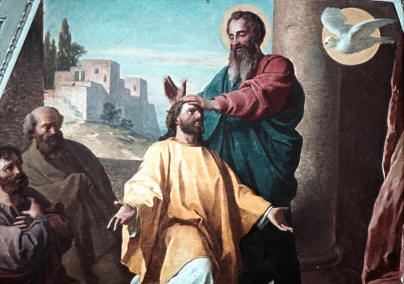
Paul lays hands on Timothy

How could Melchizedek have had no father or mother?

Q.  How can the book of Hebrews say that Melchizedek, the priest who blessed Abraham, was “without father or mother” and “without beginning of days or end of life”?  Wasn’t he human?

Byzantine icon of Melchizedek

Here’s what I say about this in my study guide to Deuteronomy and Hebrews, where I note that the author of Hebrews talks about Melchizedek in the third of the four messages or sermons that make up the book:

* * * * *

This message is based primarily on Psalm 110, but in it the author characteristically draws on other Scriptures for support, in this case the story in Genesis that describes who Melchizedek was.

The author first translates the word Melchizedek, explaining that it means “King of Righteousness.” Melchizedek was most likely not a given name, but an honorary title of the Jebusite kings who formerly ruled in Jerusalem, including the one in the Genesis story who greeted Abraham. (A similar example of an honorary title is the name Pharaoh that was given to all the rulers of Egypt.)

After the Israelites conquered Jerusalem, their own kings took over the title Melchizedek. Since the Jebusite kings had been priests, the Israelite kings also assumed an honorary role as priests and interceded for the nation in prayer. But they were not allowed to offer sacrifices; this was reserved for the descendants of Aaron under the law of Moses.

The author next explains that King of Salem (that is, of Jerusalem) means “King of Peace.” By translating these two terms, the author identifies Jesus, who is a priest in the order of Melchizedek by virtue of being the Messianic king of Jerusalem, as someone who helps people become righteous before God and so find peace with God.

Now come some more significant details—or rather, a significant lack of them. The Hebrew Scriptures usually introduce a new figure into their narratives by describing the person’s parentage and ancestry. They usually also report when a figure dies. But the book of Genesis doesn’t do either of these things in the case of Melchizedek.

This allows the author of Hebrews to observe that, when considered only in light of what the Scriptures say about him, Melchizedek seems to have no origin or ending. He appears to “remain a priest forever.” In this way he “resembles the Son of God,” and this allows him to serve as an earthly representation of the Messiah. This is why the Lord chose to name him as the head of the order of priests to which the Messiah (represented in Psalm 110 by the Davidic king) would belong.

This is a classic example of the author’s typological method, which is based on the understanding that transcendent spiritual realities are reflected in earthly replicas. A little later in this message the author makes the basis of this method explicit, noting how the earthly tabernacle had to be modeled after the heavenly pattern Moses was shown. The Greek word is typos, the source of the English word type, and so this interpretive method is known as typology.

* * * * *

To summarize what I say in the guide, the author of Hebrews is able to establish a connection between Melchizedek and Jesus by considering Melchizedek in light of what the Scriptures say about him (that his title means “king of righteousness” and that he was king of Salem = “peace“), but only in light of what the Scriptures say about him, not what they don’t say.  Since the details of his parentage, birth, and death aren’t reported, this allows an even stronger typological connection to Jesus, who has a permanent priesthood “on the basis of an indestructible life.”

In other words, the key to understanding how the Bible could say that Melchizedek was “without father and mother” and “without beginning of days or end of life” lies in appreciating the distinctive typological method of the book of Hebrews.

Why did Jesus entrust His mother Mary to John’s care?

Q.  When Jesus was dying and entrusted his mother to John, does that mean Joseph was dead?

Jesus entrusts Mary to John’s care. Chapel Nosso Senhor dos Passos, Santa Casa de Misericórdia of Porto Alegre, Brazil.

Yes, most interpreters believe that Joseph had died and that Jesus, who had been responsible to care for his mother as the eldest son in the family, was asking John to take on this responsibility.

This shows us two remarkable things:

(1) Even at his time of greatest suffering, Jesus was thinking of others, not himself.

(2) The family of the kingdom of God takes precedence over human families. Jesus had at least four brothers whom he might have asked to take on this responsibility, but instead he gave it to a “brother” in the kingdom.

To explore this episode a little further, one fascinating and beautiful aspect of the account of Jesus’ crucifixion in John’s gospel is the way it’s arranged as a seven-part chiasm:
A: Jesus is Brought to the Place of Execution
B: Pilate Refuses the Jewish Leaders’ Request to Change the Inscription
C: The Soldiers At the Cross Cast Lots for Jesus’ Clothes
D:  Jesus Entrusts Mary into John’s Care
C: The Soldiers At the Cross Give Jesus Wine to Drink
B: Pilate Grants the Jewish Leaders’ Request to Break the Legs of the Crucified Prisoners
A: Jesus is Taken from the Place of Execution

As I note in my study guide to the gospel of John, the central placement within this arrangement of the episode in which Jesus entrusts Mary to John’s care “shows that Jesus was a person of compassion who extended mercy and care to others right to the very end of his life.”

“But,” I also observe, “it’s interesting that an account of the crucifixion would not have Jesus’ actual death at its center.  John may have an additional purpose for including this episode and placing it where he does.  He may be putting his central focus on the effects of Jesus’ death.  John may be portraying how Jesus’ death is for ‘the scattered children of God, to bring them together and make them one.’  Through his death, believers in Jesus become part of a new family, which is their true family.”

I then ask in the guide:  “Are there some other followers of Jesus who are ‘just like family’ to you?  What creates the bond between you?”

What would you say?