Couldn’t “turning the other cheek” get someone seriously hurt?

Q.  Jesus said we should “turn the other cheek” if someone hits us.  But couldn’t we be seriously hurt if we don’t defend ourselves against an attacker?

Jesus’ teaching about “turning the other cheek” comes at a point in the Sermon on the Mount where he’s contrasting later interpretations of the law of Moses with the true spirit of that law.

In this case, he’s talking about a law that specified that the community should mete out proportionate justice for offenses:  “an eye for an eye and a tooth for a tooth.”  This law was designed to prevent individuals from taking vengeance, and also to prevent disproportionate punishments (whether too lenient or too severe).

However, by the time of Jesus, people were taking the idea of “an eye for an eye” to mean that they should “keep score” personally.  Whatever someone does to you, you do back to them.  In other words, they were appealing to Scripture to justify grudges and feuds!

So Jesus basically tells them, “Don’t keep score.”  Let the other person get “one up on you,” without trying to even the score, in the interests of pursuing reconciliation and peace.

Jesus gives several examples of how not to keep score.  Lend or give money without expecting repayment.  If someone sues you, settle with them generously.  If one of the occupying Roman soldiers exercises his right to force you to carry his load for a mile, carry it an extra mile.  (As it has been observed, you go the first mile as a conscripted laborer, but you go the second mile as a potential friend.)

As for “turning the other cheek,” it’s important to recognize that Jesus says specifically to do this if someone slaps you, not if they punch or strike you.  (See this thread for a discussion of the translation.)  In the time of Jesus, slapping was intended as an insult, not to cause injury.  So the idea is that you don’t return insult for insult; instead, you say with your actions, “Insult me again if you want, but I’m still interested in reconciliation and friendship with you.”

Jesus’ early followers “got it” and they present the same idea in their writings.  Peter says, “Do not repay evil for evil or insult with insult. On the contrary, repay evil with blessing.”  Paul says similarly, “Do not repay anyone evil for evil . . . as far as it depends on you, live at peace with everyone.”

It must be emphasized that Jesus is not saying here that we should allow ourselves to be beaten up and injured without trying to defend ourselves or escape.  There’s no imperative for followers of Jesus to suffer bullying, domestic violence, and the like without protest or resistance.  If we really want to live out the spirit of this teaching and pursue what’s best for the other person, we need to take the necessary measures to stop them from being violent and help them understand how to relate to others in a proper and healthy way.

Was Paul wrong to have Timothy circumcised?

Q.  In Acts it says that when Paul wanted to take Timothy along on his travels, “he circumcised him because of the Jews who lived in that area, because everyone knew his father was a Greek.”  That’s not a very detailed explanation. I’m interested in more details on what the reasoning might have been and whether we might consider this to have been a mistake on Paul’s part. Was he giving in too much to the circumcision group?

This is an excellent question and it’s fair game to ask whether Paul made a mistake here. I don’t actually discuss this question in my Luke-Acts study guide, so I’d like to share some thoughts about it here.

One of the basic principles of biblical interpretation is, “Narrative is not necessarily normative.”  Just because the Bible describes, without negative comment, how a leader like Paul did something, that doesn’t automatically mean it was the right thing to do.

In fact, elsewhere in the book of Acts Paul makes a mistake and then later admits it.  After his arrest in Jerusalem, during his preliminary trial before the Sanhedrin, Paul realized that the council was made up half of Pharisees and half of Sadducees (who denied the resurrection). In order to split the opposition, he called out, “I stand on trial because of the hope of the resurrection.”

The ploy worked, but Paul later regretted resorting to such devious means.  In his subsequent trial before Felix, he insisted that he’d done nothing wrong so far as the Sanhedrin was concerned, “unless it was this one thing I shouted as I stood in their presence: ‘It is concerning the resurrection of the dead that I am on trial before you today.’”

So it is possible that Paul had Timothy circumcised out of fear of the Judaizers, who insisted that circumcision was necessary for good standing before God.  We can’t know for sure what Paul’s real motive was.  But we can at least ask, “Could he have done this for a good motive?  If so, what might that have been?”

The possible good motive is this:  Paul might have been encouraging Timothy to use his freedom to be circumcised.  Paul wasn’t opposed to people becoming circumcised in general, but only if they thought this was necessary to put them in better standing with God.  At the end of Galatians, Paul wrote, “neither circumcision nor uncircumcision means anything; what counts is the new creation.”  So it doesn’t matter if a person is circumcised.  They can do so for a good reason.

Timothy had a good reason.  His mother was Jewish, and now that he was a young adult who could make his own decisions about such things, he could be circumcised as a way of embracing and expressing that part of his heritage.  This would give him the added advantage of being able to work with Paul among Jews who wouldn’t have the obstacle of seeing him as an “unclean Gentile.”  In other words, this expression of freedom (freedom to rather than freedom from) would open doors of ministry for him.  In that sense, it would be legitimate and well-advised.

To offer a contemporary analogy, suppose you’re a female follower of Jesus who’s living in a Muslim country.  You want to get to know your neighbors so they can hopefully see from your life what a follower of Jesus is really like.  You could choose to wear a head scarf so that your uncovered hair wouldn’t be an obstacle to the people around you.  If you did, would you be giving in to legalism?  Or would you be using your freedom to wear a scarf to open potential doors of opportunity?

I personally believe that was the same choice Paul was helping Timothy make in Acts.

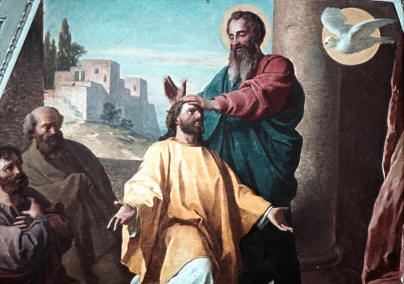
Paul lays hands on Timothy

How could Melchizedek have had no father or mother?

Q.  How can the book of Hebrews say that Melchizedek, the priest who blessed Abraham, was “without father or mother” and “without beginning of days or end of life”?  Wasn’t he human?

Byzantine icon of Melchizedek

Here’s what I say about this in my study guide to Deuteronomy and Hebrews, where I note that the author of Hebrews talks about Melchizedek in the third of the four messages or sermons that make up the book:

* * * * *

This message is based primarily on Psalm 110, but in it the author characteristically draws on other Scriptures for support, in this case the story in Genesis that describes who Melchizedek was.

The author first translates the word Melchizedek, explaining that it means “King of Righteousness.” Melchizedek was most likely not a given name, but an honorary title of the Jebusite kings who formerly ruled in Jerusalem, including the one in the Genesis story who greeted Abraham. (A similar example of an honorary title is the name Pharaoh that was given to all the rulers of Egypt.)

After the Israelites conquered Jerusalem, their own kings took over the title Melchizedek. Since the Jebusite kings had been priests, the Israelite kings also assumed an honorary role as priests and interceded for the nation in prayer. But they were not allowed to offer sacrifices; this was reserved for the descendants of Aaron under the law of Moses.

The author next explains that King of Salem (that is, of Jerusalem) means “King of Peace.” By translating these two terms, the author identifies Jesus, who is a priest in the order of Melchizedek by virtue of being the Messianic king of Jerusalem, as someone who helps people become righteous before God and so find peace with God.

Now come some more significant details—or rather, a significant lack of them. The Hebrew Scriptures usually introduce a new figure into their narratives by describing the person’s parentage and ancestry. They usually also report when a figure dies. But the book of Genesis doesn’t do either of these things in the case of Melchizedek.

This allows the author of Hebrews to observe that, when considered only in light of what the Scriptures say about him, Melchizedek seems to have no origin or ending. He appears to “remain a priest forever.” In this way he “resembles the Son of God,” and this allows him to serve as an earthly representation of the Messiah. This is why the Lord chose to name him as the head of the order of priests to which the Messiah (represented in Psalm 110 by the Davidic king) would belong.

This is a classic example of the author’s typological method, which is based on the understanding that transcendent spiritual realities are reflected in earthly replicas. A little later in this message the author makes the basis of this method explicit, noting how the earthly tabernacle had to be modeled after the heavenly pattern Moses was shown. The Greek word is typos, the source of the English word type, and so this interpretive method is known as typology.

* * * * *

To summarize what I say in the guide, the author of Hebrews is able to establish a connection between Melchizedek and Jesus by considering Melchizedek in light of what the Scriptures say about him (that his title means “king of righteousness” and that he was king of Salem = “peace“), but only in light of what the Scriptures say about him, not what they don’t say.  Since the details of his parentage, birth, and death aren’t reported, this allows an even stronger typological connection to Jesus, who has a permanent priesthood “on the basis of an indestructible life.”

In other words, the key to understanding how the Bible could say that Melchizedek was “without father and mother” and “without beginning of days or end of life” lies in appreciating the distinctive typological method of the book of Hebrews.

Why did Jesus entrust His mother Mary to John’s care?

Q.  When Jesus was dying and entrusted his mother to John, does that mean Joseph was dead?

Jesus entrusts Mary to John’s care. Chapel Nosso Senhor dos Passos, Santa Casa de Misericórdia of Porto Alegre, Brazil.

Yes, most interpreters believe that Joseph had died and that Jesus, who had been responsible to care for his mother as the eldest son in the family, was asking John to take on this responsibility.

This shows us two remarkable things:

(1) Even at his time of greatest suffering, Jesus was thinking of others, not himself.

(2) The family of the kingdom of God takes precedence over human families. Jesus had at least four brothers whom he might have asked to take on this responsibility, but instead he gave it to a “brother” in the kingdom.

To explore this episode a little further, one fascinating and beautiful aspect of the account of Jesus’ crucifixion in John’s gospel is the way it’s arranged as a seven-part chiasm:
A: Jesus is Brought to the Place of Execution
B: Pilate Refuses the Jewish Leaders’ Request to Change the Inscription
C: The Soldiers At the Cross Cast Lots for Jesus’ Clothes
D:  Jesus Entrusts Mary into John’s Care
C: The Soldiers At the Cross Give Jesus Wine to Drink
B: Pilate Grants the Jewish Leaders’ Request to Break the Legs of the Crucified Prisoners
A: Jesus is Taken from the Place of Execution

As I note in my study guide to the gospel of John, the central placement within this arrangement of the episode in which Jesus entrusts Mary to John’s care “shows that Jesus was a person of compassion who extended mercy and care to others right to the very end of his life.”

“But,” I also observe, “it’s interesting that an account of the crucifixion would not have Jesus’ actual death at its center.  John may have an additional purpose for including this episode and placing it where he does.  He may be putting his central focus on the effects of Jesus’ death.  John may be portraying how Jesus’ death is for ‘the scattered children of God, to bring them together and make them one.’  Through his death, believers in Jesus become part of a new family, which is their true family.”

I then ask in the guide:  “Are there some other followers of Jesus who are ‘just like family’ to you?  What creates the bond between you?”

What would you say?

Is the Bible what it has become?

In this series I’ve used the following examples to explore generally whether the accumulated marks of an artistic creation’s subsequent history as a cultural artifact become part of its essential substance and meaning.  I’ve done this as a means of asking specifically whether chapters and verses and other historical accretions should now be considered an integral part of the Bible:
– The cleaning of the Sistine Chapel ceiling;
– The famous crack in the Liberty Bell; and
– The isolation of the figure from Whistler’s painting Arrangement in Grey and Black as “Whistler’s Mother.”

What can each of these examples help us understand about the Bible?

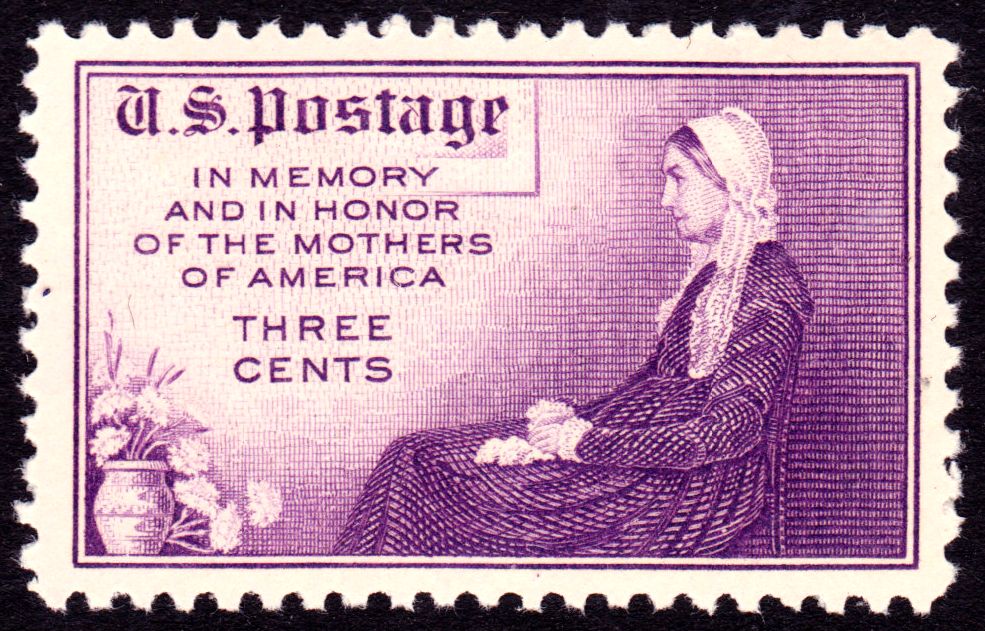
To take them in reverse order, the detail from Whistler’s painting provides a great example of how “snippets” from an artistic creation can be isolated and given a meaning contrary to the one the artist intended.  This effect is particularly pronounced when they’re also given a different name and when other material is added that reinforces the contrary meaning, like the potted flowers in the “Mothers of America” stamp.

This happens all the time with the Bible.  Episodes or even sentences are snipped out, isolated, and supplemented, and as a result, even if they still say something edifying, we miss what they really meant in their original context.  The “parable of the prodigal son,” for example, is a wonderful story of repentance and reconciliation, but if we don’t see it as only one part of the “parable of the unforgiving older brother,” we miss the overall point that Jesus wanted to make.  So there’s a strong case for the approach taken in The Books of the Bible:  removing chapters and verses and headings and presenting the books of the Bible as whole literary compositions.

However, the example of the Liberty Bell shows us that sometimes the settings and adaptations introduced by later users can enhance rather than obscure the original creative intentions behind what has become a cultural artifact.  This is true of the Bible in the sense that all of its individual works take on a deeper significance (but one that is still consistent with their original meaning) when they are gathered into a collection where they can be read in light of one another and in light of the grand story they all tell together.  The Books of the Bible is designed to encourage such a reading by grouping those books that can be read most meaningfully together and by situating each book within the grand story of Scripture.

Finally, the example of the cleaning of the Sistine Chapel ceiling shows that we do become accustomed to engaging artistic creations as they have become known, and that it can be a pleasant surprise (or even an unpleasant shock) to encounter them in something much closer to their original form.

Some people may always prefer what the Bible has become, and see it as a book inherently divided into chapters and verses.  But our hope is that through The Books of the Bible, many will be able to encounter the artistic creations (literary compositions) it contains in a form much closer to their original one, and so have a more enjoyable and meaningful encounter with God’s word than they otherwise would have had.

Interior page from The Books of the Bible

“Whistler’s Mother” or “Arrangement in Grey and Black”?

In this series of posts, to consider whether chapters and verses specifically should be accepted as an inherent part of the Bible, I’ve been exploring more generally whether the accumulated marks of any artistic creation’s subsequent history as a cultural artifact become part of its essential substance and meaning.  We saw last time, in the case of the Liberty Bell, that the cultural artifact with its distinctive marks of wear—specifically, the famous crack—is actually preferable to the original pristine artistic creation, but only because this is an even better expression of the creators’ intentions.

In other cases, good reasons can be given for stripping away at least some of the marks of an artistic creation’s subsequent history as a cultural artifact, similarly in the interests of preserving or recapturing the creator’s original intention.

Consider the painting that James Abbott McNeill Whistler originally entitled Arrangement in Grey and Black. It has been given the popular title Whistler’s Mother and it has become an icon for motherhood and filial devotion.  In 1934 the U.S. Post Office even issued a stamp “in memory and in honor of the mothers of America“ that included only the figure from Whistler’s painting, not the overall composition, and even added some potted flowers!

It is safe to state that this appropriation of the figure is not just different from, but directly counter to, the artist’s intentions in painting it.  In explaining his artistic philosophy, Whistler once insisted:

Art should be independent of all claptrap—should stand alone, and appeal to the artistic sense of eye or ear, without confounding this with emotions entirely foreign to it, as devotion, pity, love, patriotism, and the like. All these have no kind of concern with it; and that is why I insist on calling my works “arrangements” and “harmonies.”

In other words, Whistler himself explicitly rejected the sentimental approach to art that a title such as Whistler’s Mother would imply.  A viewing of his painting that was informed by this title, and which saw it as an expression of filial love and devotion, would therefore necessarily be in opposition to his intentions.  If we wish to understand the painting at all according to Whistler’s intentions, its popular title, at least, should be stripped away and replaced with the original one, and the figure should be situated within the entire original composition, so that viewers can once again appreciate Whistler’s purposes in painting it.

Some might counter that the figure in the painting has a universal quality, evocative of timeless human experience, that permits and even demands that its meaning not be limited by the views of the man who created it at a particular moment in Western cultural history.  Suppose that’s true.  Then even though we would certainly want to be aware of Whistler’s views and intentions, we could find a meaning in this figure that transcends them and reaches into interpretations that Whistler not only didn’t intend, but would actually have opposed.  In other words, a viewer might, in the end, see greater value in Whistler’s Mother than in Arrangement in Grey and Black.

However, we must note that a viewer making this judgment is not really seeing Arrangement in Grey and Black, but only a detail from it.   It is this detail, isolated from the rest of the composition, that people have used as an icon for filial devotion (as on the 1934 stamp).  Some meaning contrary to the artist’s intentions may be imputed to this isolated figure, but not to the composition as a whole, in its entirety as he created it.

This example shows that if the originally intended form or meaning of an artistic creation has been lost to “cultural associations,” repristinating that creation requires not only stripping away accretions, but also situating isolated parts back within the whole.  In the case of Whistler’s painting, the popular title should be taken away and the rest of the painting should be brought back.  (And the potted flowers have to go, too!)

I’ll conclude this series next time with some thoughts about the Bible in light of the examples I’ve explored.

James Whistler, “Arrangement in Grey and Black,” 1871

Would the Liberty Bell still be the Liberty Bell without the crack?

If we could restore the Liberty Bell to its original condition, removing the famous crack, should we?

This is one more way to ask the big question I’ve been pursuing in this series of posts. As someone put the question in the case of the darkening and harmonizing patina that had accumulated on the Sistine Chapel ceiling before it was cleaned, “Do cultural associations and markings of the passage of time heighten or mar the aesthetic value of art?”  That is, does the full creative process include settings and adaptations introduced by later users?  Or do the accumulated marks of an artistic creation’s subsequent history as a cultural artifact never really become part of its essential substance and meaning?

Our interest in these questions arises from the way The Books of the Bible seeks to strip away the accretions of centuries from the Scriptures.  This leads us to ask, Is the Bible what it has become? And if it is, does that mean we should keep engaging the Bible as it has come to be known, in its chapter-and-verse form, rather than by seeking to repristinate it in some way by recovering its constituent literary creations?

To help answer these questions, let’s think about the Liberty Bell.  It was designed as an object that would be not just functional, but beautiful.  Beyond any beauty of form or adornment, it was specifically intended, like all bells, to produce a pleasing musical sound (rather than to summon the attention by making a jarring noise, like a horn or a siren).

When the Liberty Bell cracked, the beauty of its sound was marred.  So there is certainly a difference between how the bell was originally intended to sound and the way it would sound if it were struck today.  What reasons might we give for preferring the original “art“ or “beauty“ of the bell to its present “art“ or “beauty,“ or vice versa?  In other words, if it were somehow possible to restore the bell to the condition it was in before it cracked, and recapture the original sound of its tone, would we want to do this?

Probably not.  The Liberty Bell has become a powerful cultural icon in its present condition; the crack makes it instantly identifiable.  It has come to symbolize the foundational American value of “liberty“ for a series of reasons:
– Its inscription, “Proclaim liberty throughout the land”;
– Its association with the founding generation through its use to toll their deaths (many believe it was during the 1835 funeral of Chief Justice John Marshall that it cracked beyond repair);
– The symbolic use that was then made of it by abolitionists and suffragists.

Most poignantly of all, because of the crack, this is a “wounded” bell.  It has been injured in the cause of “proclaiming liberty.”  Freedom can only be had at a price, and the wounded bell now represents and commemorates all who have paid this price for our freedom.

And so most of us would likely prefer the “art“ of the bell with its “cultural associations and markings of the passage of time“ to the “art“ of the musical note that might be restored if its crack were repaired.  All of the rich cultural associations this bell now carries would hardly be sacrificed simply to recover its original tone.

In other words, there seem to be some very good reasons for preferring the Liberty Bell as we have come to know it to what was originally the “Pennsylvania State House steeple bell.”  So is this evidence that subsequent cultural development sometimes should be preferred over original artistic intent?

Not exactly.  This bell may actually have been intended from the start to become a cultural icon.  Many historians believe that it was commissioned in 1751 to commemorate the fiftieth anniversary of the Charter of Privileges, by which William Penn transferred legislative authority from his Proprietorship to the Pennsylvania Assembly.  This is why, they argue, the bell was ordered with its inscription about “proclaiming liberty,” which is actually a quotation from Leviticus, referring to the year of jubilee.

The later uses of the bell as an icon for liberty would therefore be a development of these original intentions.  We can reasonably surmise that the Pennsylvania colonial legislators who ordered the bell would not want us today to sacrifice its greatly heightened iconic value simply to restore its tone.  Not repairing the crack would thus not only be preferable from a cultural and artistic standpoint, it would also be in keeping with what seem to have been the original intentions of the creators.

In other words, if this historical theory is correct, what came first was the Pennsylvania Assembly’s desire to commemorate the anniversary of the Charter of Privileges.  What came second was a specific means of marking this anniversary:  the commissioning of a bell.

So when we prefer the current, cracked bell with its heightened iconic value, this isn’t just an aesthetic judgment (“certainly a national symbol shouldn’t be destroyed just to restore the tone of a bell”).  Rather, it is an expression of respect for the original intentions of the bell’s patrons.  Precisely because the bell is cracked, it can now be used only as an icon for liberty (its constituting purpose), and not also for secondary purposes such as summoning the Assembly, celebrating special events, etc.

So in this case, the “markings of the passage of time” that we wish to retain are meaningful because they express the ultimate intentions of those who created the bell.

But in other cases, good reasons can be given for stripping away at least some of the marks of an artistic creation’s subsequent history as a cultural artifact, specifically in the interests of preserving or recapturing the creator’s original intention.  We’ll look at such a case next time.

Was the cleaning of the Sistine Chapel ceiling a crime against art?

At the end of the last century, a 20-year project to clean the soot and grime off the Sistine Chapel ceiling was finally completed. In my book After Chapters and Verses, I use this cleaning as an analogy for the way The Books of the Bible similarly strips away the accumulated accretions that have obscured the original appearance of the biblical writings.

It should be noted, however, that this cleaning was actually quite controversial.

Many responded with delight and wonder to the discovery that Michelangelo’s colors had originally been so bright and bold.  But others were deeply disappointed. They felt that the true art of the chapel was its frescoes as they had come to be known. They lamented that this art was lost forever when the darkening and harmonizing patina was taken away to reveal what they derided as “ice cream colors“ beneath.

Michelangelo’s portrait of Daniel before and after cleaning (courtesy Wikipedia)

As one observer put it, “Many people loved the Sistine Chapel’s subtle hues and shadowy figures and were dismayed by the brilliant pink, turquoise, lapis blue, and tangerine now uncovered from beneath centuries of candle smoke and other gunk. Through the dramatic transformation, these people lost what they had loved—even if they might have gained a masterpiece more similar to what Michelangelo had created.”

Another observer (Tim Griffins, in a post no longer on line) said the cleaning of the ceiling raised the profound question, “What is art?” He wondered, “Do cultural associations and markings of the passage of time heighten or mar the aesthetic value of art?”

This same question applies to the Bible. Is the traditional Bible, like a sooty fresco by Michaelangelo, actually better off for the wear? In other words, have the chapter and verse divisions become an essential part of what the Bible now is for us today?

For many people, they apparently have.  One young man described his initial experience with The Books of the Bible this way: “My very first impression was one of discomfort. It felt weird and somewhat disrespectful to me to pick up the Bible as a book without those little verse numbers and chapter headings. Bibles have those.”

However, after he had read in the edition for a little while, he changed his mind. “Reading Scripture this way flows beautifully,” he reported. “Rather than missing the verse numbers and chapter headings, I like them gone. They got in the way.”

In the end this young man had a very positive experience with the Bible in a new format. But a certain belief nearly prevented this—that when it comes to chapters and verses, “Bibles have those.”

Expressed more generally, this is the belief that the Bible is what it has become. This is actually an aesthetic commitment: that a work of art is not finished or complete in the form in which its creator releases it.  Rather, it continues to grow and take on substance and meaning throughout its subsequent history as a cultural artifact. If that’s the case, then something essential to the Bible actually is lost when the shaping of later centuries is undone, as happens in The Books of the Bible.

Does the full creative process include settings and adaptations introduced by later users? Do the marks of an artistic creation’s subsequent history as a cultural artifact become part of its essential substance and meaning?  Is the Bible what it has become over the centuries? And if so, does that mean we should keep engaging the Bible as it has come to be known, rather than seeking to repristinate it in some way? I’ll start exploring these questions next time by considering another artistic creation that has become a cultural icon.

Was King Jehoram’s “youngest” son not his last son?

Q.  I’m confused about Jehoram and Ahaziah. Jehoram was 32 years old when he became king and he reigned 8 years, so he was 40 when he died. The people of Jerusalem took his youngest son Ahaziah and make him king when he was . . . 22? So Jehoram stopped having sons when he was 18?  That seems so unlikely.  And then I see in a footnote that some manuscripts say that Ahaziah was 42 when his father died at 40, which of course is impossible! I mean it doesn’t really matter, but what do you think is the deal?

Actually, it does matter quite a bit, as we’ll see at the end of this post.  But first, let’s try to figure out what’s going on here.

The traditional Hebrew text of the First Testament (the Masoretic Text) does say in Chronicles that Ahaziah was 42 years old when his father died at age 40—an impossibility, as you note.  This is clearly a copying error that has crept into the text.  The account of these same rulers in Samuel-Kings has a more reliable figure: Ahaziah was 22 when his father died.

But your real question is, assuming that 22 is the correct age, why did Jehoram stop having children at only age 18 (since Ahaziah is said to be his “youngest”)?  This is an excellent question, and one that I haven’t seen discussed in the scholarly literature.

Most Israelite men didn’t marry and have children until they were somewhat older, but crown princes had a responsibility to make sure that the royal line continued, so they married younger and had many children by multiple wives and concubines.

According to the version of this account in Chronicles, the reason why Ahaziah, the youngest, succeeded to the throne is that Judah’s enemies invaded the land and carried off and killed all the older royal princes.  (Ahaziah may have been overlooked or ignored precisely because he was the youngest.)  Since there were these older brothers, this means that Jehoram probably married and started having children as soon as he was physically able, in his early teens.  But this doesn’t explain why he stopped at age 18, particularly in a climate where a nation’s enemies might try to wipe out the entire royal line.

Here’s what I think is going on.  The text explains that during Jehoram’s reign, “the Philistines and the Arabs who lived near the Cushites attacked Judah, invaded it and carried off all the goods found in the king’s palace, together with his sons and wives. Not a son was left to him except Ahaziah, the youngest.”  Then, after Jehoram dies, it says, “The people of Jerusalem made Ahaziah, Jehoram’s youngest son, king in his place, since the raiders, who came with the Arabs into the camp, had killed all the older sons.”
I think this actually means, “The people of Jerusalem made Ahaziah king in Jehoram’s place, since the raiders, who came with the Arabs into the camp, had killed all of his older sons, but Ahaziah, who had been the youngest at the time, had survived” (because he was overlook or ignored because he was just an infant).

In other words, this is one of those places where the Hebrew narrative describes a person from the perspective of a past incident that is being related, rather than from a contemporaneous perspective.  Ahaziah likely wasn’t Jehoram’s youngest son absolutely, but he was the youngest of the senior royal princes who were born early in Jehoram’s reign.  He continued to be known as the “youngest” (the qatōn) because that was how he had survived the massacre.

In fact, the Theological Dictionary of the Old Testament notes that in Judges, qatōn “singles out” Jotham, Gideon’s “youngest,” as the “sole survivor when his brothers were murdered—probably on the assumption that he was too small to be noticed.”  The TDOT then adds that “the special position of such a survivor is clear from” the story of Ahaziah in Chronicles.

This, I would say, is the answer to your excellent question—why would a king whose lineage was threatened not have had any children for the last twelve years of his reign, when he was still in young adulthood?  Actually, he did, but Ahaziah is described as the “youngest,” even though he wasn’t the last, because he survived the massacre and could succeed to the throne.

So why does this matter?

First, the fact that in the Bible a man’s son could be described as his “youngest” even though he wasn’t his last shows that we can’t read the First Testament in a simplistic, literalistic way.  We need to be sensitive to the nuances of meaning inherent in Hebrew language and literature.

Second, going back to the faulty reading “42,” we need to recognize that the Masoretic text does contain some blatant errors, some of which even contradict other places in the Bible.  (Often in cases like this the Masoretes left a marginal note to the synagogue reader to say something different than what’s found in the text, but there’s no such note in this case.)  So we shouldn’t give automatic preference to the Masoretic Text in determining the original reading.  But the RSV and NRSV do this, and so they have Ahaziah 42 years old when his father was 40—without any explanatory footnote!  A word of caution to translators: don’t preference the Masoretic Text to this extent.

Was the medium at Endor really able to bring up Samuel?

Q. How could the sorceress of Endor summon the spirit of Samuel from the dead? Was it really Samuel? How should we interpret
this episode in the Bible? Thanks.

Washington Allston, “Saul and the Witch of Endor”

For many episodes in the Old Testament such as this one, it’s truly a case of “you can’t get there from here.”  The story of Samuel and the medium who lived in Endor is related within the world view of an ancient culture in which it was believed that people who died became “shades” who rested in Sheol and who might be “disturbed” and brought up to earth for a time.  We today find it hard to understand how this could happen, particularly in light of the teaching of the New Testament that death is final so far as our earthly lives are concerned, so that the spirits of the dead cannot return to earth.

But this only illustrates how the Bible actually speaks from within a variety of cultural settings.  God “speaks our language” in the Scriptures to that extent.  I personally don’t believe that it’s possible to harmonize all of the different world views that we find represented in the Bible.  But I don’t think we need to try to do that, either.  We just need to recognize what the Bible really is and accept it as such:  a sprawling compendium of accounts from many different settings in human history that together tell the story of God’s dealings with humanity over the course of that history.

When we accept that the Bible speaks from a variety of cultural perspectives, then the message of this story about Saul and the medium becomes clear, and the account is no longer confusing or perplexing.  If we “suspend disbelief” and work with the story, allowing that the medium could bring Samuel up after his death to speak with Saul, then we realize that this episode, one of the last in Saul’s life, is filling out the portrait of his character that has been sketched all along.

In an earlier post I’ve addressed the question of why Saul was rejected as king for what seem like minor infractions, while David was called a “man after God’s own heart” even though he made major mistakes and committed serious sins.  The essential difference between these men is that David never turned away from the LORD to other gods, and as king he never usurped divine prerogatives.  Saul, on the other hand, never really accepted these limitations, and now we see him actually turning to occult powers—”mediums and spiritists”— even though he has previously expelled them from the land in obedience to the law of Moses.

Right to the end, Saul was a man who didn’t hesitate to take matters into his own hands, no matter what compromises this involved with God’s expressed wishes and intentions.  This last episode just before Saul’s untimely death validates God’s judgment against him as a king who wouldn’t respect the limitations on his power and actions necessary for him to be God’s agent ruling the people of Israel.

In other words, this account completes the biblical portrait of Saul as a truly tragic figure.  It does so within a world view we can’t quite embrace today.  But we shouldn’t let that stand in the way of our hearing its crucial message:  we can’t take it upon ourselves to decide which of God’s constraints on our lives we will honor.  We need to honor them all.